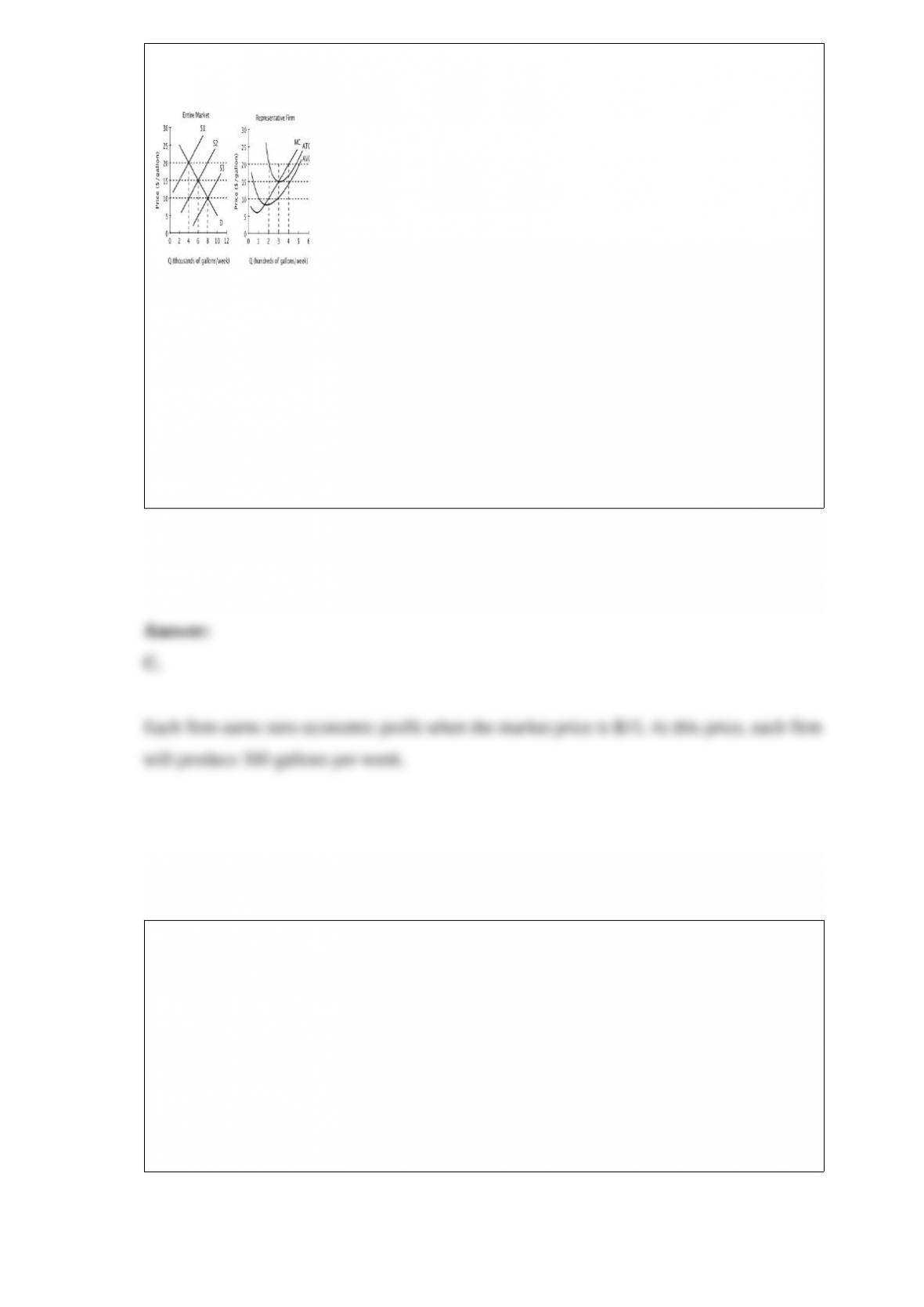
Assume that all firms in this industry have identical cost curves, and that the market is
perfectly competitive.
In the long run, the equilibrium price will be _____ per gallon, and each firm’s
profit-maximizing quantity will be ______ gallons per week.
A. $20; 4 hundred
B. $15; 6 thousand
C. $15; 3 hundred
D. $20; 4 thousand
Government support of basic research by funding scientists through the National
Science Foundation is an example of a government policy to promote economic growth
by:
A. increasing human capital.
B. increasing physical capital.
C. improving technology.
D. increasing the availability of natural resources.
Which of the following is the most likely to be a fixed factor of production at a farm?
A. The land on which the farm is located.
B. The number of workers hired to harvest the crops.
C. The amount of fertilizer used each week.
D. The amount of water used each day.
The amount taxes increase when before-tax income rises by an additional dollar is
called the:
A. average tax rate.
B. substitution effect.
C. opportunity cost.
D. marginal tax rate.
According to the Cost-Benefit Principle, you should go see the latest Star Wars movie
with your friends this week-end if:
A. the extra benefits of seeing the movie are greater than the extra costs of seeing the
movie.
B. you really like Star Wars.
C. you can afford to go to the movies.
D. the average benefit you get from going to the movies is greater than the average cost
of a ticket.
There are 20 residents in the village of Towneburg. The size of the village’s annual
fireworks display depends upon the number of shells that are fired off. Each resident’s
demand for fireworks is shown below. The total cost of the fireworks display is $1,000
plus $10 per shell.
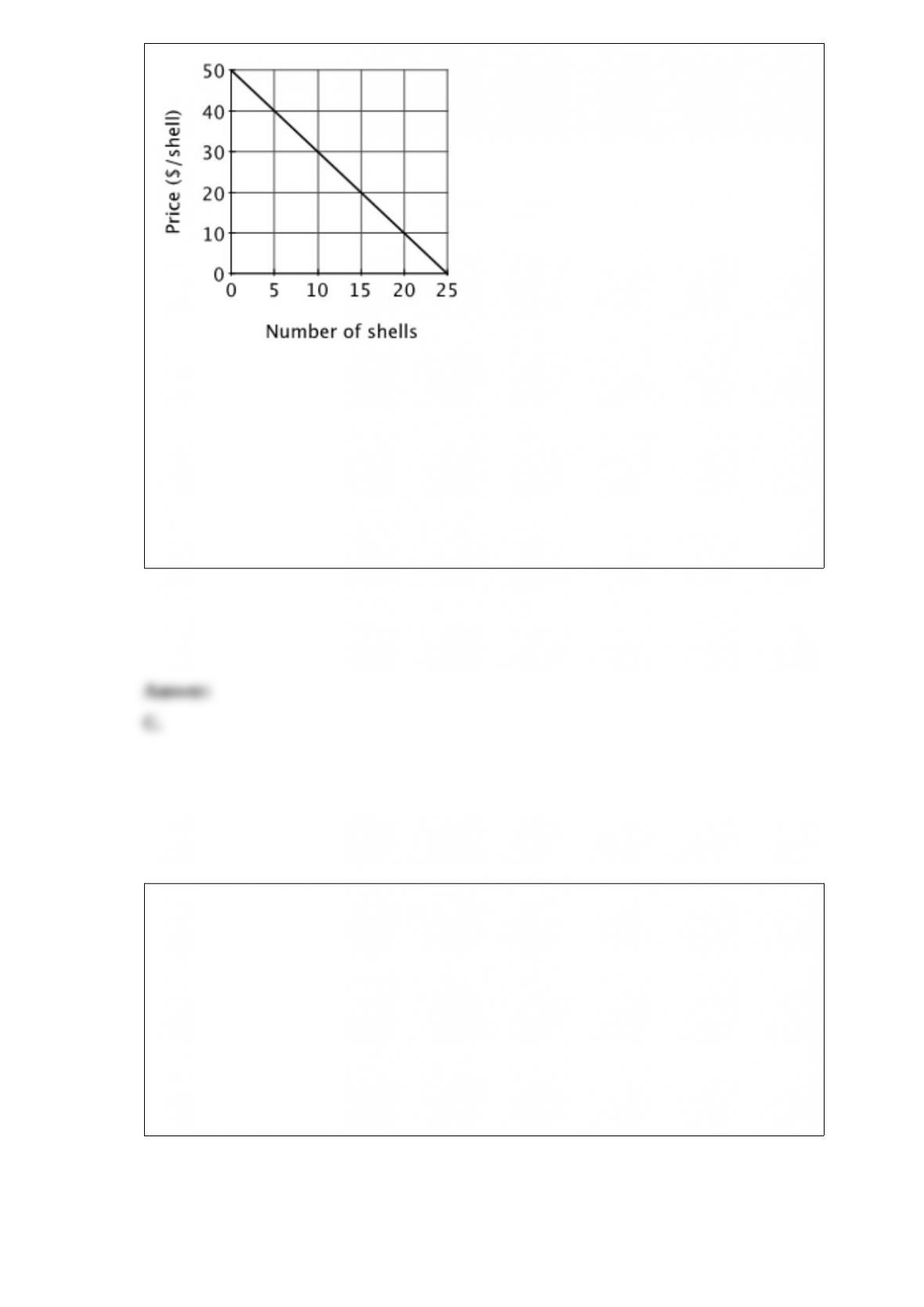
If Towneburg’s fireworks display has 20 shells, then the size of the display is:
A. optimal.
B. larger than optimal.
C. smaller than optimal.
D. unaffordable.
The degree to which the public believes the central bank’s promises to keep inflation
low, even if doing so may impose short-run economic costs, is the _____ of monetary
policy.
A. power
B. opportunity cost
C. credibility
D. expectation

Tight monetary policy raises the real interest rate, which ______ the demand for
dollars, ______ the supply of dollars, and ______ the equilibrium value of the dollar.
A. increases; increases; increases
B. decreases; decreases; decreases
C. increases; decreases; increases
D. decreases; increases; increases
The figure below shows the demand curve for a product that can be sold only in
whole-number amounts.
What is the maximum price that any buyer would be willing to pay for the first unit?
A. 40
B. 35
C. 25
D. 15
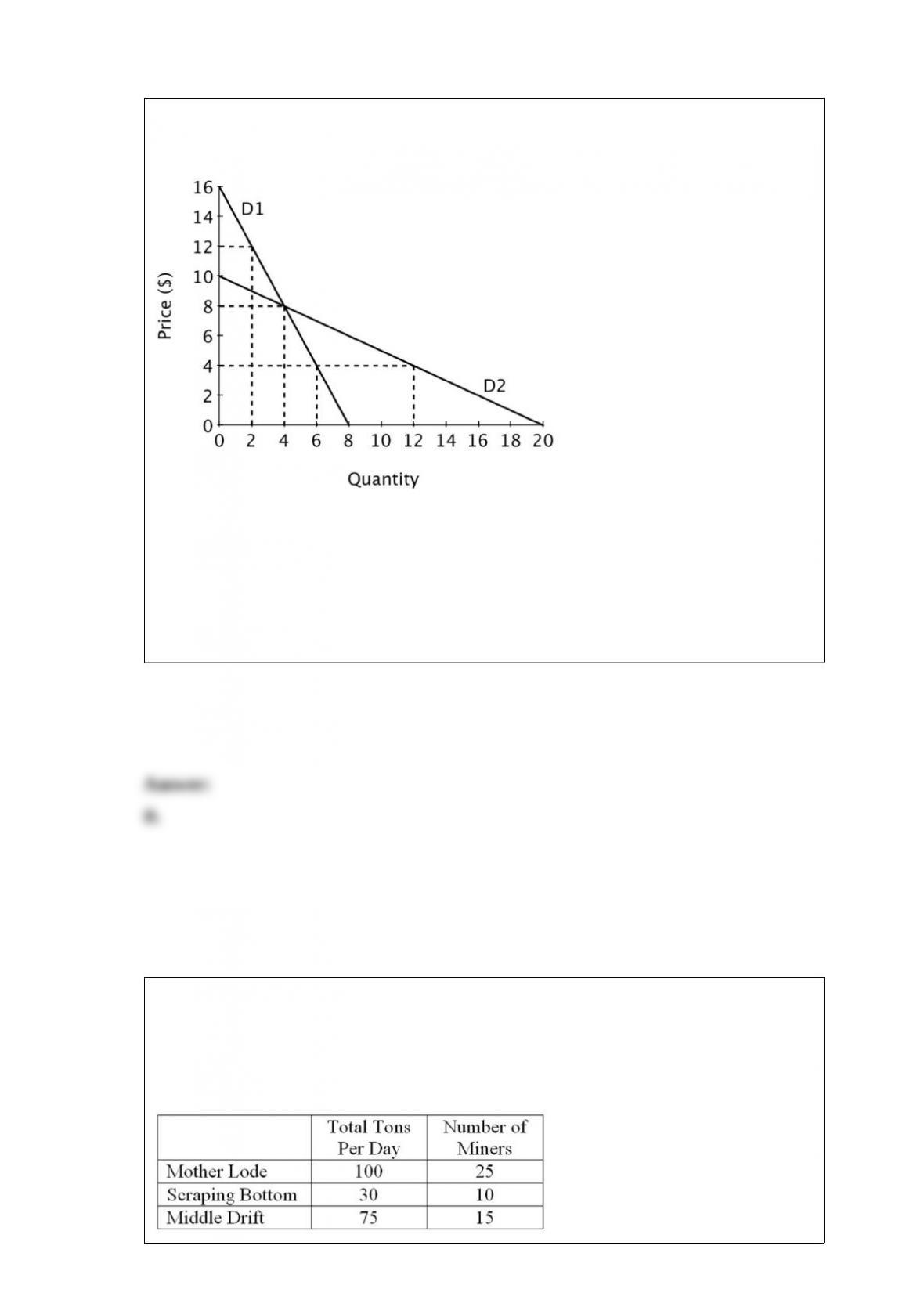
Refer to the figure below. The absolute value of the slope of the demand curve D1 is
______, and the absolute value of the slope of demand curve D2 is ______.
A. 1/2; 2
B. 2; 1/2
C. 5/4; 4/5
D. 4/5; 5/4
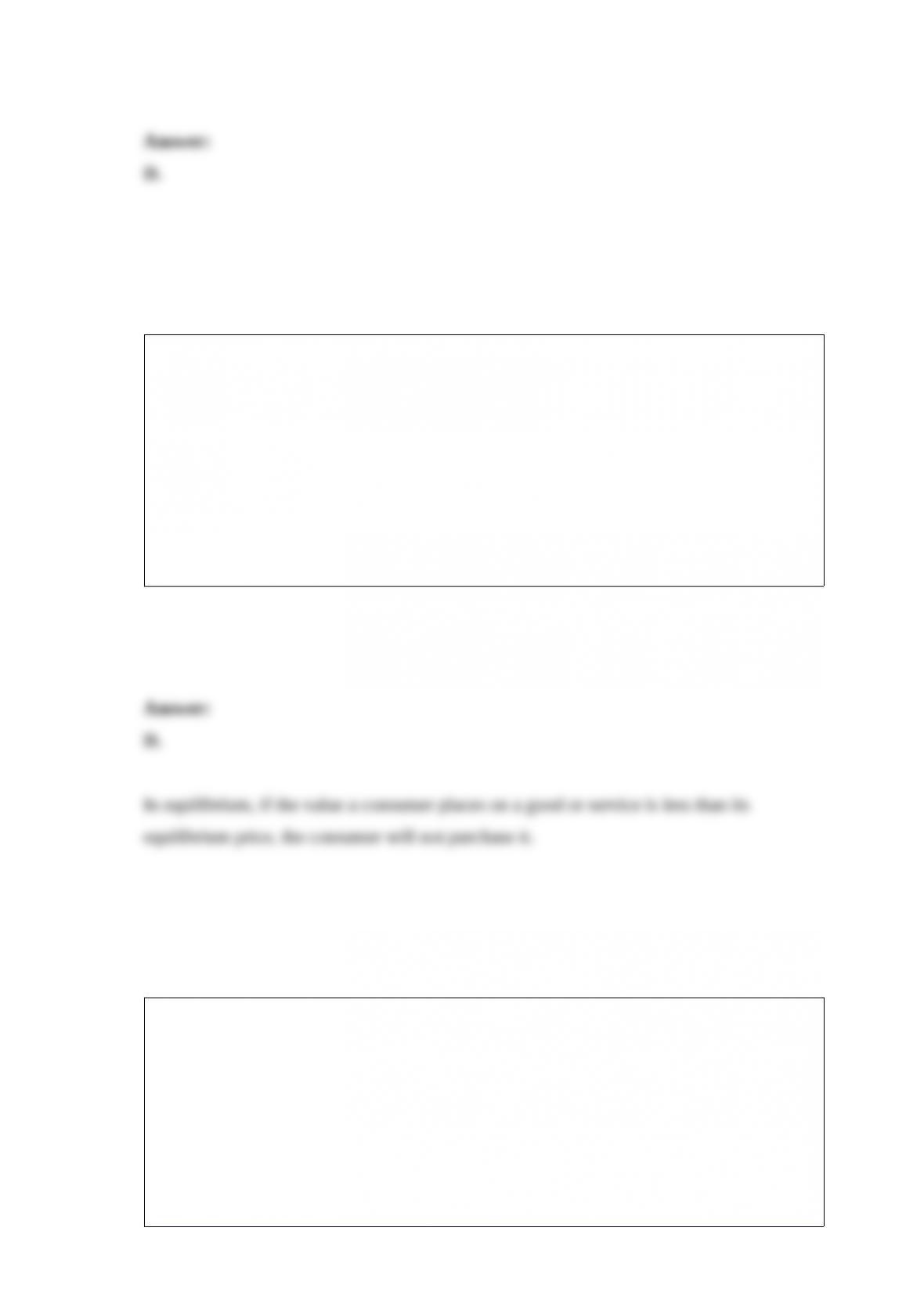
Earth Movers & Shakers operates 3 iron ore mines. The table below shows each mine’s
total daily production and the current number of miners at each mine. All miners work
for the same wage, and each miner in any given mine produces the same number of tons
per day as every other miner in that mine.

The opportunity cost of moving one miner from Scraping Bottom to another mine is:
A. 0 tons per day.
B. 3 tons per day.
C. 4 tons per day.
D. 5 tons per day.
Statistical discrimination occurs when:
A. individuals are judged solely on the basis of their personal characteristics.
B. individuals are judged on the basis of the groups to which they belong.
C. firms have perfect information about each potential buyer.
D. statistics are used to make employment decisions.
The demand for labor depends on ______ and _______.
A. the supply of labor; the marginal product of labor
B. the supply of labor; the price of output produced
C. the rate of price inflation; the price of the output produced

D. the marginal product of labor; the price of output produced
Refer to the figure below.
Based on the figure, if the economy is in short-run equilibrium with output equal to
16,000, then there is ______, and ______ could return the economy to potential output
(Y*).
A. an expansionary gap; a decrease in autonomous expenditures of 1,000
B. an expansionary gap; a decrease in autonomous expenditures of 4,000
C. a recessionary gap; an increase in autonomous expenditures of 1,000
D. a recessionary gap; an increase in autonomous expenditures of 4,000
Government policies intended to increase planned spending and output are called
______ policies.
A. aggregate
B. monetary
C. fiscal
D. expansionary
Suppose the market for coffee is in equilibrium at a price of $5 per pound. This means
that:
A. any producer who sells coffee can earn a positive economic profit.
B. potential producers not producing coffee have reservation prices less than $5 per
pound.
C. everyone can afford to buy coffee.
D. potential consumers not buying coffee value it at less than $5 per pound.
The marginal cost of an activity is the:
A. change in the total cost of the activity that results from carrying out an additional
unit of the activity.
B. the total cost of the activity divided by the change in the level of the activity.
C. the total cost of the activity divided by the level of the activity.
D. change in the level of the activity divided by the change in the cost of the activity.

For a given seller, the below above shows the relationship between the number of units
produced and the opportunity cost of producing an additional unit of output. As the
market price of this good increases, the quantity produced by this seller will ______.
A. increase
B. decrease
C. stay the same
D. stay the same until the price rises above $6 per unit, and then it will increase
Gross domestic product (GDP) equals the ______ of final ______ produced within a
country during a given period of time.
A. market value; goods
B. market value; services
C. market value; goods and services
D. quantity; goods and services

A good or service that is rival but nonexcludable is called a ______, and a good or
service that is nonrival but excludable is called a ______.
A. public good; private good
B. commons good; public good
C. commons good; collective good
D. public good; collective good
Jim and Fred are the only two cashiers employed at a retail store. Each of them works
the same 40 hours per week and each can check out 30 customers per hour by manually
entering the price of each product purchased into the cash register. The store owner
replaces the old cash registers with new ones that automatically scan product prices into
the register. With the new cash registers, Jim and Fred can each check out 60 customers
per hour. Their average labor productivity as a team before the new cash registers were
introduced was ______ customers per hour and ______ customers per hour after the
new machines were installed.
A. 30; 60
B. 30; 120
C. 60; 120
D. 1,200; 2,400
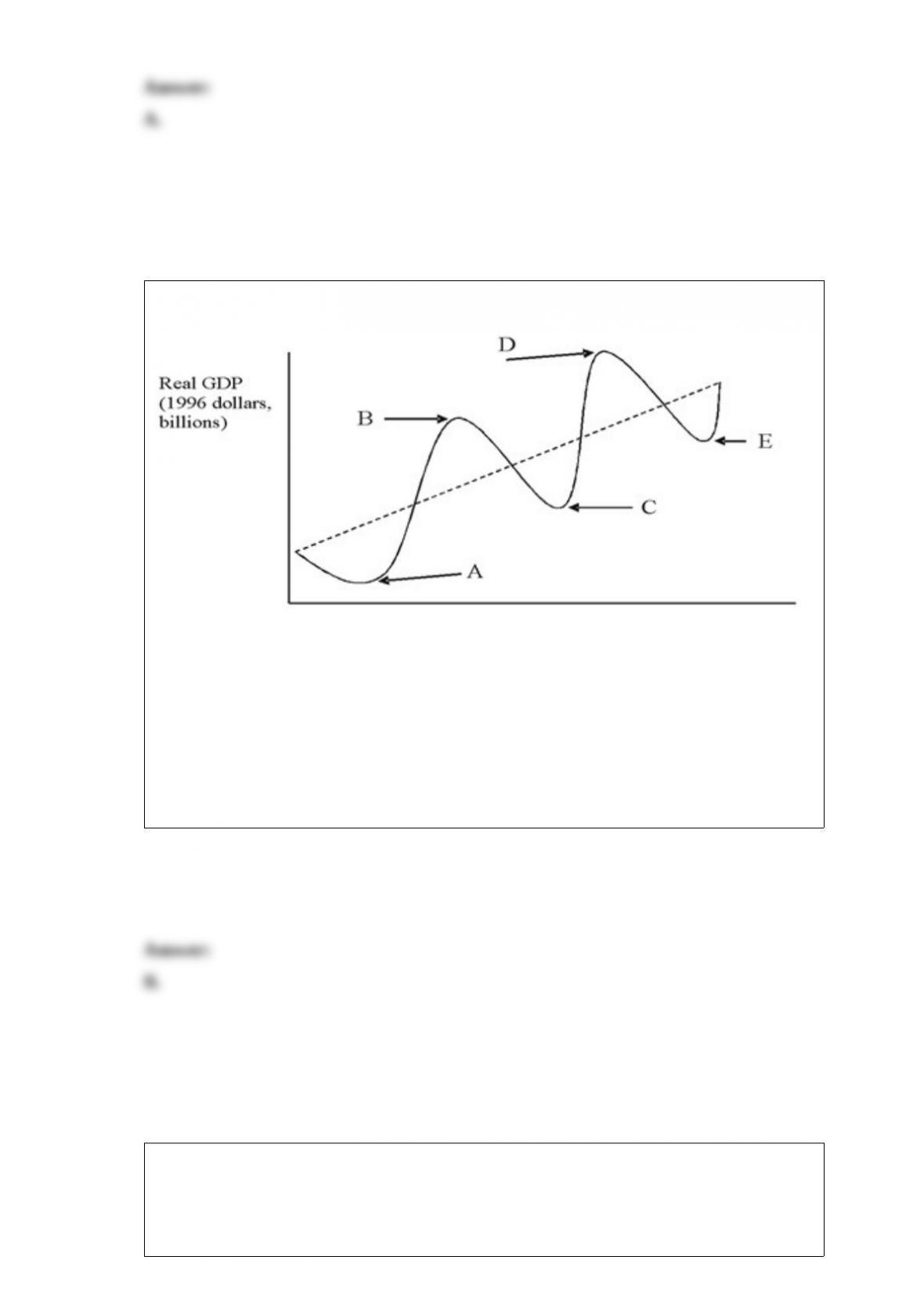
Refer to the figure below.
In the figure, which interval represents a business cycle recession?
A. A to B
B. B to C
C. A to C
D. B to D
Which of the following is not a reason why unionized firms can successfully compete
with nonunionized firms?
A. Employee morale may be higher at unionized firms, so workers are more productive.

B. Communication between management and workers is better at unionized firms.
C. Labor turnover is lower at unionized firms, so unionized firms have lower hiring
costs.
D. Unionized firms are legally protected from pricecompetition with nonunionized
firms.
Starting from long-run equilibrium, a large decrease in government purchases will
result in a(n) ______gap in the short run and ____inflation and ____output in the long
run.
A. expansionary; higher; potential
B. recessionary; lower; potential
C. expansionary; higher; higher
D. recessionary; higher; potential
The taxing agency in your state would like to impose a sales tax in a way that
minimizes deadweight loss. To achieve this goal it should tax:
A. goods that are relatively inexpensive.
B. all goods equally.

C. goods whose supply and demand curves are relatively inelastic.
D. goods but not services.
Government purchasesinclude spending by federal, state, and local governments on:
A. consumer durables, nondurables, and services.
B. stocks, bonds, and other financial instruments.
C. capital goods, residential housing, and changes in inventories.
D. final goods and services.
Which of the following is an example of a capital good?
A. A new car sold to a family
B. A metal-stamping machine used to produce cars sold to an automaker
C. A new CD player sold to an automaker for installation in a car
D. A new CD player sold to a teenager

The figure below shows a single consumer’s demand for ice cream at the student union.
The student union sells a total of 7,200 scoops of ice cream each week at a price of
$2.00 per scoop. If every student who buys ice cream has the demand curve shown
above, then there must be ______ students purchasing ice cream each week.
A. 800
B. 1,200
C. 1,500
D. 2,000
Suppose the market consists of 3 individuals: Citizen A, Citizen B and Citizen C.
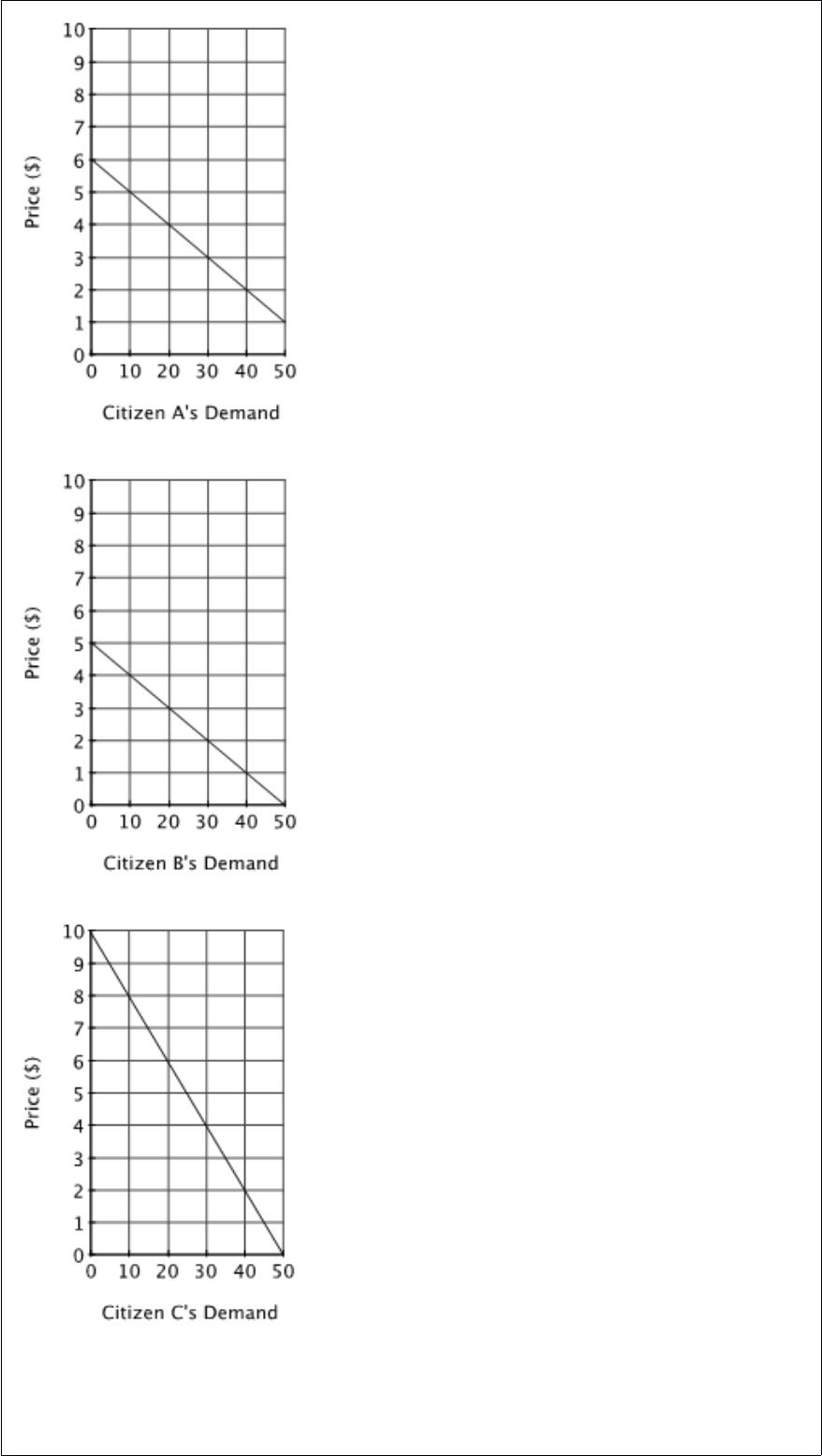
If the good shown on the graphs is a private good, then at a price of $4, market demand
is ______ units.
A. 60

B. 30
C. 10
D. 5
If 50 percent of the population in a country is employed and average labor productivity
equals $30,000, then real GDP per person equals:
A. $15,000.
B. $30,000.
C. $50,000.
D. $60,000.
The payoff matrix below shows the payoffs (in millions of dollars) for two firms, A and
B, for two different strategies, investing in new capital or not investing in new capital.
An industry spy from firm A comes to firm B and offers to pay B in exchange for B’s
certain and enforceable promise to not invest. What is the most that firm A will be
willing to pay B to not invest?
A. $30 million.
B. $20 million.
C. $35 million.
D. $50 million.