
The concept that increases in spending cause larger increases in equilibrium GDP is
known as the
a. profiler.
b. mystifier.
c. multiplier.
d. depreciator.
In the circular flow model, which of the following is considered a leakage?
a. investment spending
b. business spending
c. household saving
d. total exports
Poverty is defined in two ways: the absolute concept of poverty and the relative concept
of poverty.
a. True
b. False
A perfectly competitive industry in long-run equilibrium is described as efficient
because firms
a. produce at the low point on their average cost curve.
b. produce where marginal cost yields a profit.
c. earn no more than the cost of capital.
d. are not profitable.
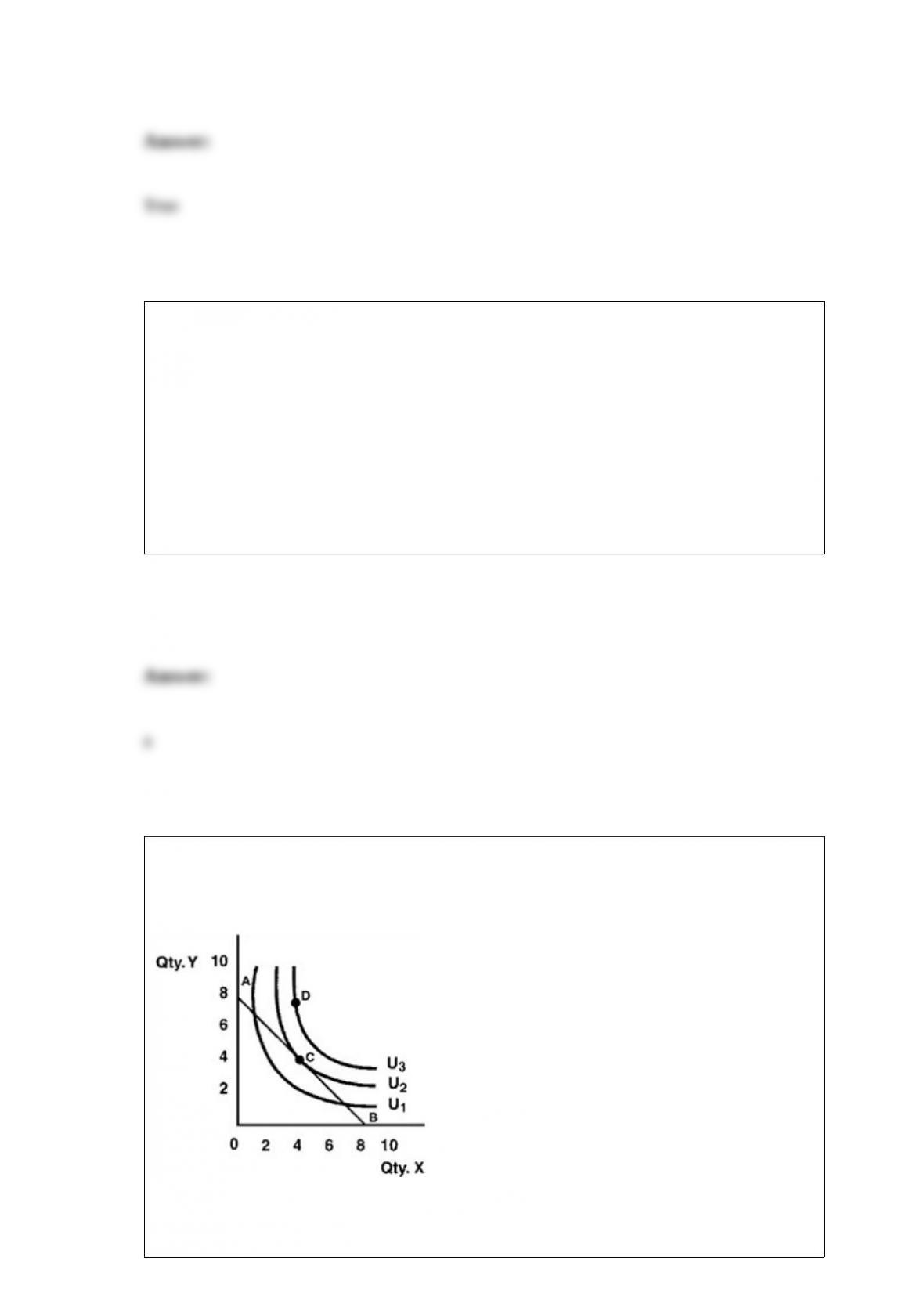
Figure 5-18
In Figure 5-18, point D for the consumer

a. will be chosen because total utility is larger there than at point C.
b. would not be chosen because it is less desirable than point C.
c. is unattainable, given the consumer’s budget.
d. has total utility equal to point C.
The process by which new product or production methods are introduced is called the
Industrial Revolution.
a. True
b. False
If the dollar depreciates, it can be said that
a. foreign countries no longer respect the United States.
b. it falls in value within the United States.
c. it takes fewer dollars to buy foreign currencies.
d. other currencies appreciate.

A total cost curve shows the largest amount of a product a firm can produce with a
minimum cost.
a. True
b. False
A firm is operating with an optimal combination of inputs. Suddenly the price of one
input rises. The firm should
a. buy less of that input and more of the other input.
b. change its input mix so that the marginal physical product of the input whose price
has risen falls and the marginal physical product of the other input rises.
c. buy less of whichever input now has the highest money price and more of the other
input.
d. reduce its output.

Liquidity refers to the
a. rapidity with which money flows through the economy.
b. ease with which an asset can be converted into cash.
c. ease with which banks move funds from checking to savings accounts.
d. All of the above are correct.
National income can be calculated by subtracting
a. depreciation from GDP.
b. indirect business taxes from GDP.
c. depreciation and indirect business taxes from GDP.
d. transfer payments and taxes from GDP.
Stagflation may follow an inflationary boom.
a. True
b. False

Which of the following is correct?
a. Current account surplus + capital account surplus = 1
b. Current account surplus − capital account surplus = 0
c. Current account surplus + capital account surplus = 0
d. Current account surplus − capital account surplus = 1
Bonds differ from stocks in all of these ways except:
a. a purchase of corporate stock becomes a part owner of the corporation, while a
bondholder does not
b. a bondholder loans money to the corporation, which has priority for repayment,
while a stockholder may lose her investment
c. stockholders know with a high degree of certainty how much money they will get,
while bondholders do not
d. all of these are correct

Scarcity of resources implies that people must make decisions consistent with the
means they have available to them.
a. True
b. False
What most frightens investors in the stock market is:
a. the possibility of losing their investments
b. the possibility of gaining too much from their investments, and the resultant tax
consequences
c. the possibility that the prices of many investments may collapse simultaneously
d. the possibility that a company that they have invested in will go bankrupt
According to the kinked demand curve model, an oligopolist may face
a. more elastic demand than a monopolistic competitor.
b. less elastic demand than a monopolistic competitor.
c. more elastic demand if she raises her price than if she lowers her price.

d. less elastic demand if she raises her price than if she lowers her price.
The circular flow diagram is best described as a(n)
a. abstraction of little value in macroeconomics.
b. exact representation of the cause and effect relationship between spending and
employment.
c. model that clarifies the relationship between spending and income.
d. model to explain the relationship between the federal deficit and tax revenues.
Figure 17-6
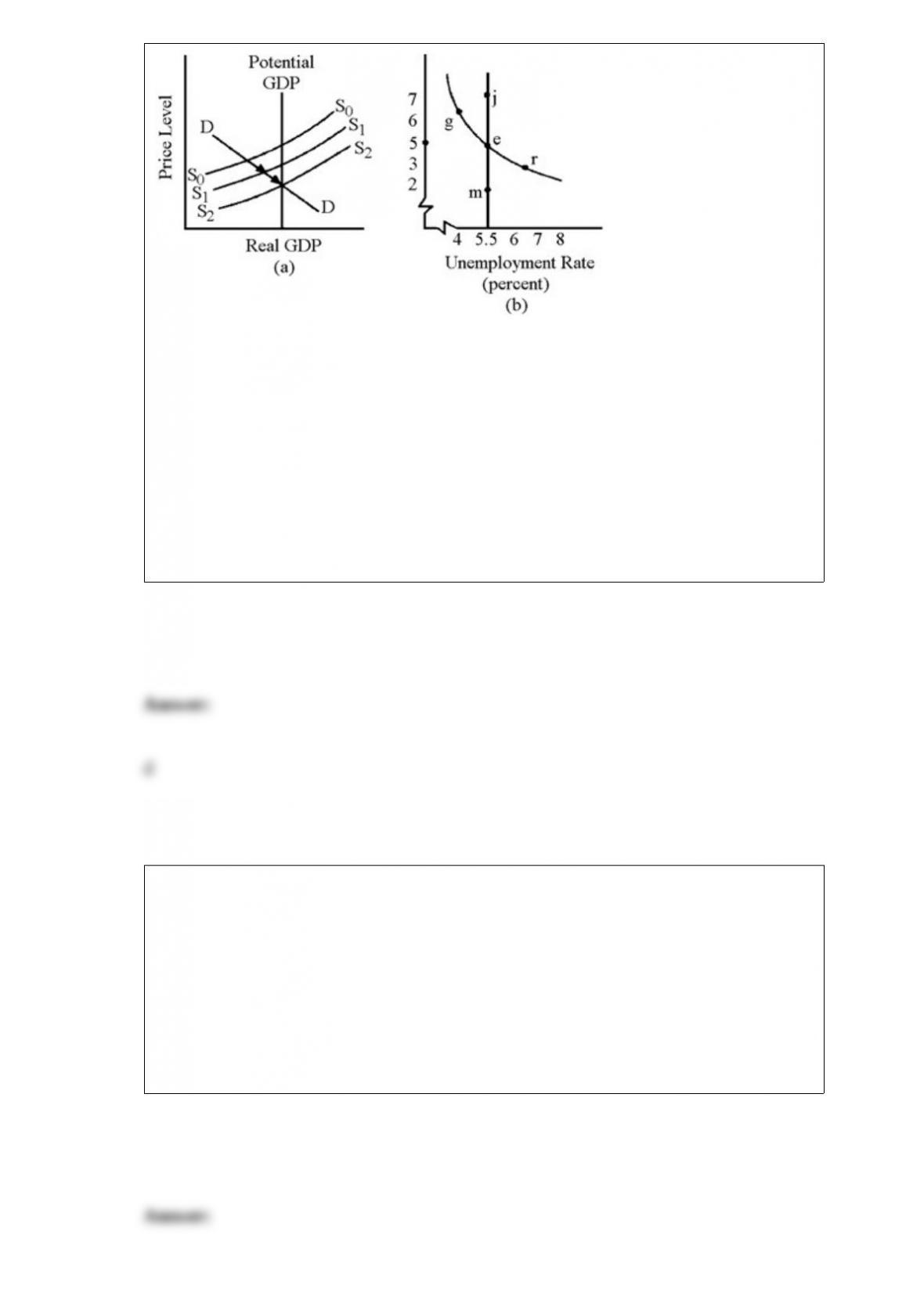
The long-run Phillips curve in Figure 17-6 (b) would include which of the following
points?
a. g, e, m
b. g, e, r
c. j, e, r
d. j, e, m
By providing free garbage removal, a community
a. discourages activities that produce detrimental externalities.
b. encourages citizens to recycle items rather than throw them out.
c. leads citizens to throw out more garbage than is socially optimal.
d. None of the above is correct.

If a competitive firm’s short run average cost curve lies above the price of the product,
we can conclude that the firm
a. is earning a huge profit.
b. is incurring losses.
c. is earning zero economic profits.
d. is earning a normal profit.
Which of the following observations concerning price discrimination is true?
a. It only occurs in monopolies.
b. It is easier for a monopolist than for a firm that is affected by competition.
c. It means that sales to all customers are equally profitable.
d. It is considered as a bad business practice under all circumstance.
Identify the economist who first addressed the environmental problem in terms of

externalities.
a. Joseph Schumpeter
b. Maynard Keynes
c. A.C. Pigou
d. J.B. Say
From 1973 to 1995 the growth rate of labor productivity in the U.S. was approximately
a. −0.8%.
b. 1.4%.
c. 2.9%.
d. 5.1%.
The demand curve facing Company ABC is perfectly elastic. What is its marginal
revenue?
a. Equal to the average revenue.
b. Less than the price.

c. Higher than the price.
d. Higher than the average revenue.
The real wage rate is defined as the wage rate divided by
a. the interest rate.
b. the money supply.
c. nominal GDP.
d. the price level.
A firm will tend to select the least costly input combination to produce its output.
a. True
b. False

Which of the following serves only the best known and heavily traded securities?
a. NYSE
b. multiple regional exchanges
c. AMEX
d. NASAQ
A contour map illustrates which of the following?
a. the cause-effect relationship between two variables
b. the cause-effect relationship between three variables
c. the way that three variables are correlated
d. the way that one variable affects another, which in turn affects a third variable
e. the way that two variables are correlated and in turn cause changes in a third variable
When GM advertises its cars, the company is trying to cause a
a. rightward shift in the supply.

b. rightward shift in the demand.
c. leftward shift in the supply.
d. leftward shift in the demand.
The Fed’s founders viewed the Fed as a means of maintaining the money supply during
economic contractions and as a lender of last resort.
a. True
b. False
An increase in taxes will cause the consumption schedule to
a. shift upward.
b. shift downward.
c. remain fixed as the economy moves upward along the schedule.
d. remain fixed as the economy moves downward along the schedule.

Discounting is the process of
a. cutting prices to get rid of surplus stocks.
b. finding the present value of future dollars.
c. finding the future value of present dollars.
d. giving special concessions to special customers.