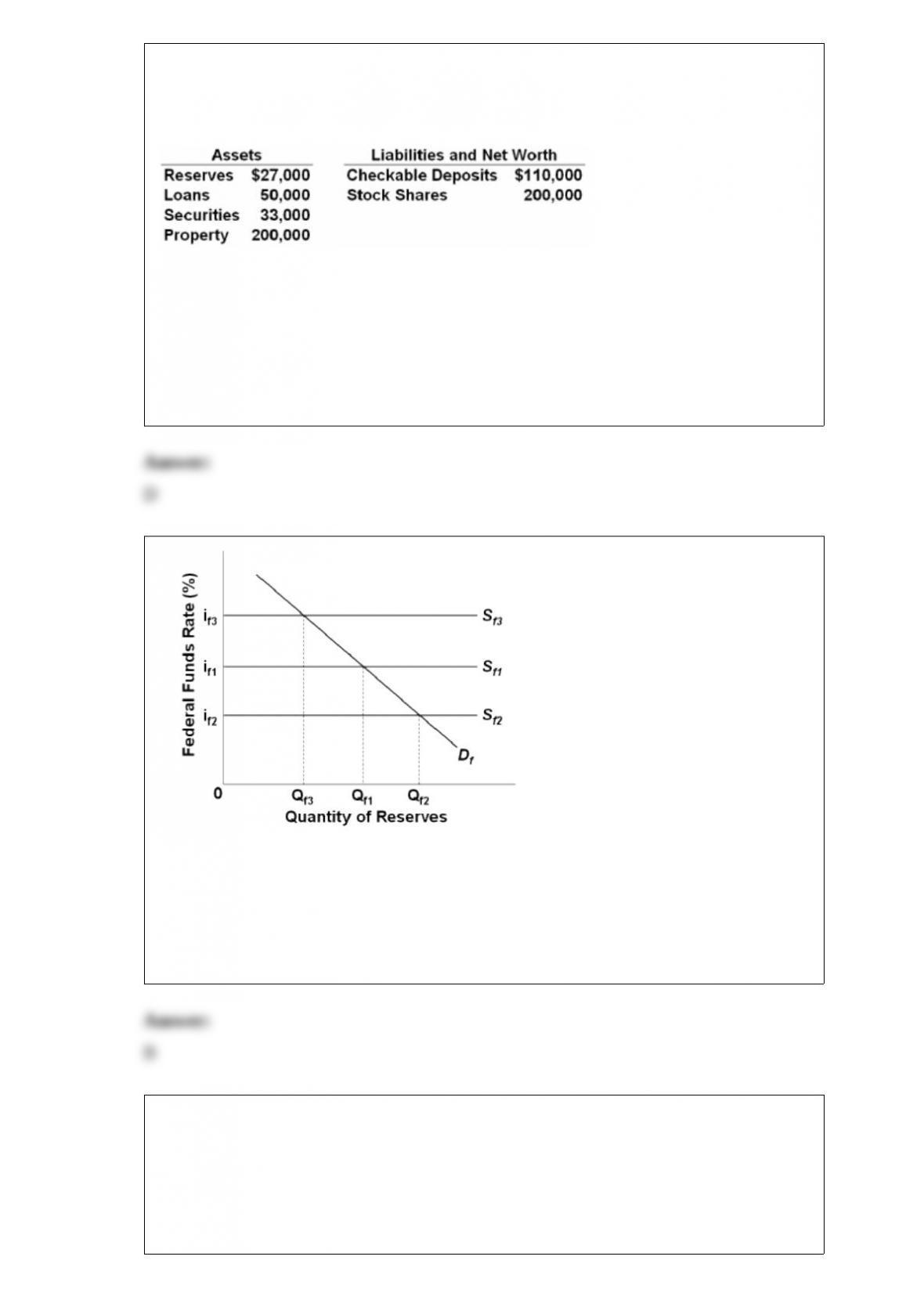
1) The following balance sheet for the ABC National Bank in answering the next
question(s). Assume the required reserve ratio is 20 percent.
Refer to the above data. If the original balance sheet was for the commercial banking
system, rather than a single bank, loans and checkable deposits could have been
expanded by a maximum of:
A.$8,000.
B.$15,000.
C.$48,000.
D.$25,000.
2)
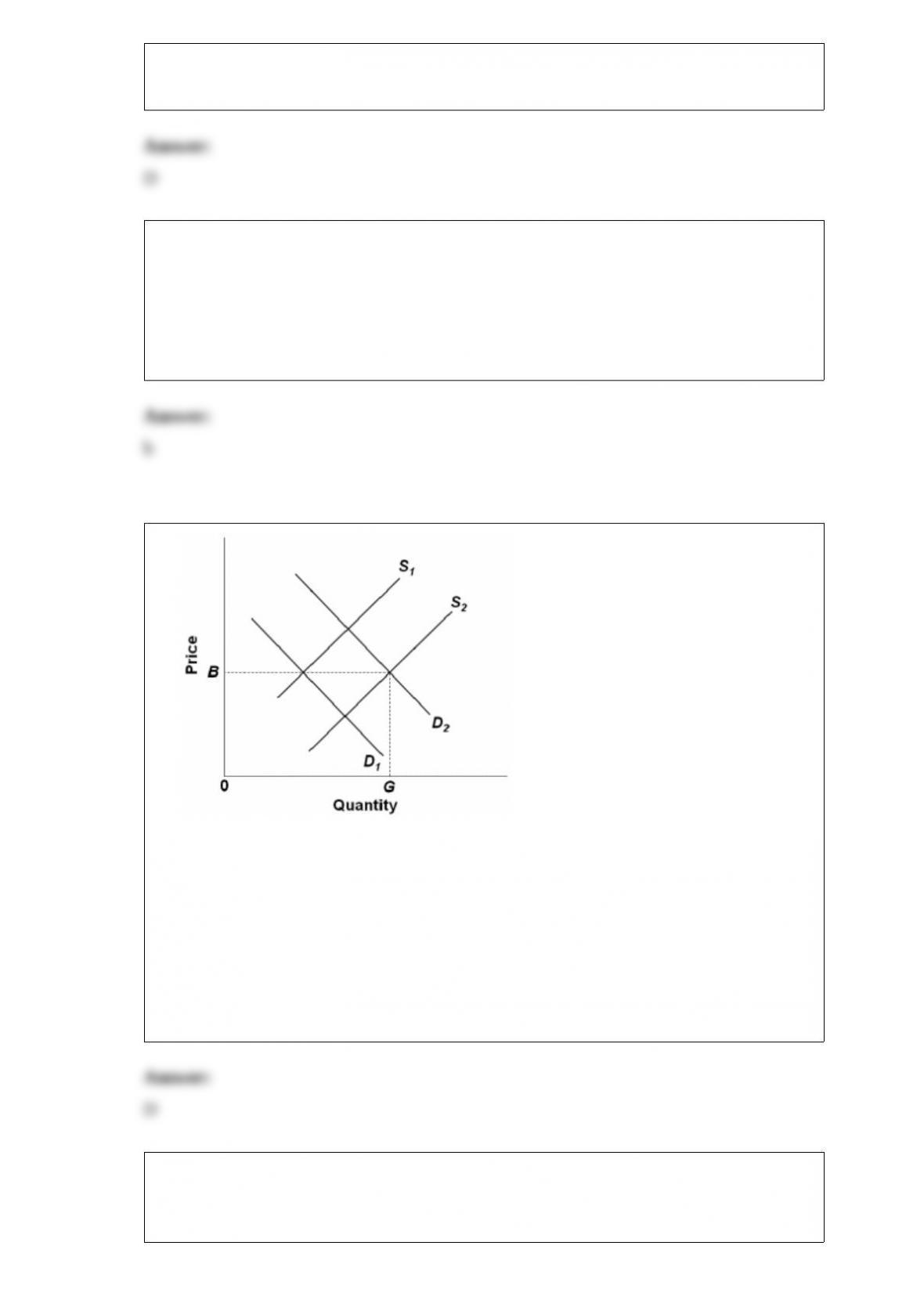
Refer to the above diagram for the Federal funds market. If the Fed wants the Federal
funds rate to fall from i1 to i2, it can use open market operations to:
A.increase the demand for Federal funds.
B.increase the supply of Federal funds.
C.decrease the supply of Federal funds.
D.decrease commercial bank reserves.
3) Suppose that in a series of paired-choice votes a new park is preferred to new
recreation center and a new recreation center is preferred to street widening. Also
suppose that street widening is preferred to a new park. This set of votes is an example
of the:
A.principal-agent problem.
B.benefits-received principle.
C.median-voter model.
D.paradox of voting.
4) under what circumstances will immigration be most likely to equalize wage rates
across countries?
a.immigration laws are strict.
b.immigration is costless and unimpeded.
c.information about job opportunities is limited.
d.skill transferability is low.
5)
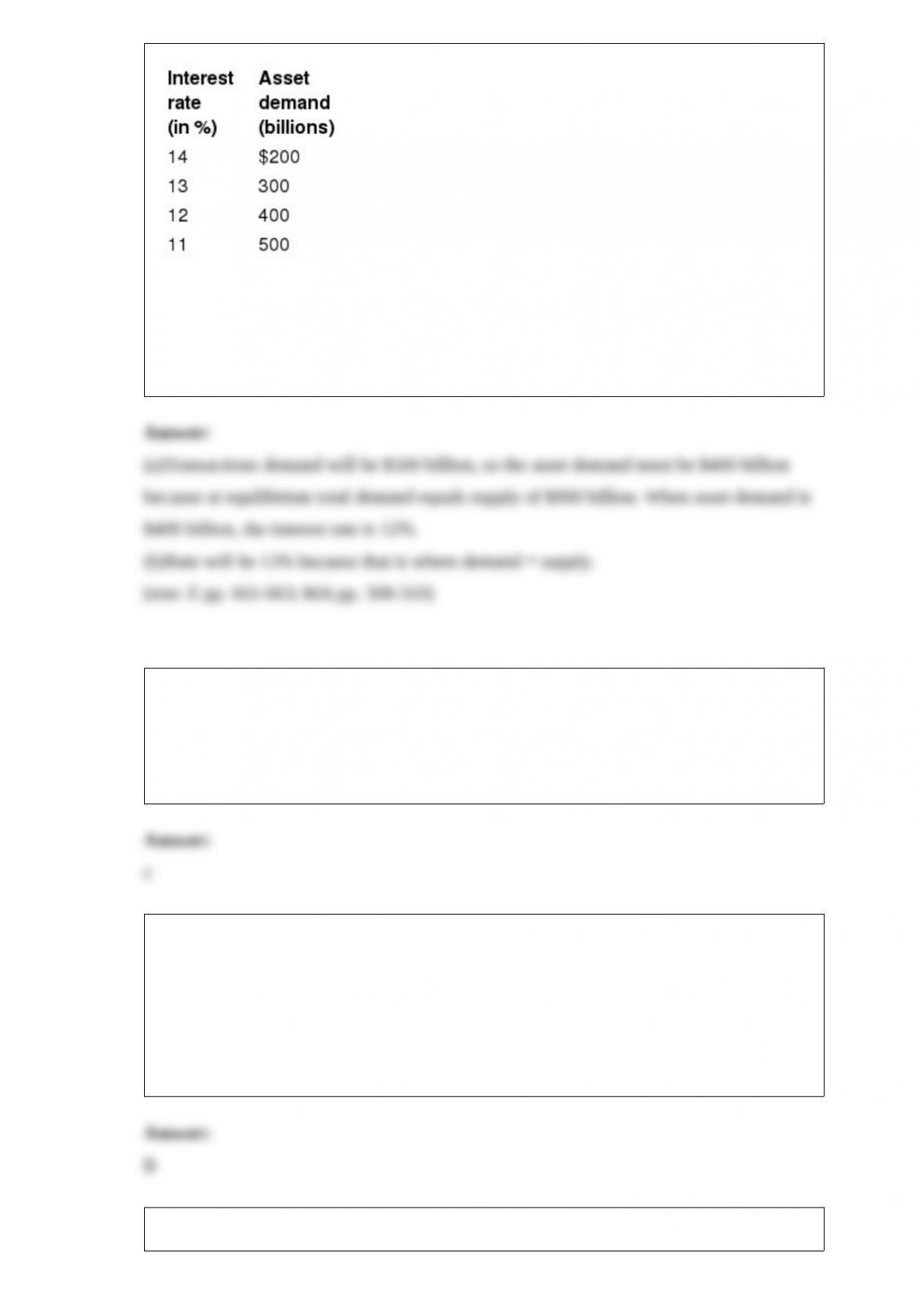
Refer to the above competitive market diagram for product Z. Assume that the current
market demand and supply curves for Z are D2 and S2. If there are substantial external
benefits associated with the production of Z, then:
A.efficient resource allocation occurs at output G and price B because the market
mechanism does not measure all benefits.
B.an output smaller than G would improve resource allocation.
C.government should levy a per unit excise tax on Z to shift the demand curve toward
D1.
D.an output greater than G would result in a more efficient allocation of resources.
6) which list provides, in order, examples of a private good, a public good, and a
quasi-public good?
a.a weather warning system, a dvd player, higher education.

b.higher education, a dvd player, a weather warning system.
c.a weather warning system, higher education, a dvd player.
d.a dvd player, a weather warning system, higher education.
7) Suppose that in some year nominal interest rates are less than the rate of inflation.
This means that:
A.money demand exceeds money supply.
B.real interest rates are negative.
C.real interest rates are positive and unusually high.
D.real interest rates exceed nominal interest rates.
8) assume for a competitive firm that mc = avc at $12, mc = atc at $20, and mc = mr at
$16. this firm will:
a.realize a profit of $4 per unit of output.
b.maximize its profit by producing in the short run.
c.minimize its losses by producing in the short run.
d.shut down in the short run.
9) Legal protections against competitors producing and selling a product identical to the
one you invented are called _________; legal protections against competitors using
your product’s name are called __________.
A.patents; trademarks
B.trademarks; copyrights
C.copyrights; patents
D.trademarks; patents
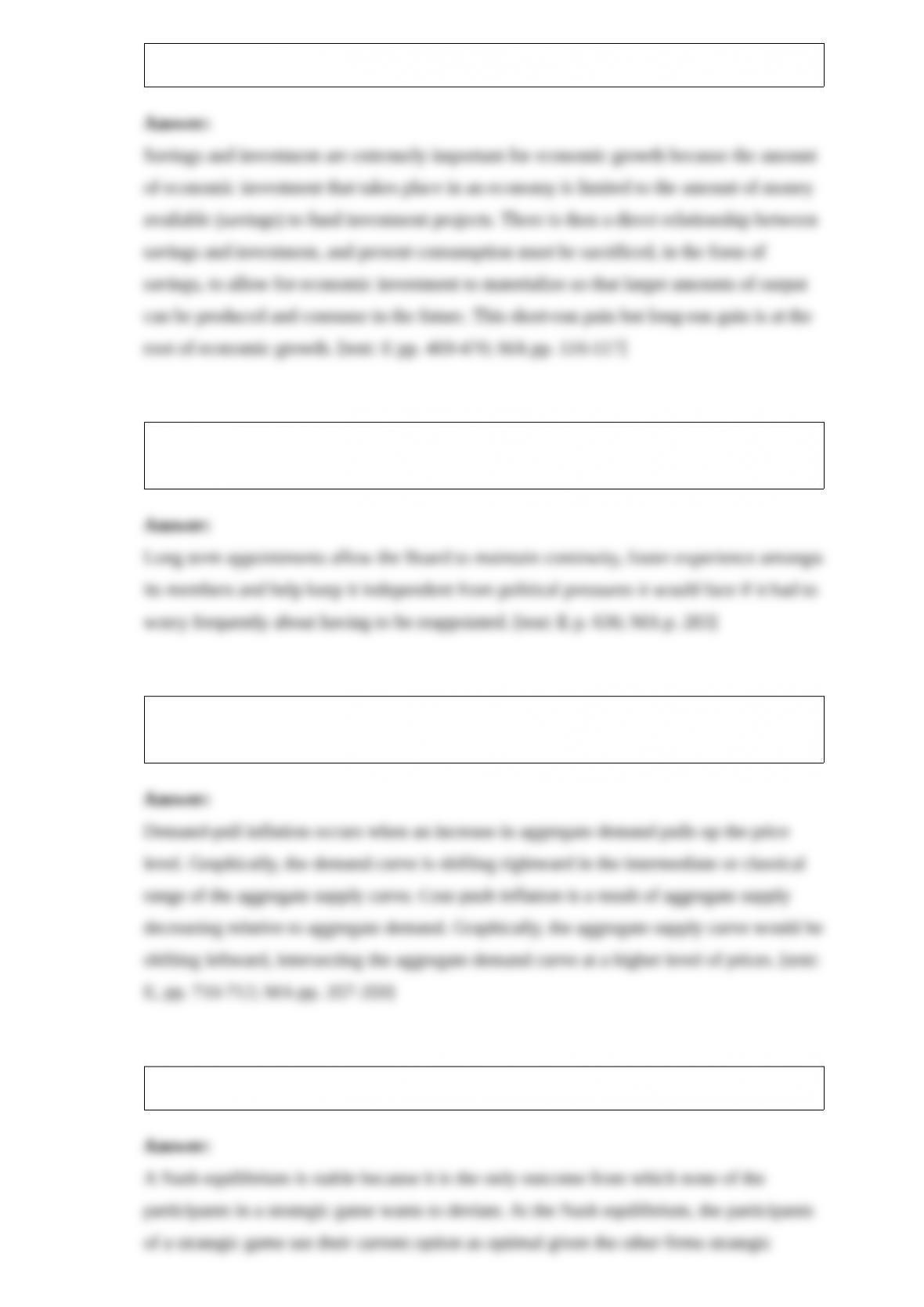
10) Use the table below to answer the questions:
(a)If the transactions demand for money equals 10% of nominal GDP, the nominal GDP
is $5000 billion, and the supply of money is $900 billion, what is the equilibrium
interest rate?
(b)If nominal GDP remains constant, and the money supply is decreased from $900 to
$800 billion, what will the equilibrium rate of interest be?
11) when total revenue is increasing:
a.marginal revenue may be either positive or negative.
b.the demand curve is relatively inelastic.
c.marginal revenue is positive.
d.marginal revenue is negative.
12) State industries are notoriously poor ‘incubators’ for the development of
profit-focused, entrepreneurial persons who may leave the firm to set up their own
businesses. This statement is an argument in favor of:
A.free immigration and emigration.
B.privatizing state industries.
C.central planning.
D.free trade.
13) an inferior good is:

a.one whose demand curve will shift rightward as incomes rise.
b.one whose price and quantity demanded vary directly.
c.one which has not been approved by the federal food and drug administration.
d.not accurately defined by any of the above statements.
14) Large time deposits of $100,000 or more are:
A.a component of M1.
B.a component of M2 but not of M1.
C.a component of M1 but not of M2.
D.not a component of M1 or M2.
15) Built-in stability means that:
A.an annually balanced budget will offset the procyclical tendencies created by state
and local finance and thereby stabilize the economy.
B.with given tax rates and expenditures policies, a rise in domestic income will reduce
a budget deficit or produce a budget surplus while a decline in income will result in a
deficit or a lower budget surplus.
C.Congress will automatically change the tax structure and expenditure programs to
correct upswings and downswings in business activity.
D.government expenditures and tax receipts automatically balance over the business
cycle, though they may be out of balance in any single year.
16) Which of the following is correct?
A.The asset demand for money is downsloping because the opportunity cost of holding
money declines as the interest rate rises.
B.The asset demand for money is downsloping because the opportunity cost of holding
money increases as the interest rate rises.
C.The transactions demand for money is downsloping because the opportunity cost of
holding money varies inversely with the interest rate.
D.The asset demand for money is downsloping because bond prices and the interest rate
are directly related.
17) Why are savings and investment so important for economic growth? How do
savings and investment affect present and future consumption? Explain.
18) How do long terms for appointments benefit the Federal Reserves Board of
Governors?
19) Differentiate between demand-pull and cost-push inflation in the basic aggregate
demand and aggregate supply model.
20) Is a Nash equilibrium stable? Explain.
21) What are two real-world complications with the long-run conclusion about the
representative firm in the model of monopolistic competition?
22) Does it matter whether capital and labor are substitutes or complements when
figuring out what will happen to the demand for labor if the price of capital increases?
Explain.
23) How did the Clayton Act of 1914 strengthen and clarify the intent of the Sherman
Act of 1890?
24) Why is the economic analysis of oligopoly so difficult? What two generalizations
can be made about the pricing behavior of oligopolists?
25) Use the following bank transactions to develop the banks balance sheet. To start the
bank, owners issue $500,000 in stock to shareholders. Next, they purchase $200,000
worth of equipment and office space to establish the physical location of the bank.
Finally, they open the bank and receive $750,000 in checkable deposits. With these
reserves, they make $600,000 worth of loans.
26) Define total fertility rate and replacement rate. Use them to describe the population
prospects for many developed countries.