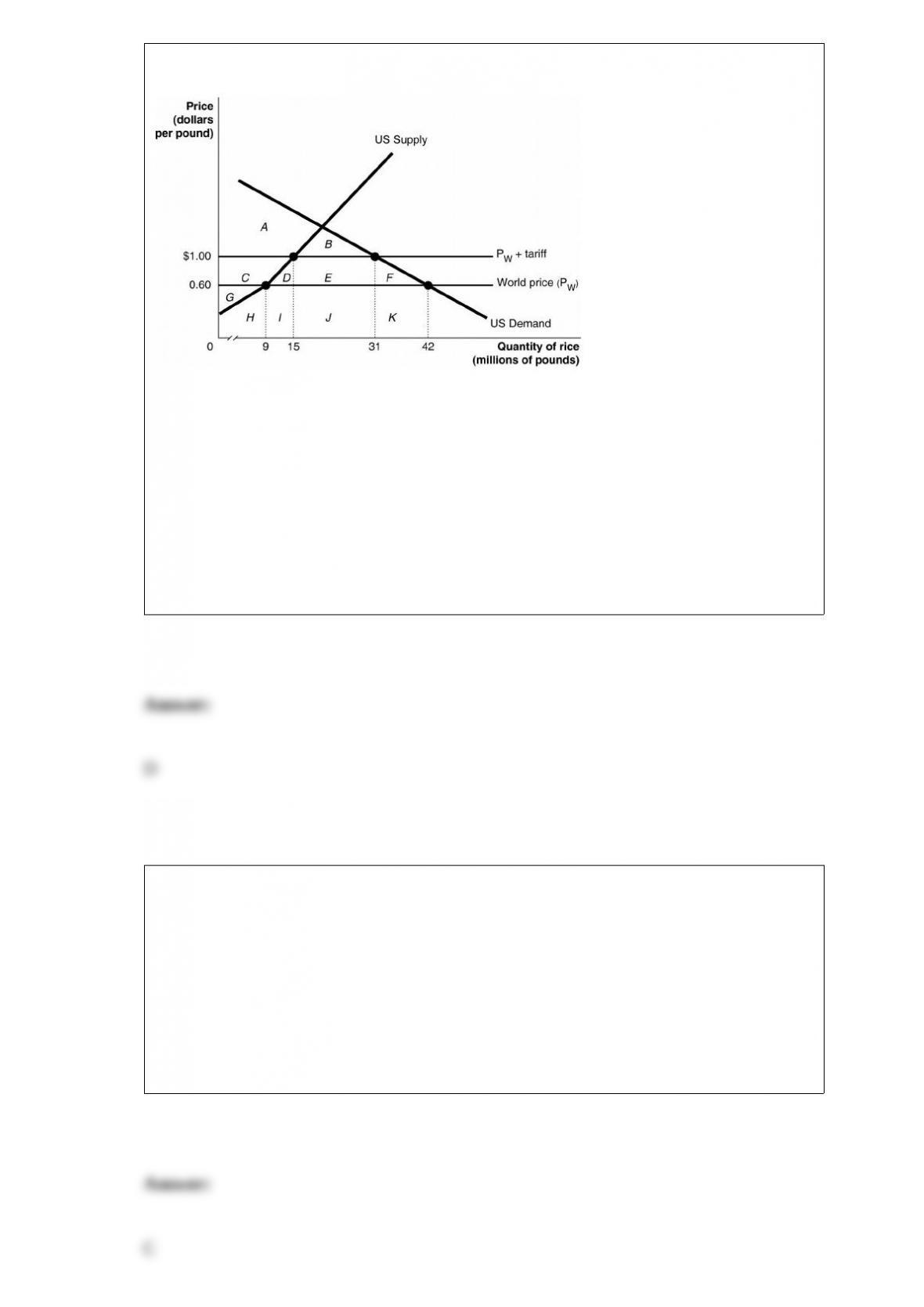
Figure 9-2
Suppose the U.S. government
imposes a $0.40 per pound tariff on rice imports. Figure 9-2 shows the impact of this
tariff. Without the tariff in place, the United States consumes
A) 9 million pounds of rice.
B) 15 million pounds of rice.
C) 31 million pounds of rice.
D) 42 million pounds of rice.
Where does the short-run Phillips curve intersect the long-run Phillips curve?
A) at the point where the rate of inflation and the unemployment rate are equal
B) at the natural rate of inflation
C) at the point where actual inflation is equal to expected inflation
D) There is no intersection between the short-run and long-run Phillips curves.

Which of the following is not an advantage of risk pooling?
A) By insuring large groups as opposed to individuals, health insurance providers
reduce adverse selection.
B) It gives very sick people in the group the same access to health care and to pay the
same premiums as healthy individuals.
C) It is easier for an insurance company to estimate the average number of claims likely
to be filed under a group policy than it is to predict the number of claims likely to be
filed under an individual policy.
D) Individuals who are insured and therefore do not have to pay the full cost of health
care services may be inclined to over-use those services.
Which of the following statements is false?
A) There is an indifference curve associated with any combination of goods selected by
a consumer.
B) A consumer is indifferent among all consumption bundles along a given budget line.
C) All consumption bundles along a given indifference curve are equally desirable.
D) Consumption bundles that lie on higher indifference curves yield higher utility.
Table 2-20
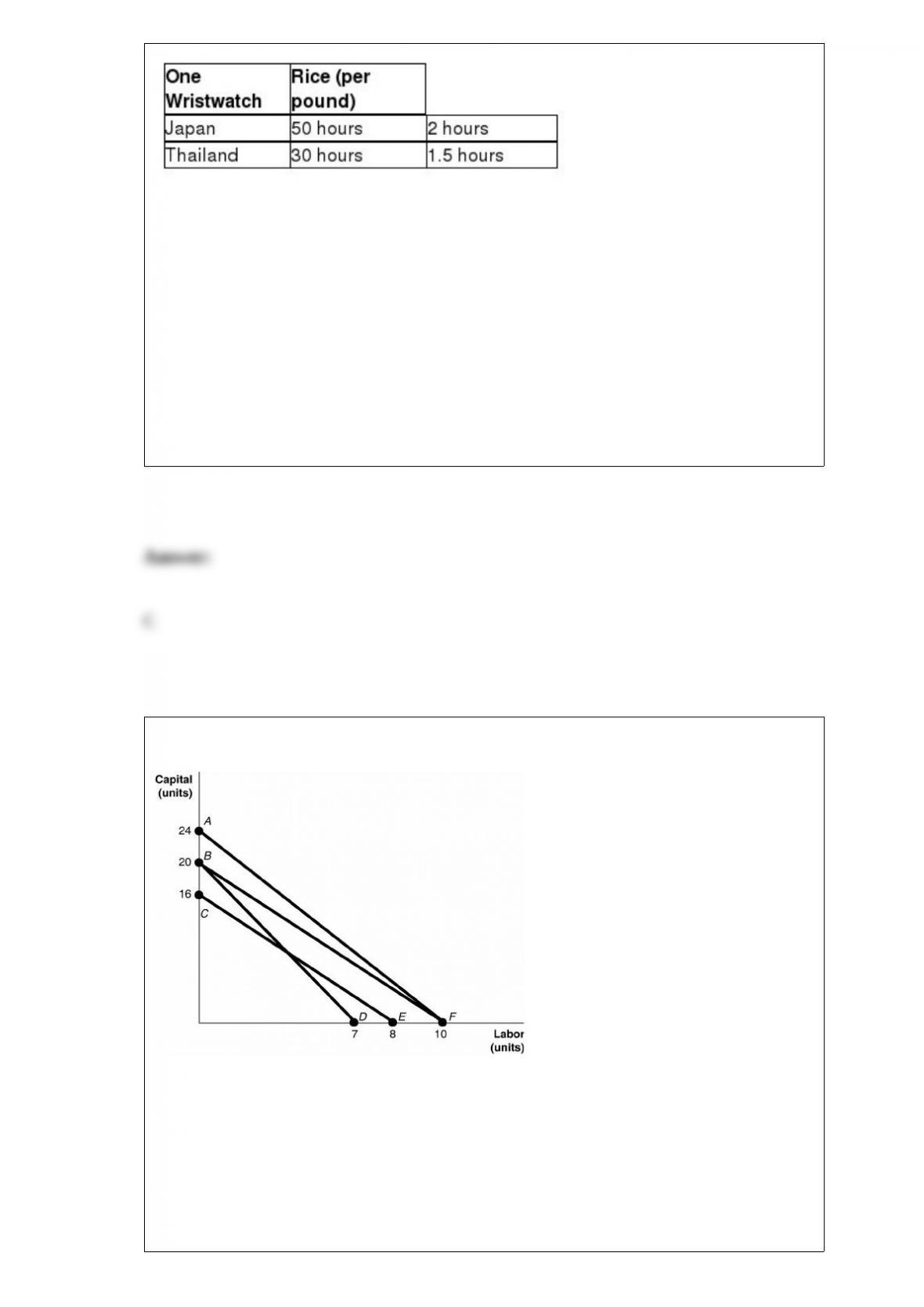
Table 2-20 shows the number of labor hours required to produce a wristwatch and a
pound of rice in Japan and Thailand.
If the two countries specialize and trade, who should export wristwatches?
A) There is no basis for trade between the two countries.
B) Japan
C) Thailand
D) They should both be importing wristwatches.
Figure 11-13
The lines shown in the diagram are isocost lines. If the price of labor is $50 per unit,
what is the price of capital along the isocost CE?
A) $400 per unit
B) $100 per unit

C) $25 per unit
D) insufficient information to answer question
Raising funds through financial intermediaries is called
A) direct finance.
B) corporate finance.
C) indirect finance.
D) dividend reinvestment.
Figure 15-4
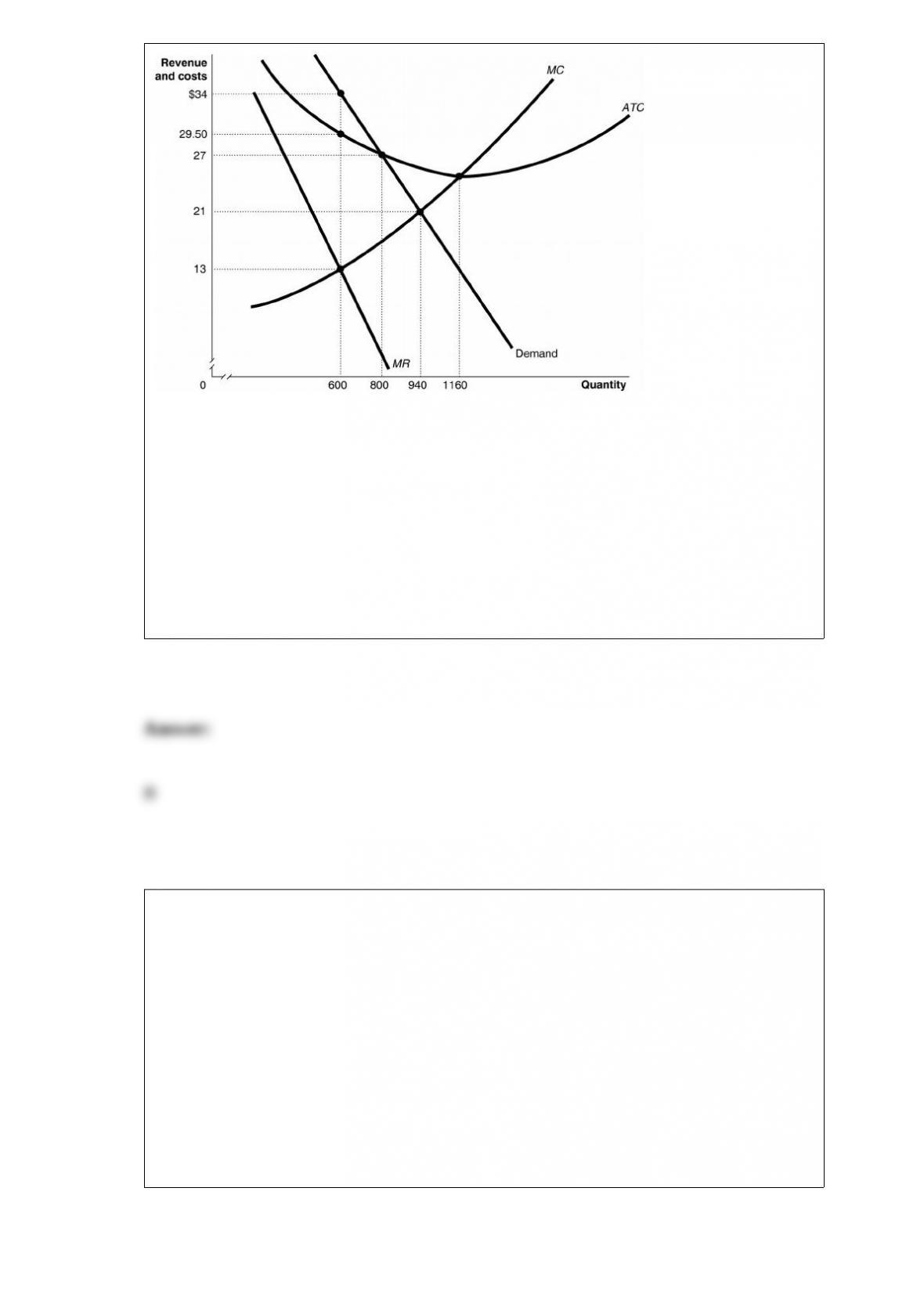
Figure 15-4 shows
the demand and cost curves for a monopolist. What is the amount of the monopoly’s
total cost of production?
A) $21,600
B) $17,700
C) $9,340
D) $7,800
Suppose real GDP is $12.1 trillion and potential GDP is $12.6 trillion. To move the
economy back to potential GDP, Congress should
A) lower taxes by an amount less than $500 billion.
B) raise government purchases by $500 billion.
C) raise government purchases by more than $500 billion.
D) lower taxes by $500 billion.
E) lower government purchases by $500 billion.

If the Fed pursues an expansionary monetary policy, investment in the United States
will ________ and net exports will ________.
A) decrease; decrease
B) decrease; increase
C) increase; decrease
D) increase; increase
If firms find that consumers are purchasing more than expected, which of the following
would you expect?
A) Aggregate expenditure will likely be greater than GDP.
B) Aggregate expenditure will likely be less than GDP.
C) The economy will adjust to macroeconomic equilibrium as inventories rise, and
production and employment fall.
D) The economy will adjust to macroeconomic equilibrium as inventories fall, and
production and employment fall.

Which of the following is a government expenditure, but is not a government purchase?
A) The federal government buys a Humvee.
B) The federal government pays the salary of an FBI agent.
C) The federal government pays out an unemployment insurance claim.
D) The Federal government pays to support research on Aids.
Assuming zero transaction cost, if your local grocer buys oranges at a low price from an
orchard and resells them to you at a higher price, then the grocer’s revenue minus costs
is known as
A) arbitrage profits.
B) transactions profits.
C) pure profits.
D) excess profits.
Many golf courses charge members an annual membership fee as well as a fee each
time they golf. One reason for this is
A) golf courses do not want their members to overuse their fairways. Charging for each
round of golf played reduces fairway maintenance costs.
B) charging both fees allows the courses to transfer more consumer surplus into profit
than charging only an admission fee.

C) charging both fees allows the courses to transfer more producer surplus into profit
than charging only an admission fee.
D) research has shown that charging both fees increases the likelihood that golfers will
renew their memberships.
Which of the following will prevent firms from engaging in price discrimination?
A) yield management
B) arbitrage
C) transactions costs
D) odd pricing
Which of the following equations correctly measures GDP in an economy?
A) GDP = C + I + G + X
B) GDP = C + net I + G + NX
C) GDP = C + I + G + NX
D) GDP = C + G + I – taxes

Which of the following would cause a decrease in the supply of milk?
A) an increase in the price of cookies (assuming that milk and cookies are
complements)
B) a decrease in the price of milk
C) an increase the price of a product that producers sell instead of milk
D) an increase in the number of firms that produce milk
If foreign holdings of U.S. dollars decrease, holding all else constant,
A) the balance on the U.S. financial account will decrease.
B) the balance on the U.S. current account will decrease.
C) the balance on the U.S. capital account will decrease.
D) the U.S. balance of trade will decrease.
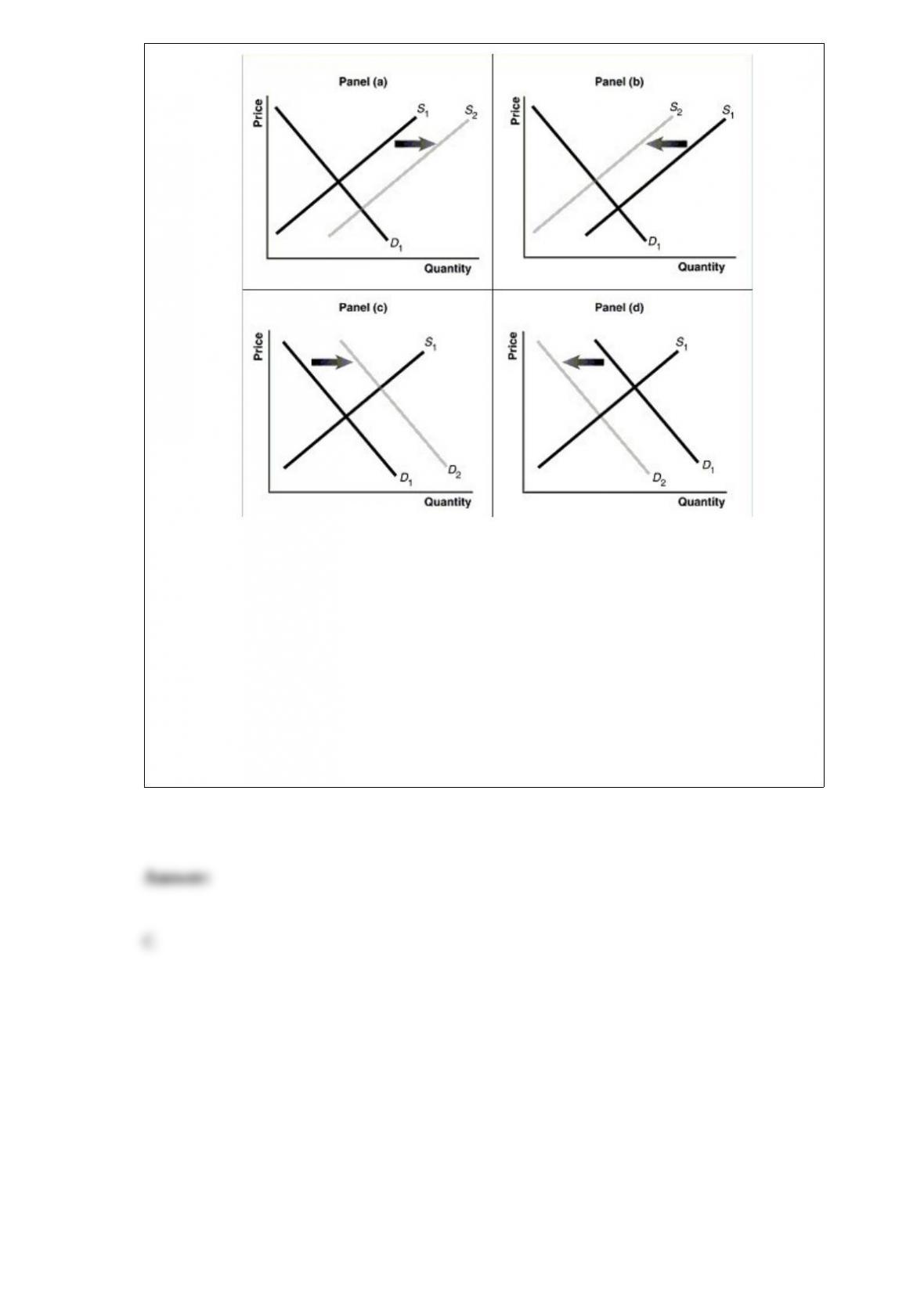
Figure 3-7
Assume that the graphs in this figure represent the demand and supply curves for
coffee. What happens in this market if buyers expect the price of coffee to rise?
A) Panel (a)
B) Panel (b)
C) Panel (c)
D) Panel (d)