
Because each customer pays according to her willingness to pay, a consumer maximizes
her consumer surplus under first-degree price discrimination.
Answer:
The demand for heating oil in the short run is more elastic than the long run demand for
heating oil.
Answer:
Aggregate expenditure includes consumption spending, planned investment spending,
government purchases, and net exports.
Answer:
The formula for the multiplier is (1 – MPC).
Answer:

A decrease in government spending will result in a decrease in the price level and a
decrease in real GDP in the long run.
Answer:
If it costs Sinclair $300 to produce 3 suede jackets and $420 to produce 4 suede jackets,
then the difference of $120 is the marginal cost of producing the 4th suede jacket.
Answer:
Costs that change as output changes are called incremental costs.
Answer:
Network externalities
A) can only exist when there are economies of scale.
B) prevent the dominance of a market by one firm.
C) exist when the usefulness of a product increases with the number of consumers who
use it.
D) are created when celebrity endorsements of products lead to a surge in the demand
for those products.
Answer:
If a demand curve shifts to the left, then
A) demand has increased.
B) quantity demanded has increased.
C) demand has decreased.
D) quantity demanded has decreased.
Answer:
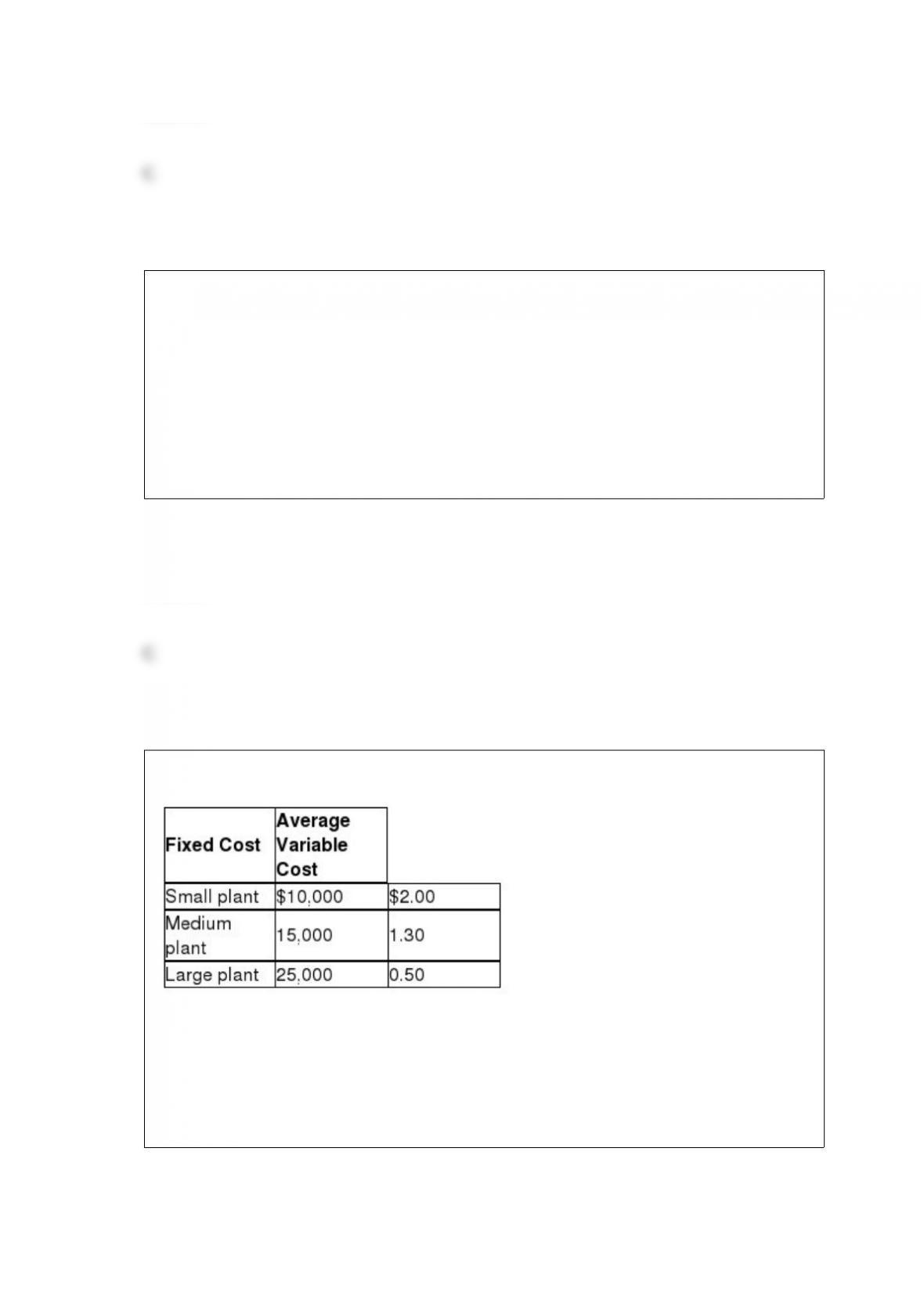
Table 11-9
Clock It To Me manufactures clock radios. The table above shows estimates of fixed
cost per period and average variable cost for three possible plant sizes. a. You are
employed as the company’s cost accountant and have been asked to prepare cost
estimates for various output levels for each of the three possible plant sizes. Record
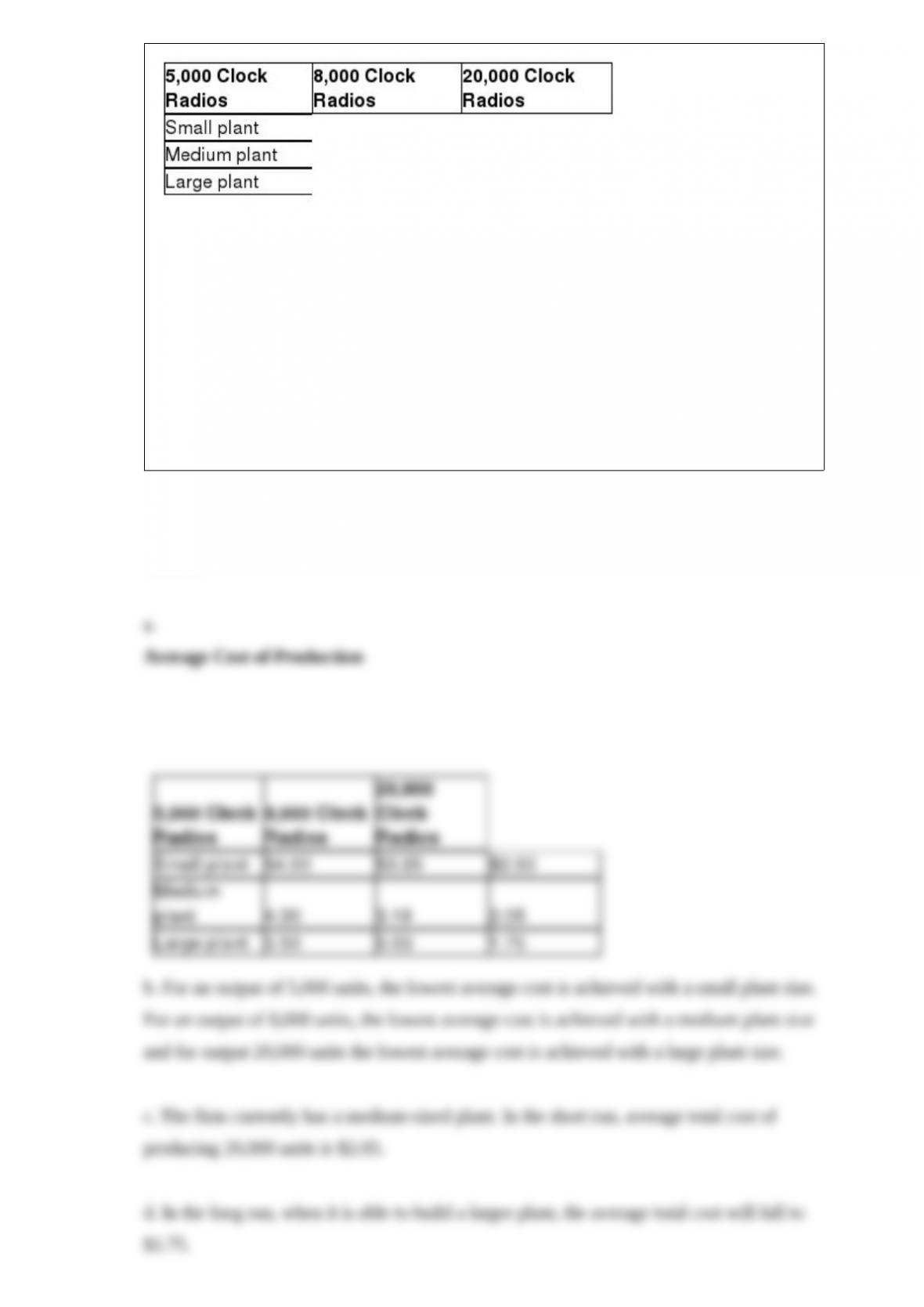
your calculations in the table below. Average Cost of Production
b. For each of the three output levels, which plant size will generate the lowest average
total cost of production?
c. Suppose the firm currently sells 8,000 clock radios per period (using the optimal
plant size for this output level). Now, however, it has just secured a long-term contract
to supply 20,000 clock radios per period. In the short run, what is the average total cost
of producing 20,000 clock radios? Provide a numerical value based on your answer in
part a.
d. What happens to average total cost of production in the long run? Provide a
numerical value based on your answer in part a.
Answer:
A.C. Pigou argued that the government can deal with a positive externality in
consumption by giving consumers a subsidy equal to the value of the externality.
Answer:
Which of the following is not “crowded out” by higher interest rates as a result of
expansionary fiscal policy?
A) consumption
B) private investment
C) net exports
D) government spending
Answer:
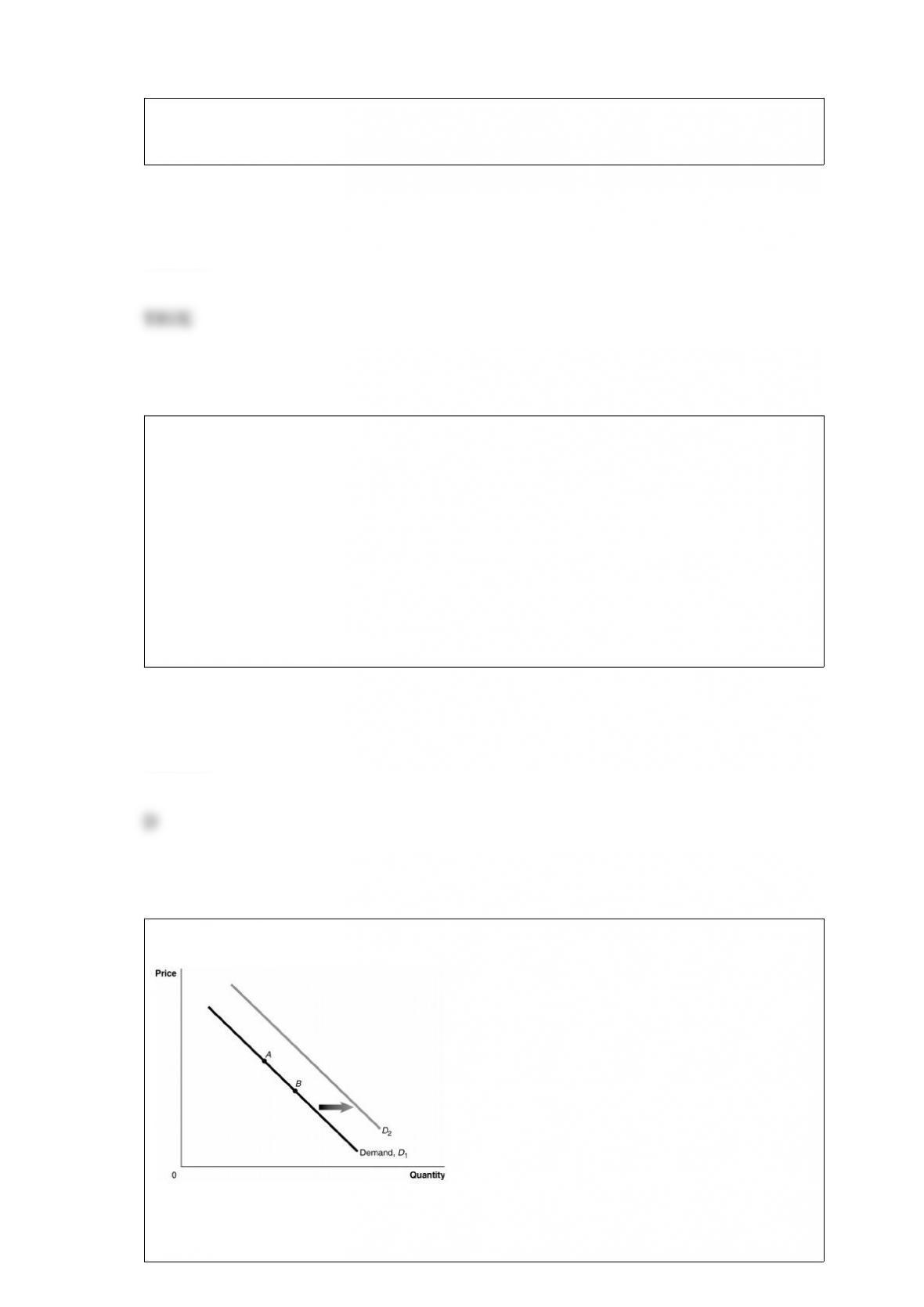
Figure 3-1
If the product represented is a normal good, a decrease in income would be represented
by a movement from
A) A to B.
B) B to A.
C) D1 to D2.
D) D2 to D1.
Answer:
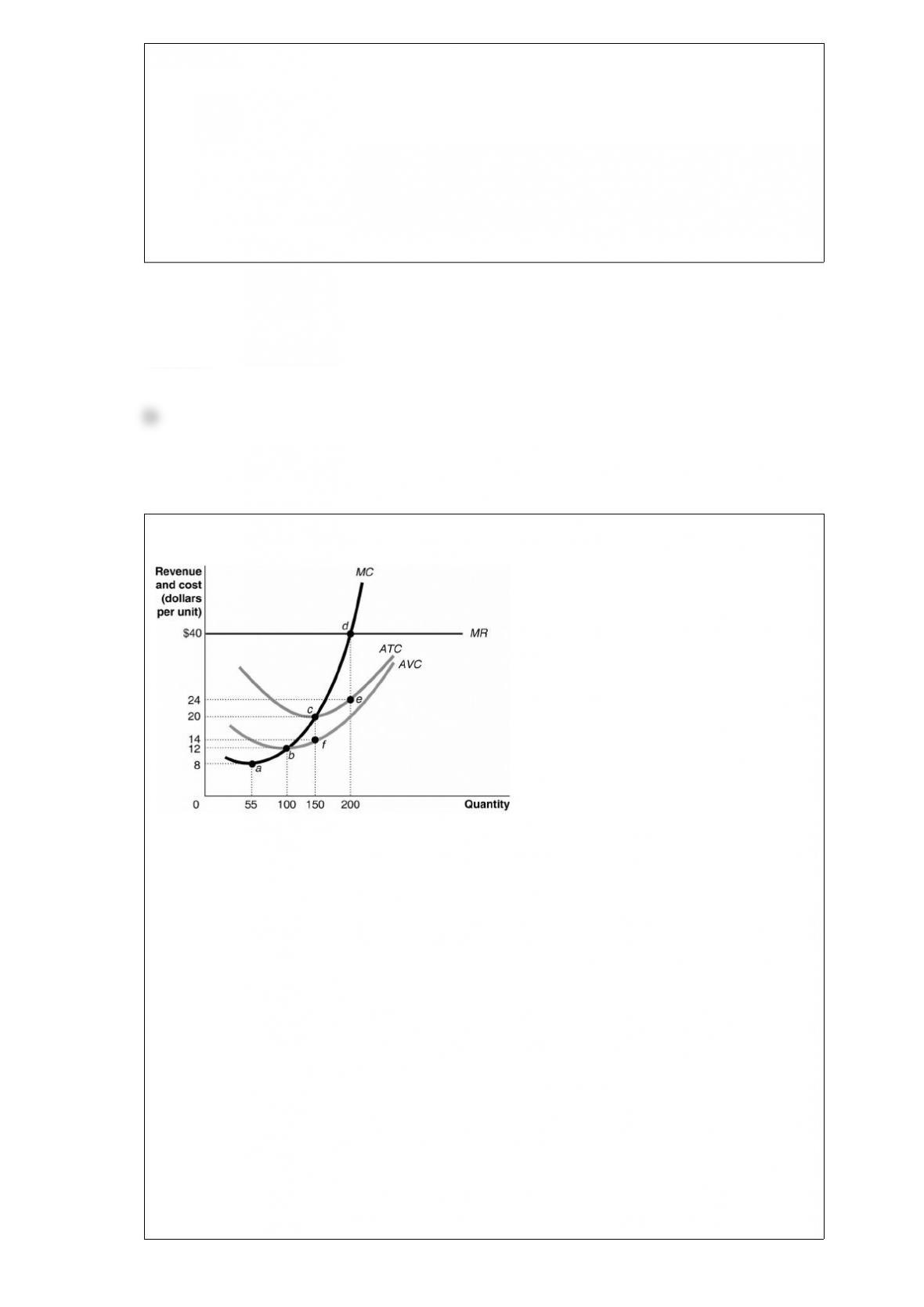
Use the figure Figure 12-18 to answer the following questions.
a. How can you determine that the figure represents a graph of a perfectly competitive
firm? Be specific; indicate which curve gives you the information and how you use this
information to arrive at your conclusion.
b. What is the market price?
c. What is the profit-maximizing output?
d. What is total revenue at the profit-maximizing output?
e. What is the total cost at the profit-maximizing output?
f. What is the profit or loss at the profit-maximizing output?
g. What is the firm’s total fixed cost?
h. What is the total variable cost?
i. Identify the firm’s short-run supply curve.
j. Is the industry in a long-run equilibrium?
k. If it is not in long-run equilibrium, what will happen in this industry to restore
long-run equilibrium?
l. In long-run equilibrium, what is the firm’s profit maximizing quantity?
Answer:

When Dr. Goldfinger decides on the companies in which he will invest, a ________
issue is being addressed.
A) microeconomic
B) macroeconomic
C) positive economic
D) normative economic
Answer:
The core personal consumption expenditures price index excludes
A) food and energy prices.
B) food and housing prices.
C) energy and housing prices.
D) housing and health care prices.
Answer:

What is the present value of $888 in a one year if the current rate of interest is five
percent?
A) $4,440
B) $845.71
C) $177.60
D) none of these
Answer:
If we want to use a measure of inflation that foreshadows price changes before they
affect prices at the retail level, we would base our measure of inflation on
A) the producer price index.
B) the consumer price index.
C) the GDP deflator.
D) the household price index.
Answer:
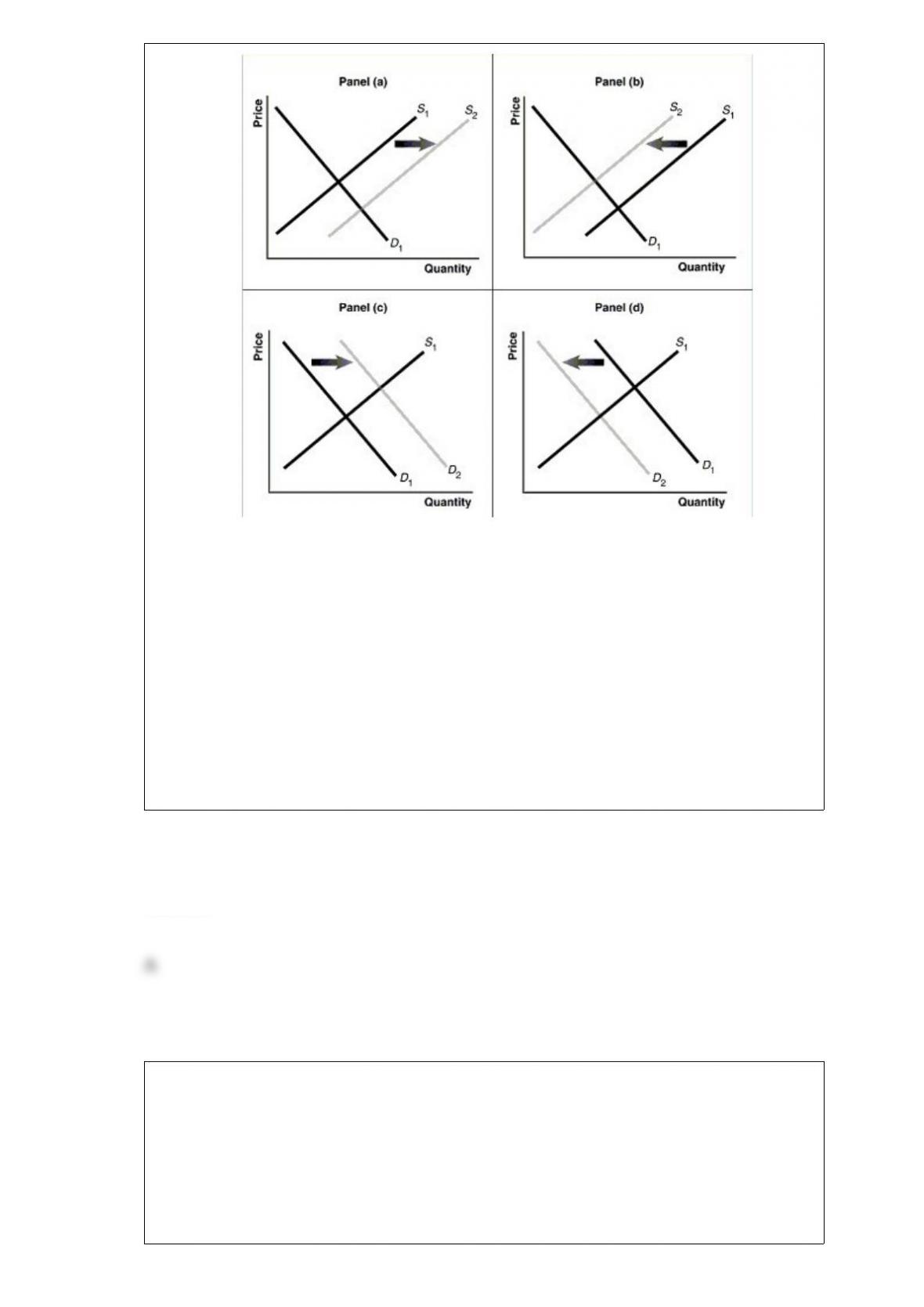
Figure 3-7
Assume that the graphs in this figure represent the demand and supply curves for
almonds. Which panel best describes what happens in this market when there is an
increase in the productivity of almond harvesters?
A) Panel (a)
B) Panel (b)
C) Panel (c)
D) Panel (d)
Answer:
A supply curve
A) is a table that shows the relationship between the price of a product and the quantity
of the product supplied.
B) is a curve that shows the relationship between the price of a product and the quantity
of the product supplied.

C) is the relationship between the supply of a good and the cost of producing the good.
D) is a curve that shows the relationship between the price of a product and the quantity
of the product that producers and consumers are willing to exchange.
Answer:
Private solutions to the problem of externalities are most likely when
A) government actively encourages these solutions.
B) transaction costs are low and the number of bargaining parties is small.
C) transaction costs are low and the number of bargaining parties is large.
D) transaction costs are low and the monetary damages to third parties is high.
Answer:
Which of the following accurately describes growth rates in the United States from
1900 to the present?
A) Growth rates rose until the 1970s and then fell until the present.
B) Growth rates have risen continuously from 1900 to the present.
C) Growth rates rose until the 1970s, slowed until the 1990s, and then rose up to the
present.
D) Growth rates have fallen continuously from 1900 to the present.
Answer:
The total amount of copper in the earth is not increasing. Does this mean that in the
market for copper, the supply curve is perfectly inelastic? Explain.
Answer:
Why do countries peg their currencies, and what problems can result from pegging?
Answer:
Would the Federal Reserve respond more aggressively with interest rate cuts in a
recession caused by a decrease in spending, as in the 2001 recession, than in a recession
caused by an increase in oil prices, as in the 1974-75 recession?
Answer:
The Bureau of Economic Analysis divides its statistics on GDP into four major
categories. List the categories of expenditures and define each.
Answer:
During 2007, many ‘subprime” and “Alt-A” borrowers began to default on their
mortgages. Describe ‘subprime” and “Alt-A” borrowers.
Answer:
What was the source of the problems encountered by many financial firms during the
late 2000s?
Answer: