
1) The philosopher John Rawls argued that
a.people would choose a more equal distribution of income if they had to determine an
economic distribution system before knowing their place in it.
b.people would choose income inequality to allow the maximum use of their individual
talents.
c.government has a role to ensure income equality to prevent social unrest.
d.people would choose equal opportunity because it is morally right.
2) Suppose that when the price of good X increases from $800 to $850, the quantity
demanded of good Y increases from 65 to 70. Using the midpoint method, the cross is
about
a.-1.2, and X and Y are complements.
b.-0.1, and X and Y are complements.
c.0.1, and X and Y are substitutes.
d.1.2, and X and Y are substitutes.
3) In which of the following product markets are we likely to observe the largest
amount of advertising?
a.markets with highly differentiated products
b.perfectly competitive markets
c.markets in which industrial products are sold
d.markets in which there is very little difference between different firms’ products
4) If the price of Verizon cell phones falls, what will happen to the demand curve for
Verizon sales people?
a.It will shift to the right.
b.It will shift to the left.
c.The direction of the shift is ambiguous.
d.It will remain unchanged.
5) Table 14-10
Suppose that a firm in a competitive market faces the following revenues and costs:
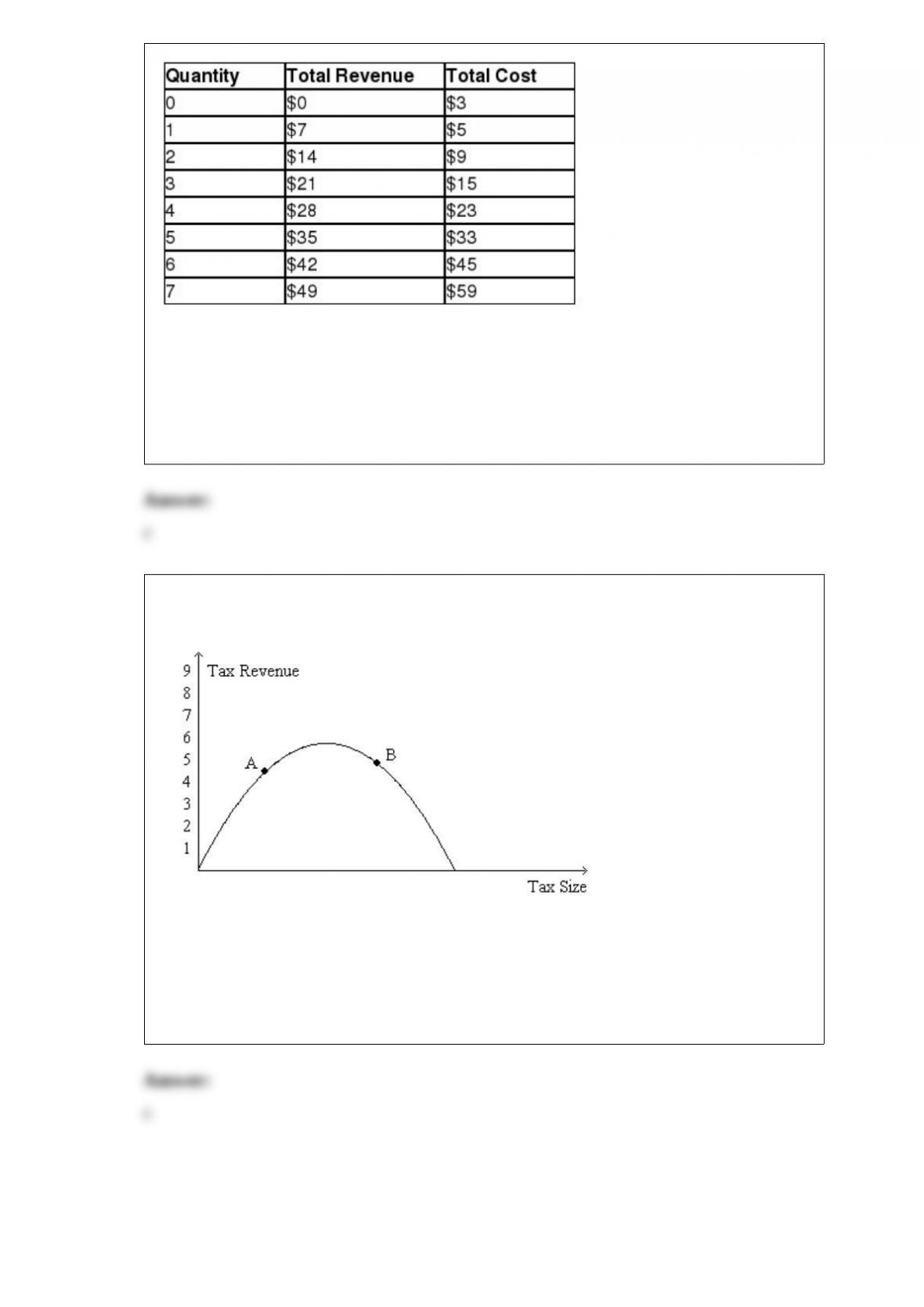
This firm should continue to produce and sell units as long as the marginal cost of
production is less than or equal to
a.$3.
b.$5.
c.$7.
d.$9.
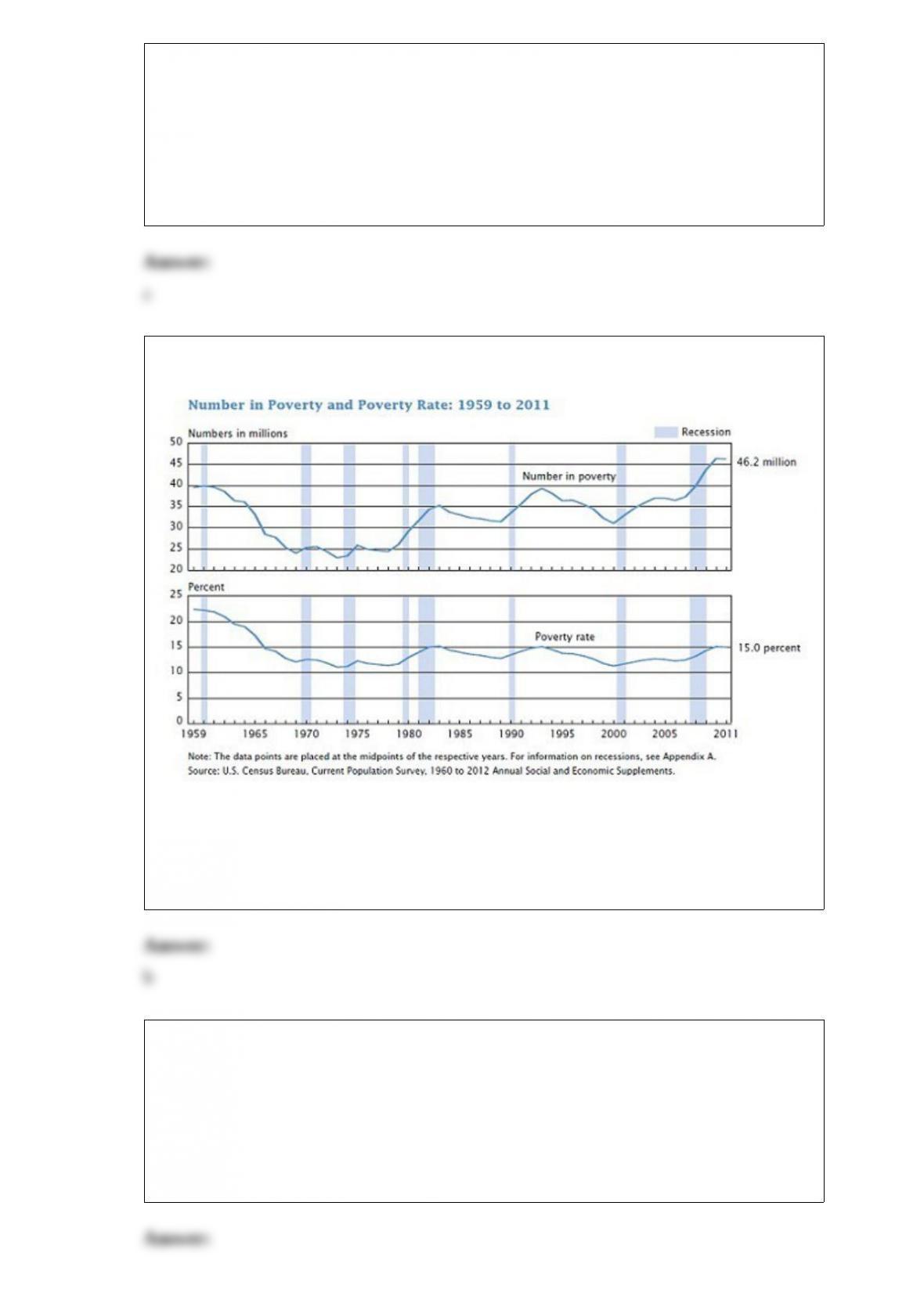
6) Figure 8-23. The figure represents the relationship between the size of a tax and the
tax revenue raised by that tax.
The curve that is shown on
the figure is called the
a.deadweight-loss curve.
b.tax-incidence curve.
c.Laffer curve.
d.Lorenz curve.
7) Moral hazard occurs when
a.an employer closely monitors an employee.
b.two people consider a trade with each other and one person has relevant information
about some aspect of the product’s quality that the other person lacks.
c.an employee lacks an incentive to promote the best interests of the employer, and the
employer cannot observe the actions of the employee.
d.an employee closely monitors the actions of her employer.
8) Figure 20-1 Number of Poor
Refer to Figure 20-1. Between 1959 and 2011 the poverty rate has
a.increased overall.
b.decreased overall.
c.stayed the same overall.
d.moved in the opposite direction of the number of people in poverty.
9) Alice and Betty’s Production Possibilities in one 8hour day.
Alice’s Production Possibilities FrontierBetty’s Production Possibilities Frontier
a. $450.
b. $900.
c. $1,350.
d. $2,025.

17) A firm operating in a perfectly competitive market may earn positive, negative, or
zero economic profit in the long run.
a.True
b.False
18) Table 17-9
The table shows the demand schedule for a particular product.
Refer to Table 17-9. Suppose the market for this product is served by two firms that
have formed a cartel. What price will the cartel charge in this market if the marginal
cost of production is $4?
a.$6
b.$8
c.$10
d.$12