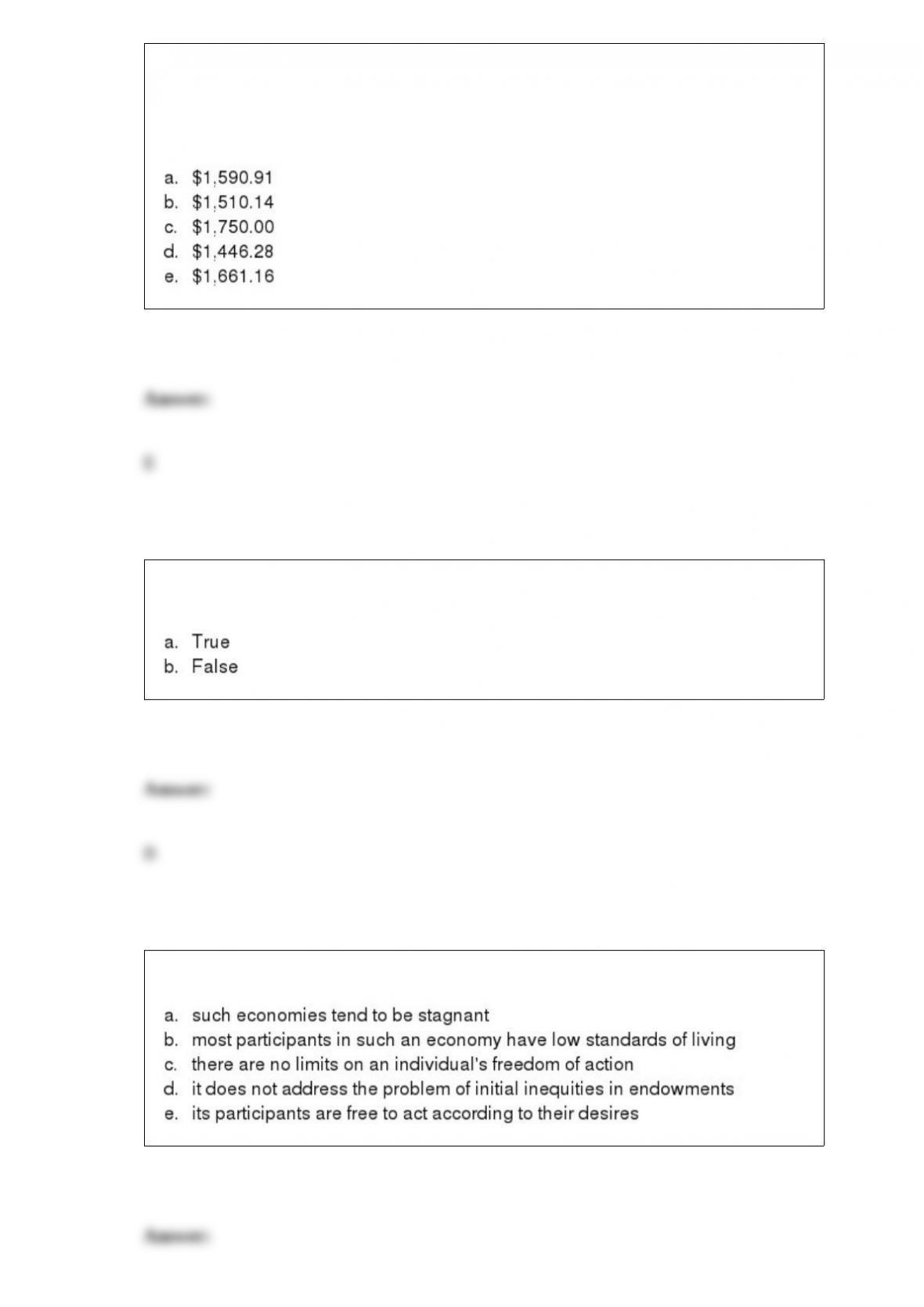
A new computer will generate $1,000 in net revenue for a firm during its first year,
$500 during its second year, $250 during its third year, and nothing thereafter. If the
interest rate is 10 percent (0.10) per year, what is the present value of the computer to
the firm? (The first payment will be received at the end of this year.)
Price-fixing agreements among competing firms are a violation of the Clayton Antitrust
Act.
A weakness of the market system of resource allocation is that

Which of the following is a reason why the Consumer Price Index (CPI) is not
calculated as a simple average of all prices?
a. Some goods experience large price changes and the CPI would be too variable if
computed by a simple average.
b. Goods differ in their importance in the average consumer’s budget.
c. Some goods never experience price changes and the CPI would not be variable
enough if computed as a simple average.
d. It would be difficult to compute a price index using a simple average of all prices.
e. Actually, the CPI is a simple average of all prices.
Suppose the population falls by 1 percent. For the standard of living to rise
a. nominal GDP can fall by as much as 1 percent
b. nominal GDP must grow by at least 1 percent
c. real GDP must grow by at least 1 percent
d. real GDP must fall by at least 1 percent
e. nominal GDP must fall by more than 1 percent

If all we know is that the opportunity cost of a car equals 100 refrigerators in France,
and 200 refrigerators in Italy, we can conclude
a. nothing about which nation has the absolute advantage in refrigerator production
b. that France has a comparative advantage in refrigerator production
c. that mutually beneficial international trade might involve the market exchange of 1
car for 80 refrigerators (whereby France would gain more than Italy)
d. that mutually beneficial international trade might involve the market exchange of 1
car for 300 refrigerators (whereby Italy would gain more than France)
e. that France has the absolute advantage in car production
Under a managed float, if U.S. GDP suddenly increased, which of the following actions
would the Bank of England need to take in order to stop any movement in the
dollar-pound exchange rate?
a. Buy British pounds for dollars in order to shift the demand curve for pounds leftward
b. Sell British pounds for dollars in order to shift the supply curve for pounds leftward
c. Sell British pounds for dollars in order to shift the supply curve for pounds rightward
d. Buy British pounds for dollars in order to shift the demand curve for pounds
rightward
e. Do nothing, since purchasing power parity will correct the situation in the short run.
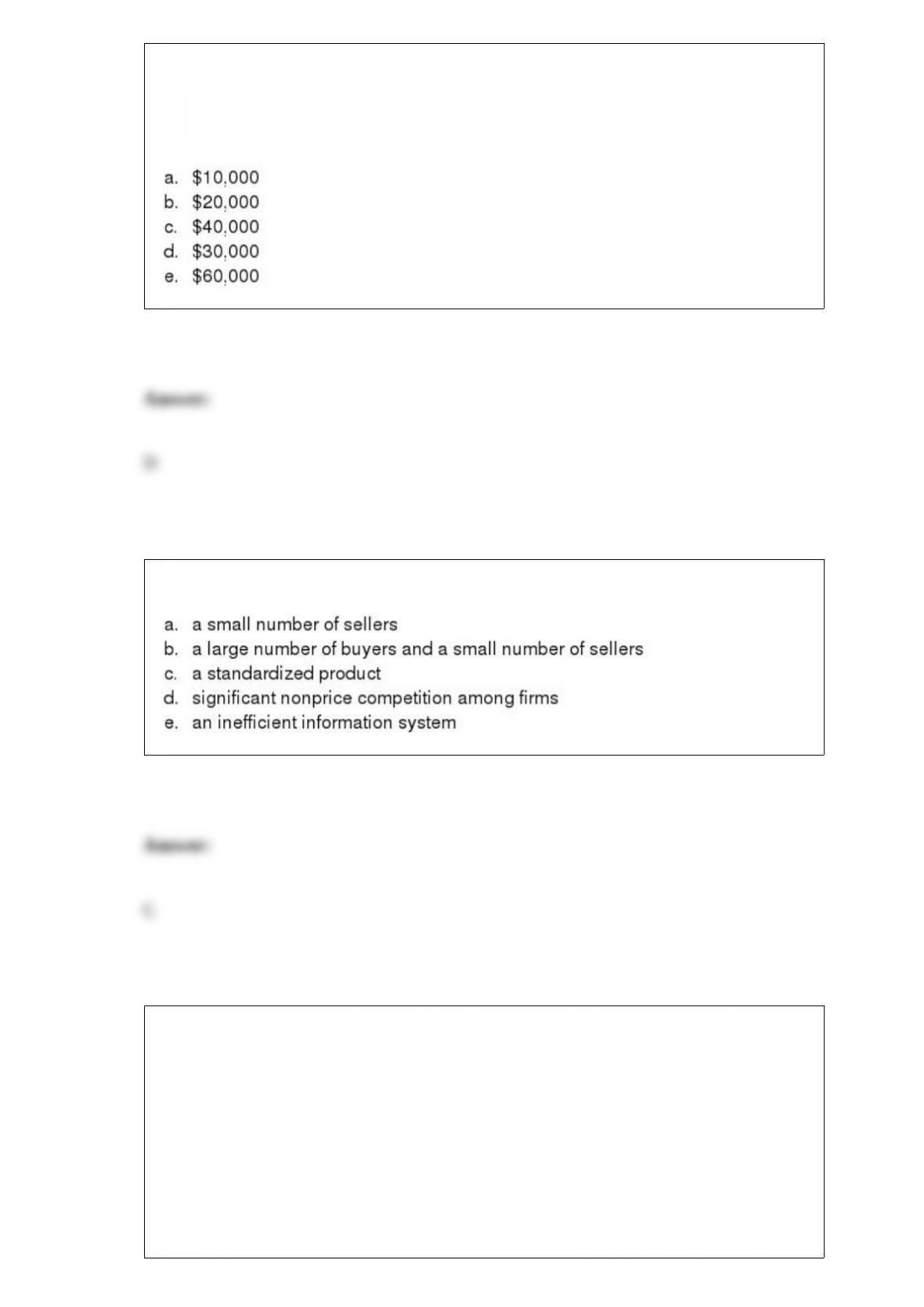
Myron worked at a factory where he earned $20,000 per year. He quit his job and
opened a bumper sticker business. After one year, his business earned $60,000 in sales
revenue and he incurred $30,000 in direct business expenses. If he received no salary
from the new business, what is his accounting profit?
One of the defining characteristics of a perfectly competitive market is
What is the effect of diminishing returns to labor on the slope of the aggregate
production function (where output is measured on the vertical axis and employment is
measured on the horizontal axis)?
a. It implies that the slope of the curve increases as the number of workers employed
increases.
b. It implies that the slope of the curve becomes negative as the number of workers
employed increases.

c. It implies that the slope of the curve decreases (or becomes flatter) as the number of
workers employed increases.
d. It keeps the slope the same throughout.
e. It has nothing to do with the slope of the aggregate production function.
If the opportunity cost of production rises as more of a good is produced,
a. the terms of trade will be independent of opportunity costs
b. the production possibilities curve will be a straight line
c. a country will specialize in producing only those goods in which it has a comparative
advantage
d. a country should produce any good in which it has an absolute advantage
e. a country may not specialize completely in the goods in which it has comparative
advantage
An increase in output will tend to
a. increase productivity in the economy as a whole
b. reduce prices of non-labor inputs and other commodities in limited supply in the
short run
c. increase real wage rates
d. increase nominal wage rates
e. decrease the price level
One way in which antitrust law fosters economic efficiency is by
An increase in the demand for loanable funds will, everything else equal,
a. increase the supply of funds
b. lower the interest rate and reduce investment spending
c. lower the interest rate and increase investment spending
d. raise the interest rate and reduce investment spending
e. raise the interest rate and increase investment spending

To maintain a fixed exchange rate, a central bank
a. must buy up any excess supply of its currency at that rate
b. must buy up any excess demand for its currency at that rate
c. must maintain a fixed money supply
d. must also maintain a fixed interest rate target
e. should “buy low and sell high”
An increase in government spending can lead to a decrease in GDP if the interest rate
changes enough.
Which of the following best describes what has happened to the U.S. labor supply and
labor demand over the past 50 years?

a. Labor supply increased and labor demand decreased.
b. Both labor supply and labor demand decreased.
c. Labor supply did not change but labor demand increased.
d. Both labor supply and labor demand increased.
e. Labor supply increased but labor demand did not change.
During which decade were John Maynard Keynes’ ideas challenged?
a. 1930s
b. 1940s
c. 1960s
d. 1970s
e. 1980s
If the capital stock increases faster than employment, then we would expect
a. both output and labor productivity to rise
b. output to rise but labor productivity to fall
c. both output and labor productivity to fall
d. output to fall but labor productivity to rise
e. output to rise but labor productivity to remain unchanged

Say’s law assures us that in the classical model, total spending is always enough to
purchase the economy’s total output.