1) In conducting their research, economists face an obstacle that not all scientists face;
specifically, in economics, it is often impractical to
a.make use of theory and observation.
b.rely upon the scientific method.
c.conduct laboratory experiments.
d.find articles or books that were written before 1900.
2) An advantage of using the midpoint method to calculate the is that it uses the metric
system.
a.True
b.False
3) Suppose you make jewelry. If the price of gold falls, then we would expect you to
a.be willing and able to produce less jewelry than before at each possible price.
b.be willing and able to produce more jewelry than before at each possible price.
c.face a greater demand for your jewelry.
d.face a weaker demand for your jewelry.
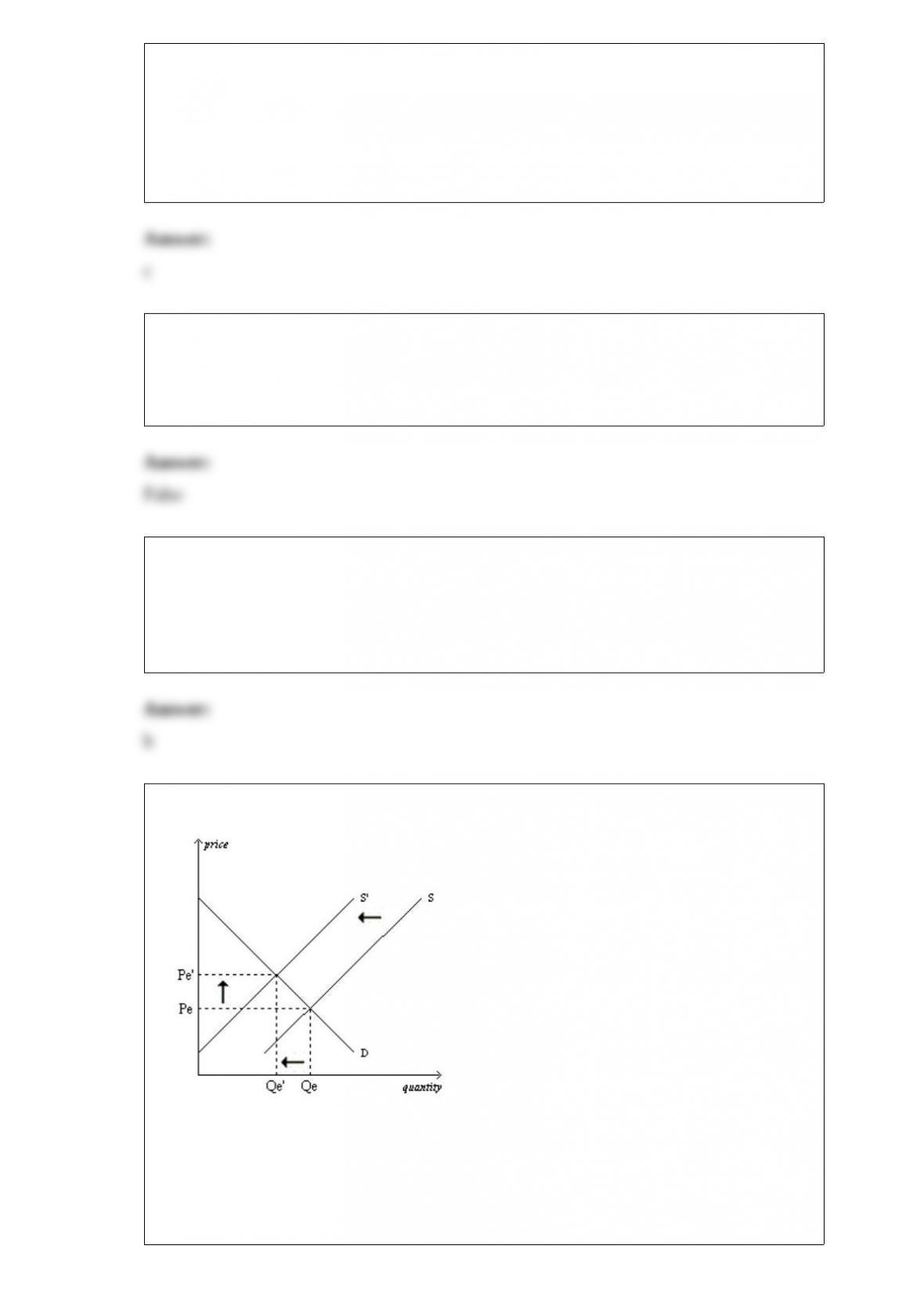
4) Panel (d)
Panel (d) shows which of the following?
a.a decrease in demand and a decrease in quantity supplied
b.a decrease in demand and a decrease in supply
c.a decrease in quantity demanded and a decrease in quantity supplied
d.a decrease in quantity demanded and a decrease in supply
5) When a tax is imposed on a good, the
a.supply curve for the good always shifts.
b.demand curve for the good always shifts.
c.amount of the good that buyers are willing to buy at each price always remains
unchanged.
d.equilibrium quantity of the good always decreases.
6) If regulators required firms in monopolistically competitive markets to set price
equal to marginal cost,
a.firms would respond by lowering their costs.
b.firms would require a subsidy to stay in business
c.new firms that enter the market would operate at efficient scale.
d.the most efficient firms would not be affected.
7) The Callaway family owns a small bait and tackle shop in a resort town in
Wisconsin. An economic recession reduces the number of tourists for one summer,
which reduces the family’s income for that year. For the Callaway family, their
a.transitory income for the year of the recession likely exceeds their permanent income.
b.permanent income likely exceeds their transitory income for the year of the recession.
c.permanent income will be more affected by the recession than their transitory income.
d.Both a and c are correct.
8) The utilitarian justification for redistributing income is based on the assumption of
diminishing marginal utility.
a.True
b.False
9) If the world price of coffee is higher than Colombia’s domestic price of coffee
without trade, then Colombia
a.should import coffee.
b.has a comparative advantage in coffee and should export coffee.
c.should produce just enough coffee to satisfy domestic demand.
d.should produce no coffee domestically.
10) Sometimes wages are set above the equilibrium level when
a.garbage collectors earn higher wages than secretaries due to compensating
differentials.
b.accountants earn more than dental technicians due to higher educational requirements.
c.movie superstars earn more than talented plumbers.
d.unions negotiate higher wages by threatening to strike.
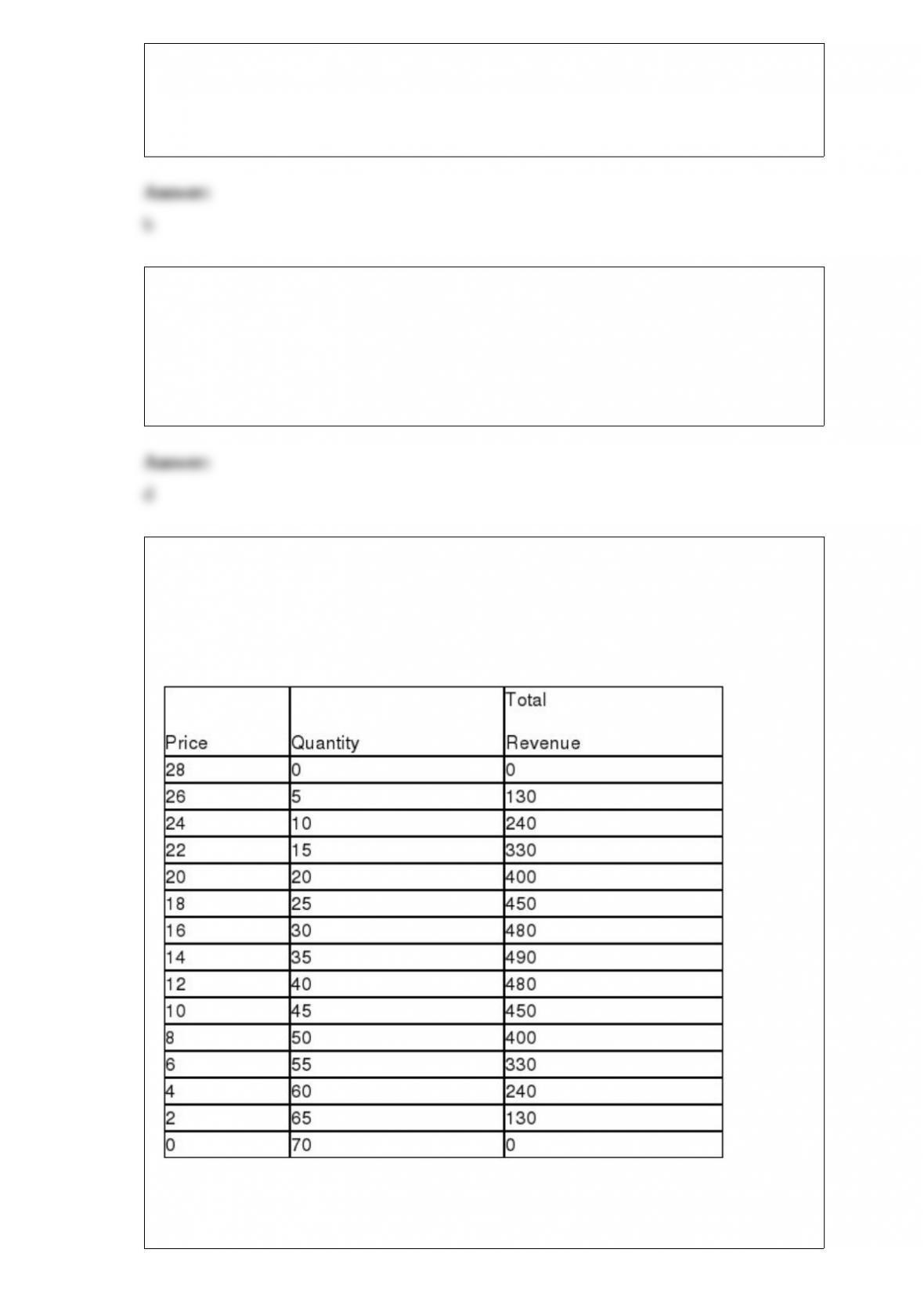
11) Table 17-11
Only two firms, ABC and XYZ, sell a particular product. The table below shows the
demand curve for their product. Each firm has the same constant marginal cost of $8
and zero fixed cost.
Refer to Table 17-11. How much less do each of these firms earn in the Nash
equilibrium than if they jointly maximize profits?
a.$5
b.$10
c.$15
d.$20
12) For a very long time the country of Zeeland has had an inflation rate of 9%.
Suddenly its inflation rate drops to 3%. The drop in the inflation rate
a.could be due to slower money supply growth. We would expect unemployment to be
higher.
b.could be due to slower money supply growth. We would expect unemployment to be
lower.
c.could be due to higher money supply growth. We would expect unemployment to be
higher.
d.could be due to higher money supply growth. We would expect unemployment to be
lower.
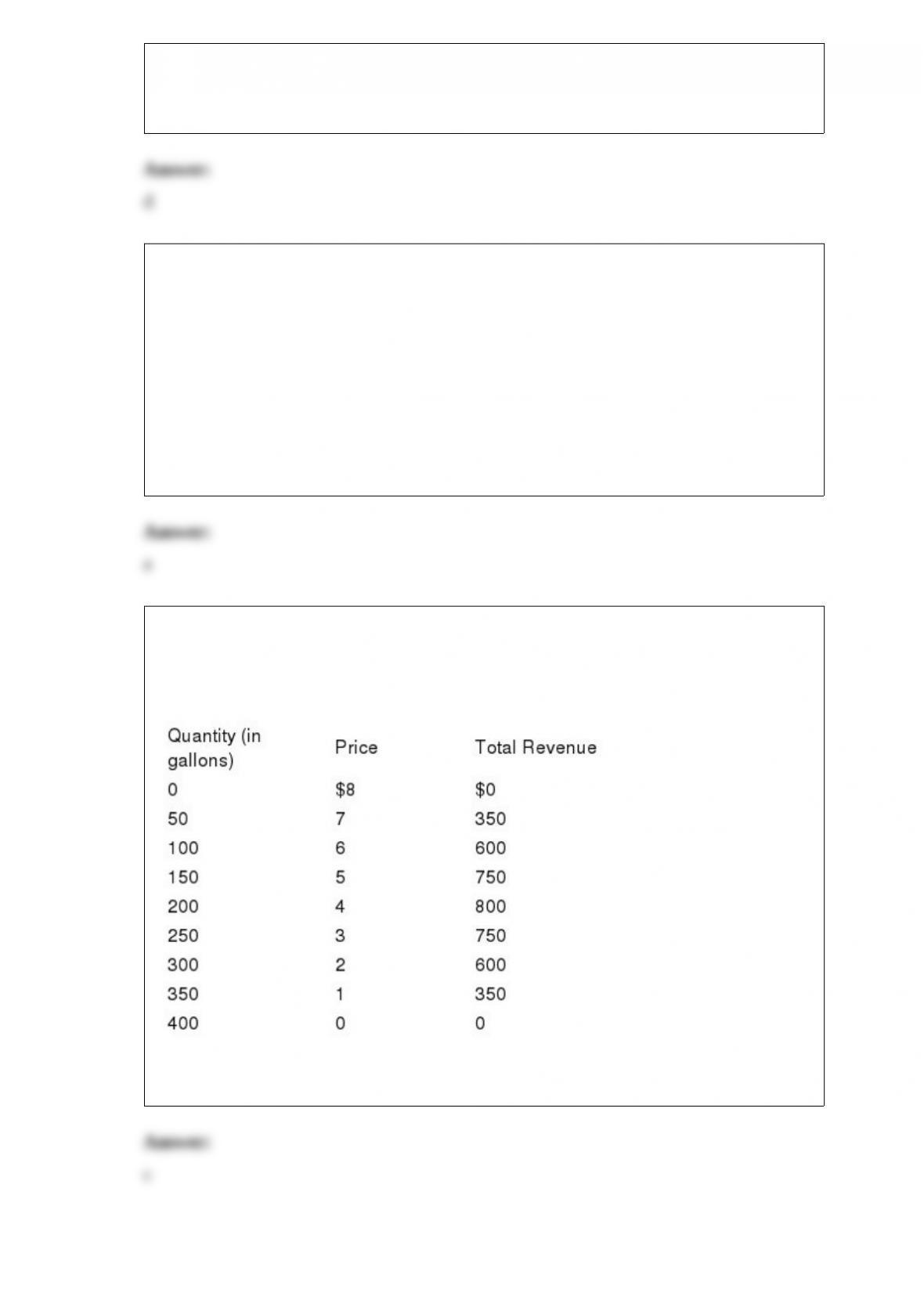
13) Table 17-12
The table shows the town of Driveaway’s demand schedule for gasoline. Assume the
town’s gasoline seller(s) incurs a cost of $2 for each gallon sold, with no fixed cost.
Refer to Table 17-12. If the market for gasoline in Driveaway is a monopoly, then the
monopolist’s maximum profit is a. $350. b. $400. c. $450. d. $500.
14) Scenario 12-1
Ken places a $20 value on a cigar, and Mark places a $17 value on it. The equilibrium
price for this brand of cigar is $15.
Suppose the government levies a tax of $1 on each cigar, and the equilibrium price of a
cigar increases to $16. What is total consumer surplus after the tax is levied?
a.$2
b.$3
c.$4
d.$5
15) Suppose a country imposes a lump-sum income tax of $5,000 on each individual in
the country. What is the marginal income tax rate for an individual who earns $40,000
during the year?
a.0%
b.10%
c.More than 10%
d.The marginal tax rate cannot be determined without knowing the entire tax schedule.
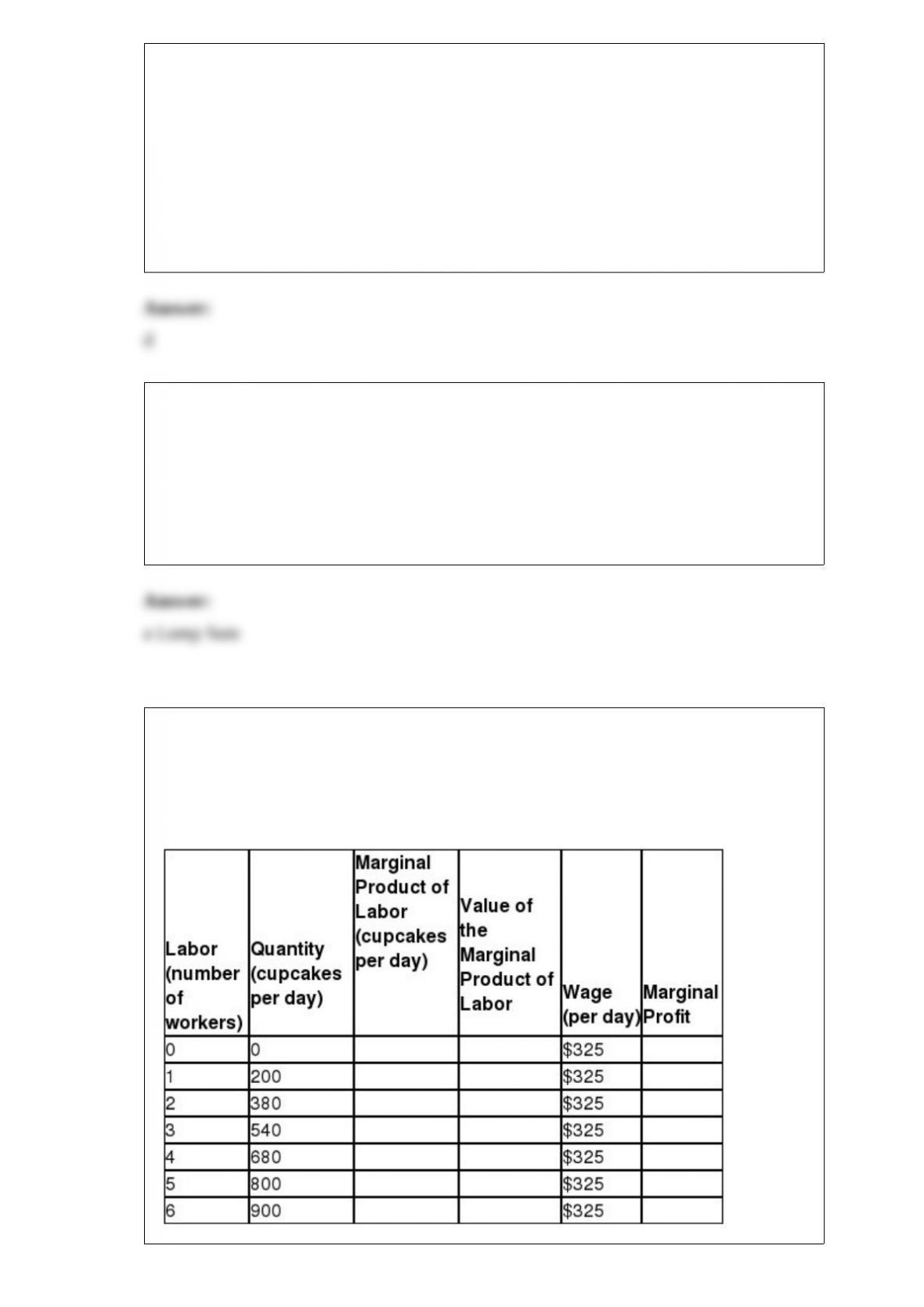
16) Table 18-11
Consider the following daily production data for MadeFromScratch, Inc.
MadeFromScratch sells cupcakes for $2 each and pays the workers a wage of $325 per
day.

Refer to Table 18-11. What is the fifth worker’s marginal product of labor?
a.120 cupcakes
b.140 cupcakes
c.160 cupcakes
d.180 cupcakes