If the demand for a product decreases and the supply of the product does not change,
equilibrium price and equilibrium quantity will both increase.
Assume that price is greater than average variable cost. If a perfectly competitive firm
is producing at an output where price is $114 and the marginal cost is $102, then the
firm is probably producing more than its profit-maximizing quantity.
The prisoner’s dilemma is used to analyze business situations in which one firm acts
first and then other firms respond.
In the market for factors of production, households earn income by supplying factors of
production to firms.
In a two-good, two country world, if one country has an absolute advantage in the
production of both goods, it can still benefit by trading with the other country.
When the Federal Reserve increases the money supply, people spend more because they
now have more money.
When the demand for a product is less elastic than the supply, consumers pay the
majority of the tax on the product.
An increase in population shifts the production possibility frontier inwards over time.

Gasoline taxes that are typically used for highway construction and maintenance are
consistent with which of the following principles of taxation?
A) the ability-to-pay principle
B) the horizontal-equity principle
C) the vertical-equity principle
D) the benefits-received principle
A monopolistically competitive firm that earns an accounting profit in the short run
A) must also earn an economic profit in the short run.
B) does not earn enough to earn an economic profit in the short run.
C) could earn an economic profit, break even or suffer an economic loss in the short
run.
D) could earn an economic profit or break even, but could not suffer an economic loss
in the short run.
Table 8-18
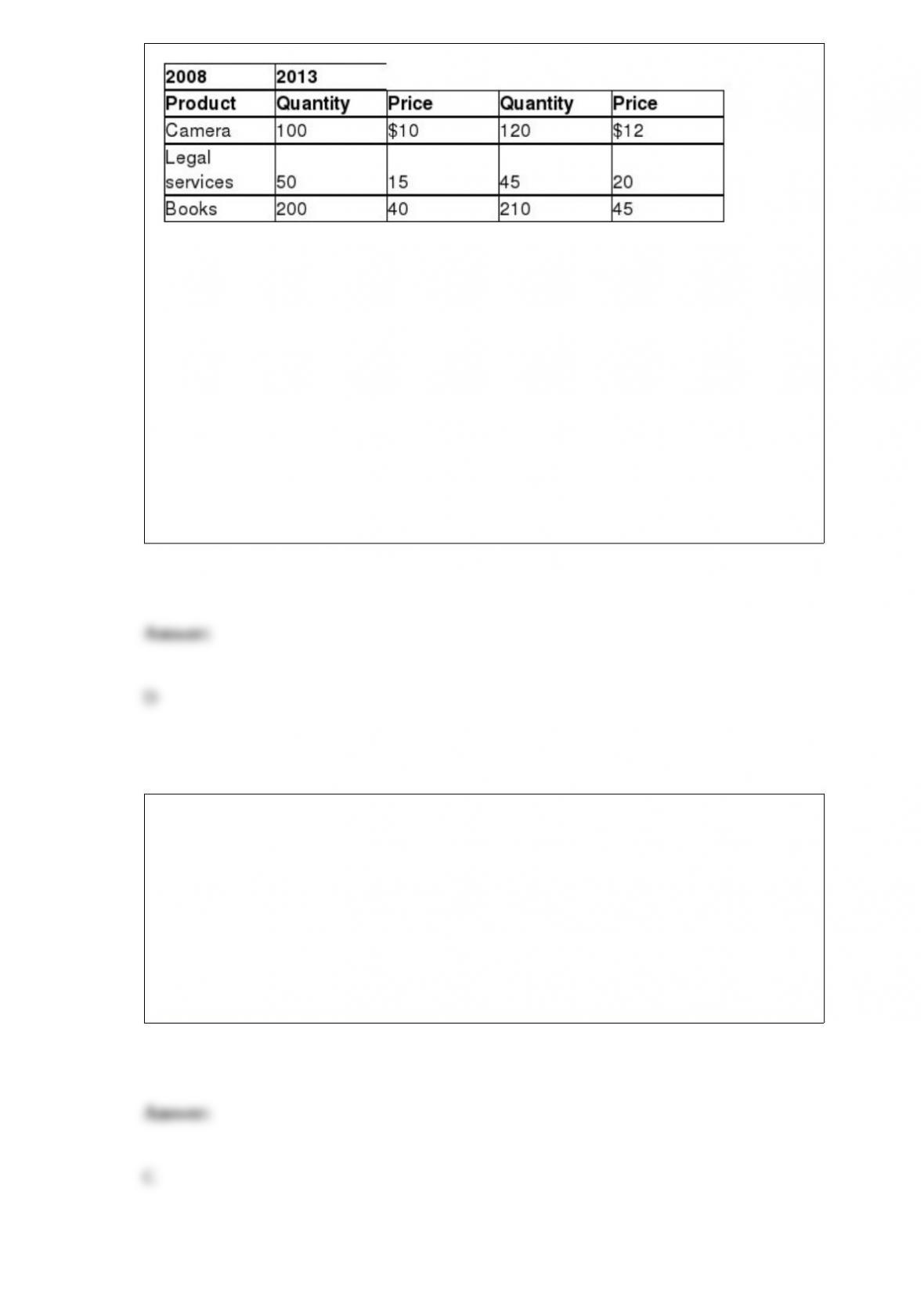
A very simple economy produces three goods: cameras, legal services, and books. The
quantities produced and their corresponding prices for 2008 and 2013 are shown in the
table above.
What is real GDP in 2013, using 2008 as the base year?
A) $28,885
B) $11,790
C) $11,200
D) $10,275
An external cost is created when you
A) graduate from college.
B) buy flowers for your mother on Mother’s Day.
C) litter on the side of the road.
D) buy a sandwich for lunch.
Determine if each of the products below displays any of the following characteristics:
(i) rivalry
(ii) nonrivalry
(iii) excludability
(iv) nonexcludability. a. a freeway during peak commute hours
b. an online college course
c. infectious disease prevention
d. open source software such as Linux
e. a movie showing at Century Theatres
When firms price their products by adding a percentage markup to their average costs
of production, this is called
A) average cost pricing.
B) rounding up.
C) break-even pricing.
D) cost-plus pricing.

Governments grant patents to
A) compensate firms for research and development costs.
B) encourage competition.
C) encourage low prices.
D) encourage firms to reveal secret production techniques.
Suppose that in a market for used cars, there are good used cars and bad used cars
(lemons). Consumers are willing to pay as much as $6,000 for a good used car but only
$1,000 for a lemon. Sellers of good used cars value their cars at $5,000 each and sellers
of lemons value their cars at $800 each. Buyers cannot tell if a used car is reliable or is
a lemon. Based on this information, what is the likely outcome in the market for used
cars?
A) Sellers of good used cars will drop out of the market.
B) Sellers of good used cars will incur losses.
C) Sellers of lemons will drop out of the market.
D) Used cars will sell for $3,000.

An unplanned increase in inventories results from
A) an increase in planned investment.
B) a decrease in planned investment.
C) actual investment that is greater than planned investment.
D) actual investment that is less than planned investment.
If a country sets a pegged exchange rate that is above the equilibrium exchange rate,
how can the country maintain the peg?
A) by purchasing surplus domestic currency at the pegged rate
B) by selling surplus domestic currency at the pegged rate
C) by purchasing surplus domestic currency at the equilibrium exchange rate
D) by increasing the pegged exchange rate
On the 45-degree line diagram, the 45-degree line shows points where
A) real income equals real GDP.
B) real aggregate expenditure equals C + I.
C) real aggregate expenditure equals real GDP.
D) real aggregate output equals the quantity produced.
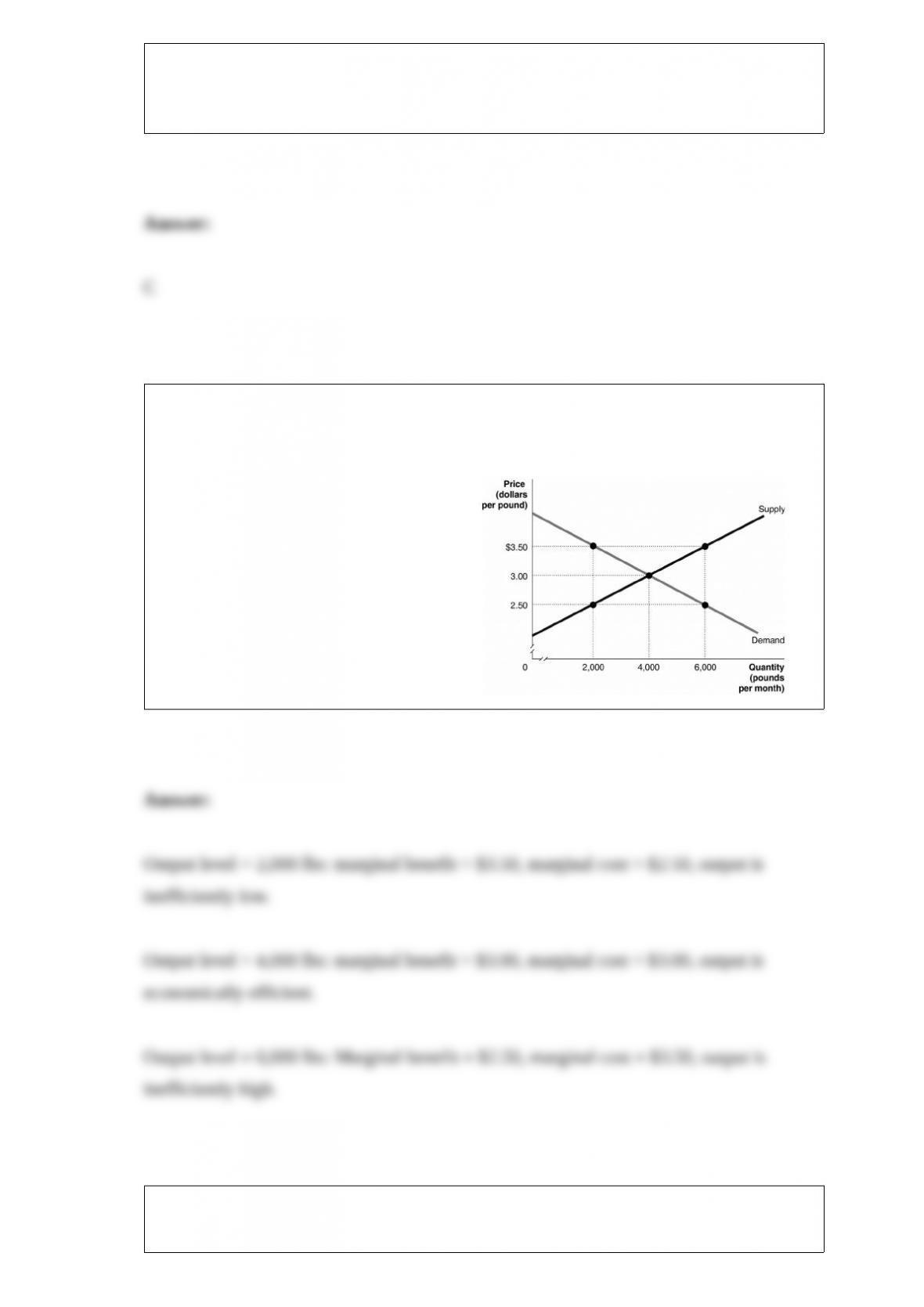
The graph below represents the market for walnuts. Identify the values of the marginal
benefit and the marginal cost at the output levels of 2,000 pounds, 4,000 pounds and
6,000 pounds. At each of these output levels, state whether output is inefficiently high,
inefficiently low, or economically efficient.
Companies often find it to be more profitable to use a commission or piece-rate system
of compensation rather than a salary system, yet many firms continue to pay their
workers salaries. List three reasons why a firm would choose a salary system of
compensation.
How would the unemployment rate and the labor force participation rate change if
discouraged workers were counted as unemployed rather than counted as out of the
labor force? Show using the formula for both measurements.
Former Alabama Governor George Wallace ran for president several times, once as a
third-party candidate in 1968. Wallace claimed there was “not a dime’s worth of
difference” between the Democratic and Republican parties during one of his
campaigns. How does Wallace’s comment relate to the median voter theorem?
If you own a bond with a 3 percent coupon rate and new bonds are paying 8 percent,
what will happen to your bond’s market price?
Explain whether it is possible for a country to have a comparative advantage in the
production of a product without having an absolute advantage in the production of that
product.
What type of business has the potential for double taxation of profits and why?
How does a decrease in the tax rate on income earned on saving affect saving,
investment, the interest rate, and economic growth?

Identify two ways by which the government controls monopolies?