
A firm will undertake an investment if the present value of the
A) income stream associated with the investment is greater than the full cost of the
investment project.
B) income stream associated with the investment is less than the full cost of the
investment project.
C) income stream associated with the investment is positive.
D) costs of the investment project exceed the present value of the returns from the
investment project.
An example of a(n) ________ comparative advantage is U.S. consumers buying
automobiles produced in Japan because Japanese companies have a reputation for
producing a higher-quality automobile than those produced in the United States.
A) unwarranted
B) acquired
C) natural
D) subsidized
Which of the following is an example of a normative question?
A) How will an increase in the price of diesel fuel affect truck drivers?
B) What fraction of an income-tax rebate check will be spent on consumer goods?
C) Should the government provide free prescription drugs to lower-income citizens?
D) How will an increase in the minimum wage affect migrant workers?
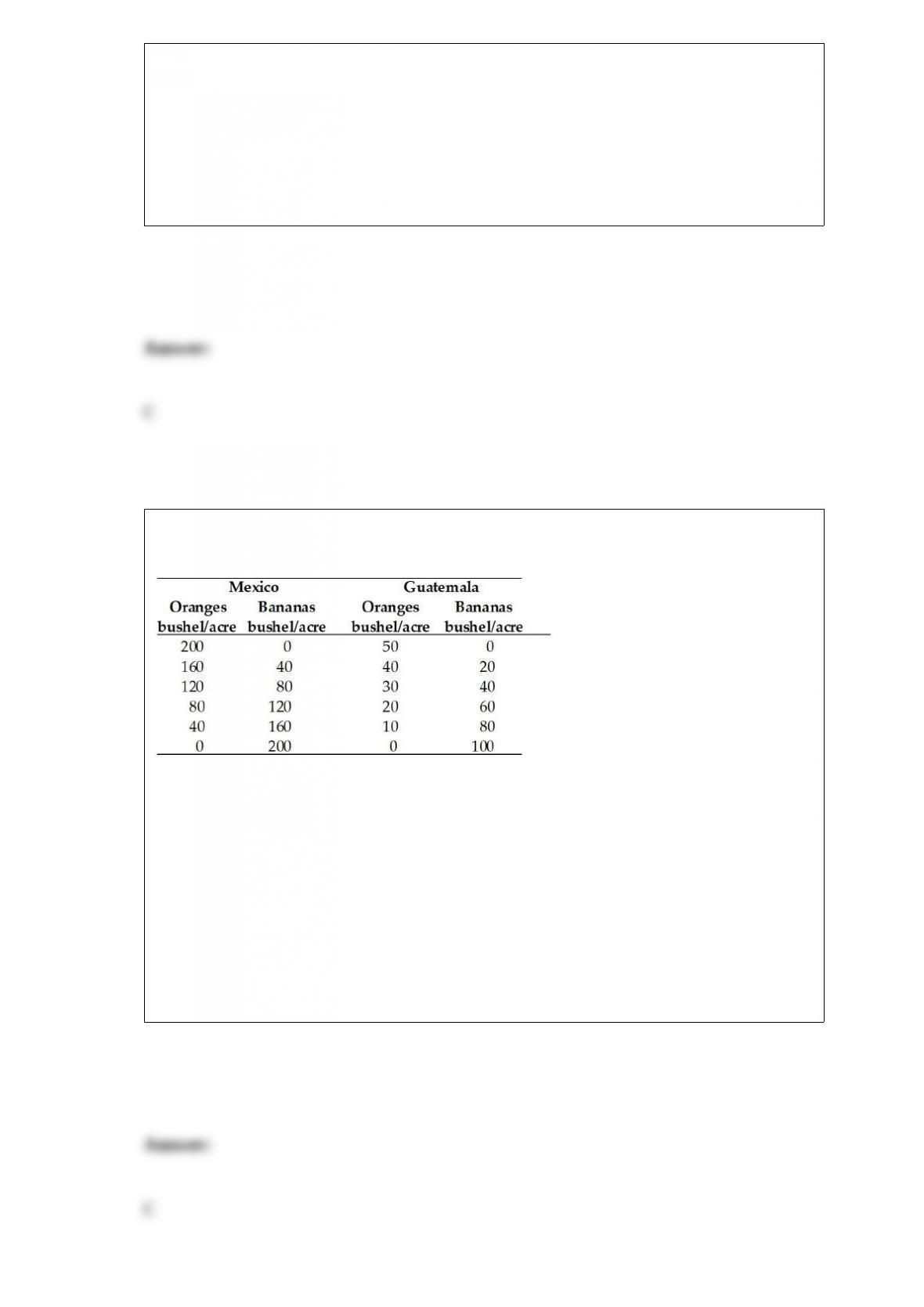
Table 20.1
Refer to Table 20.1. Guatemala should specialize in and export ________, and Mexico
should specialize in and export ________.
A) oranges; oranges
B) bananas; bananas
C) bananas; oranges
D) oranges; bananas

You spend $300 every month to keep your lawn and garden maintained. Your neighbor
has told you that she derives $50 a month in enjoyment from being able to look at your
beautiful yard. Which of the following is true?
A) You are spending too much on your yard, because your neighbor derives only $50
worth of benefits.
B) You should refuse to spend anything on your yard unless your neighbor pays you
$50 a month.
C) If you took into consideration the benefits your neighbor derived, the efficient level
of lawn maintenance would be greater than $300 a month.
D) If you took into consideration the benefits your neighbor derived, the efficient level
of lawn maintenance would be less than $300 a month.
If Argentina has an absolute advantage in the production of beef and Guatemala has an
absolute advantage in the production of bananas, then
A) it is reasonable to expect that specialization and trade will benefit both countries.
B) it is reasonable to expect that specialization will benefit both countries, but trade will
not.
C) neither country has anything to gain from specialization and trade.
D) it is reasonable to expect that trade will benefit both countries, but specialization will
not.
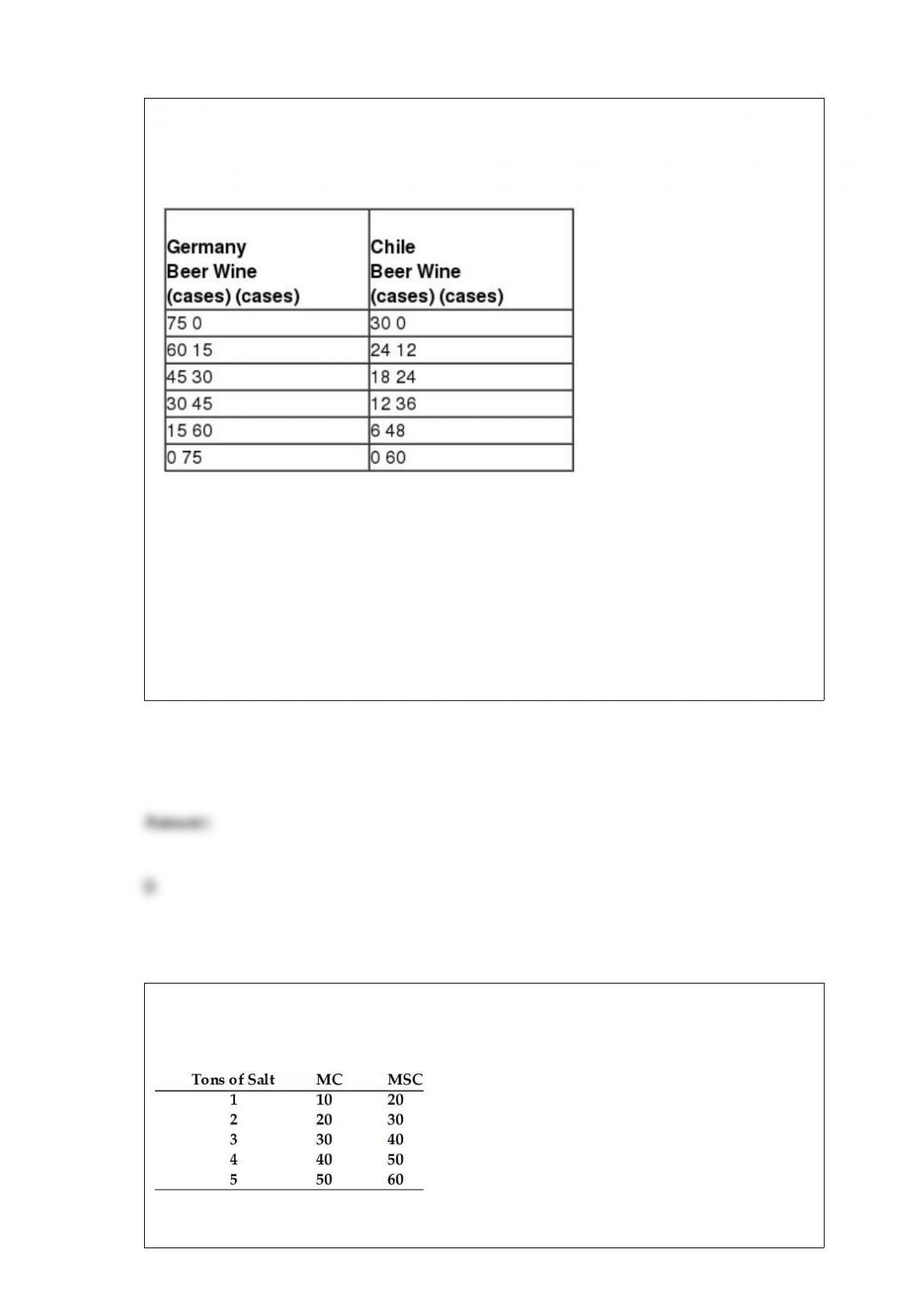
Table 20.1
Refer to Table 20.1. The opportunity cost of producing a case of beer in Germany is
A) twice as much as that in Chile.
B) half as much as that in Chile.
C) the same as that in Chile.
D) four times as much as that in Chile.
Table 16.1
Refer to Table 16.1. This salt processing firm is perfectly competitive and is forced to

take damage costs into account. If the market price of the product is $30, the firm will
produce
A) 0 tons of salt.
B) 2 tons of salt.
C) 3 tons of salt.
D) 4 tons of salt.
Corn is produced in a perfectly competitive market. The demand for ethanol increases.
This will cause the individual corn farmer’s marginal revenue to ________ and their
profit maximizing level of output to ________.
A) increase; increase
B) increase; decrease
C) decrease; increase
D) decrease; decrease
Related to the Economics in Practice on page 109: Harriet runs a corner delicatessen
and one day decides to raise her prices by 20 percent. Total revenue is likely to
________ at the end of the first month of the higher prices since demand is relatively
________ in the long term.

A) rise; inelastic
B) fall; inelastic
C) rise; elastic
D) fall; elastic
Employees with less experience tend to earn less than employees with more experience,
because
A) experience is a compensating differential.
B) experience on the job increases an employee’s human capital.
C) it is only fair that a more-experienced employee be paid more than a
less-experienced employee.
D) the government requires that more-experienced employees be paid more than
less-experienced employees.
A progressive income tax means that those with a higher income pay ________.
A) a lower percentage of their income in taxes than low-income people
B) a higher percentage of their income in taxes than low-income people
C) the same percentage of their income in taxes as low-income people
D) all the taxes in the economy
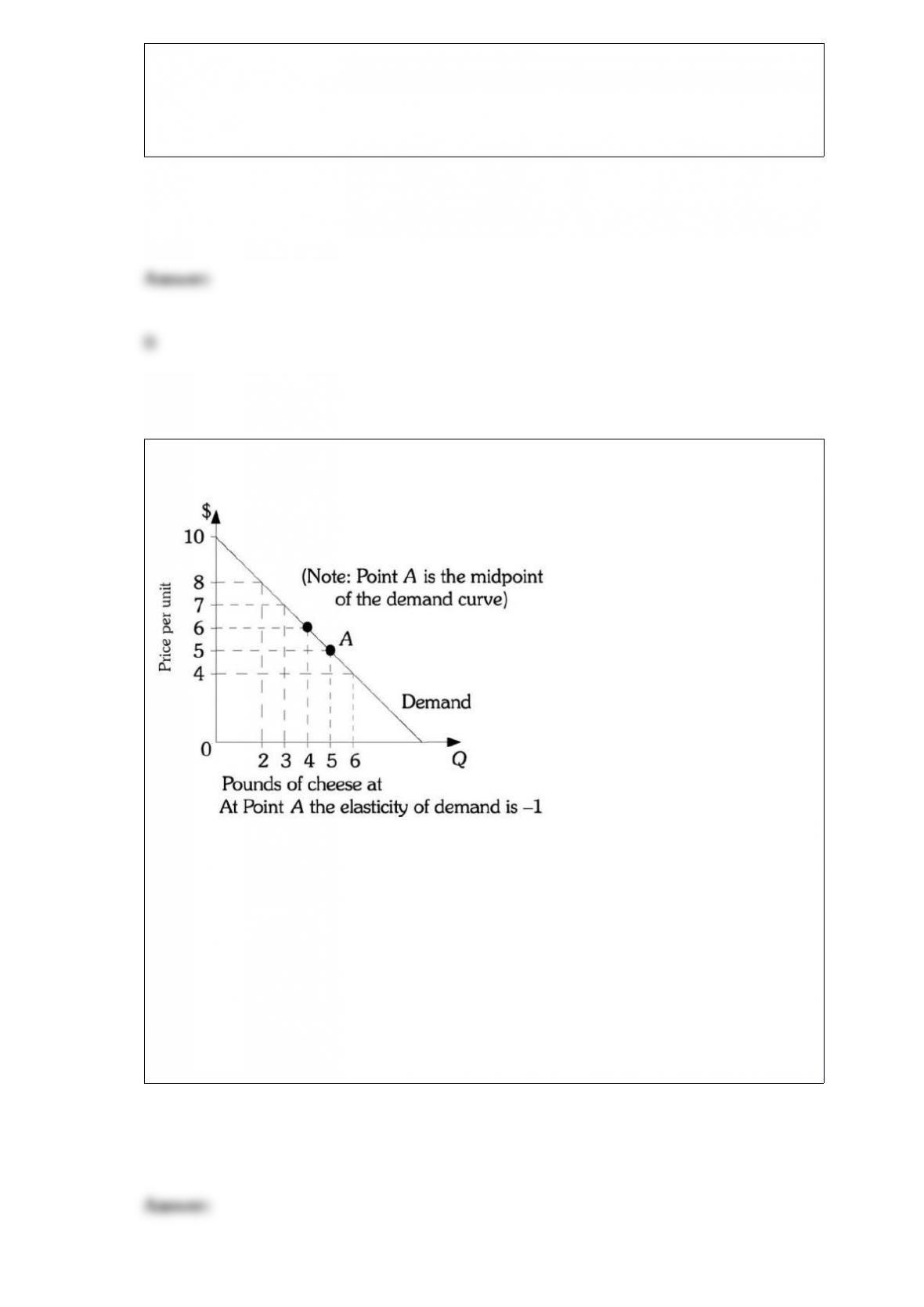
Figure 13.3
Refer to Figure 13.3. The marginal revenue of the fifth pound of cheese is
A) $1.
B) $3.
C) $6.
D) $24.

If the marginal cost of producing a public good is greater than society’s total willingness
to pay per unit, then
A) the optimal amount of the public good is being produced.
B) less than the optimal amount of the public good is being produced.
C) more than the optimal amount of the public good is being produced.
D) the amount of output being produced could be either greater than or less than the
optimal amount.
Import substitution is the process of developing local industries to manufacture goods
to
A) replace imports.
B) import.
C) replace exports.
D) export.

An deterioration in technology will cause a marginal revenue product of labor curve to
A) be unaffected because the productivity of labor has not changed.
B) shift to the left.
C) shift to the right
D) become more elastic.
When the government pays for childhood vaccinations, it is
A) internalizing an external cost.
B) using taxes to discourage an external cost.
C) subsidizing an external benefit.
D) using direct regulation to discourage an external cost.
Mike is a college student who works part time and earns $100 per week. He spends his
entire income on two goods: pepperoni pizzas and bottles of soda. The price of a
pepperoni pizza is $10 and the price of a bottle of soda is $2. Draw Mike’s budget
constraint.
The immediate and total deregulation of prices, liberalization of trade, privatization,
and development of financial institutions represent
A) the gradualism transition approach from socialism to a market economy.
B) a cooperative socialist model.
C) the shock therapy transition approach from socialism to a market economy.
D) an authoritarian socialist model.
There are outputs for which ________ costs exceed ________ costs in the short run.

A) total fixed; total
B) average variable; average total
C) total variable; total
D) average total; average variable
Michael Dell was the first individual who sold computers by mail order. The company
founded by Dell is now one of the largest and most successful computer companies in
the United States. Michael Dell would be classified as a(n)
A) entrepreneur.
B) opportunist.
C) monopolist.
D) socialist.
Upon graduation, Ellie had two job offers. The jobs were identical in every way with
two exceptions. One job was located in San Diego, CA and offered an annual salary of
$50,000. The other job was located in Omaha, NE and offered an annual salary of
$60,000. The salary difference is due to
A) compensating differentials.

B) discrimination.
C) transfer payments.
D) the firm in California had a higher demand for workers than the firm in Nebraska.
Because people can enjoy the benefits of public goods whether they pay for them or
not, they are usually unwilling to pay for them. This is known as the
A) drop-in-the-bucket problem.
B) nonexcludable problem.
C) nonrival problem.
D) free-rider problem.
You have noticed that there is an increase in the number of homeless people in your city
and at the same time you observe that there are a number of vacant apartments. You
believe that if landlords were required to rent their apartments for less than they are
currently charging, the government could reduce the number of homeless people. This
policy recommendation would be motivated by concerns over
A) economic growth.
B) stability.

C) profitability.
D) equity.
You read that 40 firms that grow and export strawberries to the United States decide to
form a cartel. The cartel aims to raise the price of strawberries and reduce output to
increase profits for the strawberry growers. You predict that this cartel will probably
A) not be successful because the number of firms is unmanageable and there are a
number of good substitutes for strawberries.
B) not be successful because there are too few firms that are trying to organize the
cartel.
C) be successful because the demand for strawberries is very elastic.
D) be successful because it will be very easy to enforce the rules among only 40 firms.
A firm is currently producing in the elastic portion of its demand curve. What course of
action do you recommend for it assuming it wants to raise revenue?
A) Continue producing at the current output level, because it maximizes its total
revenue by producing in the elastic portion of its demand curve.
B) Reduce price, because if it reduces price and demand is elastic, total revenue will
increase.

C) Increase price, because if it increases price and demand is elastic, total revenue will
increase.
D) Continue selling at the same price, but increase the amount it produces.
The government imposes a maximum price on apartments that is BELOW the
equilibrium price. You accurately predict that
A) the law will have no economic impact.
B) the law will create a surplus of apartments.
C) renters will find that landlords start offering to furnish the apartments.
D) landlords are less likely to do routine maintenance work in the apartments.
According to the law of demand, as prices rise, ceteris paribus
A) demand increases.
B) demand decreases.
C) quantity demanded decreases.
D) quantity demanded increases.

You are in the market for a used 2010 Toyota Corolla. You know that half of the 2010
Corollas are lemons and half are peaches. If you could be assured that the Corolla you
were buying was a peach, you would be willing to pay up to $12,000. On the other
hand, you would only be willing to pay $4,000 for a lemon. You have no ability to
discern whether any particular Corolla is a lemon or a peach. Sellers of Corollas, on the
other hand, are likely to know whether their particular car is a lemon or a peach.
Suppose sellers of lemons will sell their cars for $3,000 or more and peach sellers will
be willing to sell their cars for $9,000 or more. Over time the price in the market for
2010 Corollas will
A) be between $9,000 and $12,000 for peaches and between $3,000 and $4,000 for
lemons and both lemons and peaches will be traded.
B) be between $9,000 and $12,000 and only peaches will be traded.
C) be between $3,000 and $4,000 for lemons and only lemons will be traded.
D) be between $3,000 and $12,000 and both lemons and peaches will be traded.
Table 16.4 shows the situation facing two firms, both of which are polluting. Assume
that each firm emits 5 units of pollution.
Table 16.4
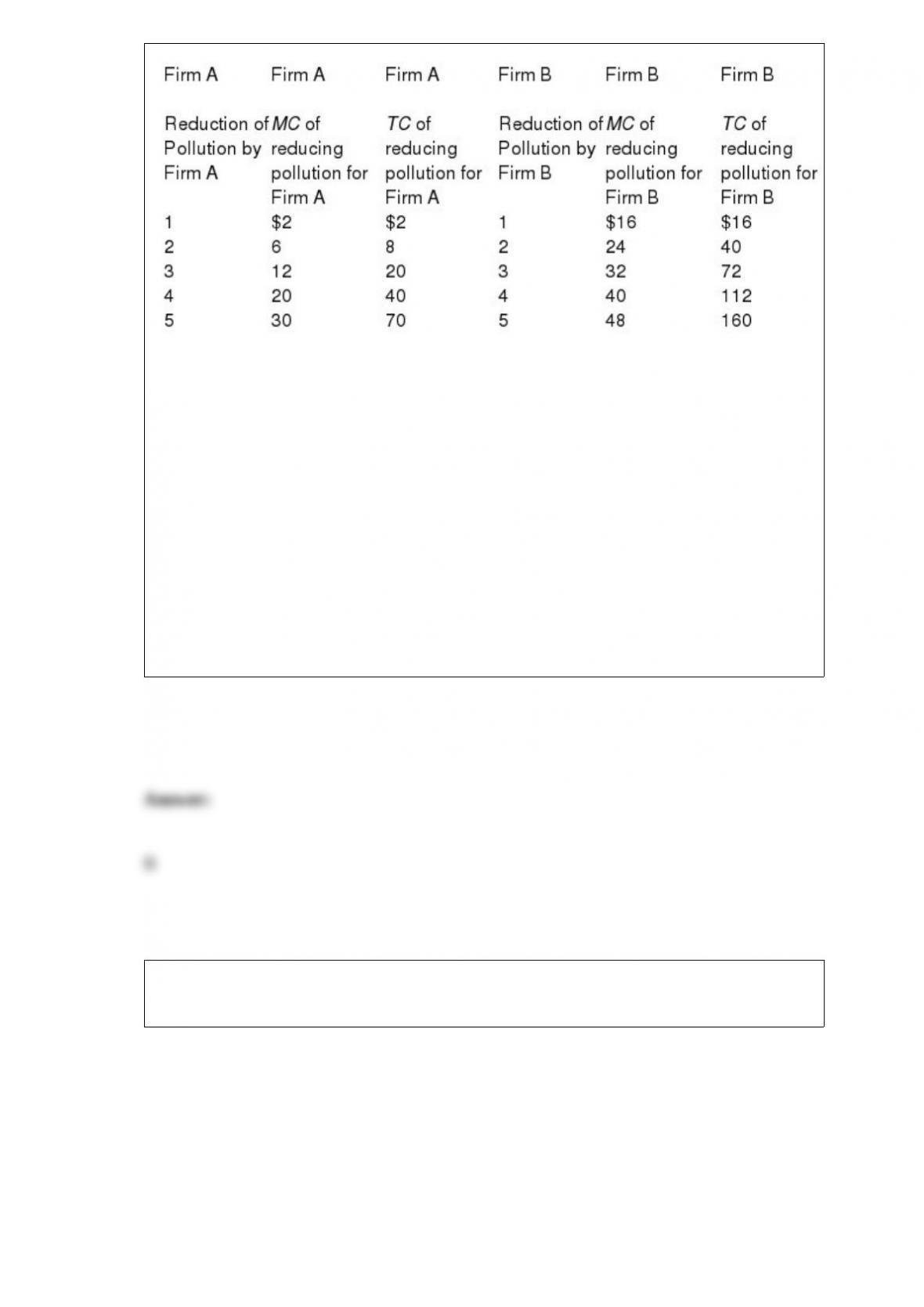
Refer to Table 16.4. Suppose the government wants to reduce the total amount of
pollution from the current level of 10 to 4. To do this, the government caps each firm’s
emissions at 2 units and issues 2 permits to each firm. If firms are allowed to trade
permits and all possible trades are made, Firm B will reduce its pollution by a total of
________ unit(s).
A) 0
B) 1
C) 2
D) 3
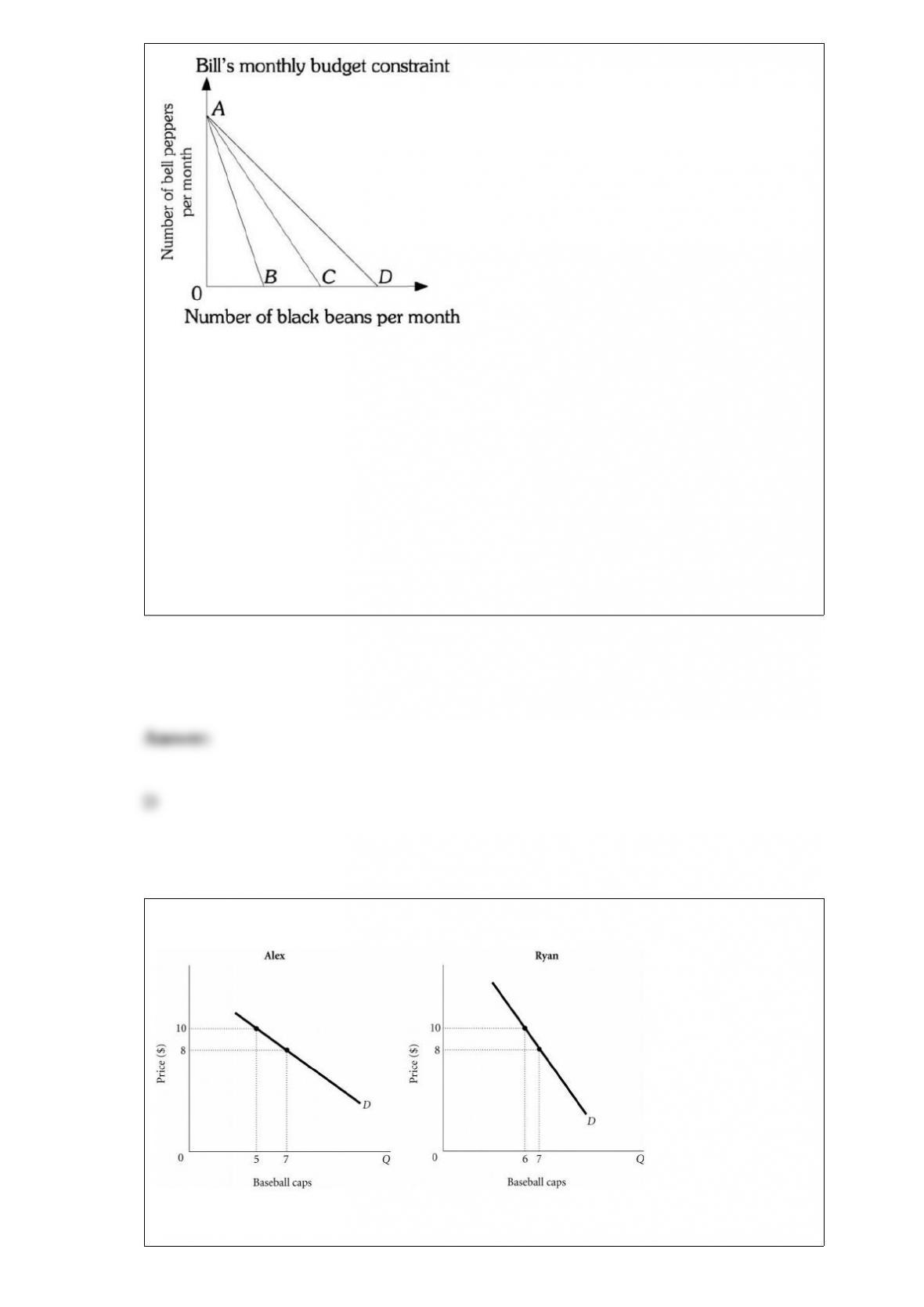
Figure 6.4
Refer to Figure 6.4. Bill’s budget constraint is AC. If the black bean price decreases,
Bill’s budget constraint will be
A) AO.
B) AB.
C) AC.
D) AD.
Figure 3.8

Refer to Figure 3.8. Assume that there are only two people in the market for baseball
caps: Alex and Ryan. Along the ________ for baseball caps, at a price of $10, quantity
demanded would be 11.
A) demand curve for Alex
B) demand curve for Ryan
C) market demand curve
D) none of the above
Assets minus liabilities equals
A) net worth.
B) wealth.
C) depreciation.
D) Both A and B are correct.
Explain dumping.
List three key reasons to study economics.
“The recent availability of satellite television has reduced the price of cable television
subscriptions.” Based on this statement, what may be concluded about price,
cross-price, or income elasticity of demand?
Table 8.4
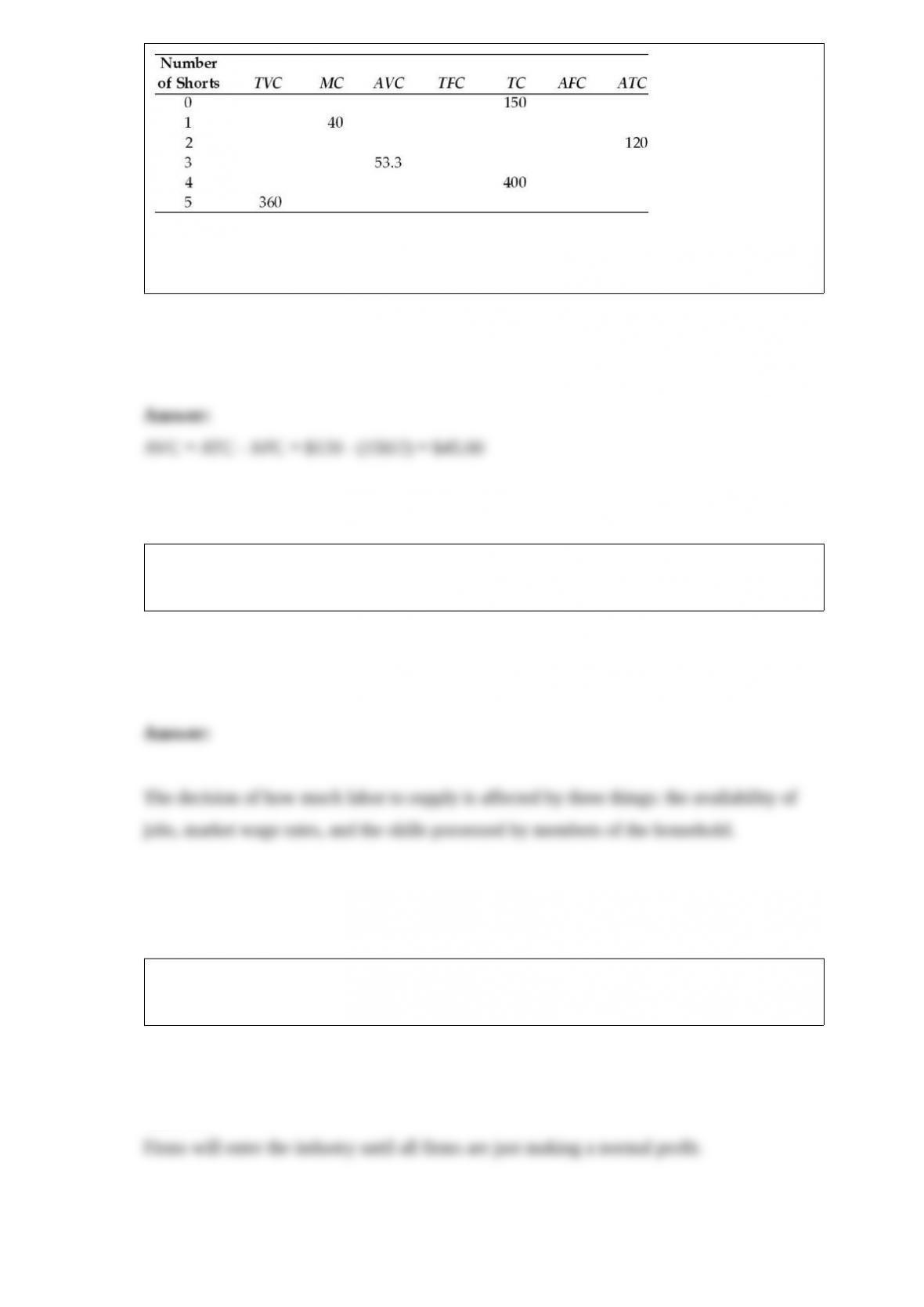
Refer to Table 8.4. If Scott produces two pairs of shorts, what are his average variable
costs?
Identify three things which affect the choices households make with respect to how
much labor to supply?
If there are short-run profits in a competitive industry, will firms enter or exit over the
long run? At what point will the final equilibrium be achieved?
Referring to Situation #1 suppose that you decide that you have to fire the first and the
third executive without hiring any replacements. What would be the opportunity cost of
the second executive’s work? Explain why your answer is not the same as in the
question above.
What are some of the problems that exist with a laissez-faire economy?
The lottery this evening is worth $50 million dollars in your state. There are two people
in your neighborhood that are buying lottery tickets. One is a student with little
financial knowledge or business acumen. The other is a successful entrepreneur that is
earning 20% rate of return on his business. Which of these people is likely to check off
the “cash” option on the ticket and which is likely to choose the structured payout and
why?
Scenario 1. Suppose your instructor informs the class that the highest grade on each of
his multiple-choice exams will automatically receive a 100. All other grades below this
will be based on this high grade. For example if the highest grade is an 80 this would
receive an automatic 100. If someone scores a 40 then the grade earned would be a 50
[(40 80) * 100%)]. To the instructors surprise all the students earned a 100 on the first
exam even though their grades were all an identical 25%. How could this have
happened?
Using the scenario above explain how this could have happened?
What does it mean for two inputs to be complements? Give an example that describes
how
labor and capital can be complementary inputs.
What is the relationship between marginal product and average product?
What is the Federal Trade Commission?
Comment on the following statement: “For a monopolist, marginal revenue is always
equal to price.”

Suppose that you buy Internet service from Friendly ISP Corporation. You are charged a
monthly fee of $3.50 and must also pay an hourly charge of $1.00 for every hour you
use the Internet. Draw a diagram of the relationship between your monthly bill from
Friendly ISP and the number of hours you use the Internet. What is the slope of the line
drawn?
What is a risk premium?