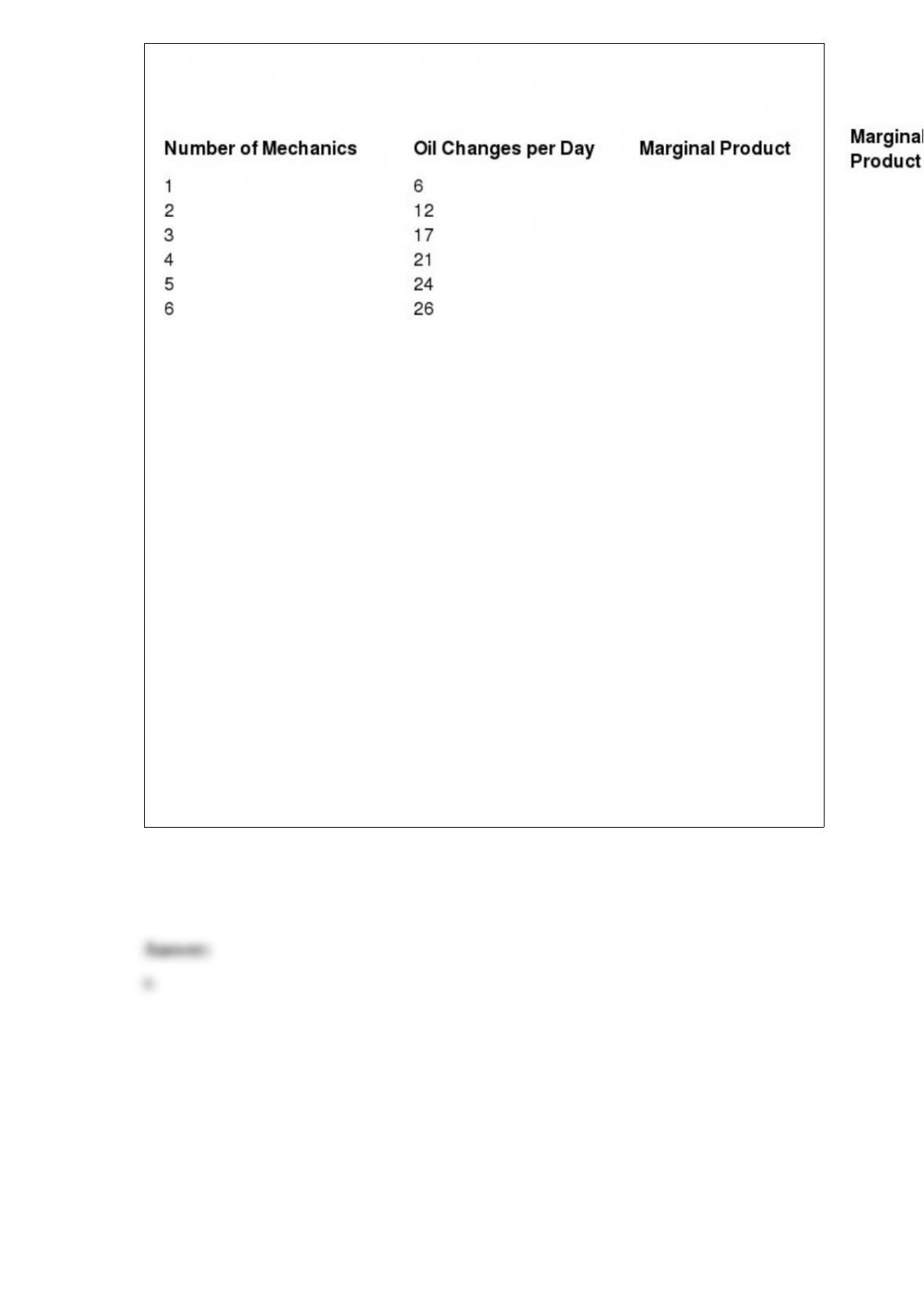
Table 17-5
Refer to Table 17-5. Oil Can Harry’s, a new automobile service shop, is ready to start
hiring. The table above shows the relationship between the number of mechanics the
firm hires and the quantity of oil changes it produces.
a. Suppose the price of an oil change is $20. Complete the table by filling in the values
for marginal product and marginal revenue product.
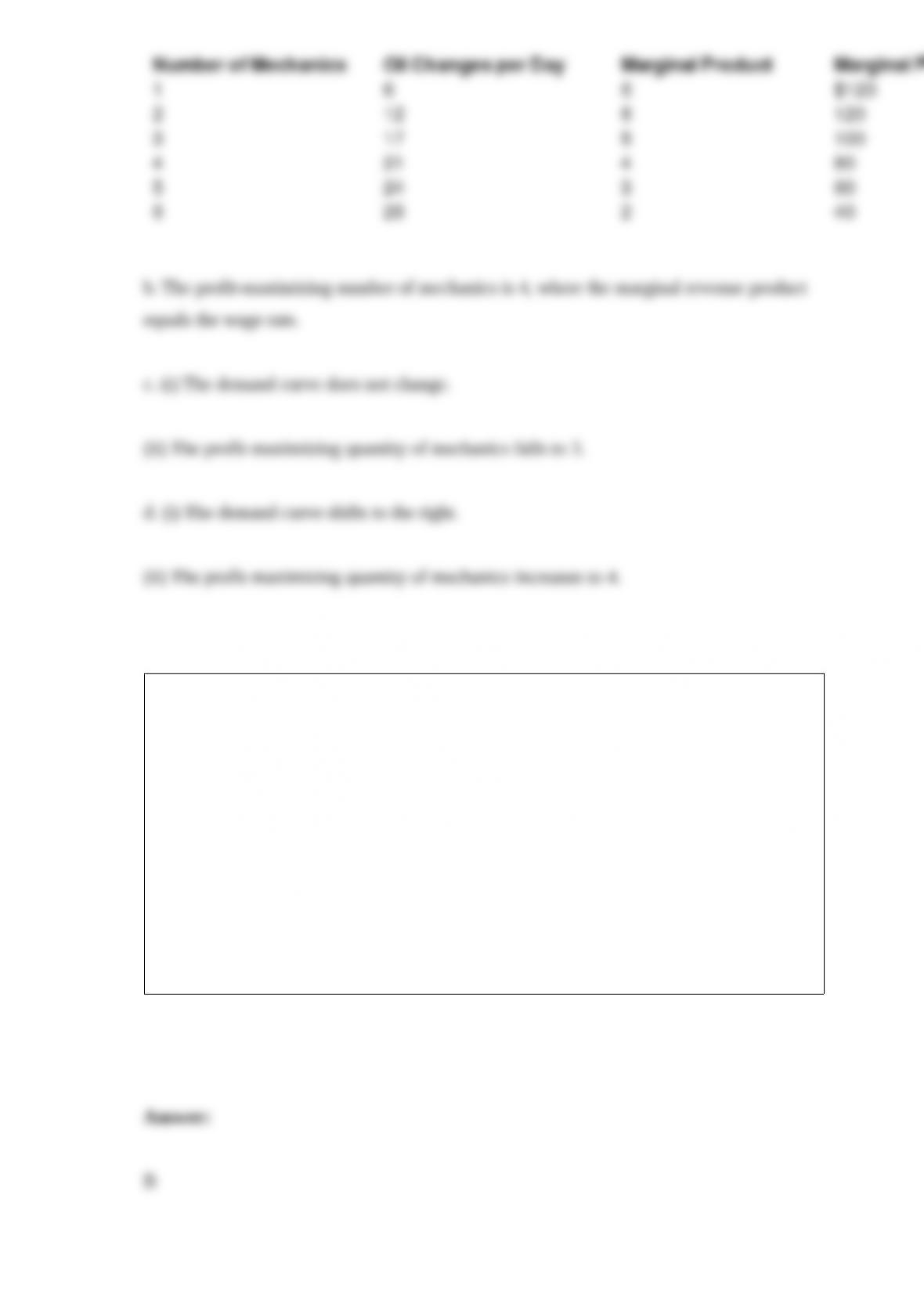
b. Oil Can Harry’s is an input price-taker. Suppose the wage paid to mechanics is $80
per day. What is the profit-maximizing number of mechanics?
c. Suppose the wage rate rises to $100 per day.
(i) What happens to the firm’s demand curve for mechanics?
(ii) What happens to the profit-maximizing quantity of mechanics?
d. Suppose the wage rate is $60 per day and the price of haircuts is now $15.
(i) What happens to the firm’s demand curve for mechanics?
(ii) What happens to the profit-maximizing quantity of mechanics?
Assume there is a shortage in the market for digital music players. Which of the
following statements correctly describes this situation?
A) The demand for digital music players is greater than the supply of digital music
players.
B) Some consumers will be unable to obtain digital music players at the market price
and will have an incentive to offer to buy the product at a higher price.
C) The price of digital music players will rise in response to the shortage; as the price
rises the quantity demanded will increase and the quantity supplied will decrease.
D) the shortage will cause an increase in the equilibrium price of digital music players.
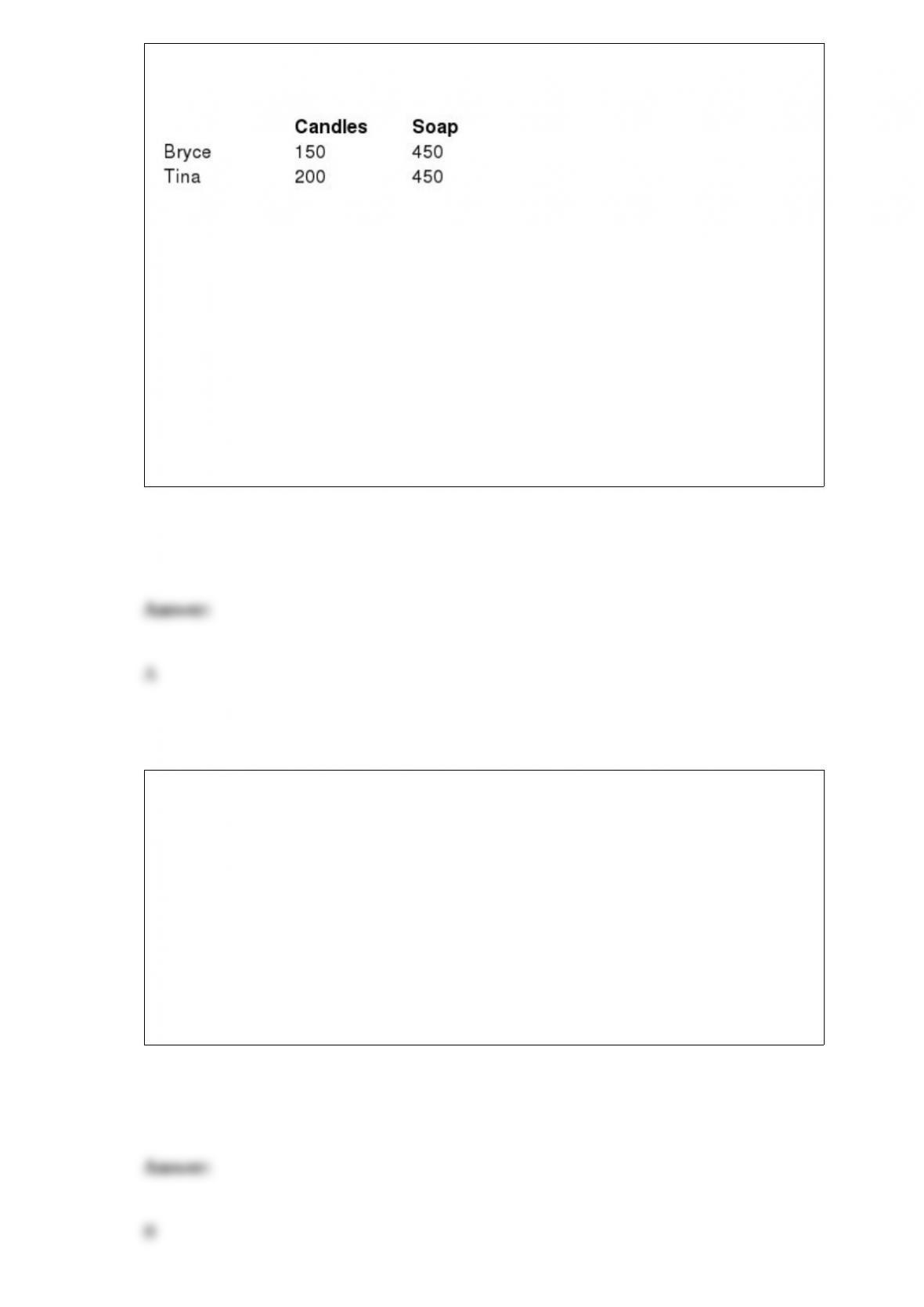
Table 9-3
Bryce and Tina are artisans who produce homemade candles and soap. Table 9-3 lists
the number of candles and bars of soap Bryce and Tina can each produce in one month.
Refer to Table 9-3. Select the statement that accurately interprets the data in the table.
A) Tina has a comparative advantage in making candles.
B) Bryce has an absolute advantage in making soap.
C) Bryce has a comparative advantage in making candles.
D) Bryce has a comparative advantage in making candles and making soap.
If the marginal cost of keeping a doctor’s office open one additional hour per day is
$200, then the doctor should keep the office open for one extra hour
A) only if the marginal benefit she receives is greater than $200 plus an acceptable
profit margin.
B) as long as the marginal benefit she receives is just equal to or greater than $200.
C) as long as the marginal cost does not rise.
D) until the marginal benefit she receives reaches zero.
How are sunk costs and fixed costs related?
A) They are not related in any way.
B) Sunk costs cannot be recovered and fixed costs can be avoided by shutting down.
C) In the short run they are equal to each other.
D) In the long run they are equal to each other.
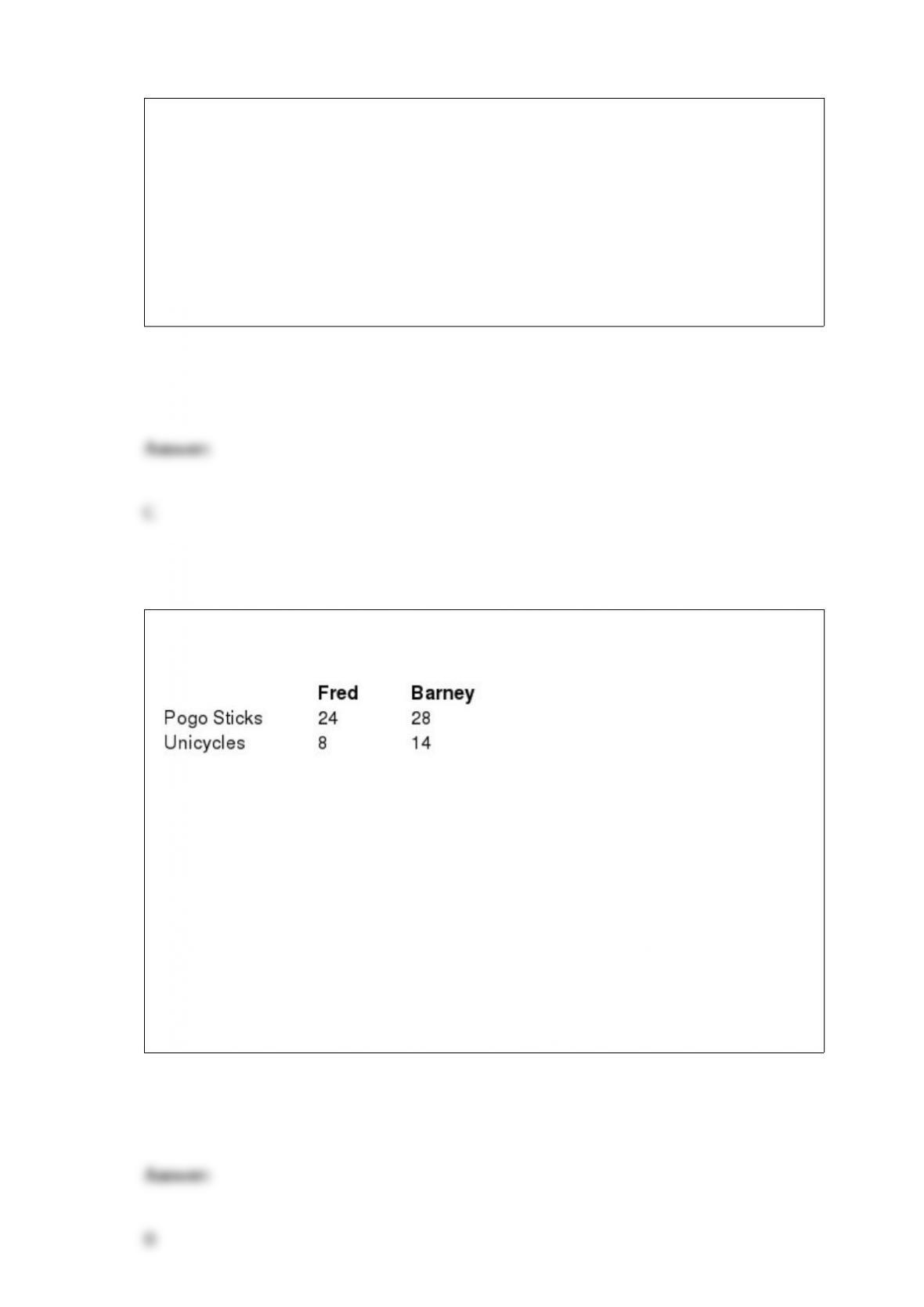
Table 2-7
Table 2-7 shows the output per month of two people, Fred and Barney. They can either
devote their time to making pogo sticks or making unicycles.
Refer to Table 2-7. What is Fred’s opportunity cost of making a unicycle?
A) 1/3 pogo stick
B) 3 pogo sticks
C) 1/2 unicycle
D) 1.3 pogo sticks
Assume that firms in a perfectly competitive market are earning economic profits.
Which of the following statements describes the change in market price and output as a
result of the entry of new firms into this market?
A) The market demand curve shifts to the right, causing price to rise and market output
to increase.
B) The market demand curve shifts to the left, causing price to fall and market output to
decrease.
C) The short-run market supply curve shifts to the right, causing price to fall and total
market output to increase.
D) The short-run market supply curve shifts to the left, causing price to rise and total
market output to decrease.
Table 2-2
Production choices for Billie’s Bedroom Shop
Refer to Table 2-2. Assume Billie’s Bedroom Shop only produces pillows and blankets.
Billie faces ________ opportunity costs in the production of pillows and blankets.
A) increasing
B) constant
C) decreasing
D) negative

If Joey Kobayashi experiences diminishing marginal utility from eating hot dogs then
A) his total utility from eating hot dogs is negative.
B) the marginal utility from the next hot dog Joey eats will be negative.
C) the additional satisfaction he receives from eating another hot dog will be less then
the satisfaction he received from his eating his last hot dog.
D) Joey is maximizing the marginal utility per dollar he receives from eating hot dogs.
How does the owner of a sole proprietorship relate to the business?
A) The owner and the business are separate legal entities.
B) The owner and the business are not separate legal entities.
C) The assets of the owner are considered separate from the asset of the business.
D) None of these describe the legal relationship of the owner to the business.

Under autarky, domestic producer surplus is represented by the area
A) above the supply curve and below the equilibrium price.
B) above the supply curve and below the demand curve.
C) below the demand curve and above the equilibrium price.
D) above the demand curve and below the supply curve.
Long-run economic profits would most likely exist in which market structure?
A) monopoly, monopolistic competition and oligopoly
B) monopoly and oligopoly
C) monopoly and monopolistic competition
D) monopoly only
In the real world
A) all sellers charge one price equal to the marginal cost of production.
B) profitable sellers will set one price based on the average elasticity of demand of

buyers.
C) many firms charge different prices based on consumers’ willingness to pay.
D) all sellers charge one price set by the government.
Because of the positive externality of vaccinations, economic efficiency would be
improved
A) if fewer people were vaccinated.
B) if more people were vaccinated.
C) only if all people were vaccinated.
D) only if no people were vaccinated.
A service station owner in Staten Island, New York, was worried that raising the price
of gasoline would cause the quantity demanded to fall by so much that he would be in a
worse situation than if he did not raise the price. If raising the price of gasoline would
cause the owner to receive less total revenue from the sale of gasoline, the demand for
gasoline is
A) elastic.
B) inelastic.

C) unit elastic.
D) perfectly inelastic.
Worker discrimination occurs when
A) workers refuse to perform risky tasks.
B) workers refuse to work with persons of a different race.
C) customers refuse to buy products produced by a racially diverse workforce.
D) employers pay different employees different wages based on race.
Which of the following terms is used to refer to widespread job turnover throughout an
economy?
A) redeployment
B) restructuring
C) onboarding
D) churning
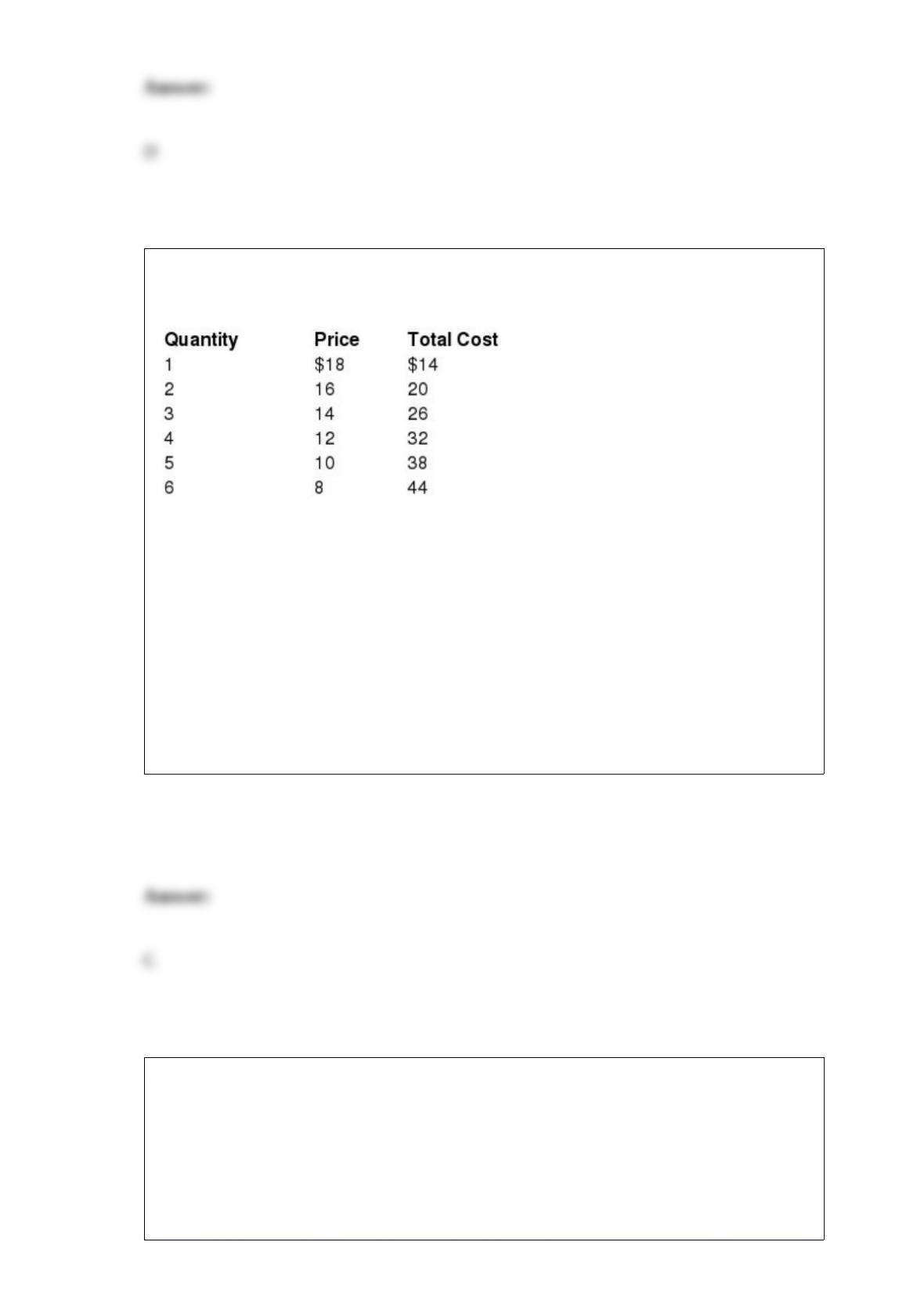
Table 13-5
Table 13-5 shows the demand and cost data facing a monopolistically competitive
producer of canvas bags.
Refer to Table 13-5. At the profit-maximizing or loss-minimizing output level
A) the firm makes a profit of $12.
B) the firm incurs a loss equal to its fixed cost.
C) the firm makes a profit of $16.
D) the firm incurs a loss of $14.
Article Summary
According to a study by the Center for Neighborhood Technology, homes located
within one-half mile of frequently-used public transportation held their value much
better during the recent housing market downturn than did those without easy access to
public transportation, and the greater home values reflect greater demand for

neighborhoods in close proximity to public transportation. In addition to higher home
values, the study found that close proximity to public transportation offers lower
transportation costs, a wider variety of travel options, and access to more employment
opportunities.
Source: Meg Handley, “Study: Proximity to Public Transit Boosts Home Values,” U.S.
News & World Report, March 22, 2013.
Refer to the Article Summary. People who do not use public transportation can still
benefit from it, as is shown by the higher home values. As a result, the marginal social
benefit from public transportation is ________ the marginal private benefit to those
who use public transportation.
A) equal to
B) greater than
C) less than
D) unrelated to
Suppose the demand curve for a product is vertical and the supply curve is upward
sloping. If a unit tax is imposed in the market for this product
A) sellers bear the entire burden of the tax.
B) buyers bear the entire burden of the tax.
C) the tax burden will be shared equally between buyers and sellers.
D) buyers share the burden of the tax with government.
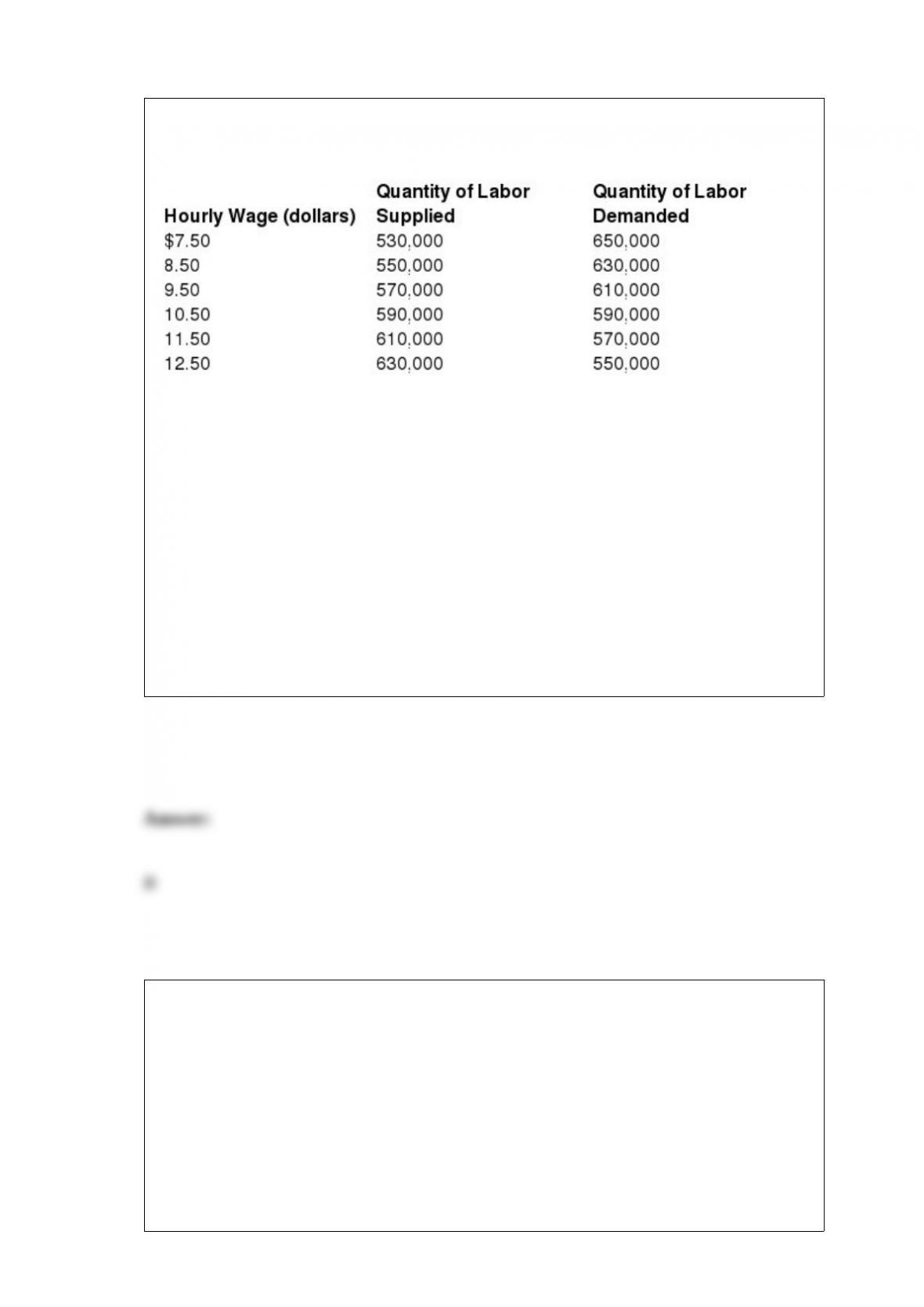
Table 4-4
Table 4-4 shows the demand and supply schedules for labor market in the city of Pixley.
Refer to Table 4-4. Suppose that the quantity of labor supplied decreases by 80,000 at
each wage level. What are the new free market equilibrium hourly wage and the new
equilibrium quantity of labor?
A) W = $8.50; Q = 550,000
B) W = $12.50; Q = 550,000
C) W = $8.50; Q = 630,000
D) W = $11.50; Q = 610,000
The income effect of a decrease in the price of macaroni and cheese (assume this is an
inferior good) results in
A) a decrease in the demand for macaroni and cheese.
B) an increase in the quantity demanded of macaroni and cheese.
C) a decrease in the quantity demanded of macaroni and cheese.
D) an increase in the demand for macaroni and cheese.

Toot Sweets Bakery sells freshly baked muffins from 6.30 am at $1.20 per muffins. By
4 pm, the remaining muffins are marked down to $0.60 each. Which of the following
statements is true?
A) Toot Sweets engages in price discrimination; a higher price for those who cannot
wait and a lower price for those willing to wait until 4 pm.
B) Toot Sweets is trying to prevent the opportunity to make arbitrage profit.
C) Toot Sweets is trying to minimize its loss.
D) Toot Sweets has underestimated the demand for its muffins.
What is accounting profit?
A) gross revenue minus explicit costs
B) gross revenue minus implicit costs
C) gross revenue minus explicit and implicit costs
D) the same as economic profit
All of the following are part of the ‘state health exchanges” provision of the Patient
Protection and Affordable Care Act (ACA) except
A) each state is required to establish an Affordable Insurance Exchange by 2014.
B) small businesses with fewer than 50 employees will be exempt from being required
to participate in the program.
C) low-income individuals will be eligible for tax credits to offset the costs of buying
health insurance.
D) health insurance policies that meet certain specified requirements will be offered by
state-run agencies, by non-profit firms, or by the federal government.
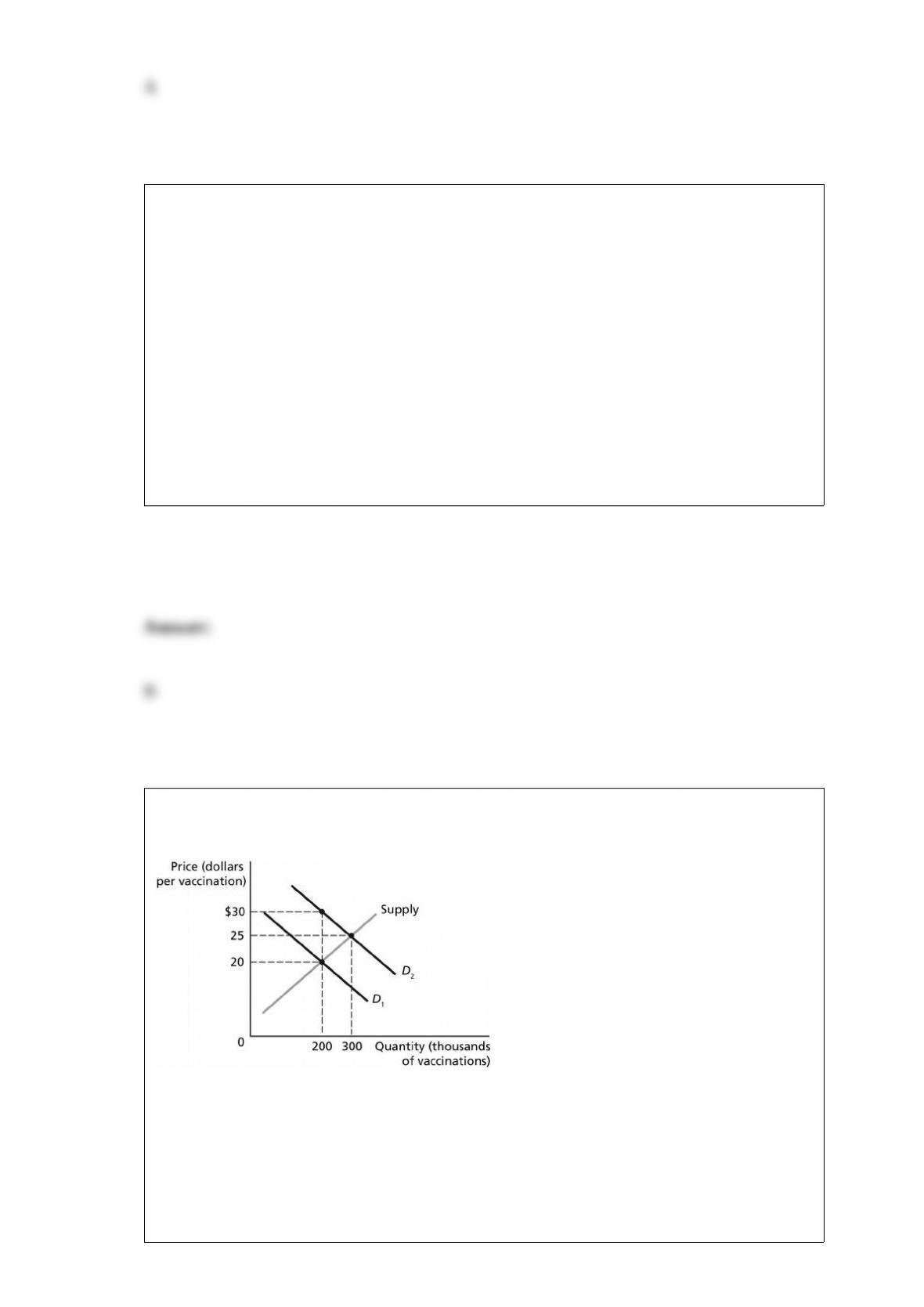
Figure 7-1
Figure 7-1 represents the market for vaccinations. Vaccinations are considered a benefit
to society, and the figure shows both the marginal private benefit and the marginal
social benefit from vaccinations.
Refer to Figure 7-1. The market equilibrium price is
A) $30.

B) $25.
C) $20.
D) <$20.
If the price elasticity of demand for insulin is equal to zero then the demand curve for
insulin is
A) horizontal.
B) downward sloping.
C) curvilinear.
D) vertical.
Suppose Adam Einberg pays $100 for a ticket to a new Broadway play and $100 was
the maximum price he was willing to pay. On the day of the performance of the play
Adam refuses to sell the ticket for $150. How would behavioral economists explain
Adam’s refusal to sell his ticket?
A) Adam’s tastes had changed from the time he bought the ticket to the time of the
performance of the play.
B) When Adam bought the ticket he was being unrealistic about his future behavior.

C) The endowment effect explains Adam’s actions. People like Adam seem to value
things that they have more than the things they do not have.
D) Adam’s income probably increased between the time he bought the ticket and the
day of the play’s performance.
To maximize profit, a perfectly competitive firm
A) should sell the quantity of output determined by the interaction between industry
demand and supply.
B) should sell the quantity of output that results in a value for total revenue that is equal
to total cost.
C) should produce the quantity of output that results in the greatest difference between
total revenue and total cost.
D) should produce the quantity of output that results in the greatest difference between
marginal revenue and marginal cost.
Which of the following is motivated by an equity concern?
A) Some states have transferred funds to food bank programs in order to increase
benefits to lower-income families.
B) Following the implementation of subsidies for energy conservation, household

demand for rooftop solar panels increased quite significantly in California.
C) The United Network for Organ Sharing advocates a system of rationing scarce
kidneys that would favor young patients over old in an effort to wring more life out of
donated organs.
D) The United States offers patent protection to pharmaceutical manufacturers to
prevent others from duplicating their products.
Which of the following statements about price elasticity of demand is false?
A) The value of the price elasticity of demand is the reciprocal of the value of the
demand curve’s slope.
B) If quantity demanded changes by a larger percentage than the percentage change in
price, demand is elastic.
C) The value of the price elasticity of demand along a downward-sloping demand curve
is always negative.
D) A linear downward-sloping demand curve has a varying price elasticity coefficient.
Figure 13-7
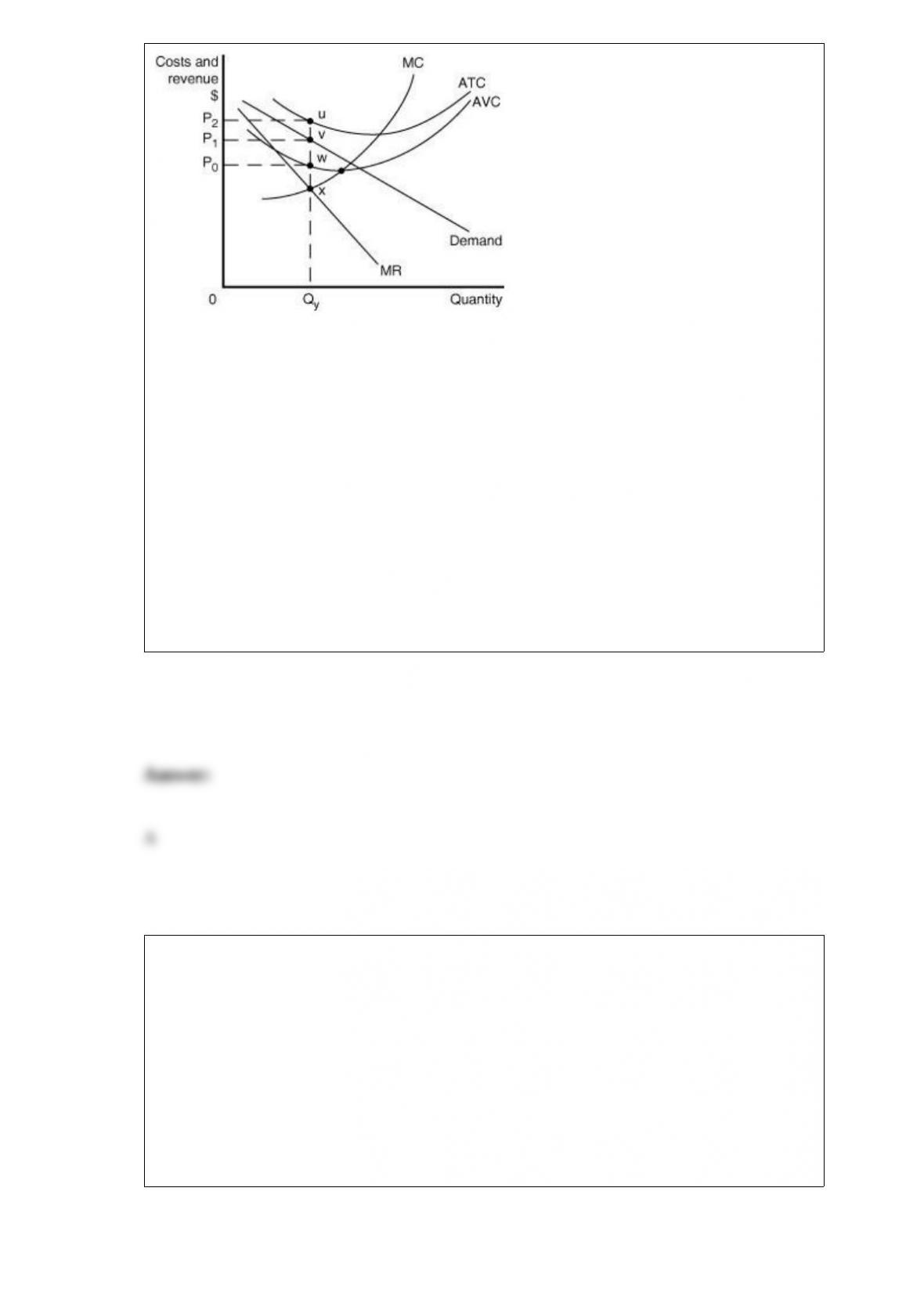
Figure 13-7 shows short-run cost and demand curves for a monopolistically competitive
firm in the footwear market.
Refer to Figure 13-7. Which of the following is the area that represents the profit or
loss experienced by the firm?
A) A loss represented by the rectangle P2uvP1.
B) A loss represented by the rectangle P2uwP0.
C) A loss represented by the rectangle P1vwP0.
D) An accounting profit equal to P1vwP0.
Many colleges and universities practice yield management to maximize the revenue
they receive from tuition and
A) to maximize the amount of aid they receive from the federal government.
B) to maximize the amount of their student loans.
C) to maximize the size of their endowments.
D) to increase the academic quality of the students who enroll in their schools.

The Coffee Nook, a small cafe near campus, sells cappuccinos for $2.50 and Russian
tea cakes for $1.00 each. What is the opportunity cost of buying a cappuccino?
A) 2 1/2 Russian tea cakes
B) 2/5 of a Russian tea cake
C) $2.50
D) $1.00