
1) In recent years the interest paid on checkable and time deposits has accounted for
around ________ of total bank operating expenses, while the costs involved in
servicing accounts have been approximately ________ of operating expenses.
A) 45 percent; 55 percent
B) 55 percent; 4 percent
C) 25 percent; 50 percent
D) 50 percent; 30 percent
2) On the expiration date of a futures contract, the price of the contract converges to the
A) purchase price of the contract
B) average price over the life of the contract
C) price of the underlying asset
D) average of the purchase price and the price of the underlying asset
3) The too-big-to-fail policy
A) reduces moral hazard problems
B) puts large banks at a competitive disadvantage in attracting large deposits
C) treats large depositors of small banks inequitably when compared to depositors of
large banks
D) allows small banks to take on more risk than large banks
4) In response to the overvalued dollar in the early 1970s, the German Bundesbank
bought dollars and sold marks to keep the exchange rate fixed, gaining international
reserves. The huge purchase of international reserves meant that the German monetary
base began to ________, leading to ________ growth in the German money supply.
A) decline; sluggish
B) decline; rapid
C) grow; sluggish
D) grow; rapid

5) When the economy is hit by a temporary negative supply shock and the central bank
does not respond by changing the autonomous component of monetary policy, then in
the long run
A) inflation will be lower
B) output will be at its potential
C) output will be lower
D) inflation will be unchanged
E) both B and D
6) If the FDIC decides that a bank is too big to fail, it will use the ________ method,
effectively ensuring that ________ depositors will suffer losses.
A) payoff; large
B) payoff; no
C) purchase and assumption; large
D) purchase and assumption; no
7) If the interest rate on a bond is below the equilibrium interest rate, there is an excess
________ of bonds and the bond price will ________.
A) demand; rise
B) demand; fall
C) supply; rise
D) supply; fall
8) The measure of the aggregate price level that is most frequently reported in the
media is the
A) GDP deflator
B) producer price index
C) consumer price index
D) household price index
9) Because of an expected rise in interest rates in the future, a banker will likely
A) make long-term rather than short-term loans
B) buy short-term rather than long-term bonds

C) buy long-term rather than short-term bonds
D) make either short or long-term loans; expectations of future interest rates are
irrelevant
10) Which of the following appears in the capital account part of the balance of
payments?
A) A gift to an American from his English aunt
B) A purchase by the Honda corporation of a U.S. Treasury bill
C) A purchase by the Bank of England of a U.S. Treasury bill
D) Income earned by the Honda corporation on its automobile plant in Ohio
11) Banks hold capital because
A) they are required to by regulatory authorities
B) higher capital increases the returns to the owners
C) it increases the likelihood of bankruptcy
D) higher capital increases the return on equity
12) Everything else held constant, an increase in the currency ratio will mean ________
in the M2 money multiplier and ________ in the M2 money supply.
A) an increase; an increase
B) an increase; a decrease
C) a decrease; an increase
D) a decrease; a decrease
13) Pieces of property that serve as a store of value are called
A) assets
B) units of account
C) liabilities
D) borrowings
14) Everything else held constant, if a central bank makes a sterilized purchase of
foreign assets, then the domestic currency will
A) appreciate
B) depreciate
C) either appreciate, depreciate, or remain constant
D) not be affected
15) The disruption to financial markets starting in August 2007 that caused both
consumer and business spending to fall
A) shifted the aggregate demand curve to the right
B) shifted the aggregate demand curve to the left
C) shifted the aggregate supply curve to the right
D) shifted the aggregate supply curve to the left
16) If the economy suffers a permanent negative supply shock because there is an
increase in regulations that permanently reduce the level of potential output, then
A) potential output falls
B) the long-run aggregate supply curve shifts leftward
C) the short-run aggregate supply curve shifts upward
D) all of the above
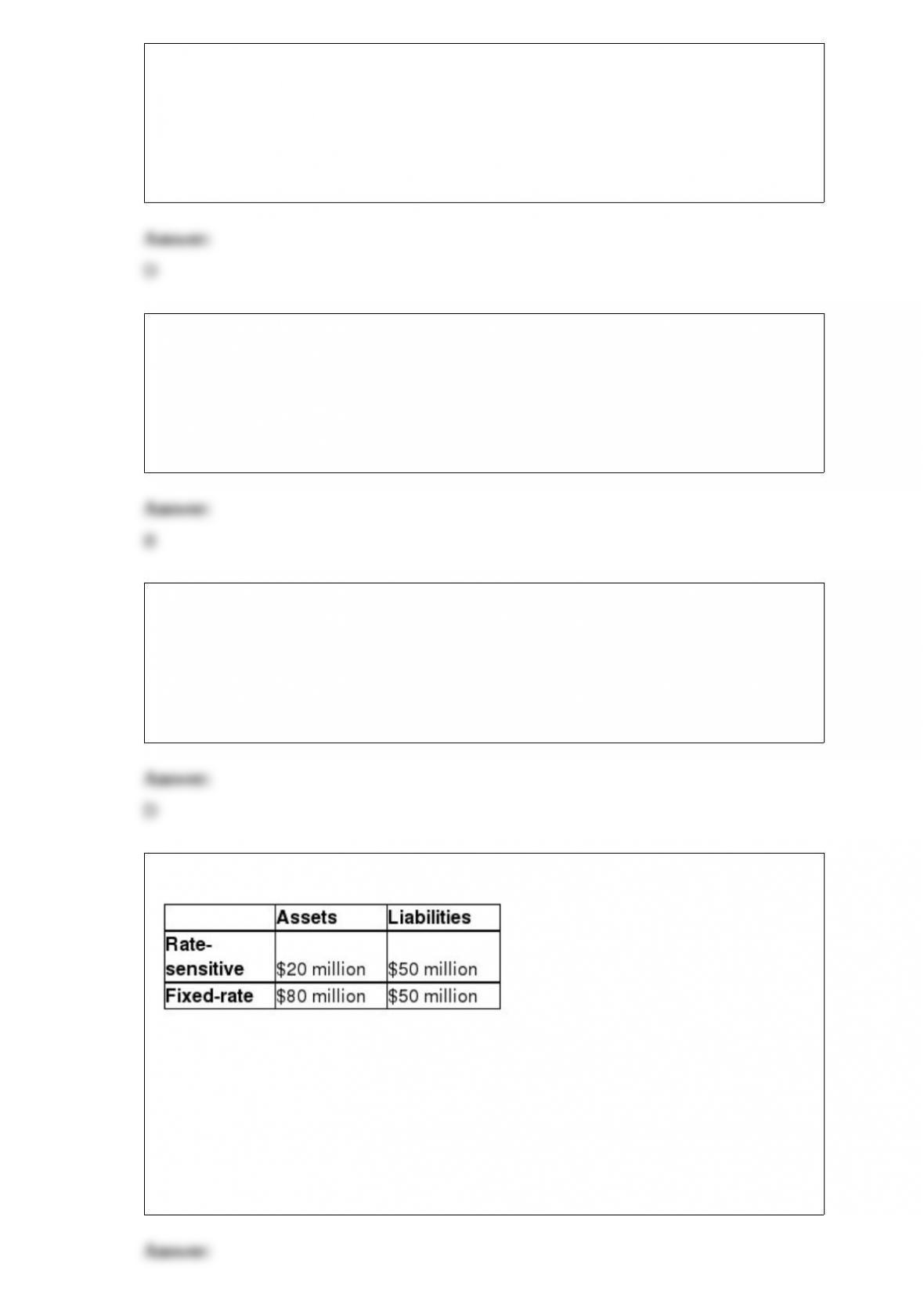
17) First National Bank
Assuming that the average duration of its assets is five years, while the average duration
of its liabilities is three years, then a 5 percentage point increase in interest rates will
cause the net worth of First National to decline by ________ of the total original asset
value.
A) 5 percent
B) 10 percent
C) 15 percent
D) 25 percent

18) A serious consequence of a financial crisis is
A) a contraction in economic activity
B) an increase in asset prices
C) financial engineering
D) financial globalization
19) The legislation overturning the Glass-Steagall Act is
A) the McFadden Act
B) the Gramm-Leach-Bliley Act
C) the Garn-St. Germain Act
D) the Riegle-Neal Act
20) Individuals that lend funds to a bank by opening a checking account are called
A) policyholders
B) partners
C) depositors
D) debt holders
21) When it comes to choosing an policy instrument, both the ________ rate and
________ aggregates are measured accurately and are available daily with almost no
delay.
A) three-month T-bill; monetary
B) three-month T-bill; reserve
C) federal funds; monetary
D) federal funds; reserve
22) Risk sharing is profitable for financial institutions due to
A) low transactions costs
B) asymmetric information
C) adverse selection

D) moral hazard
23) In the simple deposit expansion model, an expansion in checkable deposits of
$1,000 when the required reserve ratio is equal to 10 percent implies that the Fed
A) sold $1,000 in government bonds
B) sold $100 in government bonds
C) purchased $1000 in government bonds
D) purchased $100 in government bonds
24) Which of the following is not a part of the Sarbanes-Oxley Act of 2002?
A) The establishment of a Public Company Accounting Oversight Board (PCAOB) to
supervise accounting firms and thus insure that audits are independent and controlled
for quality
B) Increased penalties for white-collar crime and obstruction of official investigations
C) Requires a CEO and CFO to certify that periodic financial statements and disclosure
of the firm are accurate
D) Requires investment banks to make public their analysts’ recommendations
25) An expansionary monetary policy may cause asset prices to rise, thereby reducing
the likelihood of financial distress and causing consumer durable and housing
expenditures to rise. This monetary transmission mechanism is referred to as
A) the household liquidity effect
B) the wealth effect
C) Tobin’s q theory
D) the cash flow effect
26) Mean reversion refers to the fact that
A) small firms have higher than average returns
B) stocks that have had low returns in the past are more likely to do well in the future
C) stock returns are high during the month of January
D) stock prices fluctuate more than is justified by fundamentals

27) With ________, firms value assets on their balance sheet at what they would sell for
in the market.
A) mark-to-market accounting
B) book-value accounting
C) historical-cost accounting
D) off-balance sheet accounting
28) An increase in the riskiness of corporate bonds will ________ the price of corporate
bonds and ________ the price of Treasury bonds, everything else held constant.
A) increase; increase
B) reduce; reduce
C) reduce; increase
D) increase; reduce
29) The Dodd-Frank Wall Street Reform and Consumer Protection Act of 2010
included which of the following provisions to deal with conflicts of interest in the
credit-rating Industry?
1>Created an Office of Credit Ratings at the SEC with its own staff and the authority to
fine credit-rating agencies and to deregister an agency if it produces bad ratings.
2>Forced credit-rating agencies to provide reports to the SEC when their employees go
to work for a company that has been rated by them in the last twelve months.
3>Prohibited compliance officers from being involved in producing or selling credit
ratings.
4>Required the SEC to prevent issuers of asset-backed securities from choosing the
credit-rating agencies that will give them the highest rating and supported earlier
initiatives by the SEC.
5>Authorized investors to bring lawsuits against credit-rating agencies for a reckless
failure to get the facts when providing a credit rating.
A) 1, 2, 3, and 4
B) 2, 3, 4, and 5
C) none
D) 1, 2, 3, 4, and 5
30) As information technology improves, the lending role of financial institutions such
as banks should

A) increase somewhat
B) decrease
C) stay the same
D) increase significantly