At the quantity of output for which total revenue equals total cost,
a. economic profit is zero.
b. cost is minimized.
c. cost is maximized.
d. quantity is minimized.
e. profit is maximized.
Here are three things you could do if you do not attend your economics class: watch
television with some friends (you value this at $25), read a good novel (you value this
at $13), or go in to work (you could earn $20 during the economics class). The
opportunity cost of going to your economics class is
a. $20, because this is the only alternative of the three where you actually receive a
monetary payment.
b. $13, because this is the lowest valued alternative forfeited.
c. $25, because this is the highest valued alternative forfeited.
d. $58, because this is the total dollar sum of the alternatives forfeited.
Good weather in cities such as San Diego

a. is absolutely free for the residents of that city.
b. is allocated using a weather market.
c. imposes indirect payments for the residents of that city.
d. b and c
e. none of the above
A person buys a newly issued bond that matures in 10 years with a face value of
$10,000 and a coupon rate of 4%.How much money will the bondholder receive in the
tenth year?
a. $10,040.
b. $10,400.
c. $10,000.
d. $40.
e. $400.
Which of the following statements is false?
a. Since (total) fixed costs are constant as output changes in the short run, it follows that
average fixed cost is constant in the short run.
b. Marginal cost is the cost of producing an additional unit of output.

c. Changes in variable costs are reflected dollar-for-dollar in changes in total cost.
d. Fixed costs exist in the short run, but not in the long run.
A significant difference between perfect competition and monopolistic competition is
that
a. a perfectly competitive firm is a price searcher, while a monopolistic competitive
firm is a price taker.
b. a perfectly competitive firm faces a downward-sloping demand curve, while a
monopolistic competitive firm faces a perfectly elastic demand curve.
c. a perfectly competitive firm sells a homogeneous product, while a monopolistic
competitive firm sells a differentiated product.
d. a perfectly competitive firm sets price above marginal cost, while a monopolistic
competitive firm sets price equal to marginal cost.
If goods A and B have a cross elasticity of demand that is positive, this is evidence that
goods A and B are __________ goods.
a. complementary
b. substitute
c. normal
d. inferior
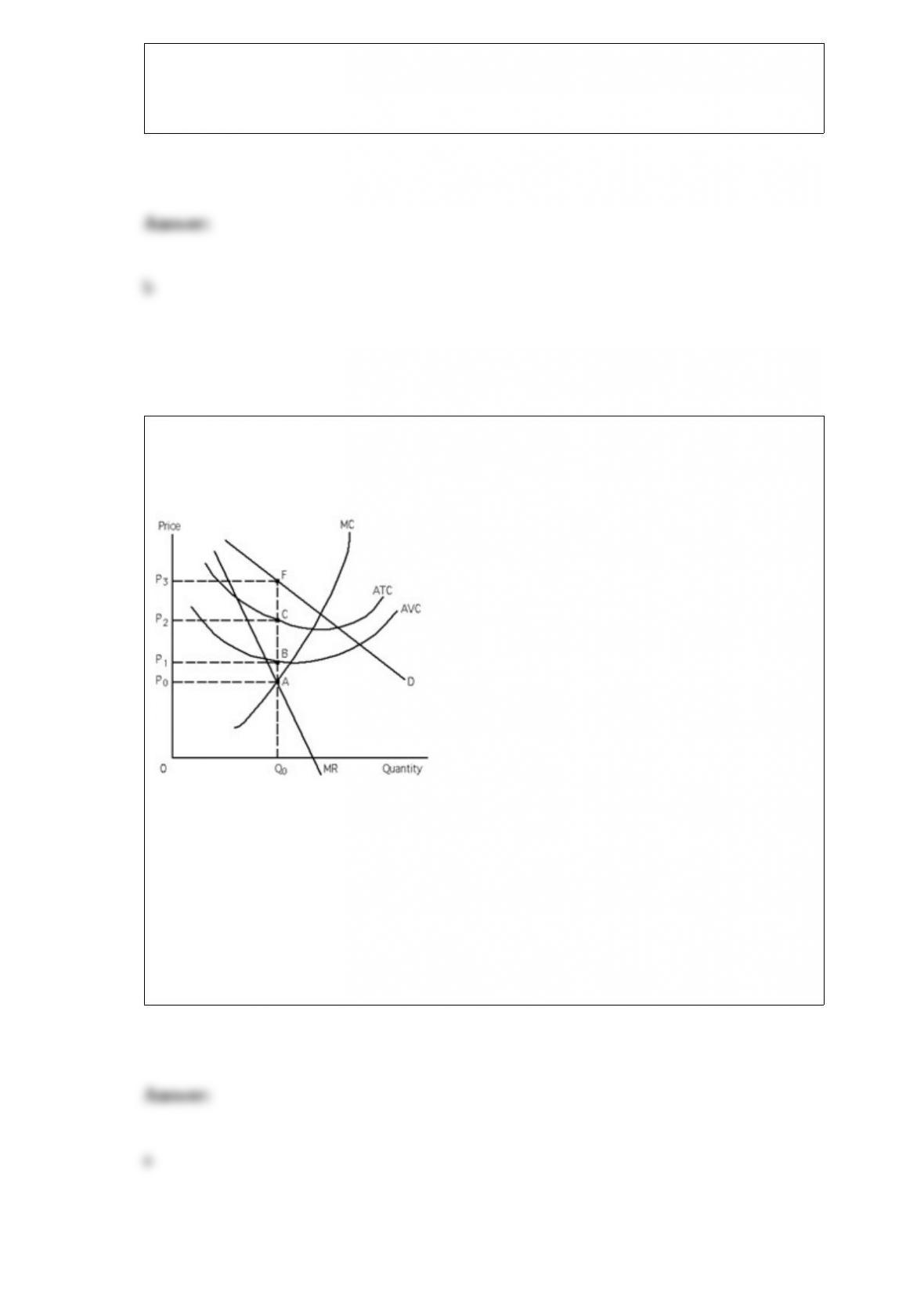
Refer to Exhibit 24-2. Total cost at the profit-maximizing quantity of output is the
Exhibit 24-2
a. area 0P2CQ0.
b. area 0P3FQ0.
c. area 0P1BQ0.
d. distance from Q0 to D.
e. none of the above
A tariff raises the price of the product on which the tariff has been placed, decreases
consumers’ surplus, increases producers’ surplus, and generates tariff revenue for the
government.
a. True
b. False
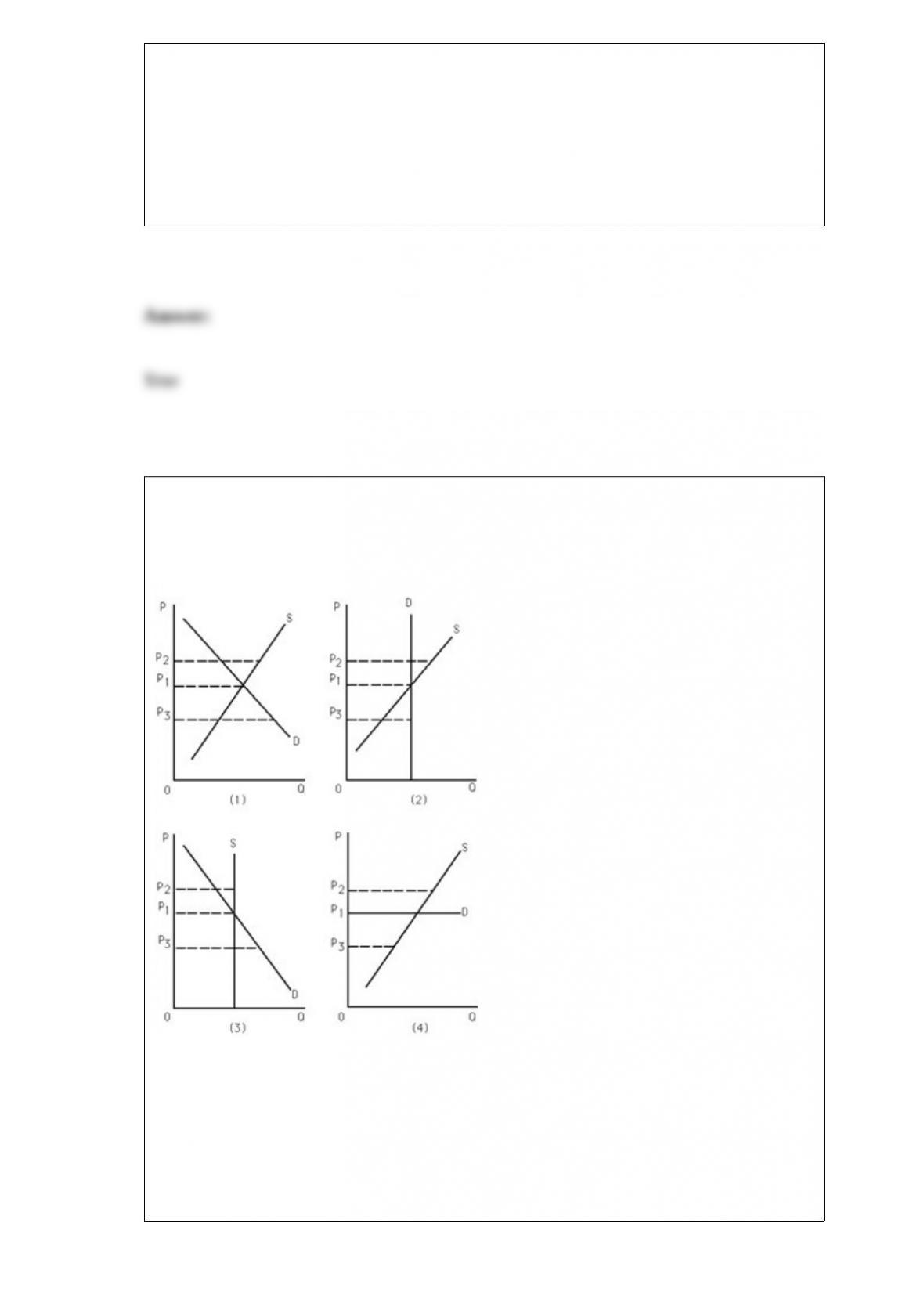
Refer to Exhibit 3-16. Which of the following is false?
Exhibit 3-16
a. Graph (1): There is a shortage of this
good when the price is equal to P3.
b. Graph (2): As supply increases, equilibrium quantity remains constant.
c. Graph (3): As demand increases, equilibrium price remains constant.
d. Graph (4): As supply changes, equilibrium price stays the same.
Which of the following is an example of a legal barrier to entry?
a. a public franchise
b. a patent
c. exclusive ownership of a scarce resource
d. a and b
e. a, b, and c
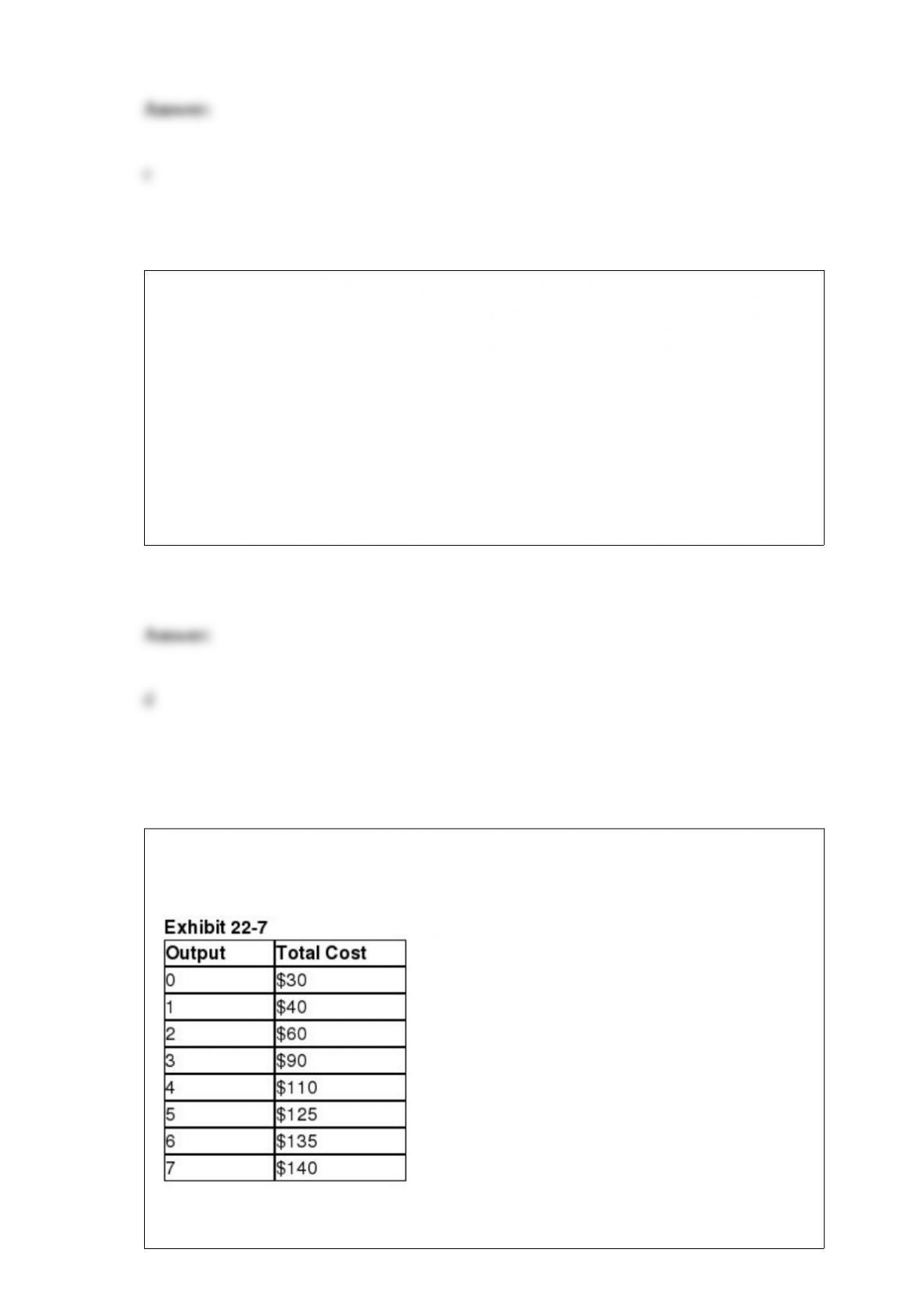
Refer to Exhibit 22-7. The total variable cost of producing 3 units is
a. $31.00.
b. $51.00.
c. $17.00.
d. $60.00.
e. There is not enough information to answer this question.
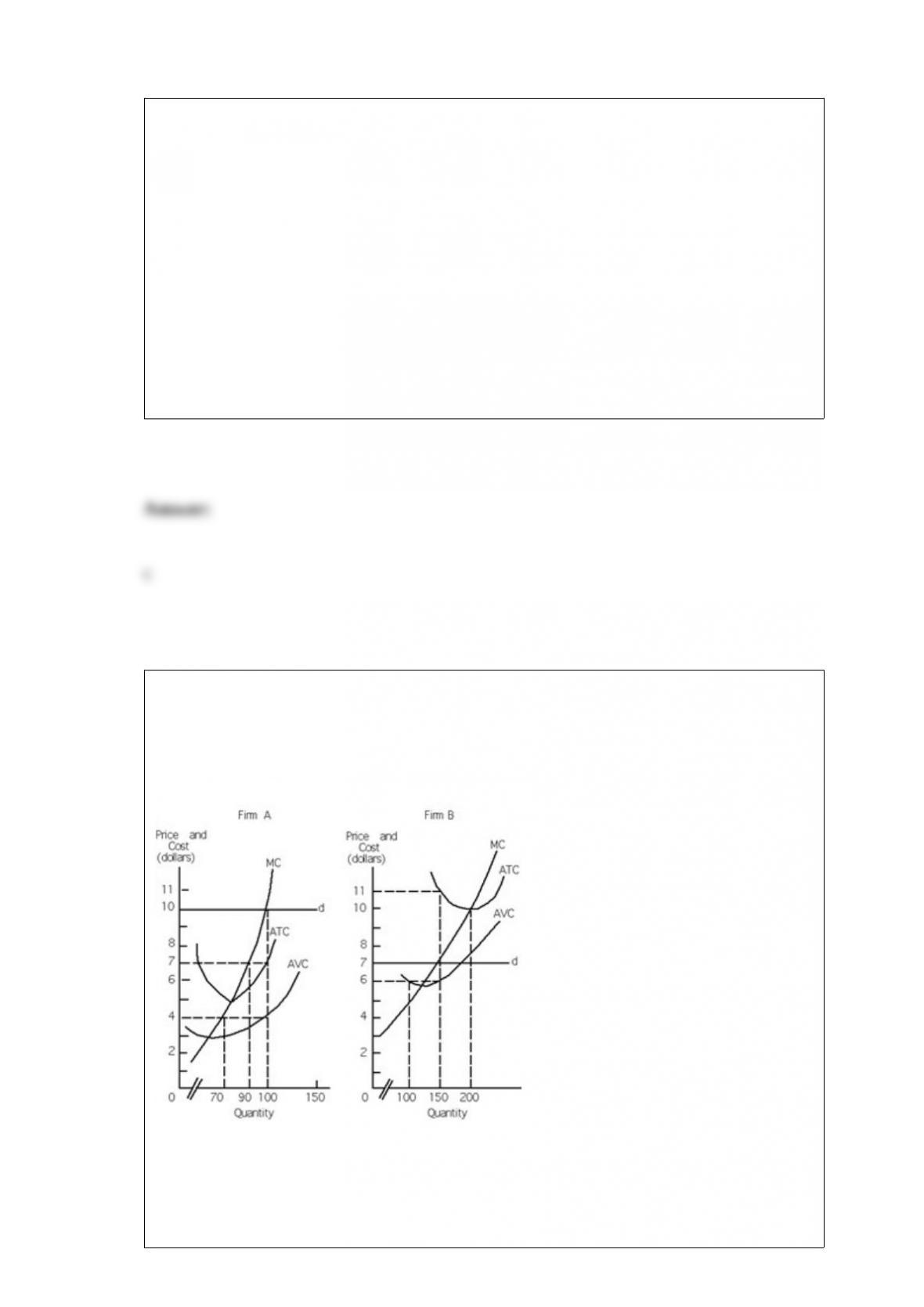
Refer to Exhibit 2-6. Which graph depicts society’s choice to produce more of good X
and less of good Y?
Exhibit 2-6
a. (1)
b. (2)
c. (3)
d. (4)
e. none of the above
Consider a setting in which there is a negative externality, but no positive
externality.The market outcome is __________________; government can bring about
the ___________________ outcome if it sets a tax equal to the __________________.
a. efficient; inefficient;
b. efficient; inefficient; MEC
c. inefficient; efficient; MEC
d. inefficient; efficient; MPC
e. inefficient; efficient; MSB
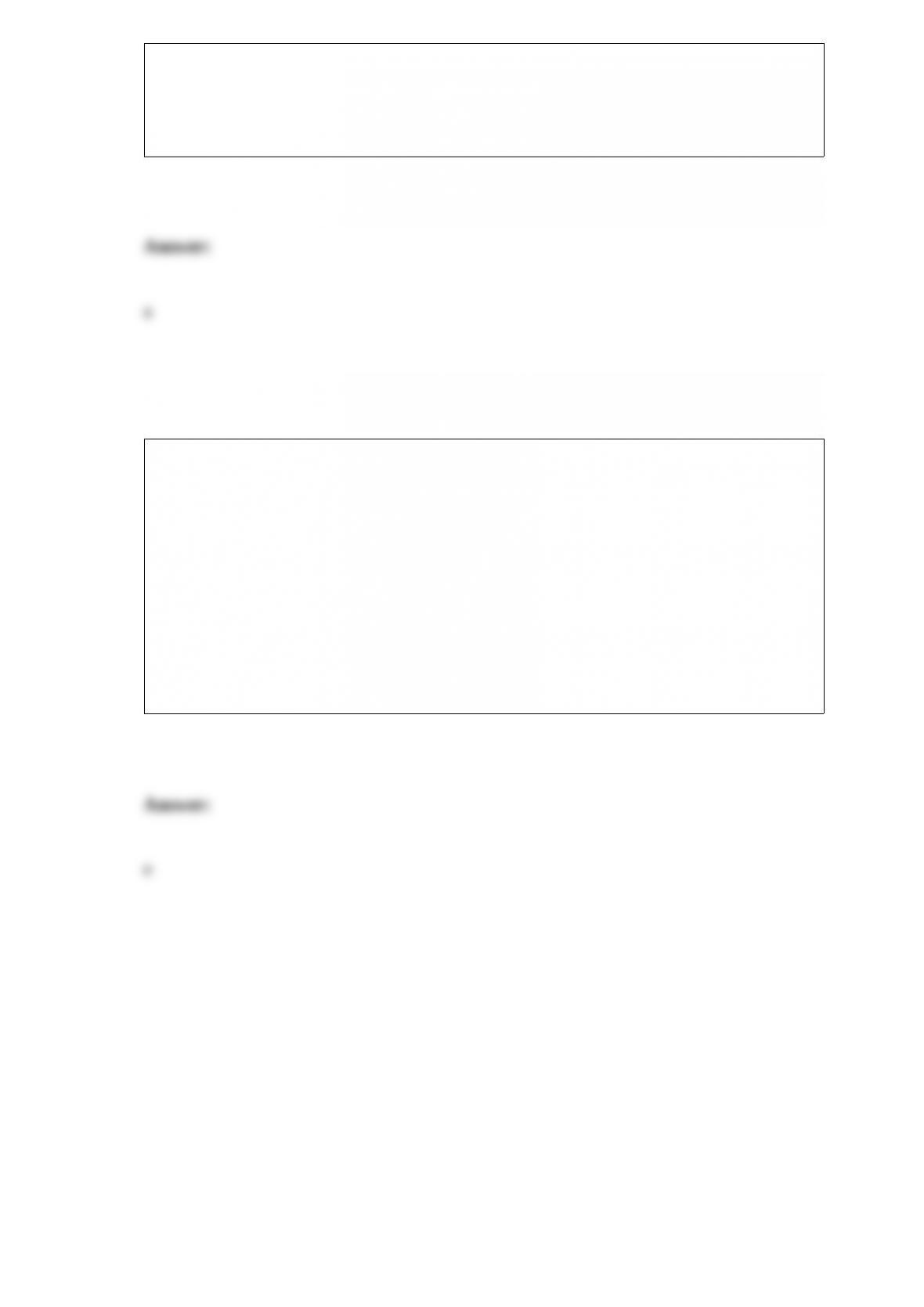
Refer to Exhibit 23-8. What is the profit (loss) of firm B at the profit-maximizing (or
loss-minimizing) level of production?
Exhibit 23-8
a. -$600
b. $270
c. $600
d. $400
e. -$400
The national defense argument for trade protectionism holds that
a. what is good for business is good for the country.
b. what is good for consumers is good for the country.
c. consumers’ surplus rises by more than producers’ surplus falls.
d. producers’ surplus rises by more than consumers’ surplus falls.
e. none of the above