
If there is a negative externality, and the market output is 100 units more than the
socially optimal output, then it follows that
a. the external costs associated with the negative externality are greater than the
marginal private costs.
b. the external costs associated with the negative externality are less than the marginal
private costs.
c. there is market failure.
d. any tax imposed on the production of the output will bring about the socially optimal
output.
e. none of the above
The yield on a bond is the
a. annual coupon payment divided by the price paid for the bond.
b. coupon rate divided by the price paid for the bond.
c. annual coupon payment divided by the face value of the bond.
d. same as the interest rate on the bond.
e. a and d
The effect of a decrease in interest rates upon economic growth is an example of
positive economics.

a. True
b. False
Ceteris paribus, economics predicts that voter turnout will be higher
a. the smaller the number of eligible voters.
b. the larger the number of eligible voters.
c. the easier it is to get to the polls on election day.
d. a and c
e. b and c
Exhibit 2-5
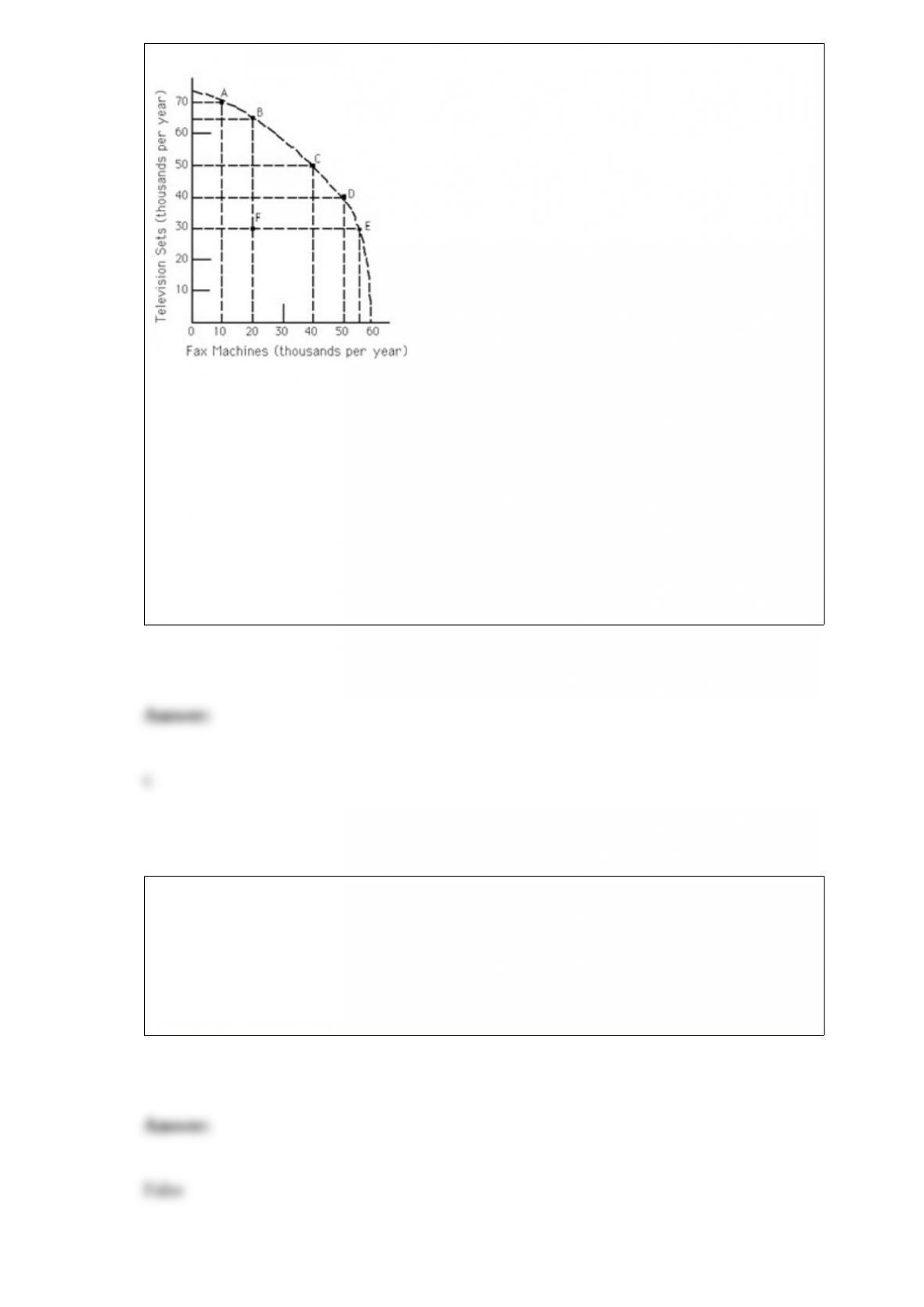
The economy is currently operating at point F. The opportunity cost of moving to point
E is approximately
a. 35 televisions.
b. 55 televisions.
c. zero televisions.
d. 40 televisions.
Minimum efficient scale refers to the output level where short-run average total cost is
lowest.
a. True
b. False
Total revenue is defined as
a. price minus quantity sold.
b. price multiplied by quantity sold.
c. price divided by quantity sold.
d. quantity divided by price sold.
e. price plus quantity sold.
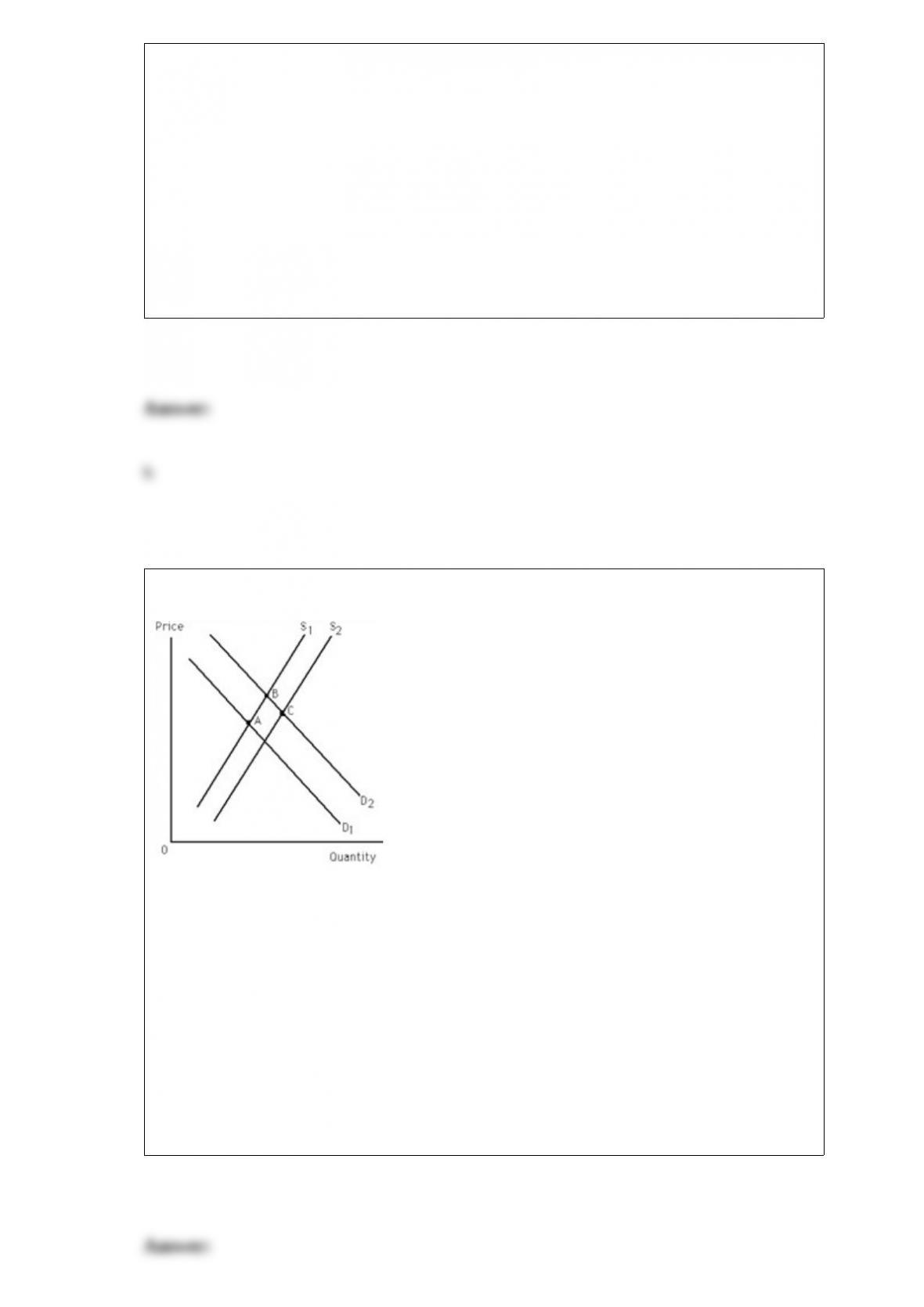
Exhibit 3-2
Suppose equilibrium is at point A. Something then changes and equilibrium becomes
point C. Which of the following is consistent with the change in equilibrium from point
A to C (assuming that good X is a normal good)?
a. There was an increase in income and production technology advanced.
b. There was a decrease in income and production technology advanced.
c. There was an increase in the price of a substitute and an increase in wages.
d. There was a decrease in the price of a complement and an increase in wages.

If the government establishes a price floor for agricultural products, then
a. consumers will pay a lower price for the products.
b. consumers will increase the quantity that they are willing to consume.
c. farmers will want to decrease their production.
d. the government will need to purchase the resulting surplus.
e. all of the above
If a person is receiving greater marginal utility per dollar from consuming one good
than another, it follows that he or she is
a. maximizing disutility.
b. not maximizing utility.
c. maximizing utility.
d. There is not enough information to answer the question.
The answer is: “A tax on imports.” What is the question?

a. What is comparative advantage?
b. What is a quota?
c. What is a tariff?
d. What reduces consumers’ surplus?
e. c and d
The marginal cost curve cuts through the AVC, ATC, and AFC curves at their lowest
points.
a. True
b. False
The law of diminishing marginal returns states that as ever larger amounts of a variable
input are combined with
a. fixed inputs, the marginal physical product of the variable input rises.
b. other variable inputs, the marginal physical product of the variable input declines.
c. fixed inputs, eventually the marginal physical product of the variable input declines.
d. other variable inputs, eventually the marginal physical product of the variable input
declines.

If the equilibrium exchange rate between U.S. dollars and Japanese yen is $0.01 = 1
yen, but currently the exchange rate is $0.009 = 1 yen, then with flexible exchange rates
the dollar price of a yen will __________ and the yen will __________.
a. increase; appreciate
b. decrease; appreciate
c. increase; depreciate
d. decrease; depreciate
Don receives 100 utils from consuming two oranges. The utility he derives from
consuming the second orange equals 30 utils. Which of the following conclusions is
derived from the law of diminishing marginal utility?
a. The marginal utility Don receives from consuming the third orange will be less than
30 utils.
b. The marginal utility Don receives from consuming the third orange will be less than
100, but greater than 30 utils.
c. If the price of oranges decreases, Don will buy fewer oranges, ceteris paribus.

d. The total utility Don receives from consuming the first orange is less than the
marginal utility from consuming the first orange.
In every economy people vie for the economy’s rationing device, a process called
a. competition.
b. entrepreneurship.
c. marginal benefit.
d. positive economics.
Exhibit 24-4
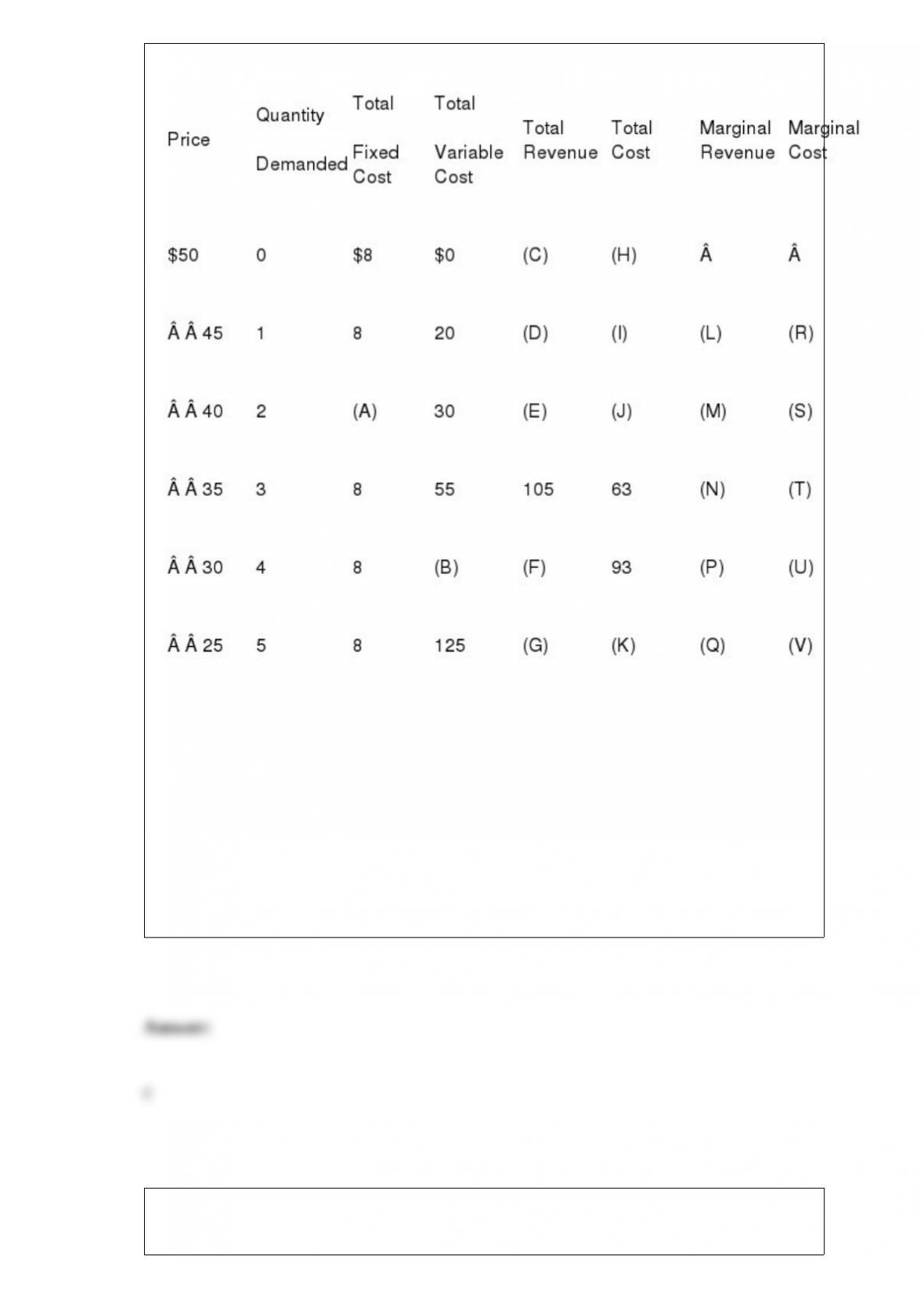
What dollar amounts go in blanks (K), (L), (M), and (N), respectively?
a. $90; $80; $53.33; and $60
b. $90; $70; $50; and $30
c. $133; $45; $35; and $25
d. $0; $90; $160; and $210
A person goes into a store and buys a computer for $1,210. In this case, price is acting
as a
a. resource.
b. good.
c. rationing device.
d. capital instrument.
e. factor of production.
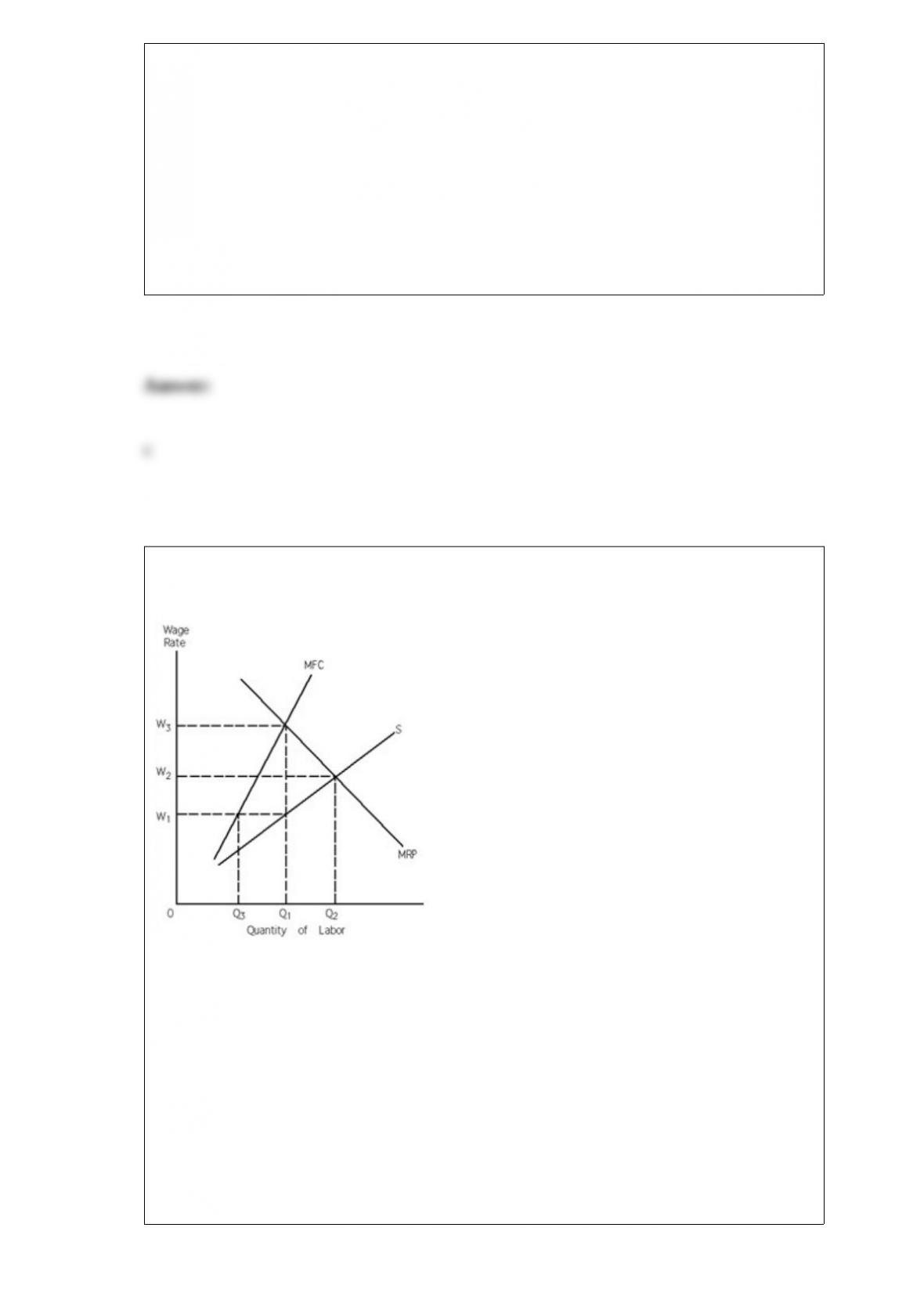
Exhibit 28-3
Consider the monopsony setting. In the absence of collective bargaining, what wage
rate does the profit-maximizing monopsonist pay?
a. W1
b. W2
c. W3
d. none of the above

Assuming only two goods X and Y, if MUX/PX = MUY/PY, then
a. the consumer is in equilibrium.
b. the consumer cannot be made better off by redirecting his purchases.
c. the consumer is deriving the same marginal utility per dollar spent on both goods.
d. a and c
e. a, b and c