
1) among the benefits that a regional trading arrangement can provide are all of these
except:
a.economies of large scale production
b.specialization fostering
c.attracting foreign investment
d.a shorter production time
2) since 1974, the major industrial countries have operated under a system of fixed
exchange rates based on the gold standard.
a.true
b.false
3) although the tokyo round of international trade negotiations reduced the
buy-american restrictions of the u.s. government, many state governments have
maintained restrictive buy-american policies.
a.true
b.false
4) the diagram below illustrates the international tin market. assume that producing and
consuming countries establish an international commodity agreement under which the
target price of tin is $5 per pound.
figure 7.1. defending the target price in face of changing demand conditions
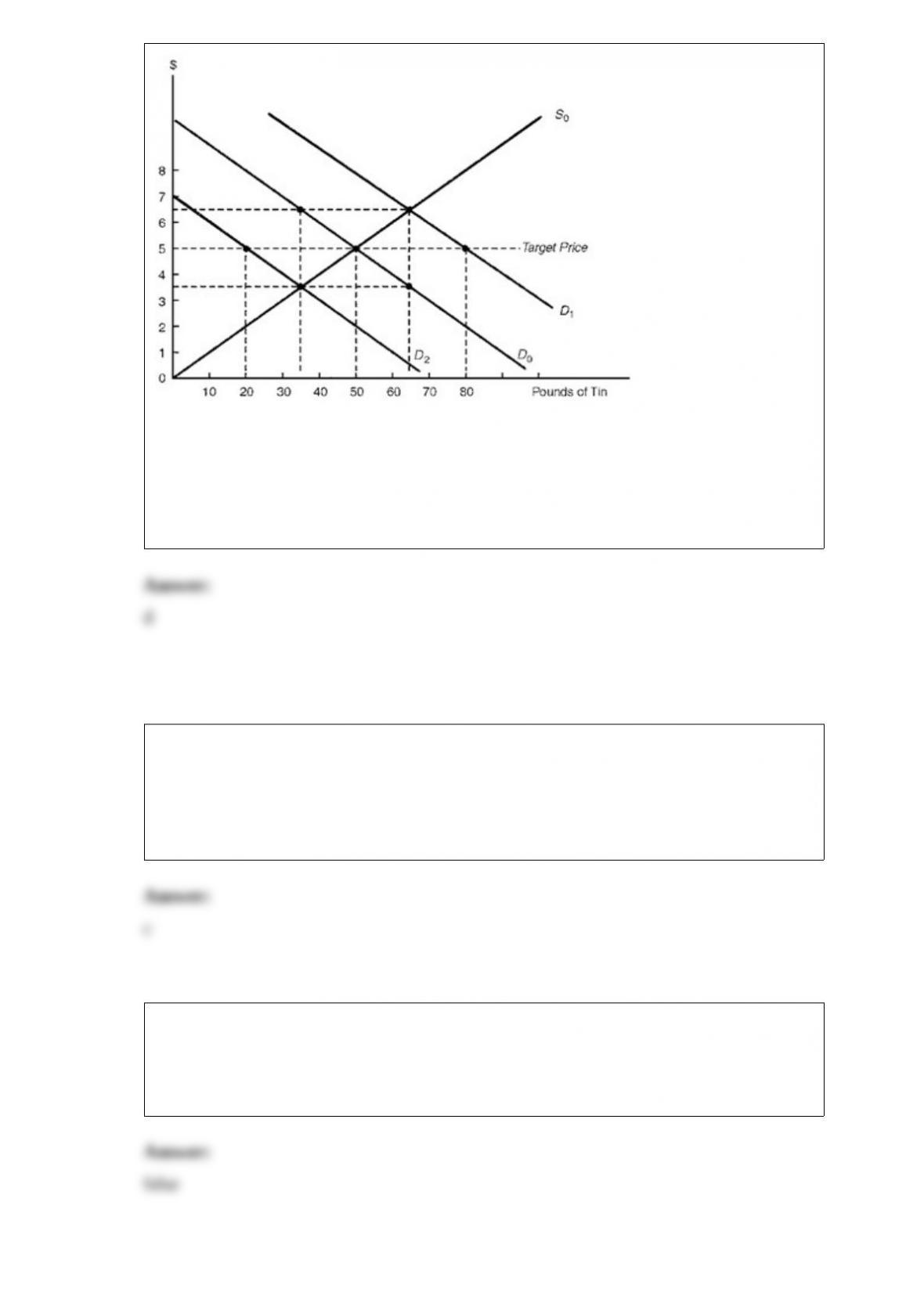
consider figure 7.1. suppose the demand for tin decreases from d0 to d2. under a system
of export quotas, the tin producers could maintain the target price by:
a.increasing the quantity of tin supplied by 15 pounds
b.increasing the quantity of tin supplied by 30 pounds
c.decreasing the quantity of tin supplied by 15 pounds
d.decreasing the quantity of tin supplied by 30 pounds
5) increased foreign competition tends to:
a.intensify inflationary pressures at home
b.induce falling output per worker-hour for domestic workers
c.place constraints on the wages of domestic workers
d.increase profits of domestic import-competing industries
6) a ad valorem tariff provides domestic producers a declining degree of protection
against import-competing goods during periods of changing prices.
a.true
b.false

7) on the balance-of-payments statement, dividend and interest income are classified as
capital-account transactions.
a.true
b.false
8) arbitrage results in a riskless profit since a trader purchases a currency at a low price
and simultaneously resells it at a higher price.
a.true
b.false
9) which term best describes the process in which the international monetary fund
provides loans to countries facing balance-of-payments difficulties provided that they
initiate programs holding promise of correcting these difficulties?
a.conditionality
b.debt service
c.reciprocal currency arrangement
d.swap agreement
10) although a net-debtor country may initially benefit from an inflow of savings from
abroad, over the long run continued borrowing results in growing dividend payments to
foreigners and a drain on the debtor-country’s economic resources.
a.true
b.false
11) the price-specie-flow mechanism illustrated why one nation’s gains from trade were
accompanied by another country’s losses.
a.true
b.false

12) open economies have more:
a.competition
b.firm turnover
c.new firms entering the market
d.all of these
13) under the trade adjustment assistance program, a domestic firm or worker can file
for governmental assistance only if it demonstrates that it suffered economic hardship
due to imports of foreign-subsidized goods.
a.true
b.false
14) developing nations often maintain that industrial countries permit raw materials to
be imported at very low tariff rates while maintaining high tariff rates on manufactured
imports. which of the following refers to the above statement?
a.tariff-quota effect
b.nominal tariff effect
c.tariff escalation effect
d.protective tariff effect
15) most of the world’s population now lives in countries that are:
a.integrated into world markets
b.becoming integrated into world markets
c.near poverty
d.a and b

16) a closed economy is one in which:
a.imports exactly equal exports, so that trade is balanced
b.domestic firms invest in industries overseas
c.the home economy is isolated from foreign trade
d.saving exactly equals investment at full employment
17) small countries tend to have higher measures of openness than larger countries
because:
a.their productivity is higher
b.they are more reliant on international trade
c.they are less reliant on international trade
d.they are more diverse
18) the uruguay round of trade negotiations was primarily concerned with:
a.import tariffs
b.export tariffs
c.economic sanctions
d.nontariff trade barriers