1) real gdp refers to:
a.the value of the domestic output after adjustments have been made for environmental
pollution and changes in the distribution of income.
b.gdp data that embody changes in the price level, but not changes in physical output.
c.gdp data that reflect changes in both physical output and the price level.
d.gdp data that have been adjusted for changes in the price level.
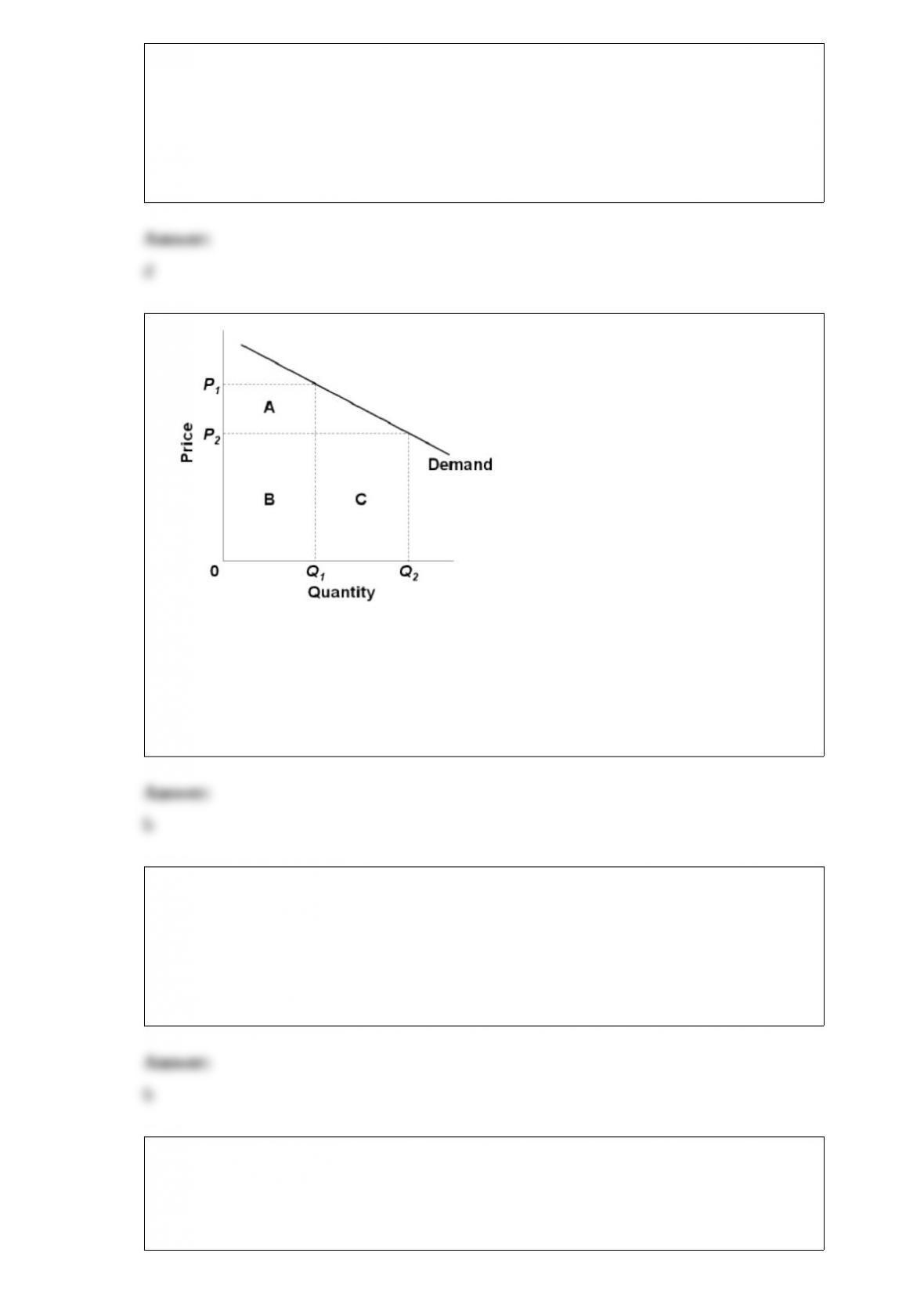
2)
refer to the above diagram. the quantity difference between areas a and c for the
indicated price reduction measures:
a.marginal cost.
b.marginal revenue.
c.monopoly price.
d.a welfare or efficiency loss.
3) if the total variable cost of 9 units of output is $90 and the total variable cost of 10
units of output is $120, then:
a.the average variable cost of 10 units is $10.
b.the average variable cost of 9 units is $10.
c.the marginal cost of the tenth unit is $90.
d.the firm is operating in the range of increasing marginal returns.
4) Suppose that government imposes a specific excise tax on product X of $2 per unit
and that the price elasticity of supply of X is unitary (coefficient = 1). If the incidence
of the tax is such that the producers of X pay $1.90 of the tax and the consumers pay
$.10, we can conclude that the:

A.supply of X is highly inelastic.
B.supply of X is highly elastic.
C.demand for X is highly inelastic.
D.demand for X is highly elastic.
5) All else equal, when the Federal Reserve Banks engage in a restrictive monetary
policy, the prices of government bonds usually:
A.fall.
B.rise.
C.remain constant.
D.move in the same direction as the bonds’ interest rate yield.
6) Which one of the following topics would be of most interest to a public choice
economist?
A.the theory of comparative advantage
B.the law of increasing opportunity cost
C.inflation and unemployment
D.rent-seeking behavior
7) Cost-benefit analysis attempts to:
A.compare the real worth, rather than the market values, of various goods and services.
B.compare the relative desirability of alternative distributions of income.
C.determine whether it is better to cut government expenditures or reduce taxes.
D.compare the benefits and costs associated with any economic project or activity.
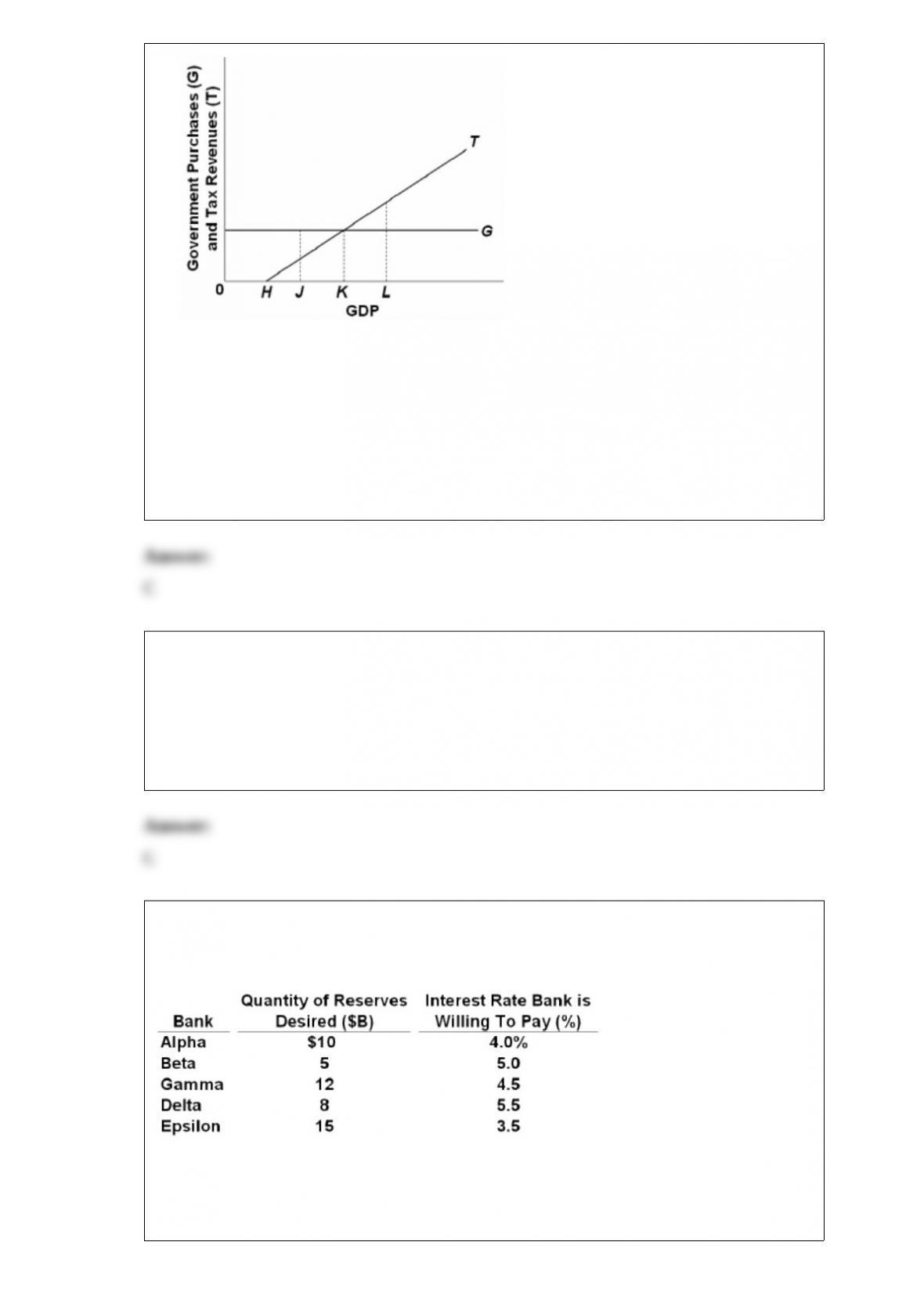
8)
Refer to the above diagram. The degree of built-in stability in the above economy could
be increased by:
A.reducing government purchases so that the purchases line shifts downward but
parallel to its present position.
B.changing the tax system so that the tax line is shifted downward but parallel to its
present position.
C.changing the tax system so that the tax line has a greater slope.
D.altering the government expenditures line so that it has a positive slope.
9) Funds lent to startup firms in return for shares of the profit if the firms succeed are
called:
A.retained earnings.
B.time deposits.
C.venture capital.
D.transfer payments.
10) The following information: The Fed is going to auction $30 billion in reserves using
the term auction facility. It receives the following bids:
Refer to the above information. What interest rate will the Fed charge for these
reserves?
A.4 percent.
B.4.5 percent.
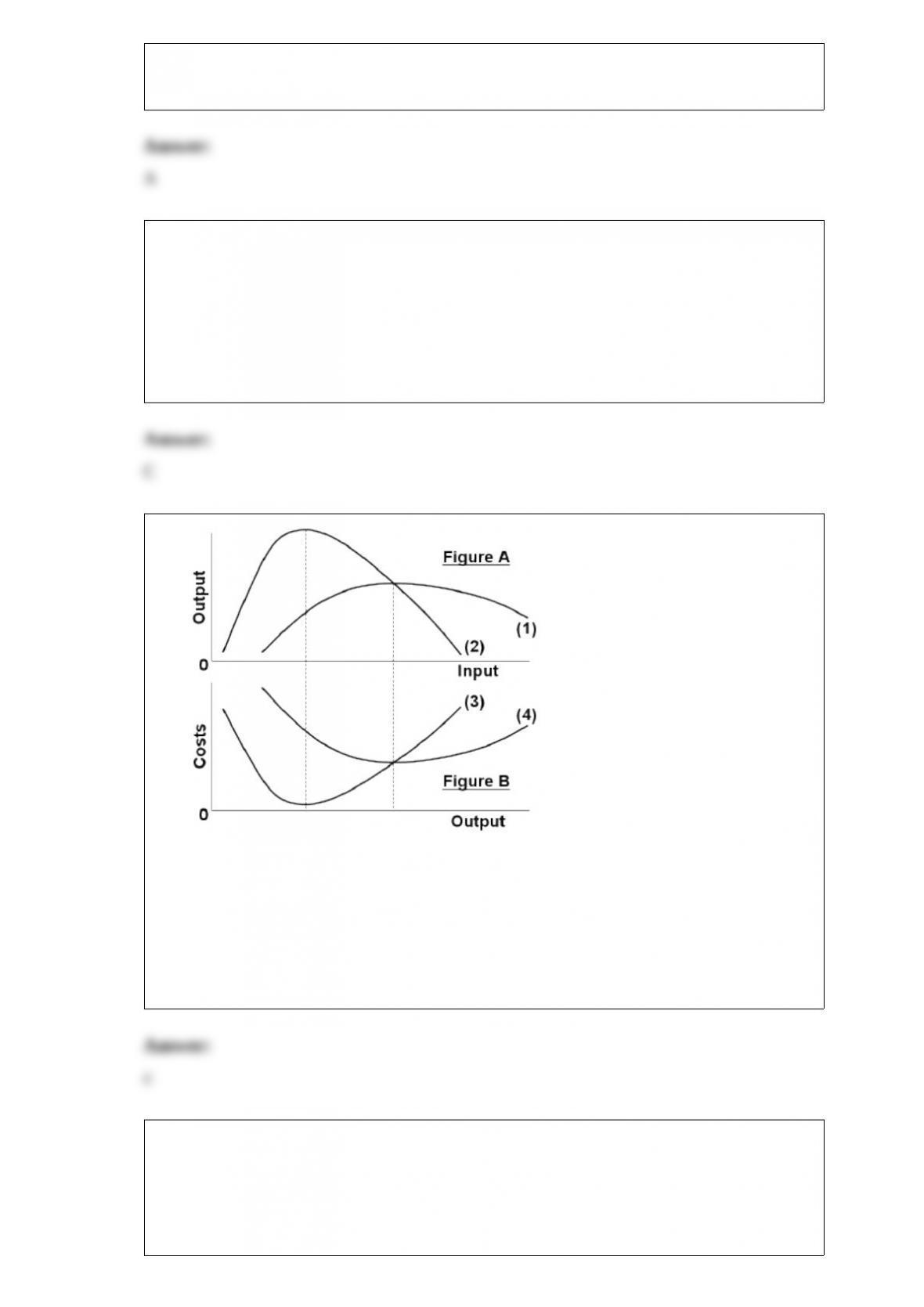
C.5.5 percent.
D.The interest rate will vary depending on what each bank bid.
11) Overall, economists believe that deregulation of industries formerly subjected to
industrial regulation:
A.has been a clear failure.
B.is neutral in its impact to society’s well-being, creating minimal net benefits at best.
C.has produced large net benefits for consumers and society.
D.has produced sizable efficiency gains in the communications industry, but not in the
transportation industry (railways, trucking, airlines).
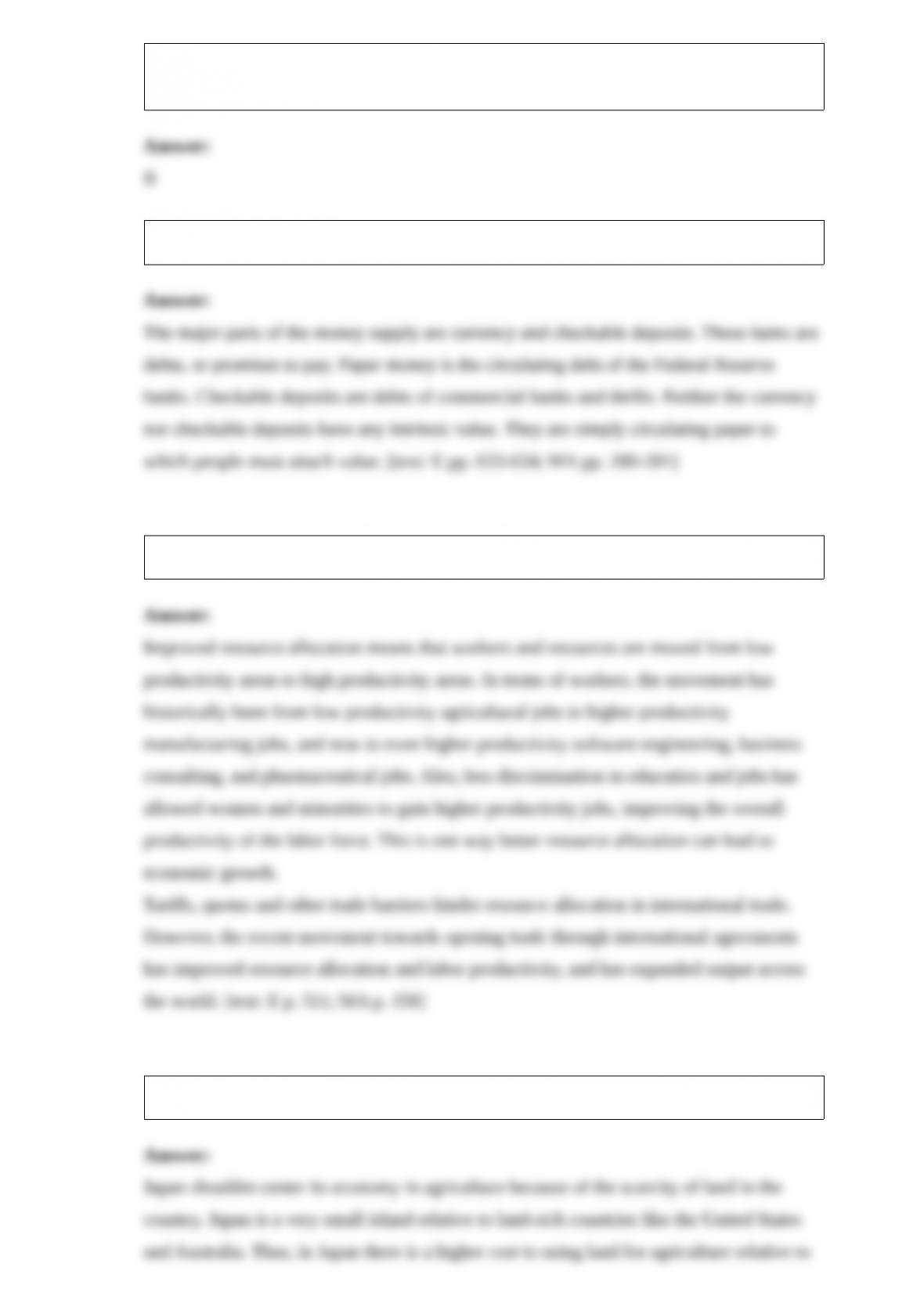
12)
refer to the above short-run production and cost data. the curves of figures a and b
suggest that:
a.average product and average variable cost reach their maximum points at the same
output.
b.avc cuts mc at the latter’s maximum point.
c.avc reaches a minimum where ap is at its maximum.
d.afc declines so long as output increases.
13) Most of the DVCs find it difficult to accumulate capital goods because:
A.the terms of trade prohibit the inflow of private capital from the advanced nations.
B.it is very difficult to restrict consumption and thus to free resources for capital goods
production.
C.domestic monetary policies designed to achieve price stability result in low interest
rates, thereby discouraging investment.
D.investment is interest inelastic in DVCs.
14) Why is money considered to be debt?
15) How has improved resource allocation stimulated economic growth?
16) Why shouldnt Japan make its main production sector agriculture?
17) How large is the actual multiplier?
18) How does innovation differ from invention and diffusion? How does innovation
affect competition among firms?
19) What is the fast-second strategy? What are the risks to a dominant firm from using
such a strategy?
20) What are the basic purposes of antitrust policy?
21) Identify the major items in the consolidated balance sheet of the Federal Reserve
Banks.