1) elastic demand is analogous to a __________ and inelastic demand to a _________.
a.normal wrench; socket wrench
b.tight rubber band; loose rubber band
c.ace bandage; firm rubber tie-down
d.one-foot ruler; tape measure
2) The first discovery (as distinct from first commercial application) of a product or
process is called:
A.innovation.
B.invention.
C.creative destruction.
D.diffusion.
3) Which of the following countries recently joined the ranks of the world’s leading
trading nations by total dollar volume?
A.China
B.Chile
C.Ireland
D.Belgium
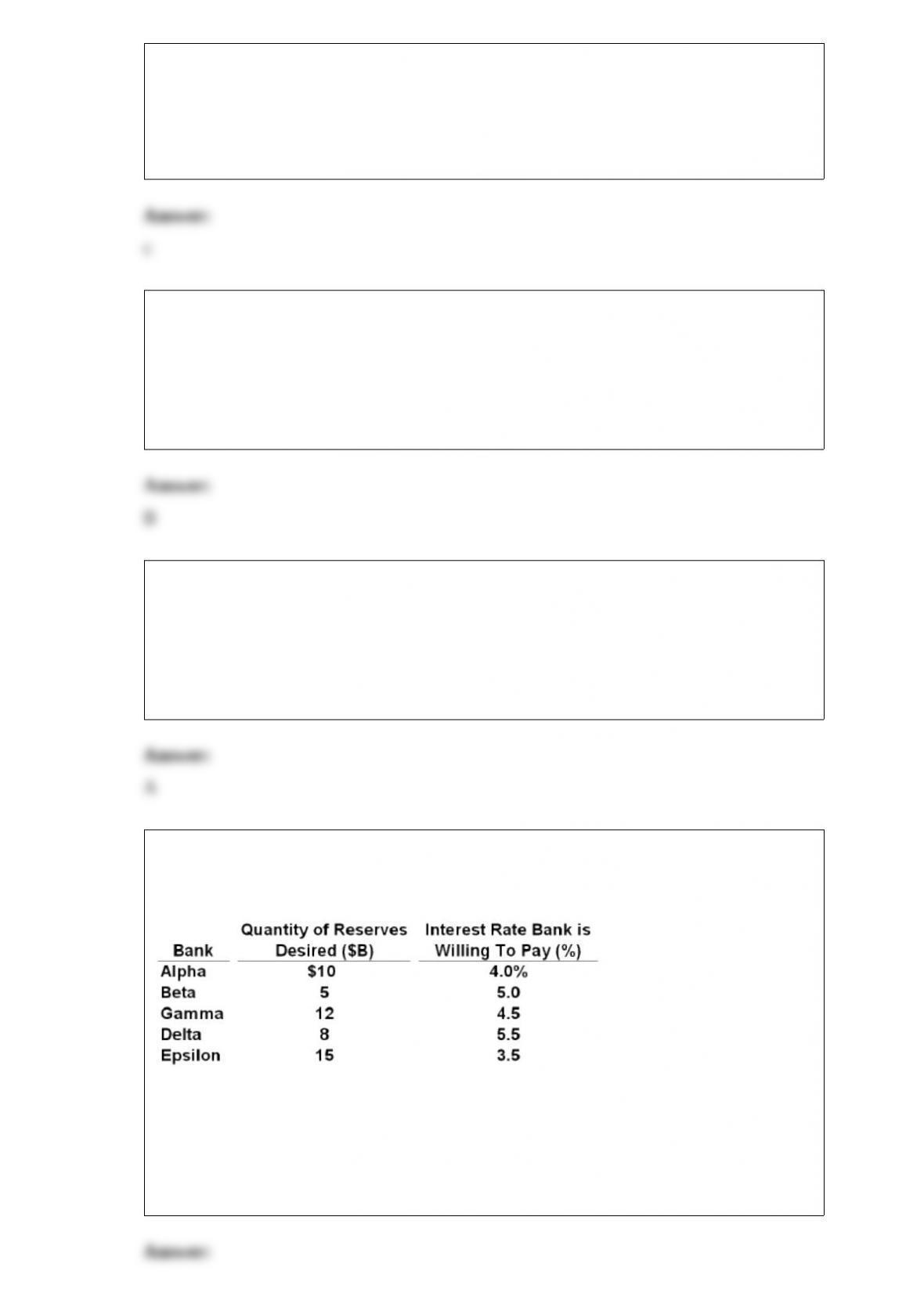
4) The following information: The Fed is going to auction $30 billion in reserves using
the term auction facility. It receives the following bids:
Refer to the above information. As a result of the auction, how much and at what
interest rate will Beta bank borrow?
A.$0; 3.5 percent (rate charged winning bidders)
B.$0; 4.5 percent (rate charged winning bidders)
C.$5 billion; 4 percent
D.$5 billion; 5 percent

5) (Last Word) Which of the following is not an item in the list of leading economic
indicators?
A.the rate of inflation
B.the length of the average work week
C.the money supply
D.the value of the index of consumer expectations
6) if the nominal interest rate is 5 percent and the real interest rate is 2 percent, then the
inflation premium is:
a.8 percent.
b.5 percent.
c.3 percent.
d.2 percent.
7) If the MPC in an economy is .9, a $1 billion increase in government spending will
ultimately increase consumption by:
A.$1 billion.
B.$.9 billion.
C.$10 billion.
D.$9 billion.
8) the problems of aggregate inflation and unemployment are:
a.major topics of macroeconomics.
b.not relevant to the u.s. economy.
c.major topics of microeconomics.
d.peculiar to command economies.
9) (Last Word) The U.S. sugar price support program has:
A.cost U.S. consumers much more than it has benefited U.S. sugar producers.
B.cost U.S. consumers much less than it has benefited U.S. sugar producers.
C.reduced the price of sugar to U.S. consumers.
D.increased sugar imports as a percentage of U.S. sugar consumption.
10) which of the following is a microeconomic statement?
a.the real domestic output increased by 2.5 percent last year.
b.unemployment was 6.8 percent of the labor force last year.
c.the price of personal computers declined last year.
d.the general price level increased by 4 percent last year.
11) Graphical analysis of tariffs reveals that:
A.they benefit domestic consumers at the expense of domestic producers.
B.revenue gains outweigh the costs to domestic consumers.
C.they increase domestic production of the good for which imports face tariffs.
D.although the benefits are not shared equally, everyone in the domestic economy
benefits from tariffs.
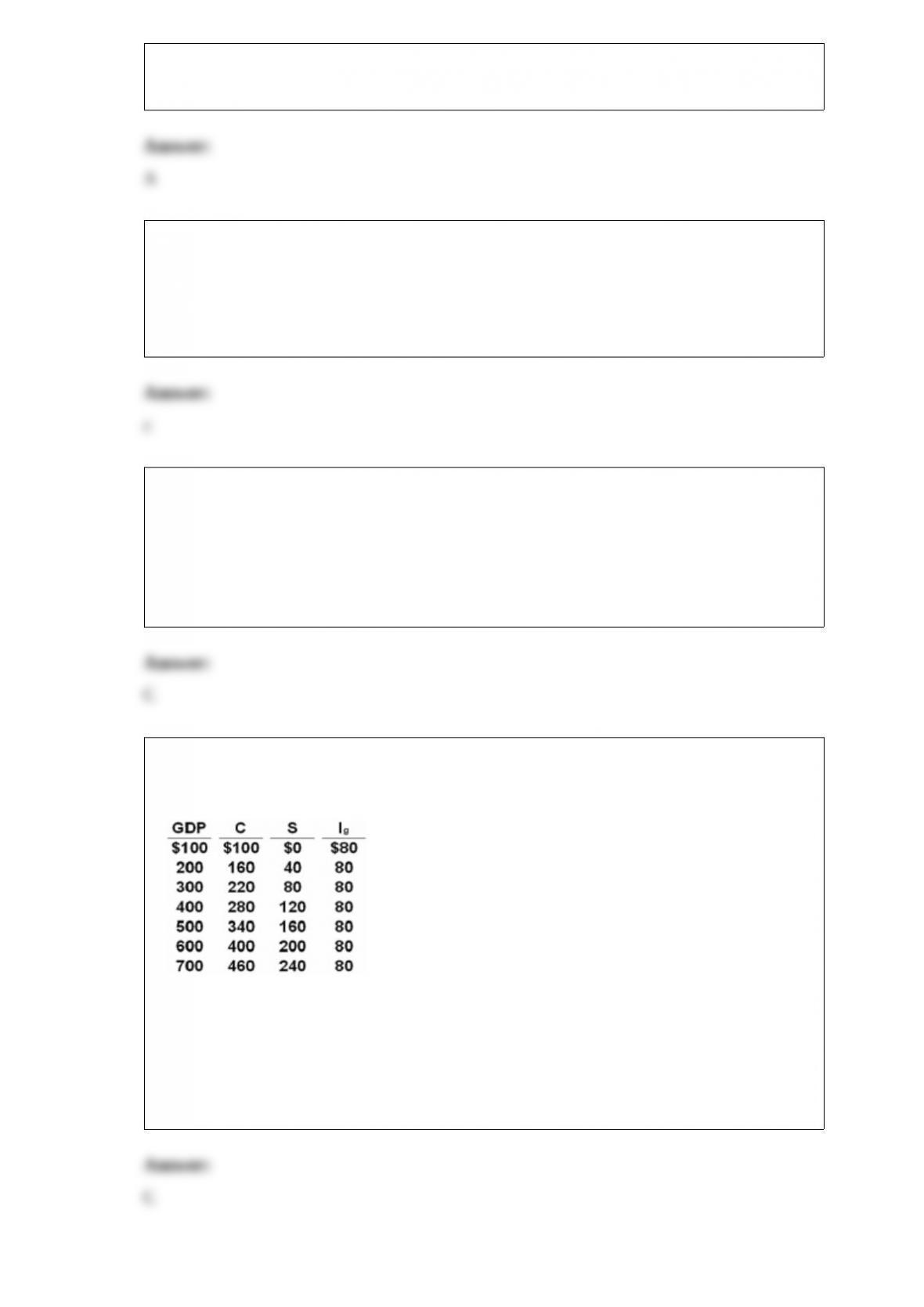
12) The following information is for a closed economy:
Refer to the above information. If government now spends $80 billion at each level of
GDP and taxes remain at zero, the equilibrium GDP:
A.will rise to $700.
B.will rise to $600.
C.will rise to $500.
D.may either rise or fall.

13) when economists say that health care services are overconsumed, they mean that:
a.rich people buy too much health care and poor people buy too little.
b.some resources now used in the health care industry could produce alternative goods
and services that society values more highly.
c.health care is being purchased in amounts such that marginal benefits exceed marginal
costs.
d.the price of health care is below equilibrium so that quantity demanded exceeds
quantity supplied.
14) health care costs have greatly increased in recent years in the united states. this fact
alone does not establish an overallocation of resources to health care because:
a.the benefits of health care have also greatly increased in recent years.
b.rising medical care prices have inflated health care costs.
c.the marginal cost of health care exceeds the average total cost of health care.
d.negative externalities sometime result from additional health care spending.
15) income data that show the percentage of total income received by each fifth of all
households describe the:
a.functional distribution of income.
b.horizontal distribution of income.
c.personal distribution of income.
d.vertical distribution of income.
16) The following is a list of figures for a given year in billions of dollars. Using this
data, compute: (a) GDP; (b) NDP; (c) NI; (d) PI; (e) DI; (f) Net exports.
17) government lotteries are:
a.used by a large number of states to supplement their tax revenues.
b.illegal in the united states, but are a common source of revenue in other countries.
c.used by local governments, but not by state governments.
d.a form of progressive taxation.
18) How does the time dimension affect income inequality?
19) Explain how process innovation reduces cost and increases profits. How does this
innovation affect the firms total product curve and average cost curve?
20) What are three qualifications to the view that allocative and productive efficiency
are not realized in oligopoly?
21) What is the difference between income and wealth? How can wealth contribute to
income inequality?
22) What accounts for differences in living standards between rich and poor countries
today?