
The neoclassical theory of distribution explains the allocation of:
A) output between goods and services.
B) output among consumption, investment, and government spending.
C) income among factors of production.
D) income between saving and investment.
To the extent that low interest rates contributed to the financial crisis of 2008″2009, the
blame for this policy lies with:
A) the Federal Reserve.
B) investment banks.
C) rating agencies.
D) mortgage brokers.
All of the following are exogenous variables in the mother of all models in the
Appendix to Chapter 14 except the:
A) world interest rate.

B) labor force.
C) world real interest rate.
D) price level.
During the Great Depression, countries that devalued their currencies generally ______
whereas countries that maintained the old exchange rate ______.
A) suffered longer; experienced no depression
B) recovered relatively quickly; experienced no depression
C) suffered longer; recovered relatively quickly
D) recovered relatively quickly; suffered longer
Countries with greater central-bank independence can achieve lower rates of inflation:
A) at the cost of higher levels of unemployment.
B) at the cost of slower growth rates of real GDP.
C) at the cost of greater volatility of real GDP.
D) with no apparent real economic costs.

If a liquidity trap does exist, then ______ policy will not be effective in increasing
income when interest rates reach very ______ levels.
A) monetary; high
B) monetary; low
C) fiscal; high
D) fiscal; low
Policymakers may be better able to achieve their goals using a fixed policy rule rather
than using discretion if they face the problem of:
A) short and predictable inside lags.
B) time-inconsistent policy.
C) short and predictable outside lags.
D) weak automatic stabilizers.

Some economists argue that monetary union will not work as well in Europe as it does
in the United States for all of the following reasons except:
A) labor is not as mobile in Europe as it is in the United States.
B) there is no strong central government that can use fiscal policy in Europe as there is
in the United States.
C) there is no common language in Europe as there is in the United States.
D) there is no European central bank as there is in the United States.
When f(k) is drawn on a graph with increases in k noted along the horizontal axis, the
slope of the line denotes:
A) output per worker.
B) output per unit of capital.
C) the marginal product of labor.
D) the marginal product of capital.

A deficit adjusted for inflation should include only government spending used to make
_____ interest payments.
A) real
B) nominal
C) foreign
D) domestic
If an economy is in a steady state with no population growth or technological change
and the marginal product of capital is less than the depreciation rate:
A) the economy is following the Golden Rule.
B) steady-state consumption per worker would be higher in a steady state with a lower
saving rate.
C) steady-state consumption per worker would be higher in a steady state with a higher
saving rate.
D) the depreciation rate should be decreased to achieve the Golden Rule level of
consumption per worker.
A consumer’s budget constraint for two periods with positive interest rate r may be
represented by the equation:

A) C1+ C2= Y1+ Y2.
B) C1+ C2/(1+ r)= Y1+ Y2/(1+ r).
C) C1+ C2(1+ r)= Y1+ Y2(1+ r).
D) C1/(1+ r)+ C2= Y1/(1+ r)+ Y2.
In an open economy:
A) a trade deficit is always good.
B) a trade deficit is always bad.
C) a trade deficit may be good or bad.
D) a trade surplus is always bad.
A devaluation of a currency under a fixed-exchange-rate system occurs when the level
at which the currency is fixed is:
A) increased.
B) decreased.

C) allowed to float.
D) kept fixed within a band.
According to the Fisher equation, the real interest, rt, equals the nominal interest rate, it,
minus the expected inflation rate, which is written as:
A) Etpt
B) Etpt+1
C) Et+1pt
D) Et + 1pt + 1
Assume that some large foreign countries decide to subsidize investment by instituting
an investment tax credit. Then a small country’s real exchange rate:
A) will fall and its net exports will rise.
B) will rise and its net exports will fall.
C) and net exports will both fall.
D) and exports will both rise.

If past economic fluctuations resulted from inept economic policies, then the historical
evidence would support using:
A) active macroeconomic policy only.
B) passive macroeconomic policy only.
C) either active or passive macroeconomic policy.
D) neither active nor passive macroeconomic policy.
According to the Mundell”Fleming model, under flexible exchange rates expansionary
monetary policy ______ increase income, and under fixed exchange rates expansionary
monetary policy ______ increase income.
A) can; can
B) can; cannot
C) cannot; can
D) cannot; cannot

The macroeconomic model may be completed by adding either the Keynesian
assumption that ______ or the classical assumption that ______.
A) output is fixed; prices are fixed
B) prices are fixed; output is fixed
C) the interest rate is fixed; the money supply is fixed
D) prices are flexible; output varies
To the extent that mortgage defaults contributed to the financial crisis of 2008″2009,
blame for these actions lies with:
A) homebuyers who borrowed more than they could afford to repay.
B) mortgage brokers who encouraged households to borrow excessively.
C) government policymakers who pursued policies to encourage homeownership
D) all of the above

Economists occasionally speak of “helicopter money” as a short-hand approach to
explaining increases in the money supply. Suppose the Chairman of the Federal Reserve
flies over the country in a helicopter dropping 10,000,000 in newly printed $100 bills (a
total of $1 billion). By how much will the money supply increase if, holding everything
else constant:
a. all of the new bills are held by the public?
b. all of the new bills are deposited in banks that choose to hold 10 percent of their
deposits as reserves (and no one in the economy holds any currency)?
c. all of the new bills are deposited in banks that practice 100-percent-reserve banking?
d. people in the economy hold half of their money as currency and half as deposits,
while banks choose to hold 10 percent of their deposits as reserves?
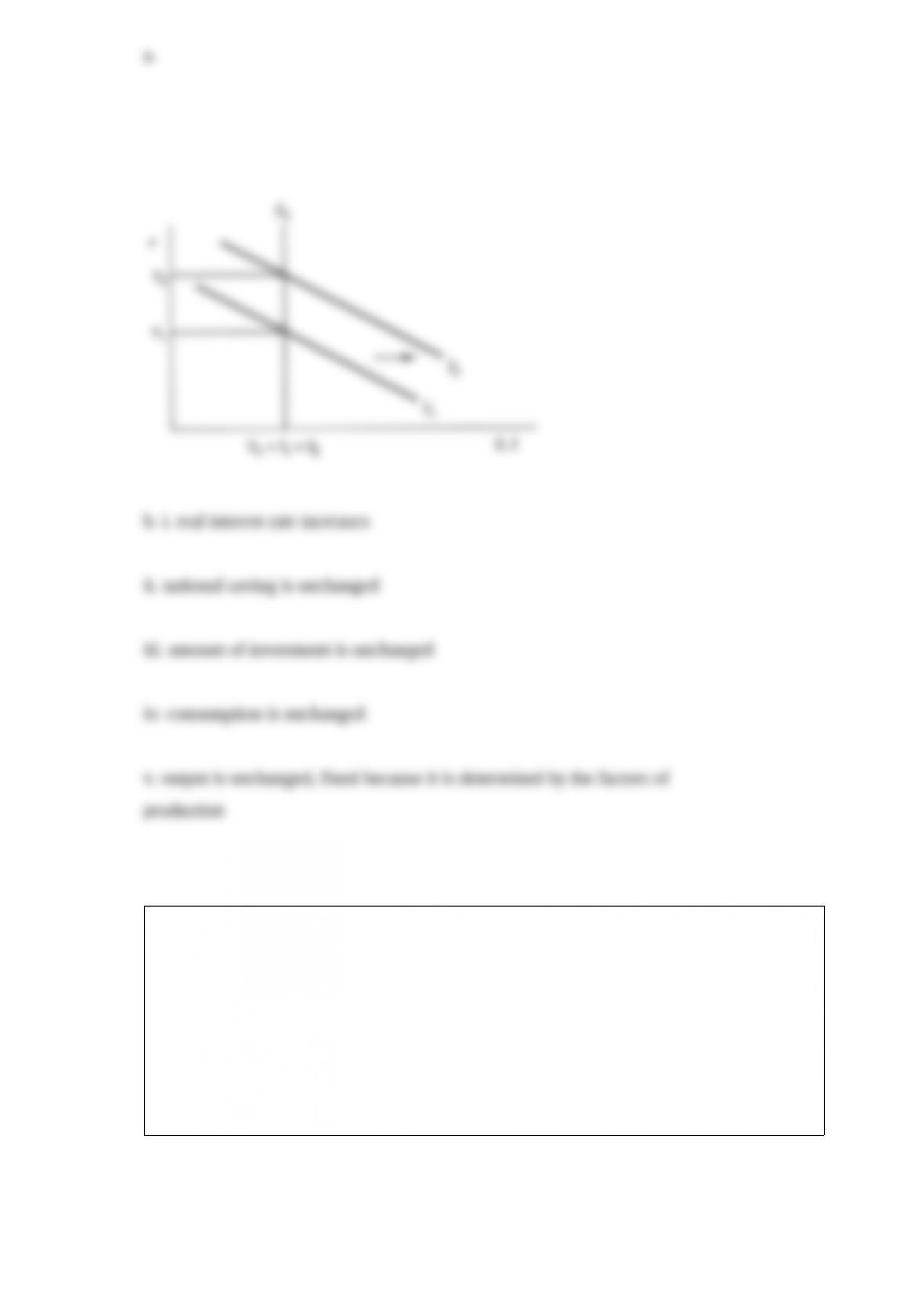
a. Suppose there is a technological breakthrough that increases the productivity of all
capital and, consequently, increases the demand for investment. Using the long-run
model of the economy developed in Chapter 3, graphically illustrate the impact of the
increased investment demand. Be sure to label: i. the axes; ii. the curves; iii. the initial
equilibrium values; iv. the direction curves shift; and v. the terminal equilibrium values.
b. State in words what happens to: i. the real interest rate; ii. national saving; iii.
investment; iv. consumption; and v. output.
The earned income tax credit:
A) increases the government’s tax revenue.
B) reduces the incomes of poor working families.
C) does not raise labor costs.
D) is not an alternative to raising the minimum wage.
Assume that a competitive economy can be described by a constant returns to scale
(Cobb”Douglas) production function and all factors of production are fully employed.
Holding other factors constant, including the quantity of capital and technology,
carefully explain how a one-time, 10-percent increase in the quantity of labor (perhaps
the result of a special immigration policy) will change each of the following:
a. the level of output produced;
b. the real wage of labor;
c. the real rental price of capital;
d. labor’s share of total income.
A monetary policy rule that targets nominal GDP would ______ money growth when
nominal GDP rises above the target and ______ money growth when nominal GDP
falls below the target.

A) reduce; raise
B) raise; reduce
C) reduce; reduce
D) raise; raise
The dynamic aggregate demand curve illustrates the _____ relationship between the
quantity of output demanded in the short run and _____.
A) positive; inflation
B) positive; the price level
C) negative; inflation
D) negative; the price level
Economic forecasters did:
A) well in forecasting the Great Depression but did poorly in forecasting the recession
of 1982.
B) poorly in forecasting both the Great Depression and the recession of 1982.
C) well in forecasting both the Great Depression and the recession of 1982.

D) poorly in forecasting the Great Depression but did well in forecasting the recession
of 1982.
Starting from a trade balance, if the world interest rate falls, then, holding other factors
constant, in a small open economy the amount of domestic investment will _____ and
net exports will _____.
A) increase; increase
B) increase; decrease
C) increase, not change
D) decrease; increase
Assume that an economy has the Phillips curve p = p“1 ” 0.5(u ” 0.06). How many
percentage-point-years of cyclical unemployment are needed to reduce inflation by 5
percentage points?
A) 20
B) 10
C) 5
D) 2.5

Using fiscal policy, including automatic stabilizers, to stabilize output over a business
cycle is not consistent with:
A) rational expectations.
B) inflation targeting.
C) the natural-rate hypothesis.
D) a strict balanced-budget rule.
According to studies of individual unemployed workers, these workers are most likely
to find a job:
A) about three months before their unemployment insurance runs out.
B) within a few weeks of their unemployment insurance running out.
C) about three months after their unemployment insurance runs out.
D) at a time not influenced by the remaining number of weeks of unemployment
insurance.

A central bank operating with discretion can achieve the same outcome as the central
bank committed to a fixed rule of zero inflation if:
A) there are no inside lags.
B) there are no outside lags.
C) the central bank dislikes unemployment much more than inflation.
D) the central bank dislikes inflation much more than unemployment.
If nominal wages cannot be cut, then the only way to reduce real wages is by:
A) adjustments via inflation.
B) unions.
C) legislation.
D) productivity increases.

The real interest rate is equal to the:
A) amount of interest that a lender actually receives when making a loan.
B) nominal interest rate plus the inflation rate.
C) nominal interest rate minus the inflation rate.
D) nominal interest rate.
Adding to the stock of spare parts that a manufacturer keeps on hand to replace worn
out or broken parts is an example of:
A) the efficient markets hypothesis.
B) precautionary saving.
C) inventory investment.
D) reserve requirements.