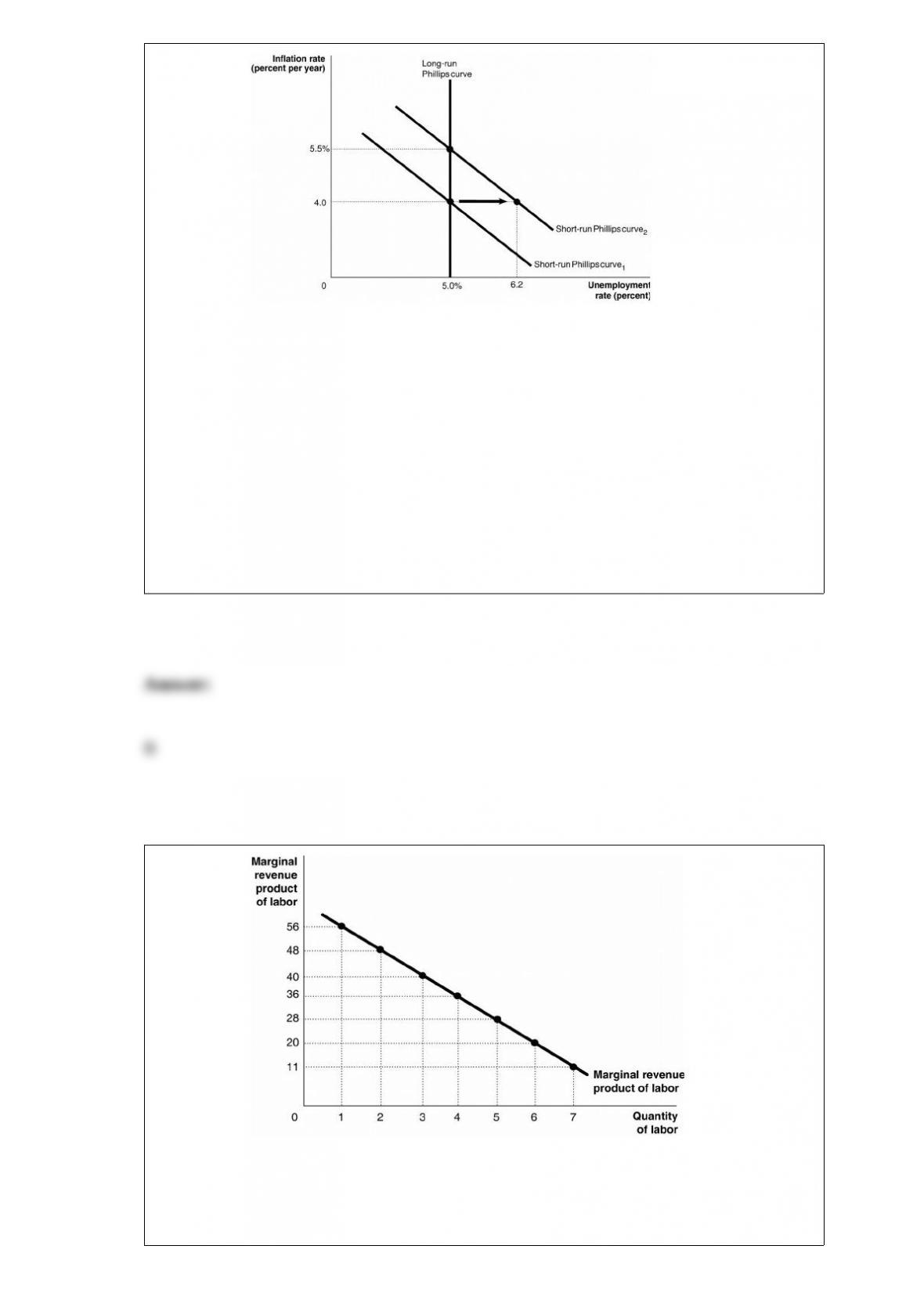
Figure 28-4
Consider the shift in the short-run Phillips curves shown in the above graph. This shift
may be explained by
A) an increase in the natural rate of unemployment from 5.0 to 6.2 percent.
B) an increase in the expected rate of inflation from 4.0 to 5.5 percent.
C) either an increase in the natural rate of unemployment from 5.0 to 6.2 percent or an
increase in the expected rate of inflation from 4.0 to 5.5 percent.
D) None of the above is correct.
Figure 17-2 Figure 17-2
shows the marginal revenue product for Becca’s Baubles, a producer of hand-beaded
bracelets.
If Becca can sell her bracelets at $3 each, what is the marginal product of the 4th

worker?
A) $36
B) 12 bracelets
C) 36 bracelets
D) $144
The impact of crowding out may be the least
A) during a deep recession.
B) when real GDP is above but close to potential GDP.
C) during an expansion.
D) when real GDP is below but close to potential GDP.
In the circular flow diagram, ________ supply the factors of production, and ________
goods and services.
A) households; sell
B) households; buy
C) firms; sell
D) firms; buy

If a monopolistically competitive firm has excess capacity
A) it has exhausted all economies of scale.
B) it is producing beyond the minimum efficient scale.
C) it is experiences diseconomies of scale.
D) it produces an output rate that places it on the negatively sloped portion of its
average total cost curve.
In an economy with ________, there are more prices than in an economy with
________.
A) barter; money
B) money; barter
C) fiat money; commodity money
D) fiat money; barter

A central bank can help stop a bank panic by
A) raising the required reserve ratio.
B) calling in consumer loans.
C) acting as a lender of last resort.
D) decreasing income taxes.
Wage differences among workers of different races and gender could be due to all of the
following except
A) differences in preferences for jobs.
B) differences in work experience.
C) differences in education.
D) labor unions.
The Apple iPhone is sold in a box labeled “Made in China,” but a study by economists
at the Asian Development Bank found that the actual percentage of the price of the
iPhone accounted for by the only work done in China, which is assembly, is
A) 4 percent.
B) 12 percent.
C) 25 percent.

D) 65 percent.
In a competitive market, when there is no deadweight loss,
A) consumer surplus is minimized.
B) producer surplus is minimized.
C) consumer surplus plus producer surplus is minimized.
D) consumer surplus plus producer surplus is maximized.
When the demand for a product is more elastic than the supply,
A) consumers pay the majority of the tax on the product.
B) consumers pay the entire tax on the product.
C) firms pay the majority of the tax on the product.
D) firms pay the entire tax on the product.
Economist A.C. Pigou argued that to deal with a negative externality in production, the
government should impose a tax equal to the cost of the externality. What did Pigou
believe should be done in the case of a positive externality in consumption? How would
his recommendation impact the demand and market equilibrium for the product which
is generating the positive externality?
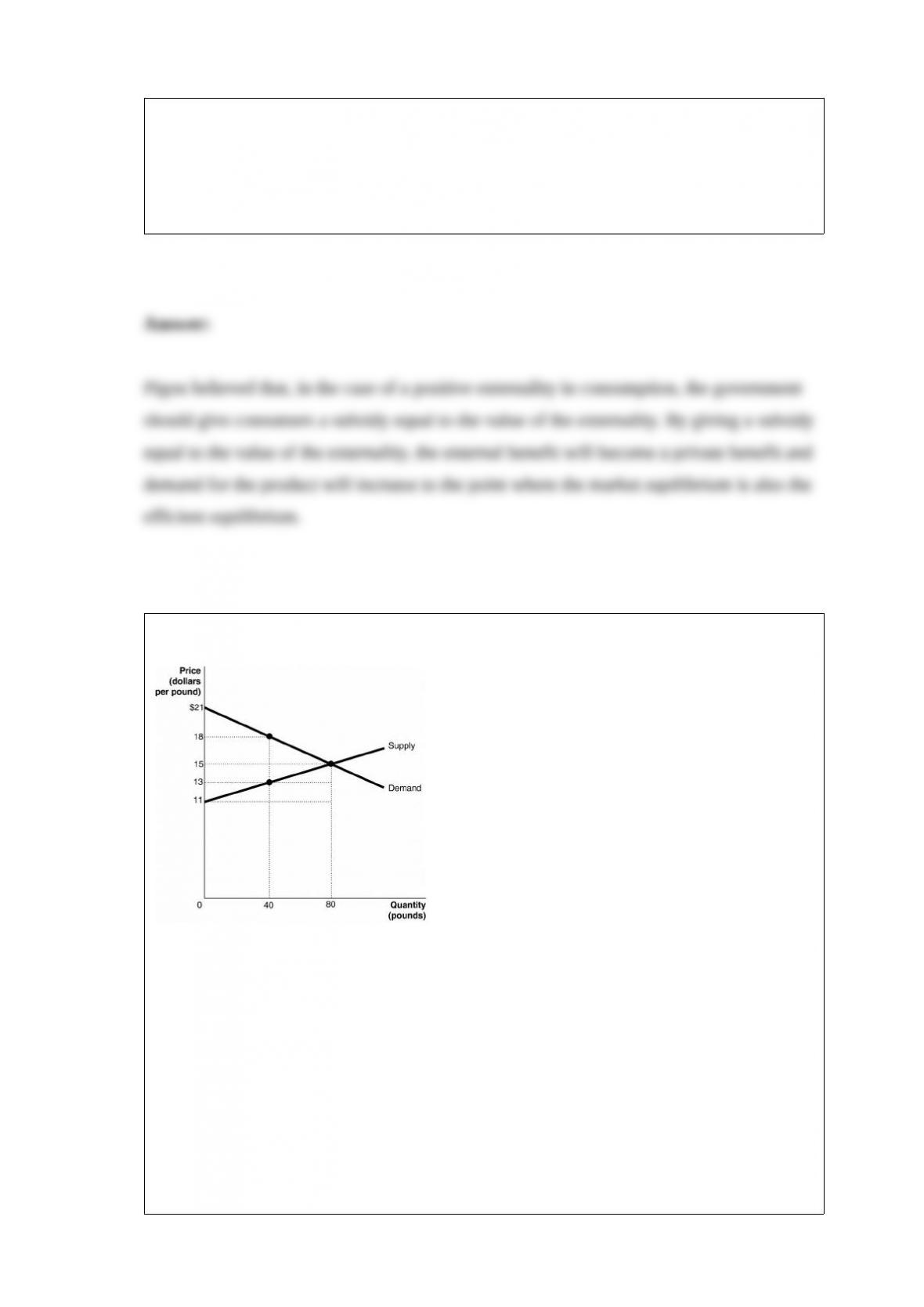
Figure 4-3
Figure 4-3 shows the market for tiger shrimp. The
market is initially in equilibrium at a price of $15 and a quantity of 80. Now suppose
producers decide to cut output to 40in order to raise the price to $18.
What is the value of consumer surplus at a price of $18?
A) $60
B) $120
C) $180
D) $240

Ali’s Gyros operates near a college campus. Ali has been selling 120 gyros a day at
$4.50 each and is considering a price cut. He estimates that he would be able to sell 200
gyros per day at $3.50 each.
a. Calculate the price elasticity of demand using the midpoint formula.
b. Calculate the change in revenue as a result of the price cut.
When the coupon rate on newly issued bonds increases relative to older, outstanding
bonds, what happens?
A) The market price of the older bond falls in the secondary market.
B) The market price of the older bond rises in the secondary market.
C) Older bonds can still be sold at their face value.
D) Older bonds will sell for less than their face value.