Pollution-generating companies tend to overproduce because
a. consumers want something as compensation for the pollution.
b. the supply curve of the firm incorporates only the private costs of production.
c. the private costs exceed the social costs.
d. consumers pay for waste disposal in the price of the product.
e. they have extra profits to spend on advertising.
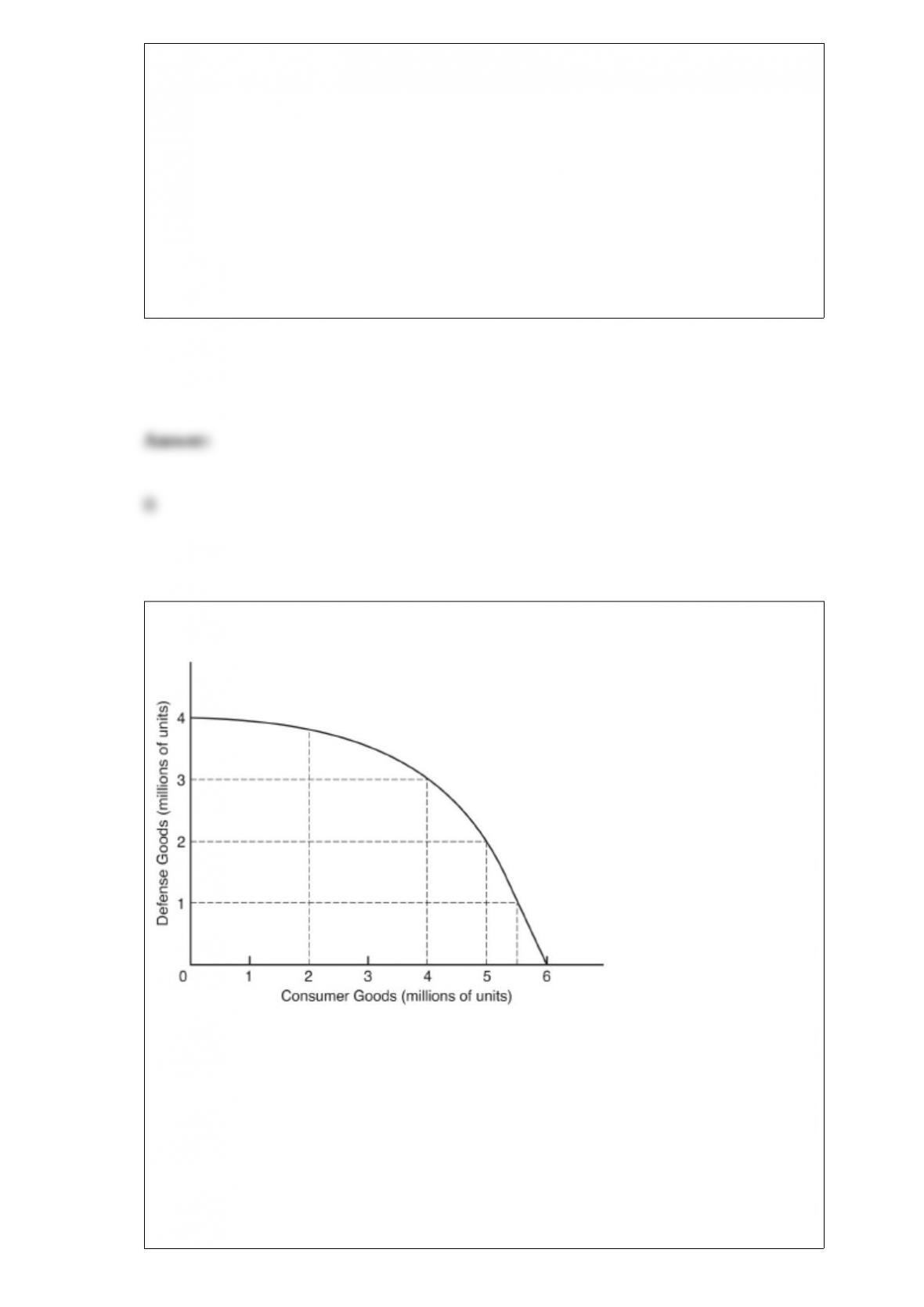
The following questions are based on the following diagram:
If the economy currently produces 4 million units of consumer goods and 2 million
units of defense goods
a. it is operating on its production possibilities curve.
b. there must be unemployment of resources.
c. it is producing a combination that requires more resources than it has.

d. it is achieving economic but not technical efficiency.
e. defense goods are preferred to consumer goods.
The effect of racial discrimination in the labor market is to
a. increase the size of the African American labor force.
b. create two separate labor markets where one would suffice.
c. eliminate other forms of discrimination.
d. raise the productivity of the labor force.
e. raise the average wage of all labor combined.
The fact that initial improvements in the health of cotton textile workers were far less
costly to achieve than the final stages of compliance with OSHA regulations illustrates
that typical production possibilities curves are
a. vertical.
b. horizontal.
c. bowed in.
d. bowed out.

e. upward sloping to the right.
As the degree of risk connected with a loan increases, the difference between the actual
rate of interest on the loan and the pure rate of interest
a. increases.
b. decreases.
c. remains unchanged.
d. becomes zero.
e. is negative.
According to real business cycle models
a. total real output does not change in response to changes in aggregate supply and
demand; only price levels change.
b. aggregate supply is horizontal so that fluctuations in real GDP result from changes in
aggregate demand.
c. changes in total real output vary inversely with changes in real GDP.
d. real output cannot grow faster than the real rate of interest.

e. real wages tend to fall when real GDP falls and rise when real GDP rises.
The assets of a commercial bank include
a. net worth.
b. demand deposits.
c. loans.
d. time deposits.
e. savings accounts.
If I spend $50 per week on gasoline, regardless of the price per gallon, my price
elasticity of demand for gasoline is
a. 0.
b. 1.
c. 2.
d. infinite.
e. indeterminable.

Inflation that wipes out the value of money quickly and thoroughly is called
a. runaway inflation.
b. deflation.
c. push-pull inflation.
d. stagflation.
e. reflation.
General Motors was formed in 1908 by
a. David Rothermel.
b. Walter Chrysler.
c. William Durant.
d. Henry Ford.
e. Alfred Sloan.

A marginal propensity to consume of 0.8 means the value of the multiplier is
a. 1.
b. 2.
c. 3.
d. 4.
e. 5.
At the national level, the brewing industry can be considered to best reflect the
characteristics of which market structure?
a. monopoly
b. pure oligopoly
c. perfect competition
d. differentiated oligopoly
e. a cartel

Changes in which of the following would be excluded from a list of factors causing the
demand curve to shift?
a. consumer tastes
b. consumer incomes
c. the price of the good
d. the number of consumers in the market
e. the level of other prices
Which of the following regions would be mostlikely to contain those countries with the
lowest per capita income?
a. North America
b. western Europe
c. Southeast Asia
d. eastern Europe
e. the Mediterranean

The power to decide on the amount of government securities the Fed should buy or sell
at any given time rests with the
a. Federal Open Market Committee.
b. president of the United States.
c. chairperson of the Federal Reserve Board.
d. secretary of the Treasury.
e. Council of Economic Advisers.
One way government could intervene when external diseconomies exist in an industry
is to act to
a. shift the industry demand curve to the right.
b. shift the industry supply curve to the left.
c. subsidize the industry to raise its profits.
d. encourage increased production of the industry’s product.
e. make the industry’s supply curve more nearly reflect the supply curve of a
competitive industry.

A slowdown in the United States’ rate of increase in productivity is of concern to policy
makers because it
a. reduces our dependency on imports.
b. may contribute to a higher rate of inflation.
c. shifts the Phillips curve downward to the left.
d. forces interest rates too low.
e. makes foreign producers less competitive.
Another term for opportunity cost is ________ cost.
a. irrelevant
b. unnecessary
c. normative
d. disappearing
e. alternative
Since the end of World War II, the incidence of poverty as measured by the Social
Security Administration’s criterion has ________ percent of the population.

a. held steady at about 15
b. declined from about 50 to 25
c. increased from about 20 to 24
d. declined from about 30 to 15
e. increased from about 25 to 32
The most important reason for having a legal reserve requirement is to
a. ensure bank safety.
b. prevent banks from reaping tremendous profits as intermediaries.
c. keep currency in circulation.
d. control the money supply.
e. provide enough money to meet everyday needs, such as check cashing and savings
withdrawals.
A major U.S. tax bill that contained a provision for an incremental tax credit for
research and development was passed in

a. 1981.
b. 1979.
c. 1974.
d. 1967.
e. 1963.
The following schedule shows the utility Mr. Pomeroy derives from consumption of
various amounts of food per day. Use it to answer the next question.
A person who eats a first chocolate from a box of candies, and a second, then a third,
and so on (and nothing else), in an afternoon experiences a
a. continuous fall in total utility.
b. continuous rise in marginal utility.
c. simultaneous rise and fall in both total and marginal utility.
d. rise in marginal utility while total utility declines.
e. rise in total utility while marginal utility rises and then falls.

Over the past 50 years, the U.S. money supply has
a. increased every year, despite federal efforts to hold it in check.
b. increased in some years but has tended to shrink overall.
c. generally increased, although not at a constant rate.
d. not changed; although the amount of money in circulation has varied, the actual
money supply has not grown or shrunk.
e. fallen.
Both aggregate demand and aggregate supply curves are relationships between
a. income and employment.
b. output and income.
c. the price level and real output.
d. interest rates and the prices of financial assets.
e. inflation and unemployment.
The need for barter is eliminated when money is used as a
a. medium of exchange.

b. measure of the price level.
c. standard of value.
d. hoard of wealth.
e. store of value.
Incomes policies are another name for
a. the Employment Act of 1946.
b. functional finance.
c. welfare programs.
d. wage and price guidelines and/or controls.
e. a full-employment budget.
The following questions are based on the following diagram of a monopolist:
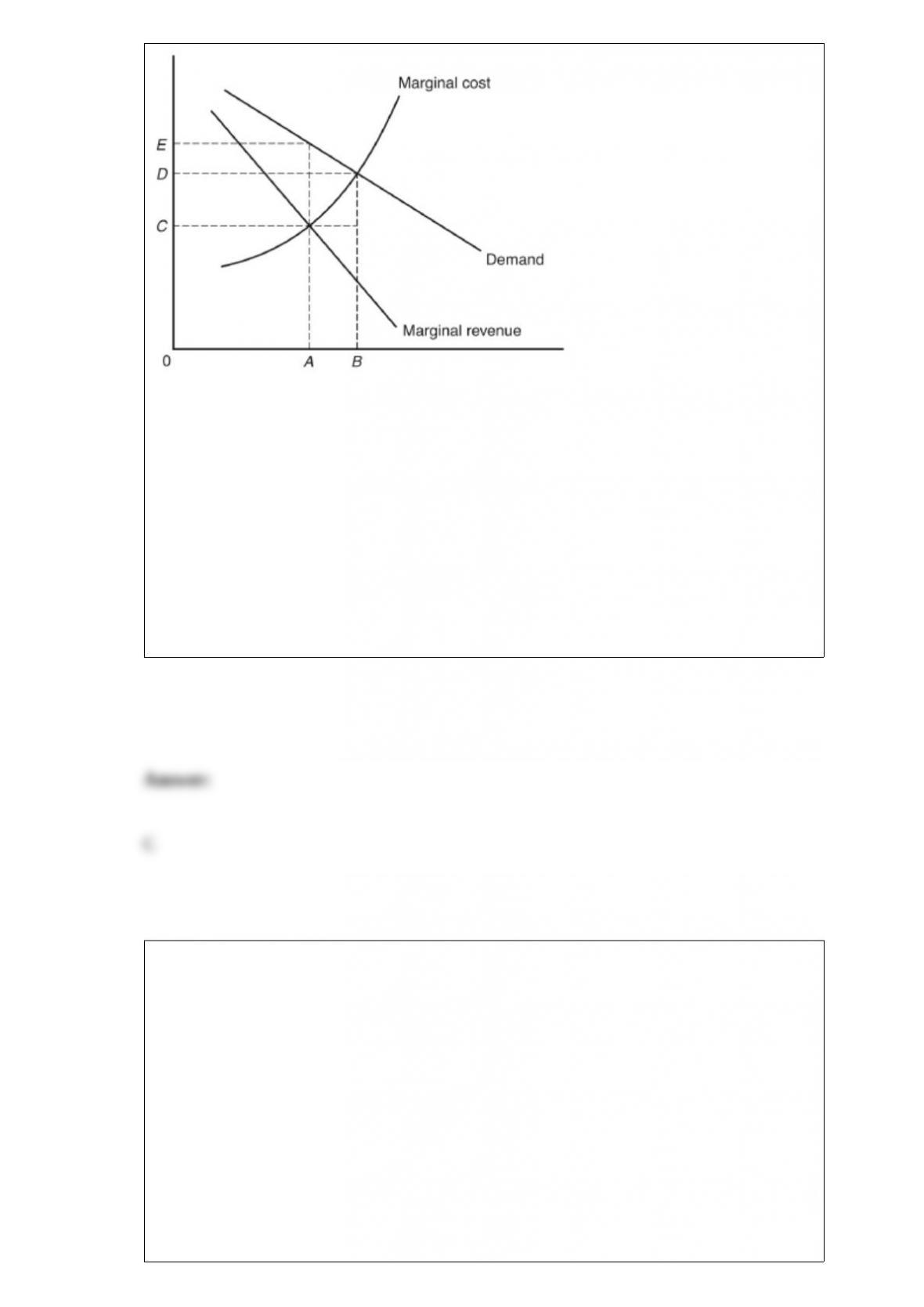
At the profit-maximizing output rate, marginal costs will be
a. 0A.
b. 0B.
c. 0C.
d. 0D.
e. 0E.
On a Keynesian-style aggregate supply curve, expansionary fiscal and monetary
policies have the smallest impact on the price level when the economy is operating in
the ________ range.
a. horizontal
b. coincident
c. intermediate
d. vertical
e. optimal
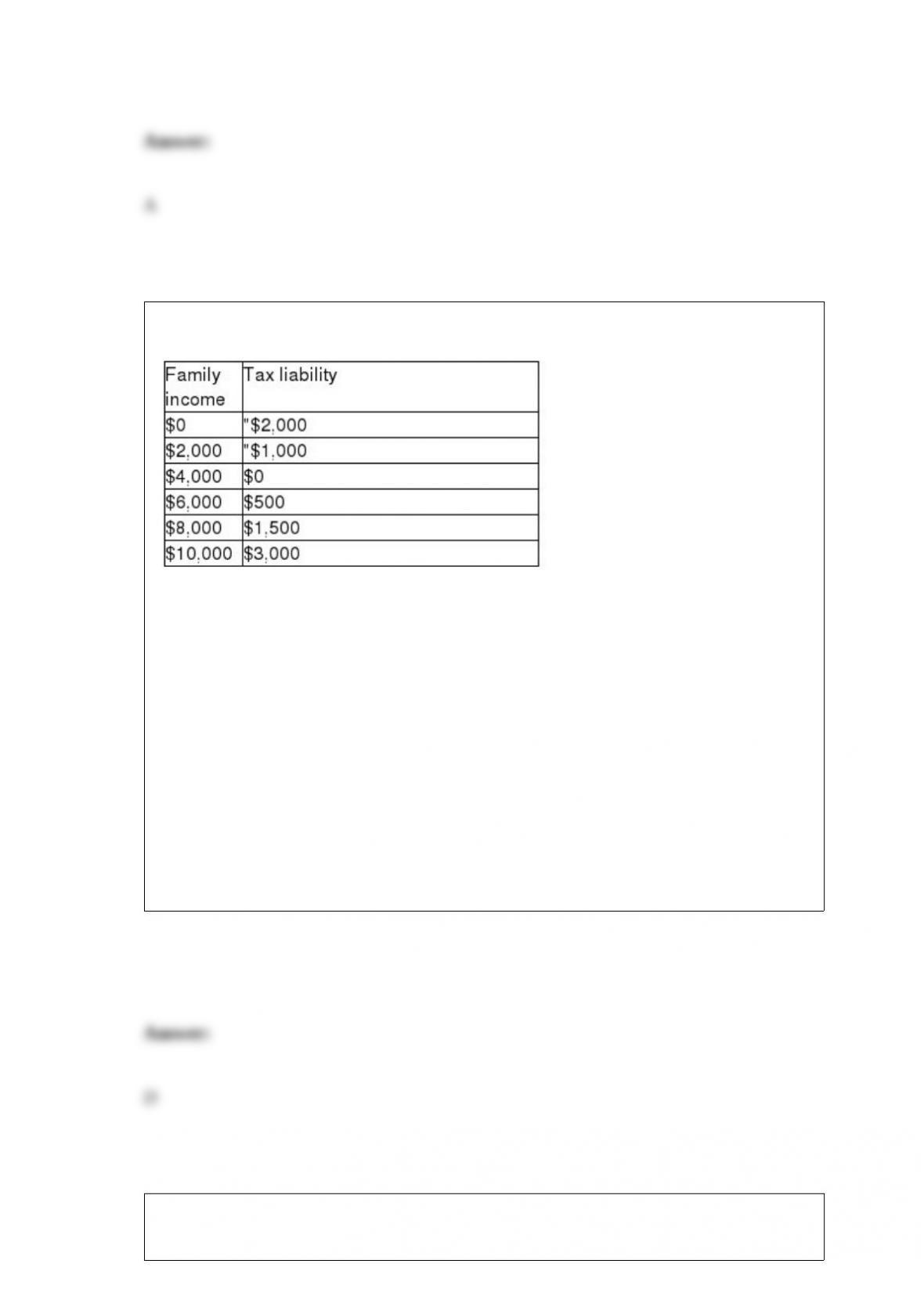
This table shows a payment schedule for a hypothetical negative income tax program.
Suppose a family with an earned income of $2,000 receives an extra $2,000 under a
negative income tax scheme. If this family’s earned income increased by $100, the tax
payment it receives would
a. remain at $2,000.
b. decrease by $100.
c. decrease by more than $100.
d. decrease by less than $100.
e. increase but by less than $100.
If intended investment increases from 200 to 250, GDP will rise by ________ billion.

a. $30
b. $50
c. $83
d. $125
e. $250
In which of the following situations describing the coffee-versus-computer production
possibilities potential does country A have a comparative advantage in coffee? Country
A: 1,000 bushels of coffee or 10 computers; country B:
a. 500 bushels of coffee or 5 computers.
b. 1,200 bushels of coffee or 12 computers.
c. 1,500 bushels of coffee or 12 computers.
d. 1,300 bushels of coffee or 15 computers.
e. 1,600 bushels of coffee or 15 computers.
If the average product of labor falls from 5 to 4.5 when a sixth unit of labor is added,
the marginal product of this sixth person is

a. 27.
b. 9.5.
c. 4.5.
d. 2.
e. 0.5.
The phenomenon of the backward-bending market supply curve for labor
a. indicates the declining quality of labor as unemployment decreases.
b. reflects the policy of labor unions.
c. results from falling worker productivity as income increases.
d. results from workers’ increased preference for work as wage rates rise.
e. indicates a worker’s desire to buy more leisure as income rises.