
The difference between profit seeking under perfect competition and profit seeking
under monopoly is that
a. under the former output will increase and price will decrease, whereas under the
latter only output will increase.
b. under the former output will increase and price may increase, whereas under the
latter output will increase and price will decrease.
c. under the former new firms will enter the industry, whereas under the latter the firm
will simply raise its price and earn higher profits.
d. none of the above
A constant-cost industry has a long-run (industry) supply curve that is
a. upward sloping.
b. downward sloping.
c. horizontal.
d. U-shaped.
Refer to Exhibit 34-4. The opportunity cost of one unit of good B is __________ for

country 1 and __________ for country 2.
a. 20A; 15A
b. 2A; 1A
c. 40A; 15A
d. 1/2A; 1A
e. 1/40A; 1/15B
A possible objective of labor unions is
a. employment for all their members.
b. minimizing the total wage bill.
c. maximizing income for all union members.
d. all of the above
e. none of the above

When marginal private cost is less than marginal social cost,
a. a public good exists.
b. a negative externality exists.
c. a positive externality exists.
d. negative economic profits are made.
e. a and d
If the Gini coefficient is 1, there is
a. complete income inequality.
b. complete income equality.
c. relative income equality.
d. relative income inequality.

A voter will tend to be more informed if the issue in question
a. affects everyone very little.
b. is complicated and difficult to understand.
c. has an intense and a direct effect on the voter.
d. is of special interest to a small group to which the voter does not belong.
In order for a firm to earn economic profits, price must exceed average total cost.
a. True
b. False
In the long run,
a. all costs are variable costs.
b. all costs are fixed costs.
c. there are no variable costs.
d. b and c

Suppose the data show that each year between 1964 and 2014, 10 percent of all income
earners (in the United States) earned a low enough income to be considered poor. It
follows that
a. the person who was part of the 10 percent poor in 1964 was also part of the 10
percent poor in 2014.
b. the person who was part of the 10 percent poor in 1964 may not be part of the 10
percent poor in 2014.
c. there is no upward income mobility in the United States.
d. the income distribution in the United States (during this period of time) was unequal.
e. b and d
Which of the following issues is most unlikely to be addressed by an economist
practicing positive economics?
a. the relationship between the minimum wage and the number of unemployed
unskilled workers
b. the effect of a minimum wage increase on inner-city crime rates
c. the desirability of a minimum wage increase
d. the consequences of implementing a minimum wage law in China

If for good Z income elasticity is less than 1 but greater than zero, then demand for
good Z is income __________, and good Z is a(n) __________ good.
a. inelastic; normal
b. inelastic; inferior
c. elastic; normal
d. elastic; an inferior
e. unit elastic; normal
Which of the following statements is false?
a. Competing for artificial rents is socially unproductive; competing for real rents is not.
b. If the production of good X generates real rents, then in the process of competing for
these real rents, it would not be unusual for the supply of good X to rise.
c. Individuals and firms will compete for real rents, but not for artificial rents.
d. An artificial rent is an economic rent that would not exist without government.

Refer to Exhibit 35-5.Based on the information provided in this table, between Monday
and Tuesday, the U.S. dollar ____________ against the Japanese yen and the yen
_____________ against the U.S. dollar.
Exhibit 35-5
U.S. $ EquivalentForeign Currency per U.S. $
a. appreciated; appreciated
b. depreciated; appreciated
c. appreciated; depreciated
d. depreciated; depreciated
To an economist, wage discrimination exists when
a. individuals of equal marginal revenue products are paid different wage rates.
b. people of different ethnic backgrounds are treated differently by employers.
c. women are paid different wage rates than men.
d. African-Americans are paid different wage rates than whites.
e. b, c, and d

In the supply-and-demand diagram of the market for peanut butter, the equilibrium
point has moved up and to the right. What could have caused this?
a. a fall in the price of peanuts
b. a rise in the price of peanuts
c. a rise in income, assuming that peanut butter is an inferior good
d. a shift in preferences toward peanut butter
e. none of the above
How is scarcity related to competition?
a. Competition is an effect of scarcity.
b. Scarcity is an effect of competition.
c. Both scarcity and competition are effects of a rationing device.
d. Both scarcity and competition are effects of opportunity cost.
e. Scarcity produces disutility and competition produces utility.

A monopolist can sell 8,000 units at a price of $15. Lowering price by $2 raises the
quantity demanded by 2,000 units. What is the change in total revenue that results from
this price change?
a. $10,000
b. $4,000
c. $130,000
d. $90,000
When the government enacts policies that lead to lower mortgage lending standards and
lower interest rates, their actions can indirectly lead to higher home prices.
a. True
b. False
The elasticity of demand for labor measures the percentage change in quantity
demanded of labor that occurs as a result of a percentage change in the wage rate.
a. True
b. False

A perfectly competitive firm will always maximize short-run profits by producing the
level of output where average total cost is minimized.
a. True
b. False
A “devaluation” occurs when
a. the official price of a currency is raised.
b. the official price of a currency is lowered.
c. a nation’s currency depreciates under a flexible exchange rate system.
d. a nation’s currency appreciates under a flexible exchange rate system.
e. none of the above
Refer to Exhibit 23-1. The data in this table are relevant to a perfectly competitive firm
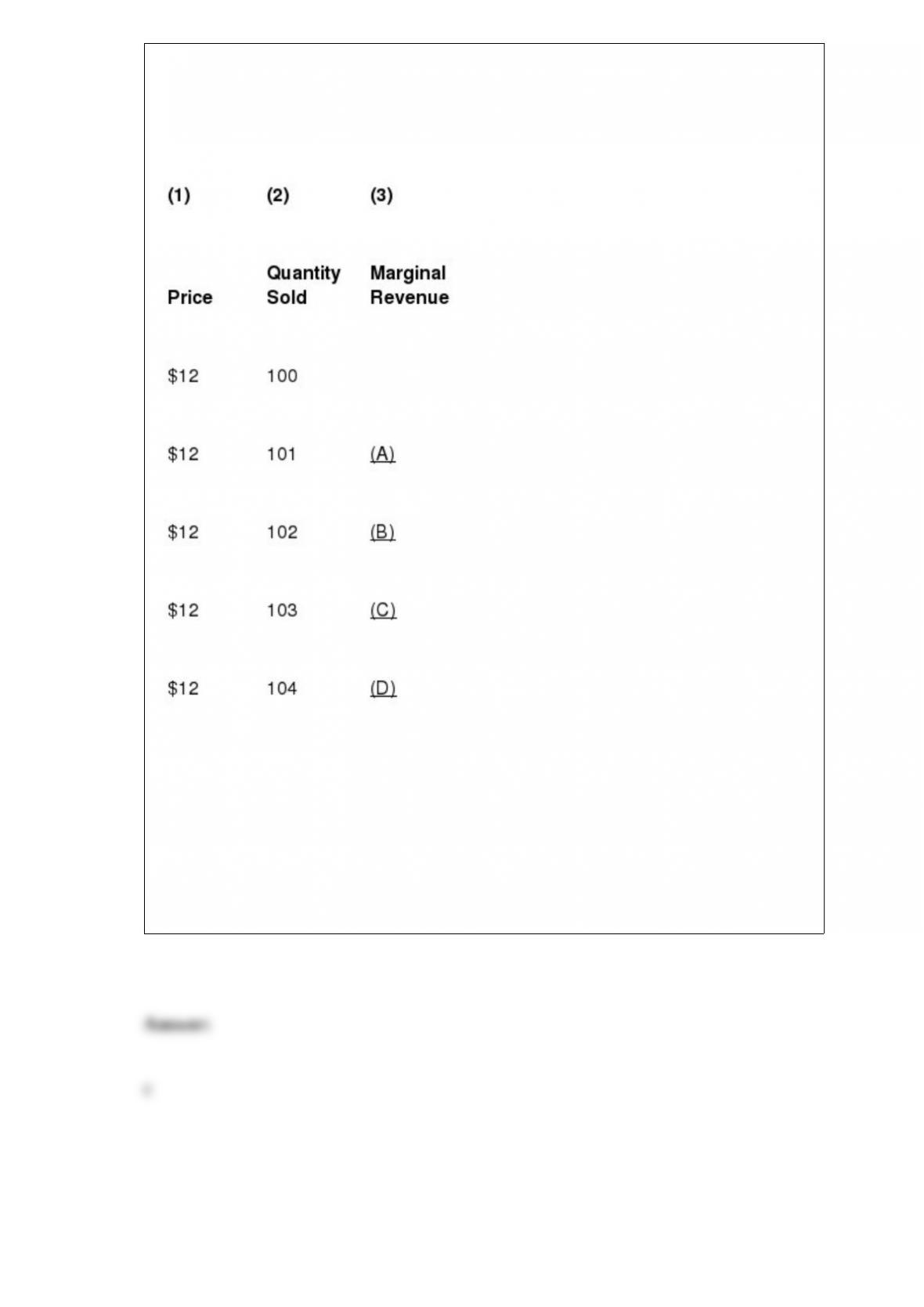
because
Exhibit 23-1 (1) (2) (3)
a. its total revenue is different at different levels of quantities sold.
b. its total revenue is the same at all levels of quantities sold.
c. it doesn’t have to lower price to sell additional units of the product.
d. marginal revenue is greater than price.