
1) susie buys two goods – rounds of golf and massages. suppose that the price of a
round of golf is $20, and the price of a massage is $30. in a typical week susie will play
two rounds of golf, getting 20 units of satisfaction from the second round. she normally
buys three massages each week, with the third giving her 30 units of satisfaction. if she
were to buy a fourth massage in a week, it would give her 20 units of satisfaction. if the
price of massages is reduced to $15, which of the following outcomes might we expect
to occur?
a.susie would leave her consumption choices unchanged because of diminishing
marginal utility in the consumption of massages.
b.susie would buy more massages and fewer rounds of golf, as predicted by the income
effect.
c.susie would buy more massages and more rounds of golf, as predicted by the
substitution effect.
d.susie would buy more massages and fewer rounds of golf, as predicted by the
substitution effect.
2) at each point on an indifference curve:
a.money income is the same.
b.the prices of the two products are the same.
c.total utility is the same.
d.marginal utility is the same.
3) if nominal gdp in some year is $280 and real gdp is $160, then the gdp price index
for that year is:
a.175.
b.57.
c.160.
d.280.
4) Per-unit production cost is:
A.real output divided by inputs.
B.total input cost divided by units of output.
C.units of output divided by total input cost.
D.a determinant of aggregate demand.

5) prashanth decides to buy a $75 ticket to a particular new york professional hockey
game rather than a $50 ticket for a particular broadway play. we can conclude that
prashanth:
a.is relatively unappreciative of the arts.
b.obtains more marginal utility from the play than from the hockey game.
c.has a higher “marginal utility to price ratio” for the hockey game than for the play.
d.has recently attended several other broadway plays.
6) The aggregate supply curve (short-run) is upsloping because:
A.wages and other resource prices match changes in the price level.
B.the price level is flexible upward but inflexible downward.
C.per-unit production costs rise as the economy moves toward and beyond its
full-employment real output.
D.wages and other resource prices are flexible upward but inflexible downward.
7) in recent years, firms that produce the wide variety of corn-based products have
experienced rising costs. this has been due primarily to:
a.introduction of expensive capital used to process corn.
b.lower productivity in processing corn.
c.lower prices for corn.
d.higher prices for corn.
8) the following is cost information for the creamy crisp donut company:
entrepreneur’s potential earnings as a salaried worker = $50,000
annual lease on building = $22,000
annual revenue from operations = $380,000
payments to workers = $120,000
utilities (electricity, water, disposal) costs = $8,000
value of entrepreneur’s talent in the next best entrepreneurial activity = $80,000
entrepreneur’s forgone interest on personal funds used to finance the business = $6,000
refer to the above data. creamy crisp’s accounting profit is:
a.$150,000.
b.$380,000.
c.$230,000.
d.$294,000.
9) The equality-efficiency tradeoff refers to:
A.the conflict between risk averters and risk takers.
B.the willingness of Congress to abandon existing welfare programs in favor of a
comprehensive plan to increase education and training for low-income persons.
C.possible conflicts between the goals of economic efficiency and greater income
equality.
D.the difference between the goals of income equality and equality of economic
opportunity.
10) gdp includes:
a.neither intermediate nor final goods.
b.both intermediate and final goods.
c.intermediate, but not final, goods.
d.final, but not intermediate, goods.
11)
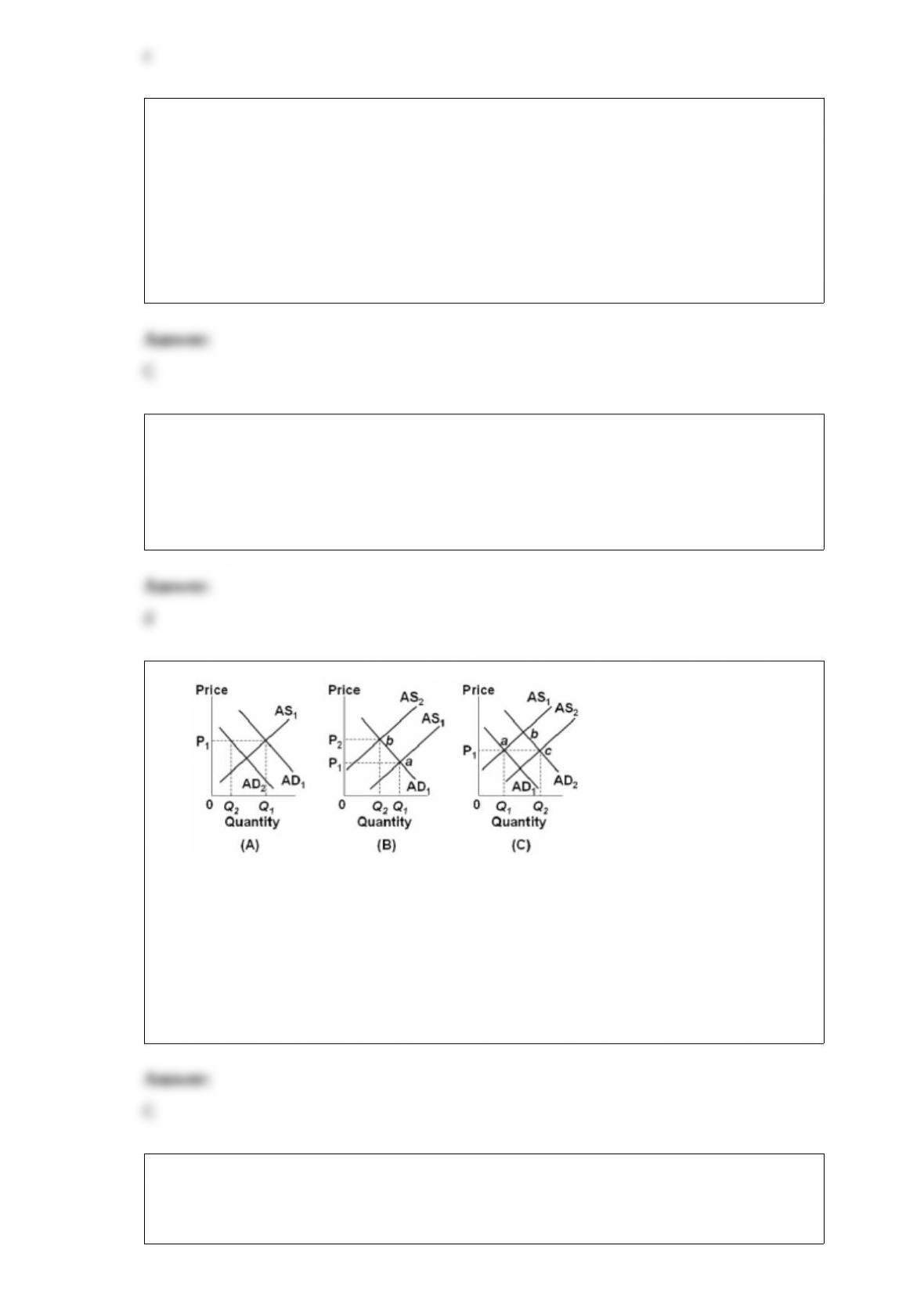
Refer to the above diagrams, in which AD1 and AS1 are the “before” curves and AD2
and AS2 are the “after” curves. Other things equal, an increase in investment spending
is depicted by:
A.panel (A) only.
B.panel (B) only.
C.panel (C) only.
D.panels (B) and (C).
12) Construction workers frequently sponsor political lobbying in support of greater
public spending on highways and public buildings. One reason they do this is to:
A.restrict the supply of construction workers.

B.increase the elasticity of demand for construction workers.
C.increase the demand for construction workers.
D.increase the price of substitute inputs.
13) gross domestic product (gdp) measures and reports output:
a.as an index number.
b.in percentage terms.
c.in dollar amounts.
d.in quantities of physical units (for example, pounds, gallons, and bushels).