
In which of the following situations might you expect expansionary monetary policy to
reduce the unemployment rate?
A) if expectations are rational
B) if changes in monetary policy are unanticipated
C) if actual inflation is higher than expected
D) if actual inflation is lower than expected
Which of the following would cause a decrease in the supply of milk?
A) an increase in the price of cookies (assuming that milk and cookies are
complements)
B) a decrease in the price of milk
C) an increase the price of a product that producers sell instead of milk
D) an increase in the number of firms that produce milk
The law of one price holds exactly only if
A) antitrust laws are being enforced.
B) buyers have complete information.
C) transactions costs are zero.
D) it is impossible for buyers to resell the good.
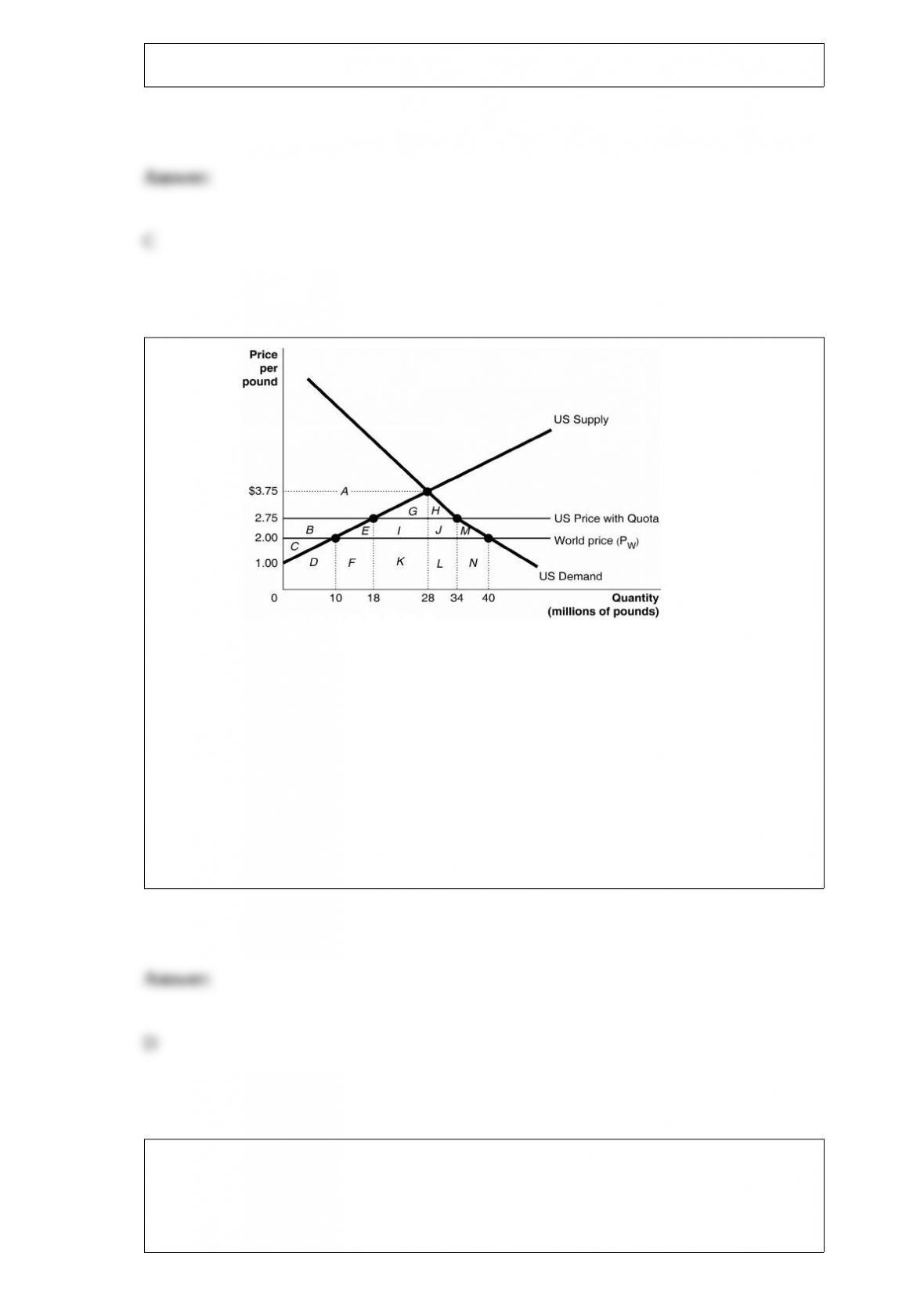
Figure 9-3 Since 1953 the
United States has imposed a quota to limit the imports of peanuts. Figure 9-3 illustrates
the impact of the quota. What is the area that represents the deadweight loss as a result
of the quota?
A) G + H
B) G + H + I + J
C) E + I + J + M
D) E + M
Which of the following isnot an example of rent-seeking behavior?
A) competition for subsidies

B) lobbying the government to impose tariffs on certain imported products
C) competition for the exclusive right to import a product
D) engaging in aggressive advertising that slams a competitor’s product
Firms
A) have no influence on the circular flow in a market economy.
B) purchase resources in the product market.
C) sell goods in the product market.
D) sell resources in the factor market.
The real wage equals the nominal wage ________ the CPI, all times 100.
A) divided by
B) times
C) minus
D) plus

All centrally planned economies
A) have been political dictatorships.
B) started out as market economies.
C) began as mixed economies.
D) have become mixed economies.
A firm that is first to the market with a new product frequently discovers that there are
design flaws or problems with the product that were not anticipated. How do these
problems affect the innovating firm?
A) The firm is protected by a first-mover advantage: Initial design flaws tend not to
harm a firm significantly because consumers resist changing products for fear of
incurring high switching costs.
B) They reduce profits for the new innovations and open the door to competitors who
can enter the new market with a better product.
C) Because these design flaws were not anticipated, consumers tend to be more
forgiving and are likely to remain loyal to the company and its products.
D) The firm’s cost increases as it improves the product, but it will not be able to raise its
price for fear of alienating customers. Consequently, its profits will erode although its
market share remains secure.

Silver is an example of a
A) commodity money.
B) barter money.
C) fiat money.
D) representative money.
The real rate of interest is
A) the nominal interest rate plus the inflation rate.
B) the nominal interest rate minus the inflation rate.
C) the interest rate determined by the supply and demand in the money market.
D) the nominal interest rate.
Which of the following statements is true about monopolistically competitive firms?
A) Unlike perfectly competitive firms, monopolistically competitive firms are able to
raise their prices without losing all of their customers.
B) Like perfectly competitive firms, monopolistically competitive firms are not able to
raise prices without losing all of their customers because they face competition from

firms selling similar products.
C) Like perfectly competitive firms, monopolistically competitive firms maximize their
profits by settling price equal to marginal cost.
D) Unlike perfectly competitive firms, monopolistically competitive face perfectly
inelastic demand curves.
A tax is efficient if
A) individuals with the lowest incomes pay proportionately lower taxes than individuals
with the highest incomes.
B) it is based on profits earned and not on wages.
C) it encourages saving and investment.
D) it imposes a small excess burden relative to the revenue it raises.
Table 12-2

Table 12-2 lists the various pounds (lbs.) of apples that Margie Stattler can sell. Assume
that Margie operates in a perfectly competitive market. How many pounds of apples
should Margie sell to maximize her profit?
A) 300 pounds
B) 400 pounds
C) This cannot be determined without knowing Margie’s total or marginal production
costs.
D) This can be determined only when all of the values for market price, total revenue,
average revenue and marginal revenue are given.

Figure 22-4
Within a country, the impact of wars and revolutions and their subsequent destruction of
capital is reflected in the per-worker production function in the figure above by a
movement from
A) A to C.
B) B to C.
C) B to A.
D) E to B.