
1) A reduction in the collective discrimination coefficients of employers will increase
the wage rate of those discriminated against, but reduce their employment.
2) Mainstream macroeconomics has incorporated some aspects of monetarism and
rational expectations theory.
3) Process innovation is represented as a downshift in a firm’s total product curve and
its average total cost curve.
4) central planning is plagued with a coordination problem and an incentive problem.
5) The higher a resource’s current price, the more extraction should be delayed to a later
period.
6) The operational lag of fiscal policy refers to the time that elapses between the
beginning of a recession or inflation and the certain awareness that it is actually
happening.
7) If you pay a $1,000 tax on $10,000 of taxable income and a $3,000 tax on a taxable
income of $16,000, the tax is progressive.

8) an income elasticity coefficient of -1.8 means the product is a normal good.
9) Capital flight refers to the fact that many DVCs must use their export earnings to pay
interest on their outstanding external debts.
10) productivity growth was greater between 1973 and 1995 than between 1995 and
2007.
11) Electricity generating plants with low fixed costs tend to have high operating costs.
12) The total fertility rate is the average number of children that each person is expected
to have during his or her lifetime.
13) A firm’s optimal amount of R&D occurs where the interest-rate cost of funds and
the expected rate of return are equal.
14) answer the next question(s) on the basis of the following national income data. all
figures are in billions of dollars.
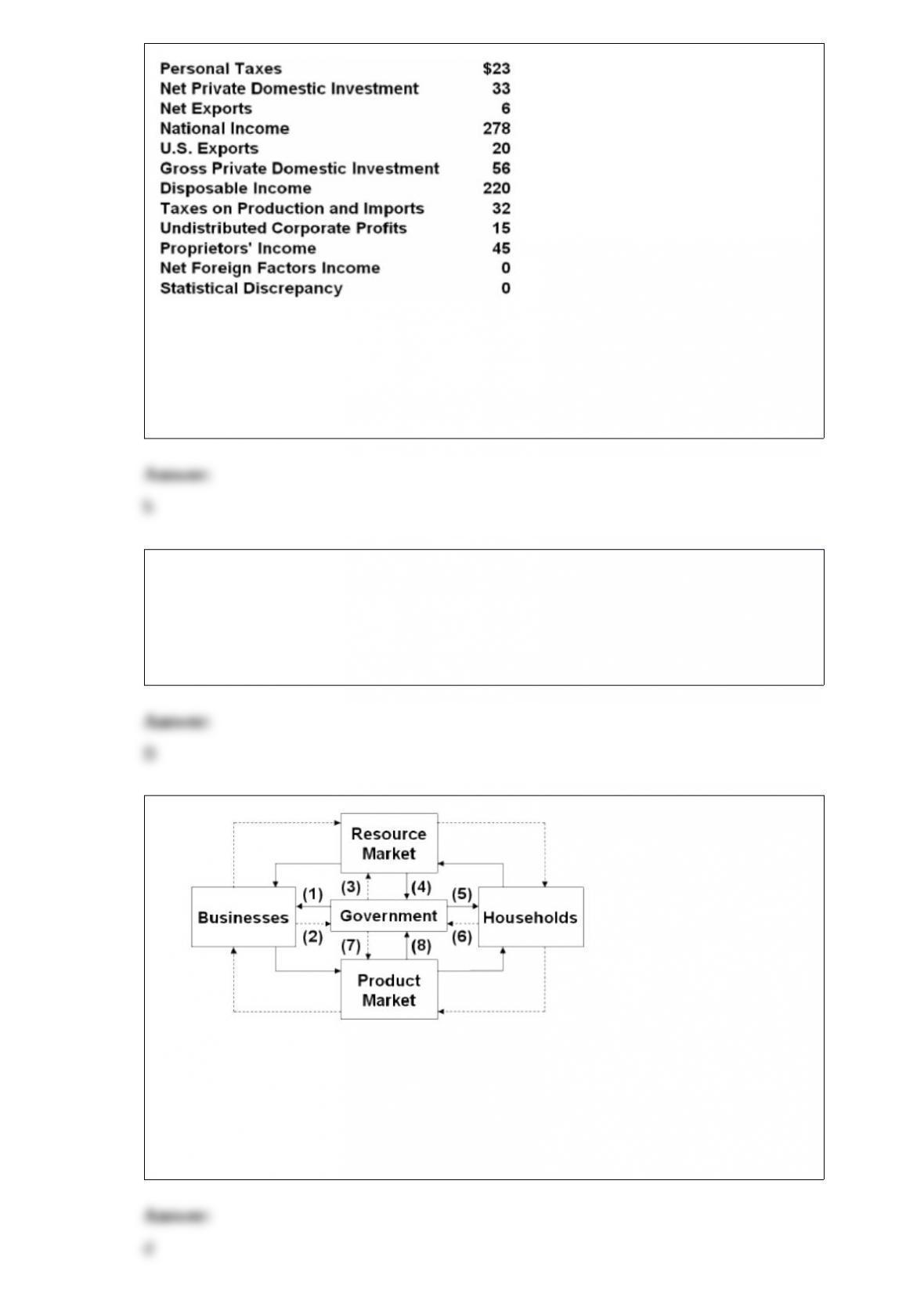
refer to the above data. the gross domestic product is:
a.$328.
b.$301.
c.$382.
d.$333.
15) In a labor dispute in which the existing contract has expired, a:
A.firm can legally lock up unruly workers.
B.firm can legally lock out union workers.
C.union can legally restrict customer access to the firm.
D.union can legally restrict physical access by management to the firm.
16)
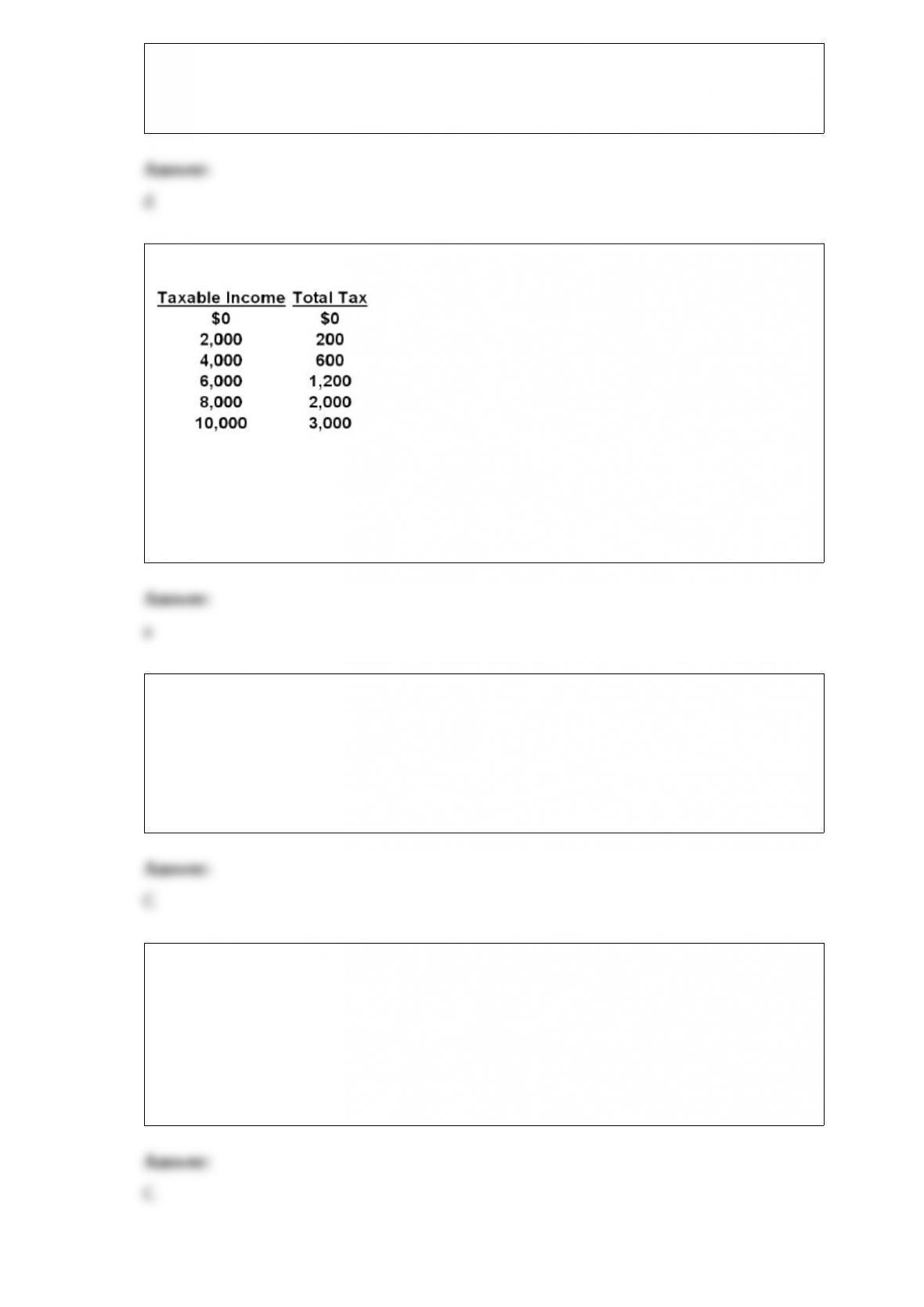
refer to the above diagram, in which solid arrows reflect real flows; broken arrows are
monetary flows. flow (7) might represent:
a.a transfer payment to disabled persons.
b.wage payments to public school teachers.
c.subsidies to corporations to stimulate exports.
d.the u.s. bureau of engraving and printing’s expenditures for paper.

17)
Refer to the above diagram. The degree of built-in stability in the above economy could
be increased by:
A.reducing government purchases so that the purchases line shifts downward but
parallel to its present position.
B.changing the tax system so that the tax line is shifted downward but parallel to its
present position.
C.changing the tax system so that the tax line has a greater slope.
D.altering the government expenditures line so that it has a positive slope.
18) Public choice theorists contend public bureaucracies are inefficient primarily
because:
A.the value of public goods is more easily measured than is the value of private goods.
B.of the absence of competitive market pressures.
C.public sector workers are more security-conscious than are private sector workers.
D.relatively low pay in government attracts workers of lesser quality.
19) if for a firm p = minimum atc = mc, then:
a.neither allocative efficiency nor productive efficiency is being achieved.
b.productive efficiency is being achieved, but allocative efficiency is not.
c.both allocative efficiency and productive efficiency are being achieved.
d.allocative efficiency is being achieved, but productive efficiency is not.
20) which of the following could be used to correct for a positive externality?
a.a subsidy to consumers of the good.
b.a subsidy to producers of the good.
c.provision of the good by government.
d.all of these are ways to correct for a positive externality.
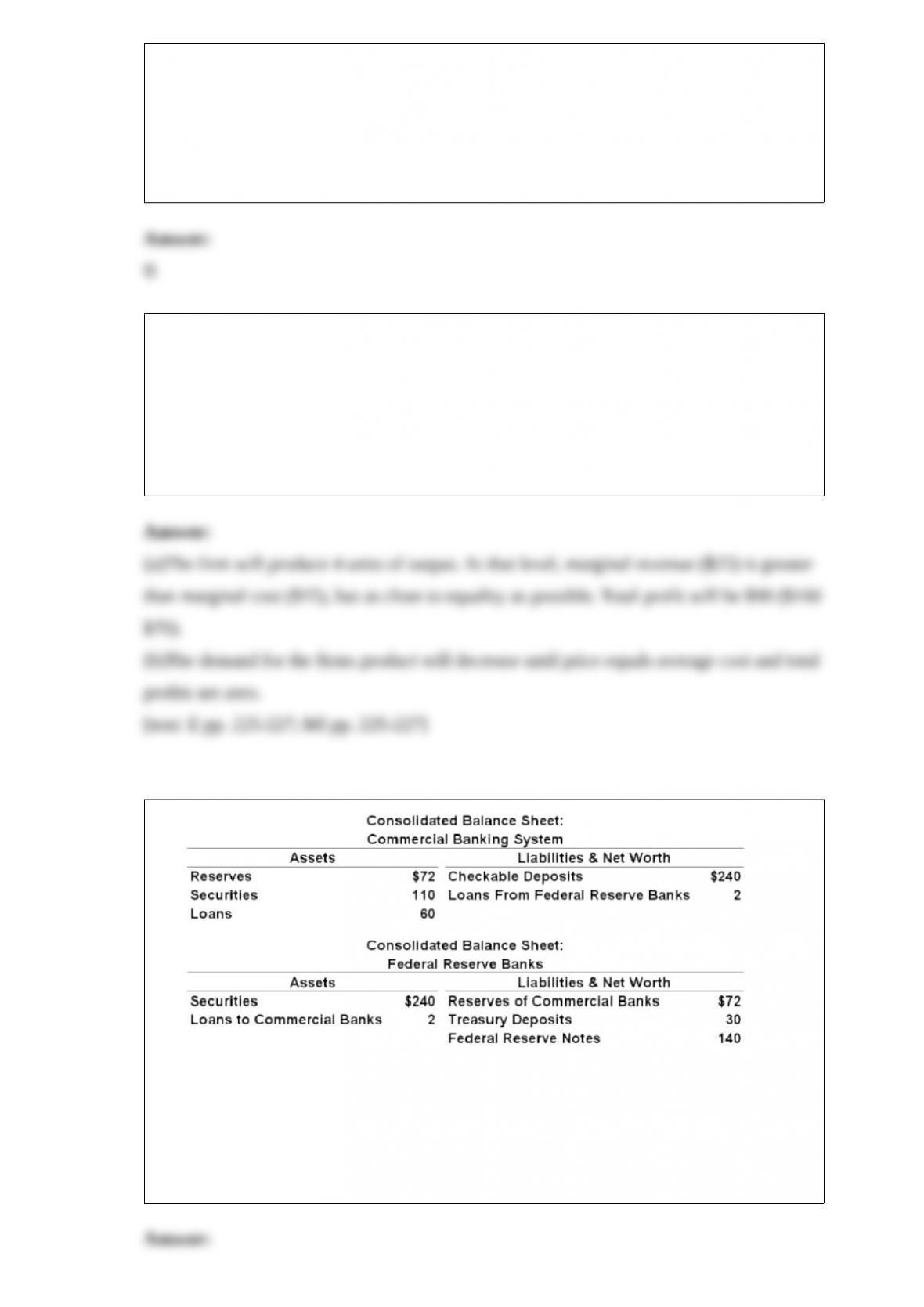
21) the following data represent a personal income tax schedule.
refer to the above table. this tax is such that the after-tax distribution of income will be:
a.more equal than the before-tax distribution.
b.less equal than the before-tax distribution.
c.distributed in precisely the same way as the before-tax distribution.
d.less than the before-tax distribution by the same percentage at each income level.
22) A normal profit is:
A.the average profitability of a firm over one complete business cycle.
B.calculated by subtracting explicit costs from total revenue.
C.the return required to retain entrepreneurial talent in some particular line of
production.
D.the amount by which total revenue exceeds total costs.
23) A major criticism of industrial regulation is that:
A.it has been applied to virtually all major U.S. corporations in the post-Second World
War period.
B.marginal cost pricing has created an underallocation of resources.
C.by allowing a fair return price, it gives natural monopolists little incentive to contain
costs.
D.regulatory commissions have frequently caused natural monopolies to go bankrupt.
24) Which of the following helps explain growing income inequality in the United
States in recent years?
A.reduced immigration
B.increased demand for highly skilled workers
C.the falling labor force participation rate of women
D.increased power of unions
25) Assume that the short run cost and demand data given in the table below confront a
monopolistic competitor selling a given product and engaged in a given amount of
product promotion. Compute the marginal cost and marginal revenue of each unit of
output and enter these figures in the table.
(a)At what output level and at what price will the firm produce in the short run? What
will be the total profit?
(b)What will happen to demand, price, and profit in the long run?
26)
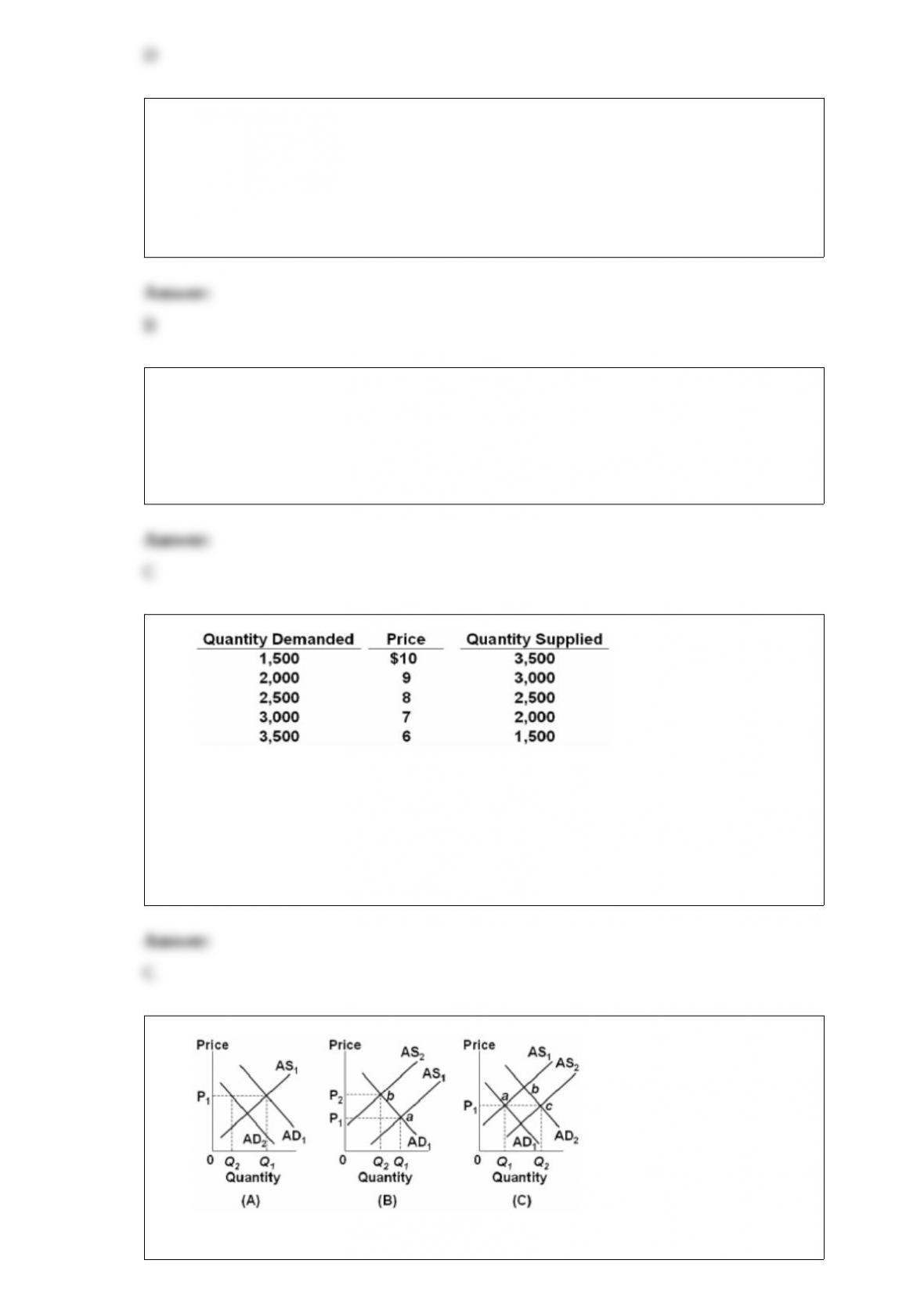
Which of the following is correct? When the Federal Reserve buys government
securities from the public, the money supply:
A.contracts and commercial bank reserves increase.
B.expands and commercial bank reserves decrease.
C.contracts and commercial bank reserves decrease.
D.expands and commercial bank reserves increase.
27) Since its inception in 1996, the Temporary Assistance for Needy Families (TANF)
program has:
A.increased, rather than reduced, the number of people on welfare.
B.reduced the number of people on welfare by more than one-half.
C.aided the poor by automatically increasing welfare payments when inflation occurs.
D.greatly increased the unemployment rate.
28) In 2007, the U.S. unionization rate was:
A.5.5 percent, down by nearly one-half from the mid-1950s.
B.15.7 percent, up by about one-fourth from the mid-1950s.
C.12.1 percent, down by nearly one-half from the mid-1950s.
D.21.2 percent, down by 4 percentage points from the mid-1950s.
29)
Refer to the above data. If government levies a per unit excise tax of $1 on suppliers of
this product, equilibrium price and quantity will be:
A.$9 and 3,000.
B.$7.50 and 2,250.
C.$8.50 and 2,250.
D.$7 and 3,000.
30)
Refer to the above diagrams, in which AD1 and AS1 are the “before” curves and AD2
and AS2 are the “after” curves. A recession is depicted by:
A.panel (A) only.
B.panel (B) only.
C.panel (C) only.
D.panels (A) and (B).
31) The transactions demand for money will shift to the:
A.right when the interest rate increases.
B.left when the interest rate decreases.
C.right when aggregate income increases.
D.right when aggregate income decreases.
32) If the MPC in an economy is .75, a $1 billion increase in taxes will ultimately
reduce consumption by:
A.$1 billion.
B.$.75 billion.
C.$3 billion.
D.$4 billion.
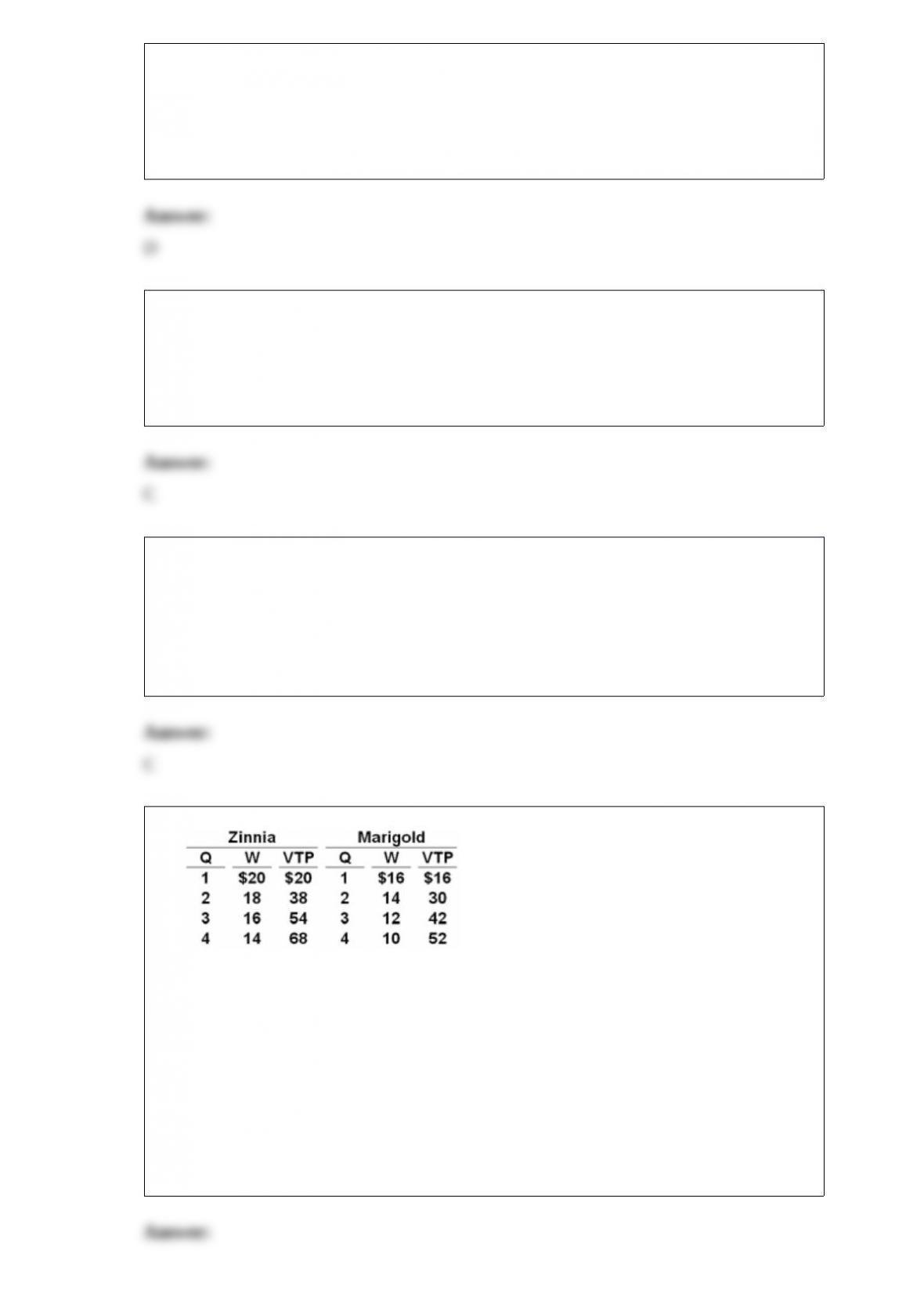
33)
symbols: q = number of workers demanded; w = wage rate; and vtp = value of the
cumulative total product (output) of the particular number of workers.
assumptions: (1) the current wage in zinnia is $20 and the current wage in marigold is
$12; (2) full employment exists in both countries.
refer to the above data, symbols, and assumptions. both nations have:
a.identical labor demand curves.
b.perfectly elastic labor demand curves.
c.downsloping labor demand curves.
d.upsloping labor demand curves.

34) In many large cities auto commuters are given quantity discounts on tickets to use
bridges, tunnels, and toll roads. Some argue that these discounts are a subsidy to traffic
congestion and air pollution. Do you agree? Explain.
35) Give the basic symbolic equations for the mainstream view of the economy.
Identify each symbol in the equation with a brief explanation. Using this equation, what
is one major explanation for instability in the economy from a mainstream perspective?
36) Some economists argue that pure monopolists will purposely avoid the price-output
combination that will maximize their profits. Explain how this less-than-maximum
profit behavior could be rational.

37) Explain how GDP would return to equilibrium if it was above or below equilibrium
GDP.
38) Suppose that by devoting all of its resources to the production of rice (R), Japan can
produce 40 units. By devoting all of its resources to corn (C), it can produce 20 units.
Comparable figures for Mexico are 15 units of rice (R) and 15 units of corn (C).
Explain why each nation will specialize in which product. What are the limits to the
terms of trade?
39) What are five reasons for the downward price-level inflexibility, especially as it
pertains to wages and prices?