1) Currency (paper money plus coins) constitutes about:
A.81 percent of the U.S. M1 money supply.
B.56 percent of the U.S. M1 money supply.
C.46 percent of the U.S. M1 money supply.
D.11 percent of the U.S. M1 money supply.
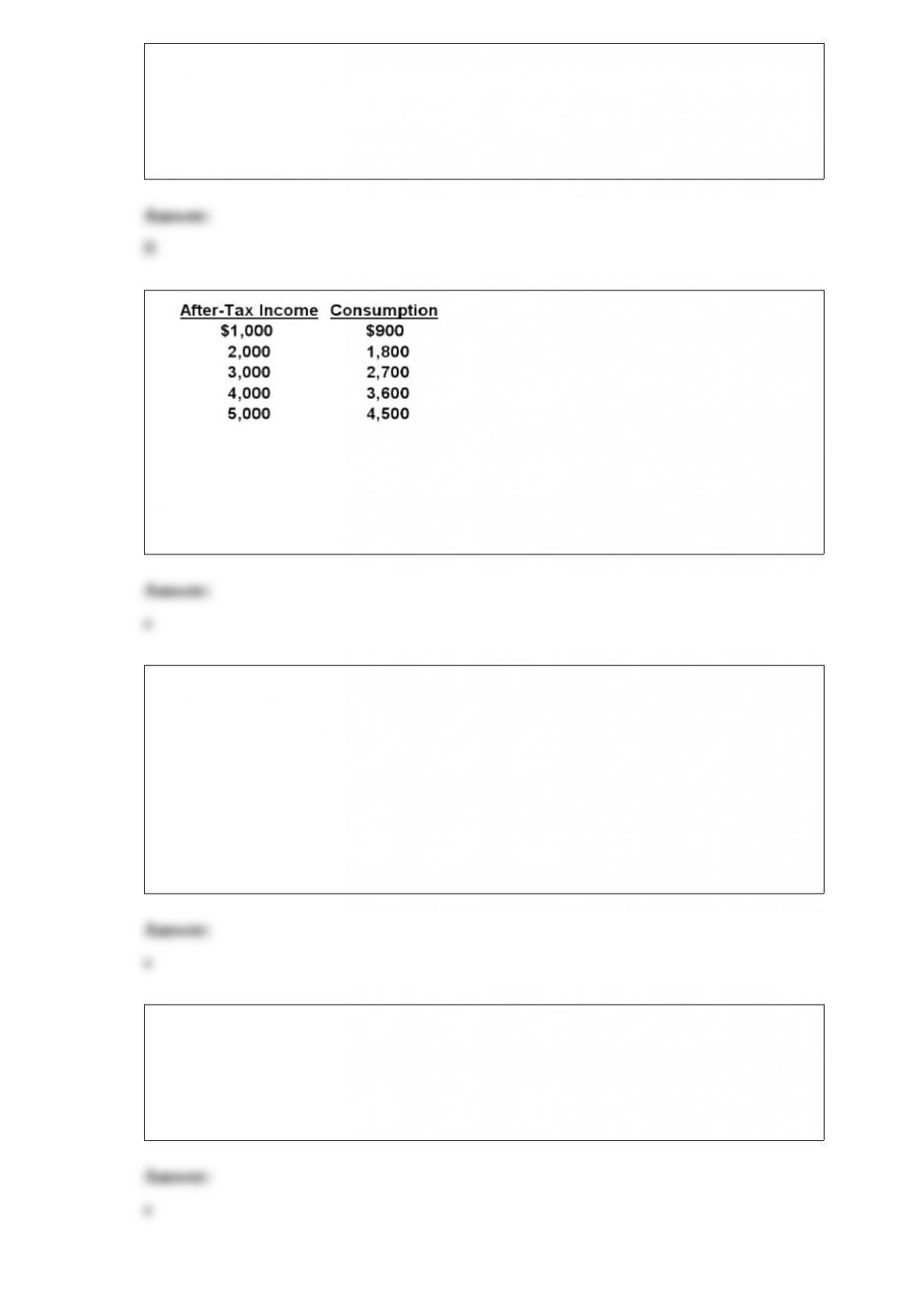
2)
the above data suggest that:
a.a policy of tax reduction will increase consumption.
b.a policy of tax increases will increase consumption.
c.tax changes will have no impact on consumption.
d.after-tax income should be lowered to increase consumption.
3) (last word) changes in stock market prices:
a.do not greatly impact the macroeconomy and used alone are not reliable predictors of
the future health of the economy.
b.greatly impact the macroeconomy but used alone are not reliable predictors of the
future health of the economy.
c.greatly impact the macroeconomy and used alone are reliable predictors of the future
health of the economy.
d.do not greatly impact the macroeconomy but used alone are reliable predictors of the
future health of the economy.
4) human capital refers to:
a.the skills and knowledge that enable a worker to be productive.
b.machinery used by labor in production.
c.the accumulated financial wealth of households.
d.physical capital owned by households rather than businesses.
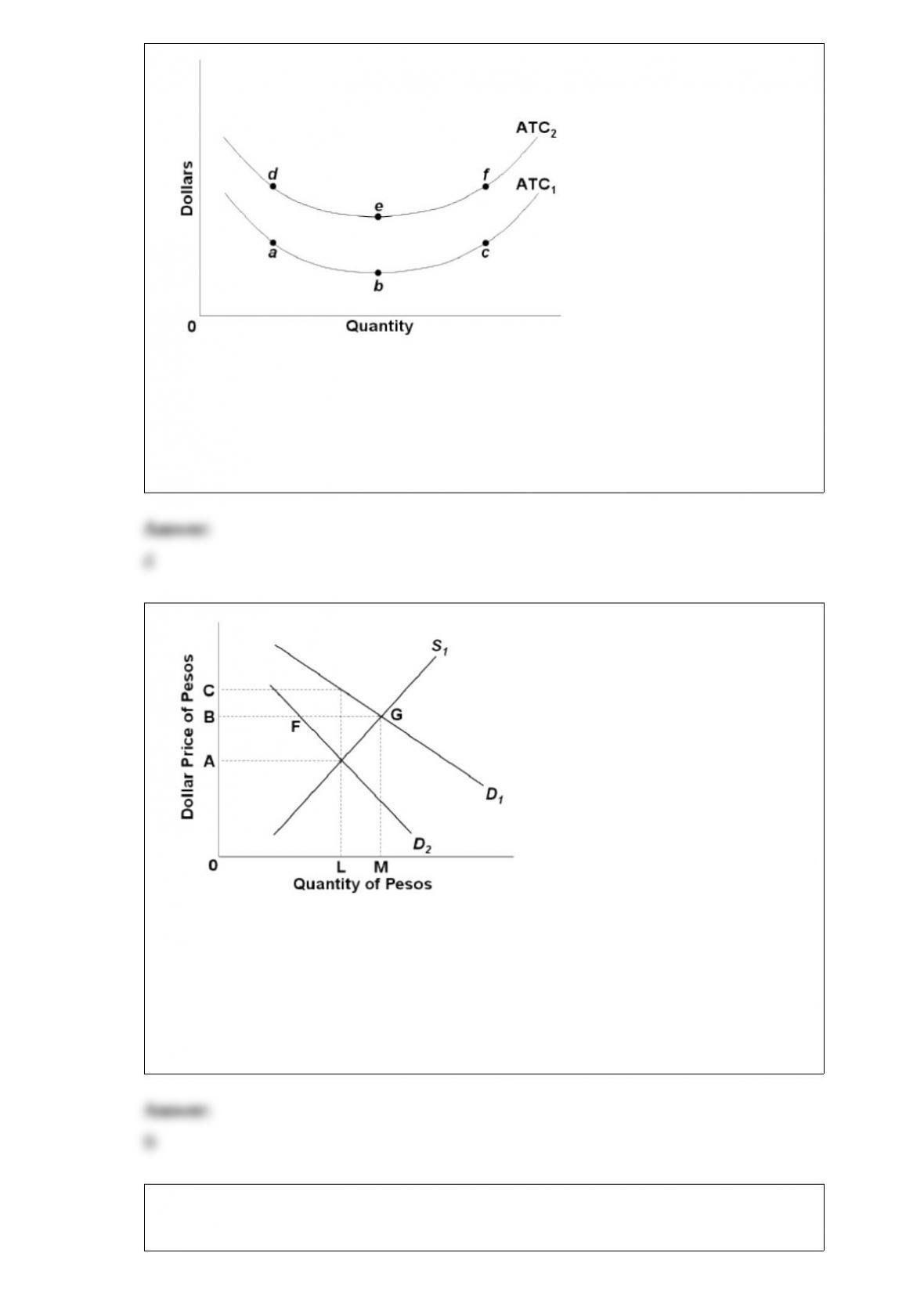
5)
refer to the above graph. which one of the following would cause a move from point d
to point e along short-run average total cost curve atc2?
a.diminishing marginal returns
b.an increase in the wage rate
c.a decrease in the wage rate
d.increasing marginal returns
6)
Refer to the above diagram. The initial demand for and supply of pesos are shown by
D1 and S1. Suppose the United States reduces its imports of Mexican goods, shifting its
demand for pesos from D1 to D2. Under a system of freely floating exchange rates:
A.gold would flow from Mexico to the United States.
B.the peso price of dollars would rise from 1/B pesos equals $1 to 1/A pesos equals $1.
C.a problem of rationing a shortage of pesos would arise in the United States.
D.the dollar price of pesos would increase to C dollars equals 1 peso.
7) A reserve requirement of 20 percent means a bank must have $1,000 of reserves if its
checkable deposits are:
A.$100.
B.$1,000.
C.$5,000.
D.$12,000.
8) in 1933 net private domestic investment was a minus $6.0 billion. this means that:
a.gross private domestic investment exceeded depreciation by $6.0 billion.
b.the economy was expanding in that year.
c.the production of 1933’s gdp used up more capital goods than were produced in that
year.
d.the economy produced no capital goods at all in 1933.
9) In the United States:
A.African-Americans have higher unionization rates than whites.
B.women have higher unionization rates than men.
C.managers have higher unionization rates than transportation workers.
D.workers in mining have higher unionization rates than workers in government.
10) marginal product becomes negative with the hiring of the __________ unit of labor.
a.third
b.fourth
c.sixth
d.seventh
11)
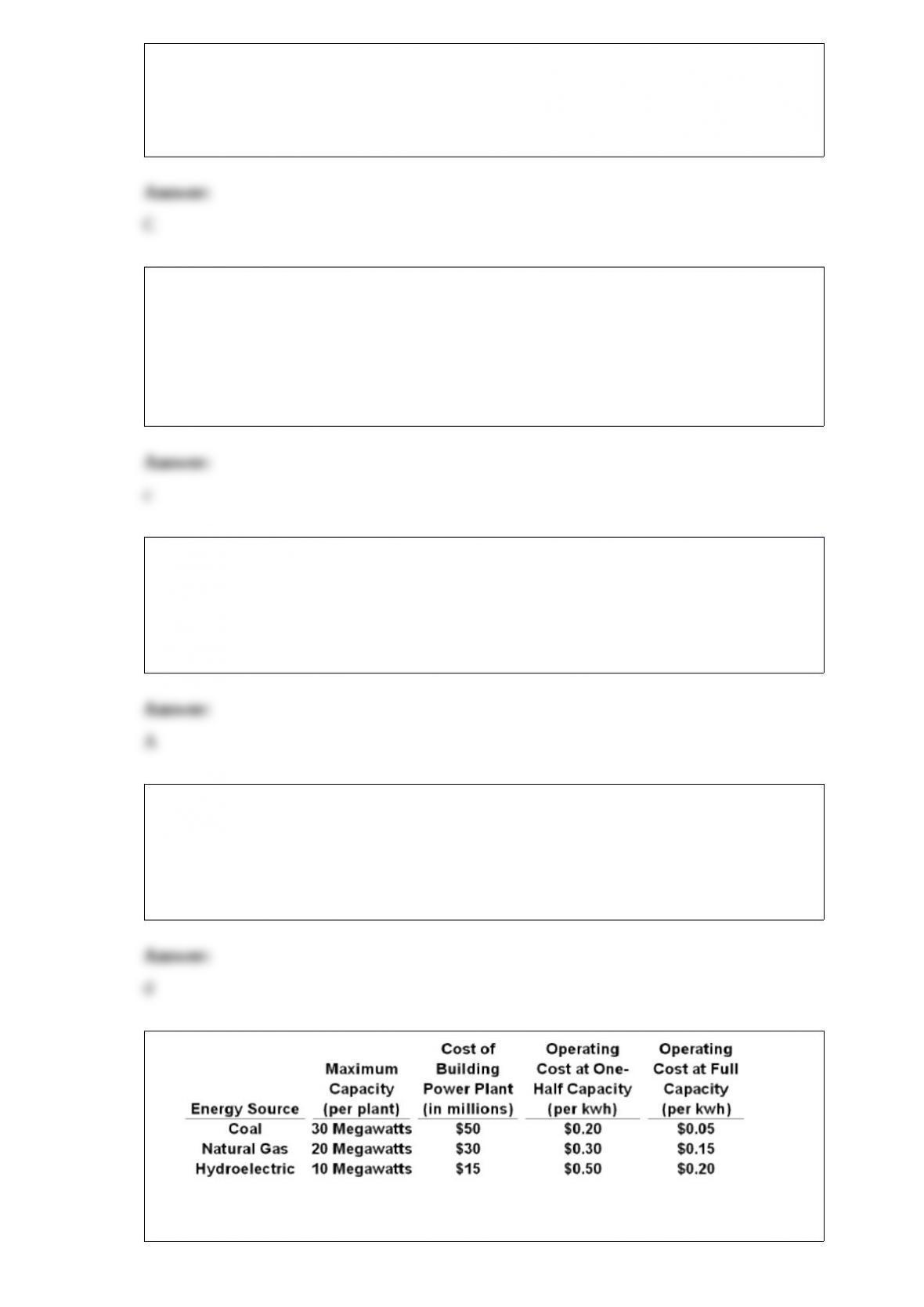
Suppose that a city’s energy demand is 30 megawatts during off-peak times, and 40
megawatts at its peak. The city has been purchasing electricity from an outside

company but has decided to build its own power plants to satisfy all of its energy
demand. The city can choose to build one or more plants to generate the needed
electricity. There are three types of plant: coal, natural gas, and hydroelectric. The three
types of plants face the costs appearing in the table above. Assuming the city’s power
needs will not change in the foreseeable future, to achieve the lowest cost of power
generation the city should build:
A.two coal-fired plants.
B.two natural gas plants.
C.one coal-fired and one hydroelectric plant.
D.four hydroelectric plants.