
In economics, marginal means
a. incremental or decremental
b. unimportant
c. level or size
d. a border-line situation
e. a bad alternative
Resource price differentials that trigger the reallocation of resources so as to equalize
payments for similar resources are known as
a. permanent differentials
b. trigger price differentials
c. reallocation differentials
d. equal differentials
e. temporary differentials
The graph of average fixed cost is a horizontal line.

a. True
b. False
As the economy recovers from a recession, we should expect that
a. demand for inferior goods will fall and demand for normal goods will rise
b. demand for both inferior and normal goods will rise
c. demand for inferior goods will rise and demand for normal goods will fall
d. demand for both inferior and normal goods will fall
e. demand for complements will fall
Exhibit 7-10
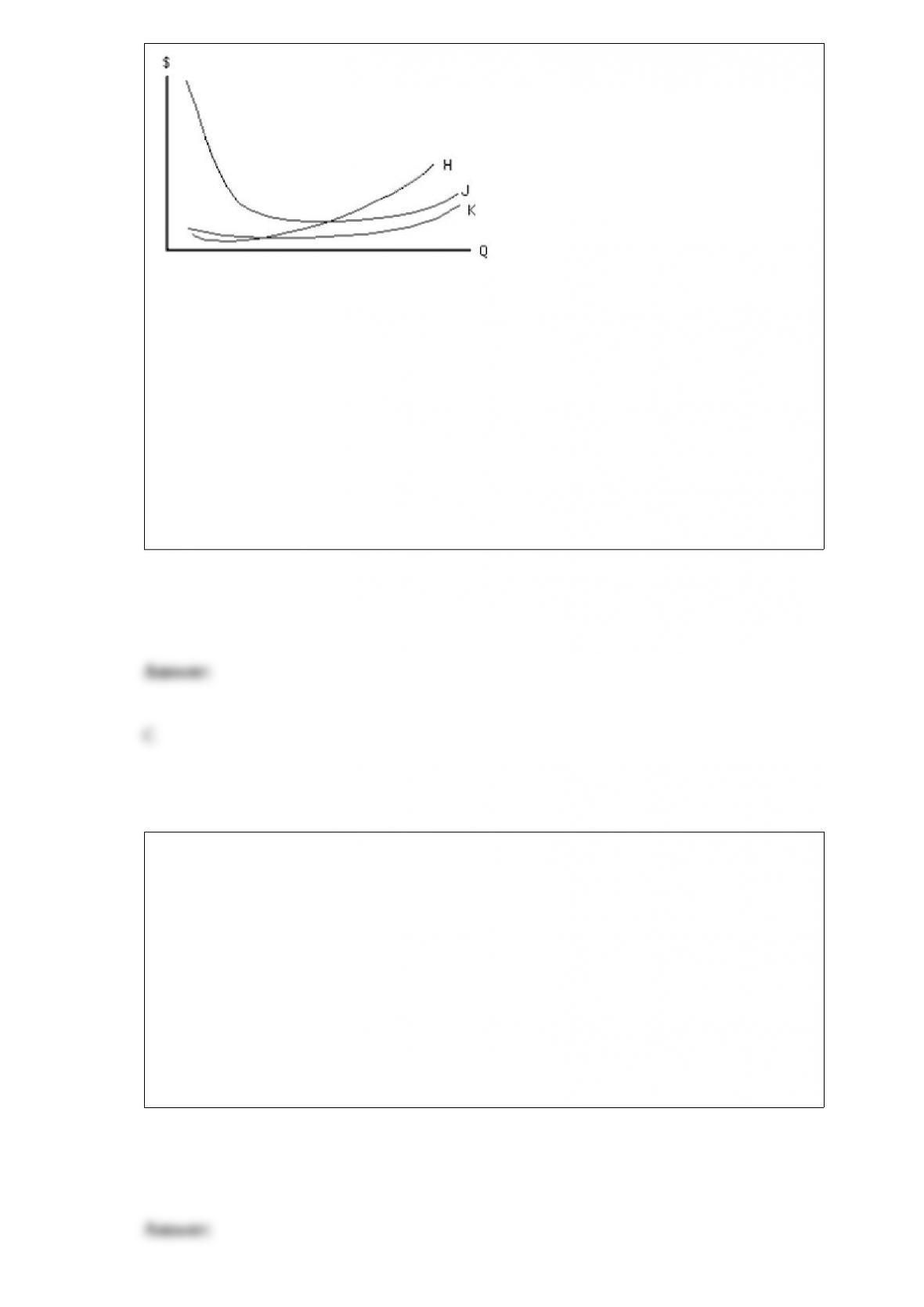
In Exhibit 7-10, lines H, J, and K represent, respectively,
a. marginal product, average product, and total product
b. average fixed cost, average total cost, and average variable cost
c. marginal cost, average total cost, and average variable cost
d. average total cost, marginal cost, and average variable cost
e. marginal cost, average product, average total cost
If the tea harvest is bad in a particular year, the supply of tea will
a. decrease, its price will decrease, and the quantity demanded of coffee will increase
b. decrease, its price will increase, and the quantity demanded of coffee will increase
c. decrease, its price will increase, and the quantity demanded of coffee will decrease
d. decrease, its price will decrease, and the quantity demanded of coffee will decrease
e. increase, its price will increase, and the quantity demanded of coffee will increase

If you live in a state with a returnable deposit law and you decide to throw out your
empty bottles and cans, chances are that someone down the line with a higher
opportunity cost than you will find them and return them for deposits.
a. True
b. False
If a perfectly competitive industry is monopolized, consumer surplus
a. can be expected to decrease
b. will usually remain constant
c. can be expected to increase
d. drops from a high value to zero
e. increases from zero to a high value
Opportunity cost is objective; therefore, its value does not change as circumstances
change.
a. True

b. False
If all resources are used efficiently to produce goods and services, a nation will find
itself producing
a. inside its production possibilities frontier
b. somewhere on its production possibilities frontier
c. outside of its production possibilities frontier
d. at one extreme end of its production possibilities frontier
e. more of one product with no decrease in the production of any other product
The Toys-R-Danger-Us Toy Company can produce 500 water pistols for a total cost of
$1,400. If the variable cost of producing 500 water pistols is $1,300, then
a. fixed cost must be $100
b. marginal cost must be $1,300
c. marginal cost must be increasing
d. average variable cost must be decreasing
e. average fixed cost must be constant

Government policies are coercive, whereas markets are not. This implies that
a. government activity will always be less efficient than market activity
b. households cannot maximize utility if they consume any government goods and
services
c. market transactions result in an equal number of gainers and losers
d. self-interest and public interest are always in conflict
e. government can provide some goods and services when private markets fail to do so
The other-things-constant assumption
a. allows the economist to make useful predictions
b. is a prediction
c. applies only to consumers’ decisions, not to those of firms
d. forces the economist to ignore reality, where things are constantly changing
e. implies rational self-interest on the part of all economic actors

Wayne Brown is a Canadian citizen studying on our campus. When he came to school
last fall, he had 400 Canadian dollars (C$), which at that time were worth $300 U.S.
dollars (US$). When he went back to Canada in June, US$300 could purchase C$450.
In June, the U.S. dollar purchased
a. 12.5 percent more Canadian dollars than it did last fall
b. 12.5 percent fewer Canadian dollars than it did last fall
c. 11.11 percent more Canadian dollars than it did last fall
d. 11.11 percent fewer Canadian dollars than it did last fall
e. the same amount of Canadian dollars, in percentage terms, as it did last fall
Exhibit 9-11
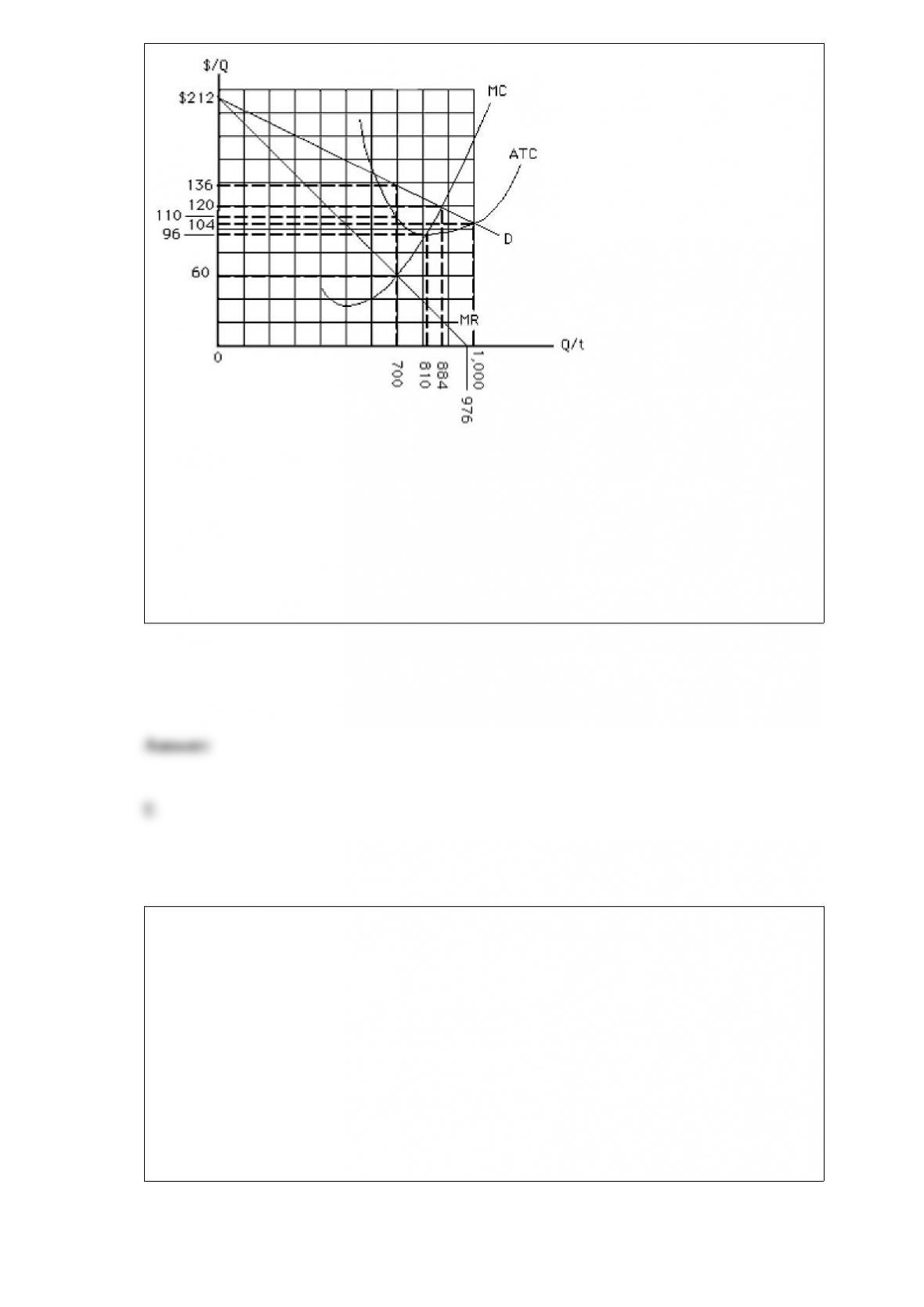
If the monopolist in Exhibit 9-11 engages in perfect price discrimination, total revenue
would be
a. $95,300
b. $104,000
c. $106,080
d. $187,408
e. equal to the area under the demand curve bounded by the horizontal axis and a
quantity of 884 units
Which U.S. government agencies handle antitrust matters?
a. the Department of Justice and Congress
b. the Federal Trade Commission and Congress
c. the Federal Trade Commission and the Securities and Exchange Commission
d. the Department of Justice and the Council of Economic Advisors
e. the Department of Justice and the Federal Trade Commission
The point of tangency between the isocost line and an isoquant illustrates the maximum
cost of producing a specific level of output.
Which of the following would not shift demand curve for union labor to the right?
a. increased demand for union-made goods
b. increased labor productivity by lowering quit rates
c. increased supply of products that compete with union-made products
d. increased labor productivity through better labor-management relations
e. appeals to consumers to buy only union-made products
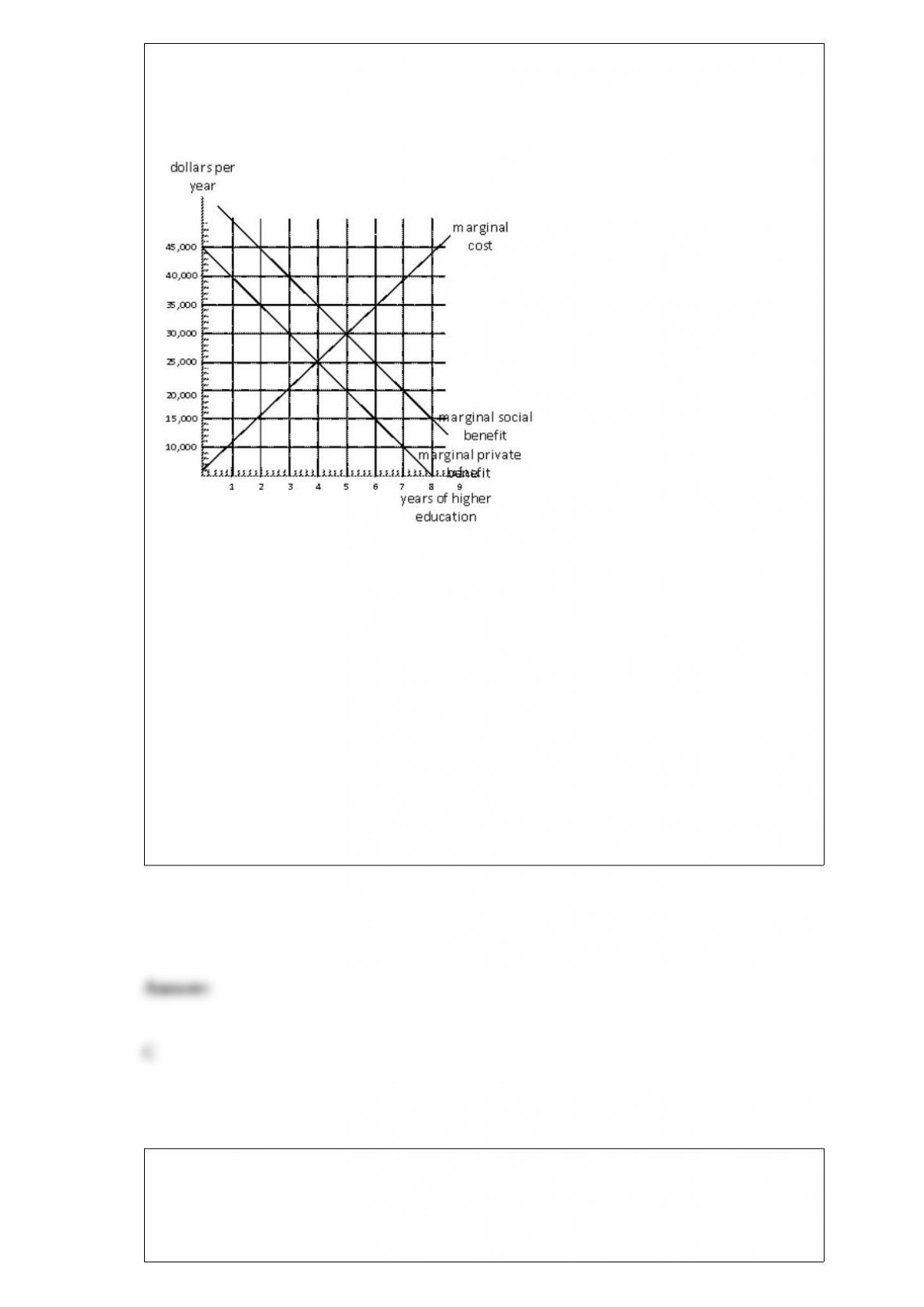
Exhibit 17-8
Exhibit 17-8 represents the consumer market for higher education. If people base their
education decisions on the marginal social benefit of education, how many years of
education will they get?
a. 3 years
b. 4 years
c. 5 years
d. 6 years
e. 7 years
The opportunity cost of going to college is best measured by the
a. cost of room and board

b. cost of tuition
c. cost of room and board plus tuition
d. income forgone by not working, plus tuition
e. income forgone by not working, plus tuition and room and board
If the market for beef cattle was initially in equilibrium, an increase in the price of the
feed grains used to fatten cattle would cause
a. the demand for beef cattle to increase, driving the price of beef upward
b. the supply of beef cattle to decline, driving the price of beef upward in the long run
c. the supply of beef to increase, placing downward pressure on the price of beef in the
long run
d. both supply and demand to fall, leaving the price of beef virtually unchanged
e. the supply of beef to increase, driving the price of beef down and increasing demand
If the U.S. dollar appreciates, it means that
a. the value of the U.S. dollar has decreased
b. the value of foreign exchange has increased

c. fewer U.S. dollars are required to purchase foreign exchange
d. more U.S. dollars are required to purchase foreign exchange
e. exports will fall immediately
An example of exclusive dealing occurs when
a. one individual serves on more than one board of directors
b. one individual serves on only one board of directors
c. a producer sells spark plugs to a car manufacturer with the understanding that the
manufacturer will buy spark plugs only from that producer
d. the seller offers a good for sale to an individual (or a limited group) on substantially
better terms than is available to the general public
e. a producer of spark plugs requires that customers also purchase rotors when they buy
spark plugs
When labor is relatively expensive, as it is in Japan,
a. manufacturers will employ lots of labor
b. the unemployment rate will be high

c. vending machines displace labor, causing unemployment
d. businesses will substitute capital — such as vending machines — in place of labor
e. alcohol and cigarettes must be sold through vending machines
Suppose Sally buys a Volvo because they are safe and, as a result, drives faster and pays
less attention to other cars on the road. This is an example of
a. the winner’s curse
b. a positive externality
c. irrational behavior
d. moral hazard
e. adverse selection
On average, college graduates earn significantly more income than those with less
education and the disparity tends to widen into middle age.
a. True
b. False
Saving is necessary for production because
a. more roundabout production is better
b. less roundabout production is better
c. production takes time
d. production is expensive
e. production requires labor
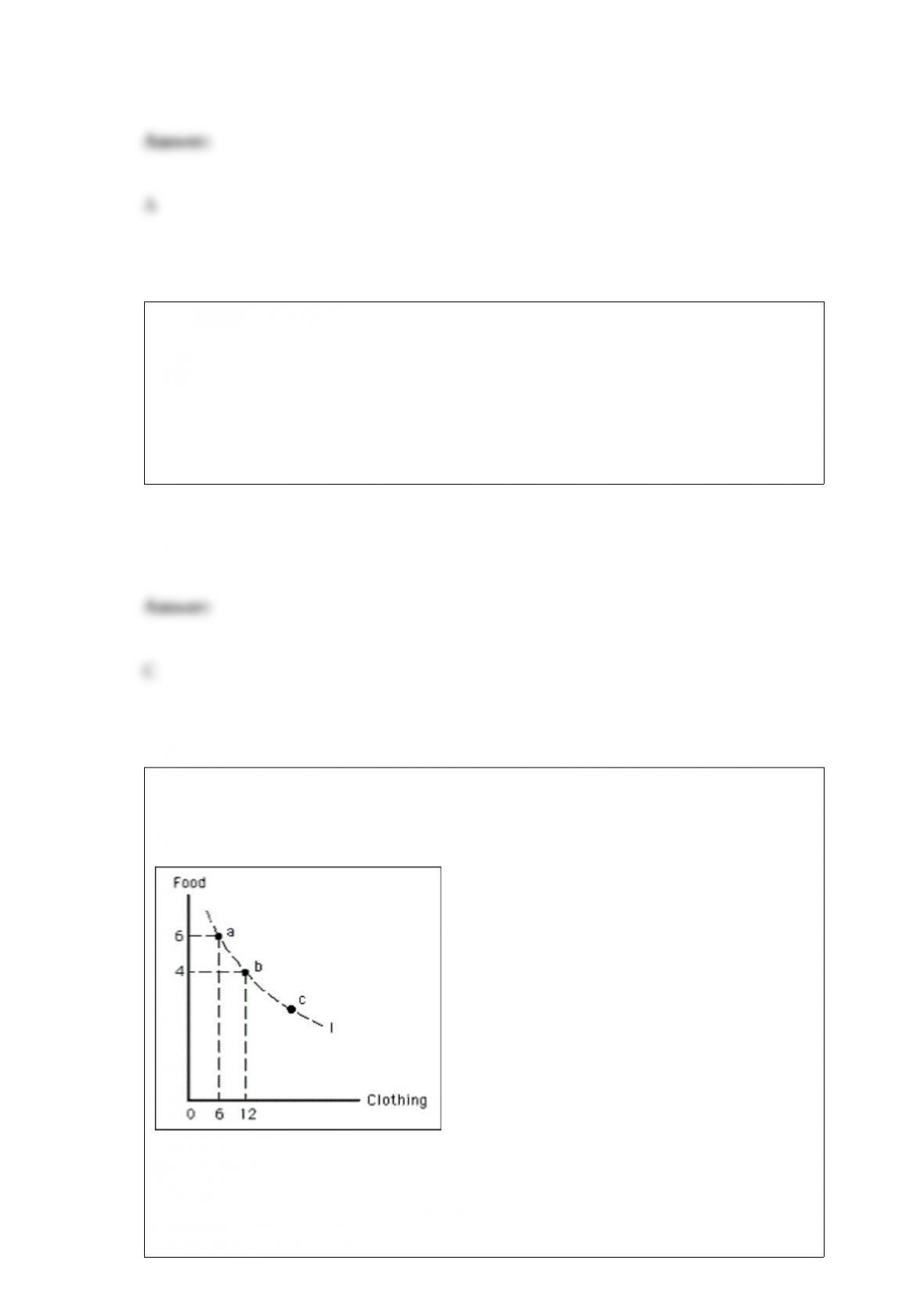
Exhibit 6-23
In Exhibit 6-23, the marginal rate of substitution of food for clothing between points a
and b equals
a. 1/3

b. 6/5
c. 3
d. 6
e. 100
Patents stimulate investment
a. by giving inventors an incentive to incur up-front costs of developing new products
b. by giving tax breaks to inventors
c. by guaranteeing a profit from new products
d. by lowering interest rates
e. through government payments that cover costs of research and development
When those on the informed side of a market self-select, the problem of __________
occurs.
a. natural selection
b. external benefits
c. adverse selection
d. the winner’s curse

e. the common pool
In a double continuous auction,
a. the price starts high and then falls
b. the price starts low and then rises
c. any buyer or seller can announce a bid or offer to the entire group
d. each buyer and each seller has power over the market price
e. there are as many prices as there are market participants