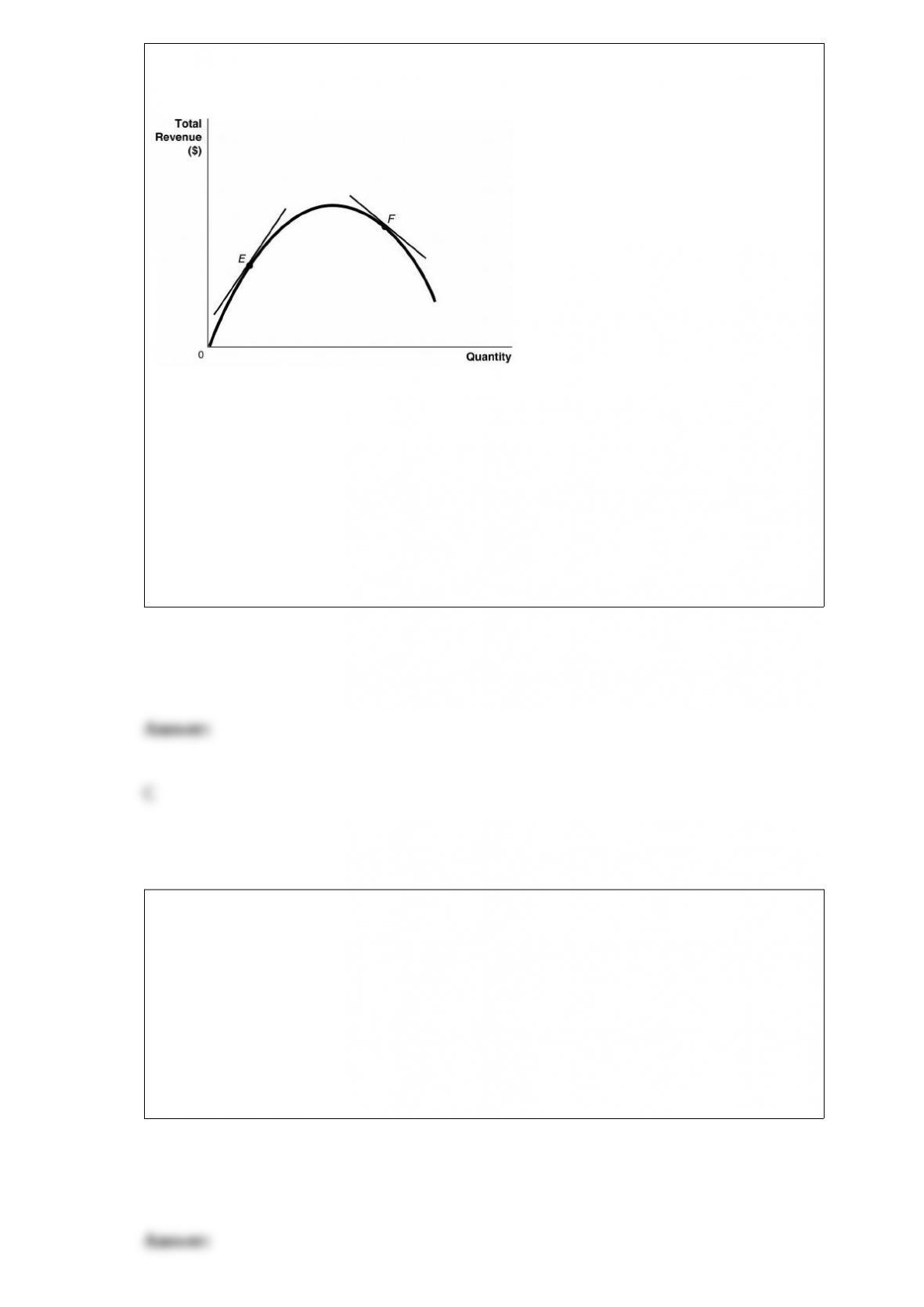
Figure 1-4
Refer to Figure 1-4. Which of the following statements is false?
A) The slope of the tangent at E is positive.
B) The slope of the tangent at F is negative.
C) The slope of the tangent at E and the slope of the tangent at F are equal.
D) Neither the slope of the tangent at E nor the slope of the tangent at F are equal to
zero.
Classifying a good as rival means
A) that the good is produced in a competitive market.
B) that there is a shortage of the good.
C) that when one person consumes a unit of the good no one else can consume it.
D) anyone who does not pay for the good cannot consume it.
Consider a used car market in which half the cars are good and half are bad (lemons).
Suppose the average price of a good car is $9,000 and the average price of a lemon is
$3,000. If rational buyers are willing to pay $6,000 for a used car, then sellers will agree
to sell mostly the lemons at this price. What is the term used to describe this situation?
A) moral hazard
B) adverse selection
C) an efficient market
D) economic irrationality
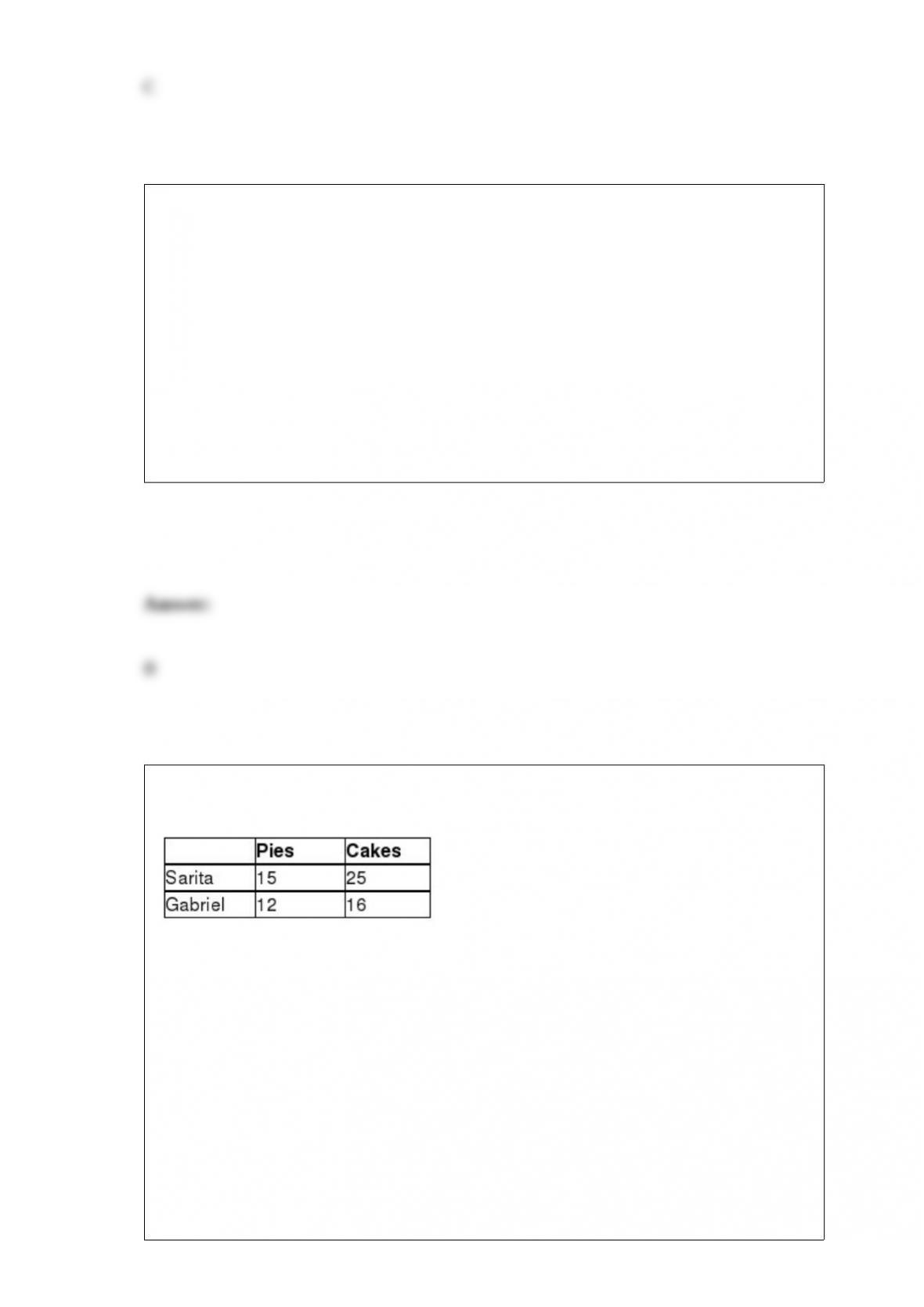
Table 9-2
Sarita and Gabriel own S&G Bakery. Table 9-2 lists the number of pies and cakes Sarita
and Gabriel can each bake in one day.
Refer to Table 9-2. Select the statement that accurately interprets the data in the table.
A) Sarita has a greater opportunity cost than Gabriel for baking cakes.
B) Sarita’s opportunity cost for baking cakes is less than Gabriel’s.
C) Gabriel has a greater opportunity cost than Sarita for baking pies.
D) Gabriel’s opportunity cost for baking cakes and baking pies are both greater than
Sarita’s.

Which of the following describes the infant industry argument for protectionism?
A) An industry must be protected in its early stages of development so that firms can
compete with government-subsidized foreign competition.
B) Some strategic industries must be protected to ensure adequate supplies of resources
needed for national defense in emergencies.
C) Domestic producers in high-wage countries must be protected from foreign
producers in low-wage countries to produce a level playing field.
D) Domestic producers require time to gain experience and lower their unit costs; this
will allow these producers to compete successfully in international markets.
If the market price is $40, the average revenue of selling five units is
A) $8.
B) $20.
C) $40.
D) $200.
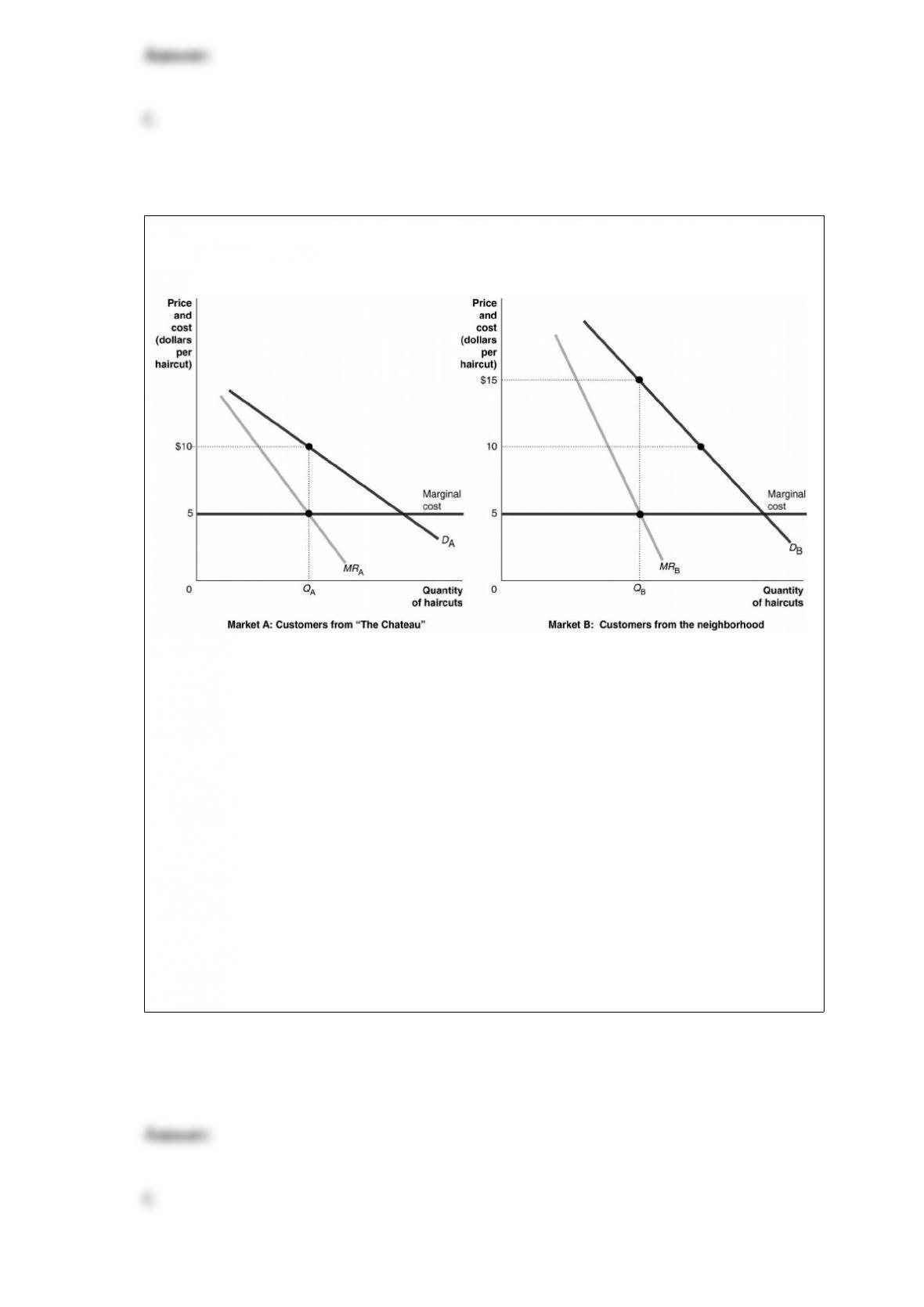
Figure 16-3
Chantal owns a hairdressing salon which caters to two main groups of customers:
residents of “The Chateau,” a retirement community, and other residents in the
neighborhood. Figure 16-3 shows the demand curves for the residents of the retirement
community, labeled Market A, and other residents in the neighborhood, labeled Market
B. The demand curves are not identical.
Refer to Figure 16-3. Which group of customers is likely to have a more elastic
demand curve (more sensitive to price)?
A) the other residents of the neighborhood – market B
B) There is no difference in the elasticity of demand between the two groups.
C) the customers from “The Chateau” – market A
D) There is insufficient information to answer this question.

Which of the following statements is true?
A) Consumer surplus measures the total benefit from participating in a market.
B) When a market is in equilibrium consumer surplus equals producer surplus.
C) Consumer surplus measures the net benefit from participating in a market.
D) Producer surplus measures the total benefit received by producers from participating
in a market.
If firms do not increase their quantity supplied when price changes, then supply is
A) perfectly elastic.
B) perfectly inelastic.
C) relatively inelastic.
D) elastic.
The price elasticity of demand is equal to
A) the value of the slope of the demand curve.

B) the change in quantity demanded divided by the change in price.
C) the percentage change in price divided by the percentage change in quantity
demanded.
D) the percentage change in quantity demanded divided by the percentage change in
price.
Arnold Marion, a first-year economics student at Fazer College, was given an
assignment to find an example of price discrimination and present it to his class. When
asked for his example Arnold said “I went to a Milwaukee Brewers baseball game with
my cousin last week. We paid $25 each for our seats in left field. My aunt and uncle
paid $50 each for their tickets; they sat five rows behind the first base dugout. This is an
example of price discrimination since we paid different prices for the same product, and
the differences were not due to differences in costs.” How would Arnold’s economics
instructor assess Arnold’s example?
A) He would agree with Arnold that he had found an example of price discrimination,
but would add that arbitrage would occur if ticket scalpers sold Brewers tickets for
more than the prices Arnold and his uncle paid.
B) He would disagree with Arnold’s example because the $25 seats and the $50 seats
were not the same products.
C) He would agree with Arnold that he had found an example of price discrimination
and would explain that the elasticity of demand for Brewers tickets is different for
Arnold and his uncle.
D) He would disagree with Arnold’s example because there were differences in
transactions costs for the $50 tickets and the $25 tickets.

Which of the following characteristics of a farmers’ market make it a good example of a
perfectly competitive market?
A) Selling product at a farmers’ market was very profitable for farmers in the early
2000s. As result, many farmers sold their farms to larger firms.
B) Farmers who sell product at a farmers’ market are similar to other entrepreneurs who
introduce products that earn short-run profits but invite competition that drives down
prices and profits in the long run.
C) Farmers who sell product at a farmers’ market are similar to other business owners
who take advantage of the willingness of some consumers to pay high prices for new
and different products.
D) Farmers selling product at a farmers’ market provide a product that is a necessity,
rather than a luxury.
As a group, people with high incomes are likely to have
A) greater-than-average family inheritances and greater than average SAT scores.
B) greater-than-average holdings of stocks and bonds and lower-than-average
productivity.
C) greater-than-average productivity and greater-than-average amounts of capital.
D) a stable marriage and no children.

What are earnings per share equal to?
A) the last dividend payment made
B) total dividend payments plus retained earnings divided by outstanding stock shares
C) the amount by which the stock’s market price has increased in the last year
D) revenues divided by the number of stockholders
A monopolistically competitive firm that is earning profits will, in the long run,
experience all of the following except
A) new rivals entering the market.
B) a decrease in demand for its product.
C) demand for the firm’s product becomes more elastic.
D) a decrease in the number of rival products.
Which of the following is an example of positive technological change?
A) A firm offers workers a higher wage to work on weekends and at night. As a result,
the firm is able to increase its weekly production of surf boards.
B) A firm buys an additional machine that it uses to make surf boards. As a result, the
firm is able to increase its weekly production of surf boards.
C) A firm conducts a new advertising campaign. As a result, the demand for the firm’s
surf boards increases.
D) A firm’s workers participate in a training program designed to increase the number
of surf boards they can produce per day.
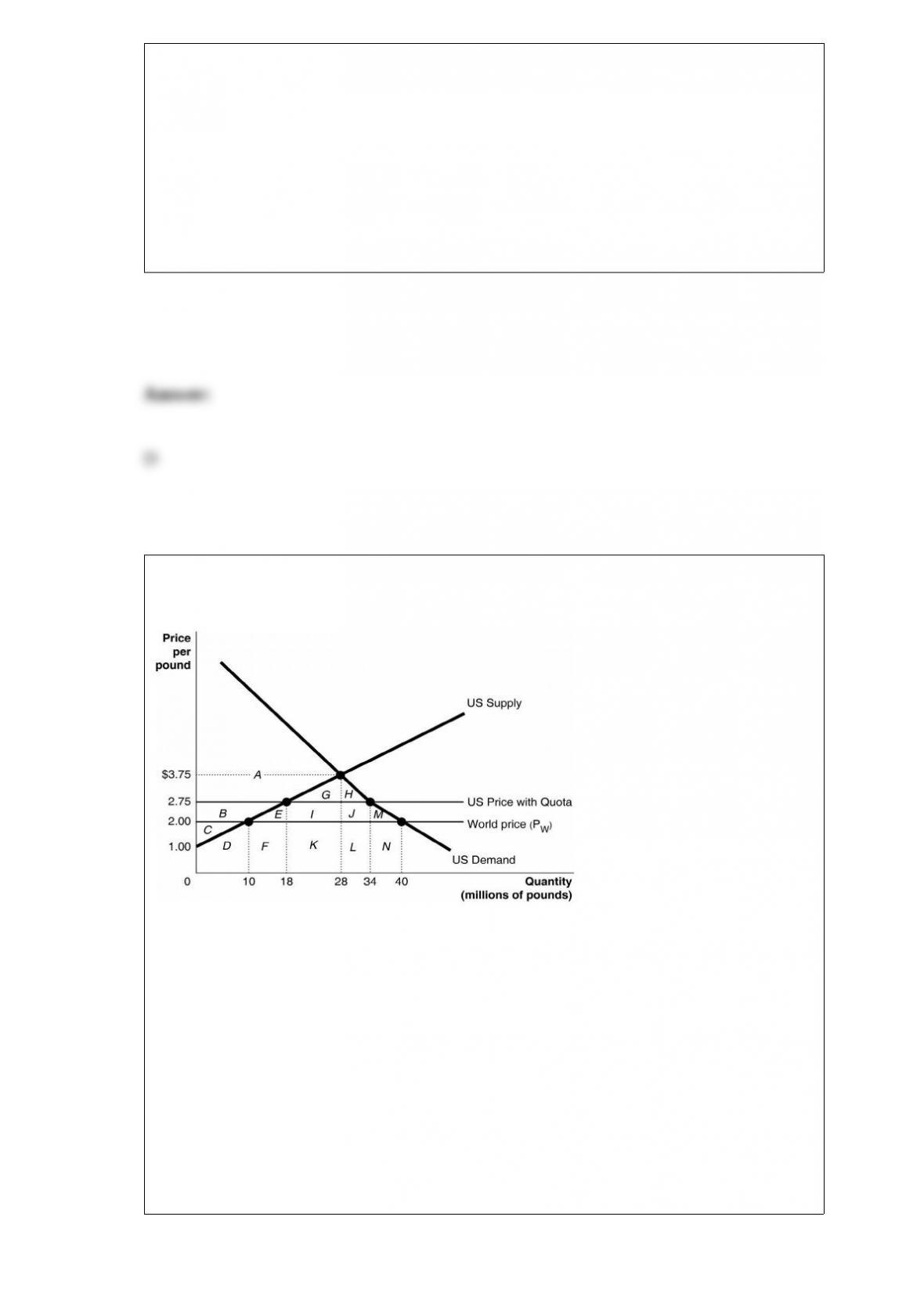
Figure 9-3
Since 1953 the United States has imposed a quota to limit the imports of peanuts.
Figure 9-3 illustrates the impact of the quota.
Refer to Figure 9-3. If there was no quota, how many pounds of peanuts would be
imported?
A) 16 million
B) 24 million
C) 30 million
D) 40 million

The average total cost of production
A) is the extra cost required to produce one more unit.
B) equals the explicit cost of production.
C) equals total cost of production divided by the level of output.
D) equals total cost of production multiplied times the level of output.
Which of the following is not a common mistake made by consumers?
A) the failure to take into account the implicit costs of an activity
B) the failure to ignore sunk costs
C) being overly optimistic about their future behavior
D) being overly pessimistic about their future behavior

Which of the following is an examples of spending on factors of production in the
circular flow model?
A) Orson buys a package of beef jerky at a convenience store.
B) Bernadette gets a manicure and pedicure before attending her parents’ anniversary
party.
C) Landon pays $100 for a season pass to a water park.
D) The “Suds Bucket” car wash buys new squeegees for all its employees.
According to the opponents of globalization, which of the following occurs as a result
of worker dislocation brought about by globalization?
A) increased labor costs for companies
B) lower workers’ wages in developed nations
C) surfeit of jobs in developed nations
D) increased investment in individual education
Figure 5-13
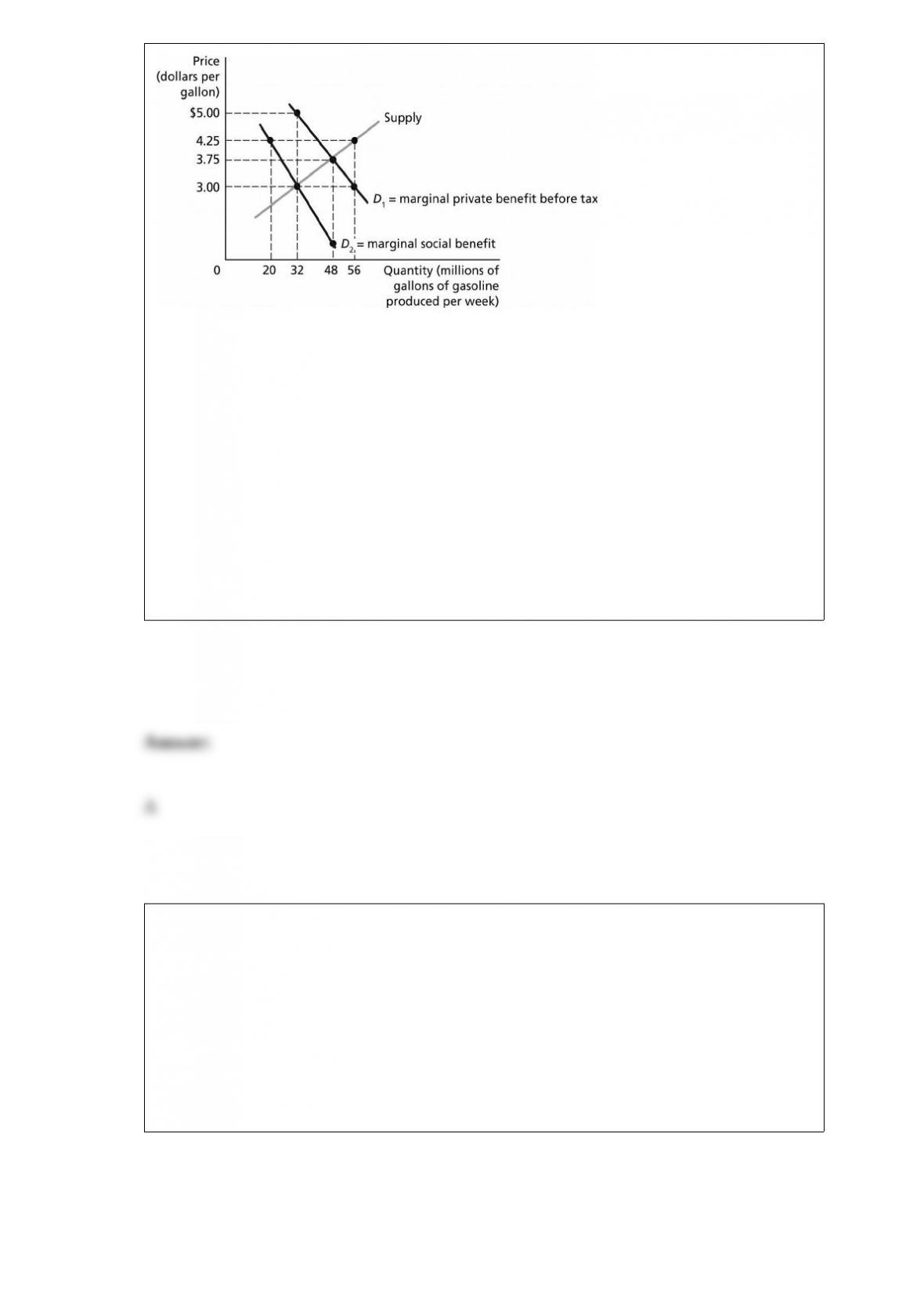
Figure 5-13 illustrates the market for gasoline before and after the government imposes
a tax to bring about the efficient level of gasoline production.
Refer to Figure 5-13. The efficient equilibrium price of gasoline is ________ per
gallon.
A) $3.00
B) $3.75
C) $4.25
D) $5.00
What must balance on a balance sheet?
A) Total assets must equal total liabilities plus equity.
B) Revenues must equal costs.
C) Retained earnings plus dividends paid must equal earnings per share.
D) All of these must balance.
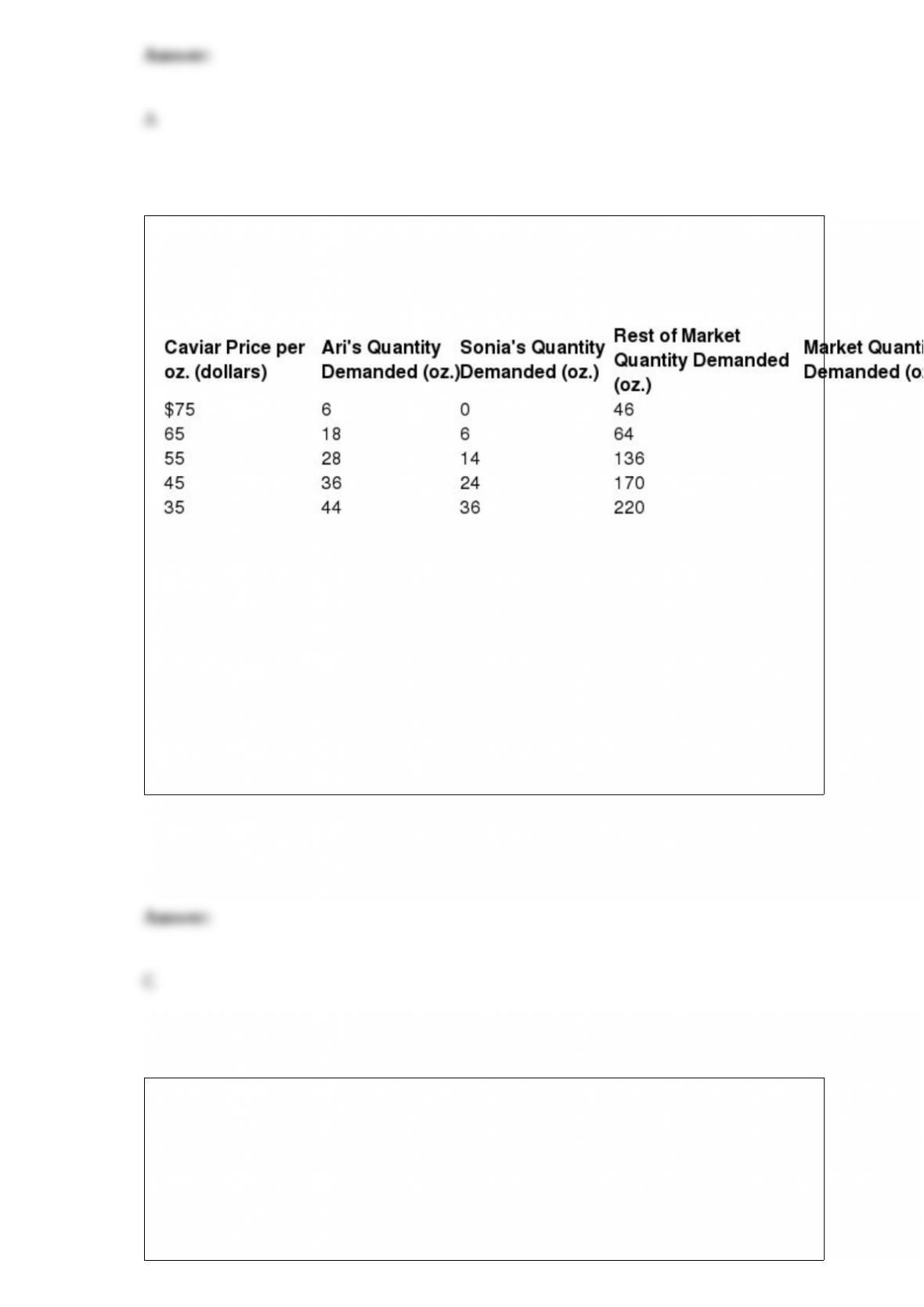
Table 3-2
Refer to Table 3-2. The table above shows the demand schedules for caviar of two
individuals (Ari and Sonia) and the rest of the market. At a price of $75, the quantity
demanded in the market would be
A) 6 oz.
B) 46 oz.
C) 52 oz.
D) 127 oz.
Which of the following statements about the distribution of income in the United States
is true?
A) The United States has the most unequal distribution of income of any high-income
country in the world.
B) The United States has a more unequal distribution of income than Bolivia and

Botswana.
C) The distribution of income in the United States is fairly equal and there have been no
dramatic changes over time.
D) The distribution of income in the United States is unequal and has become
significantly more unequal over time.
One result of the public choice model is that most economists believe that
A) when market failure occurs, government intervention will always lead to a more
efficient outcome.
B) government intervention will always result in a reduction in economic efficiency in
regulated markets.
C) policymakers may have incentives to intervene in the economy in ways that do not
promote economic efficiency.
D) the voting paradox will prevent voters from selecting the best person for public
office.
Figure 3-8
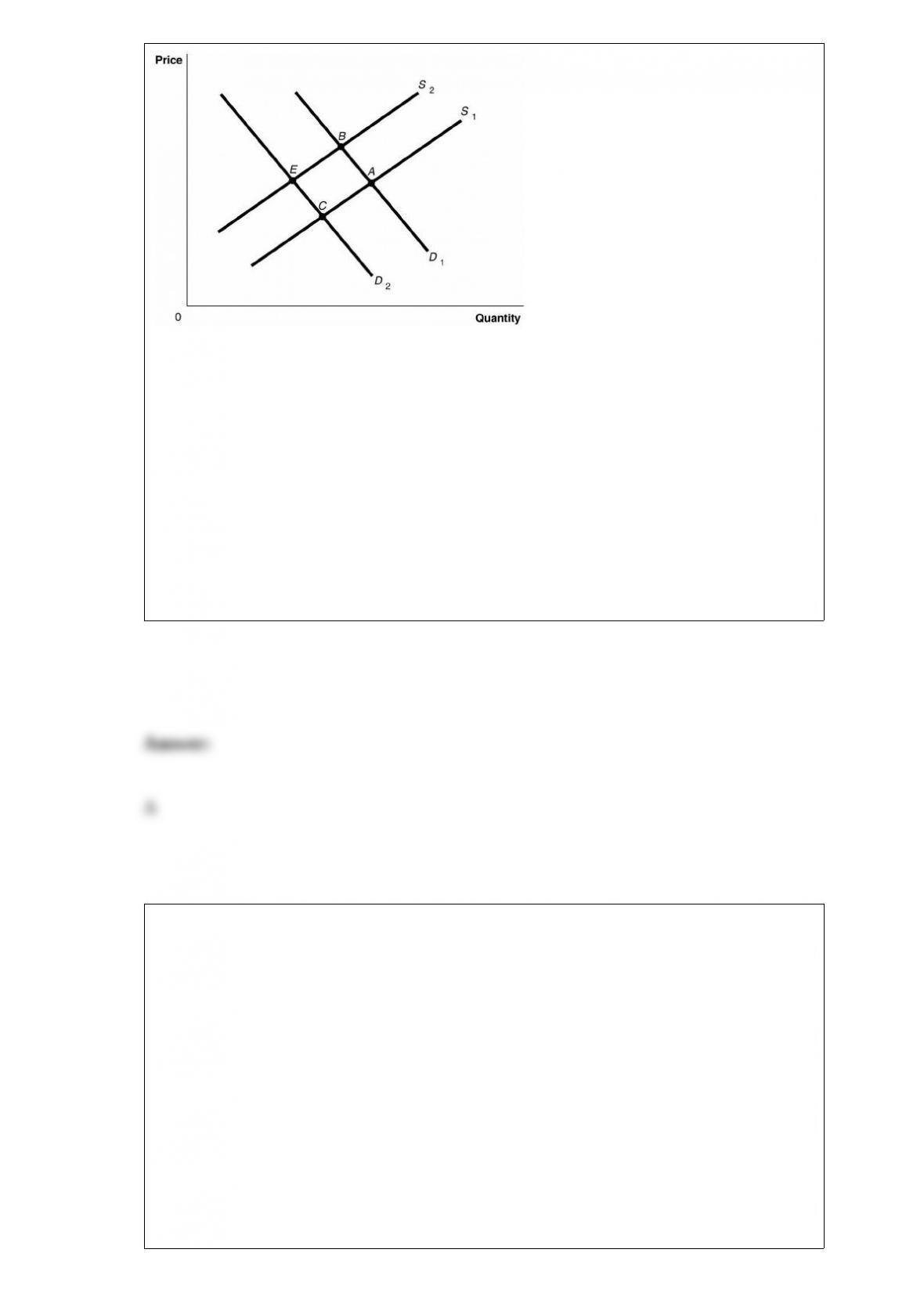
Refer to Figure 3-8. The graph in this figure illustrates an initial competitive
equilibrium in the market for apples at the intersection of D1 and S1 (point A). If the
price of oranges, a substitute for apples, decreases and the wages of apple workers
increase, how will the equilibrium point change?
A) The equilibrium point will move from A to E.
B) The equilibrium point will move from A to B.
C) The equilibrium point will move from A to C.
D) The equilibrium will first move from A to B, then return to A.
Scenario: Topsy Turvey Toys and Ureshi Toys
Topsy Turvey Toys is a U.S.-based toy retailer that buys all its merchandise from Ureshi
Toys, a Japan-based toy manufacturer with production facilities in twelve nations.
Ureshi Toys markets its toys globally without modification.Ureshi Toys is an example
of a(n) ________.
A) domestic company
B) multinational company
C) direct importer
D) shell corporation
A perfectly competitive firm has to charge the same price as every other firm in the
market. Therefore, the firm
A) faces a perfectly inelastic demand curve.
B) is not able to make a profit in the short run.
C) is a price taker.
D) faces a perfectly elastic supply curve.
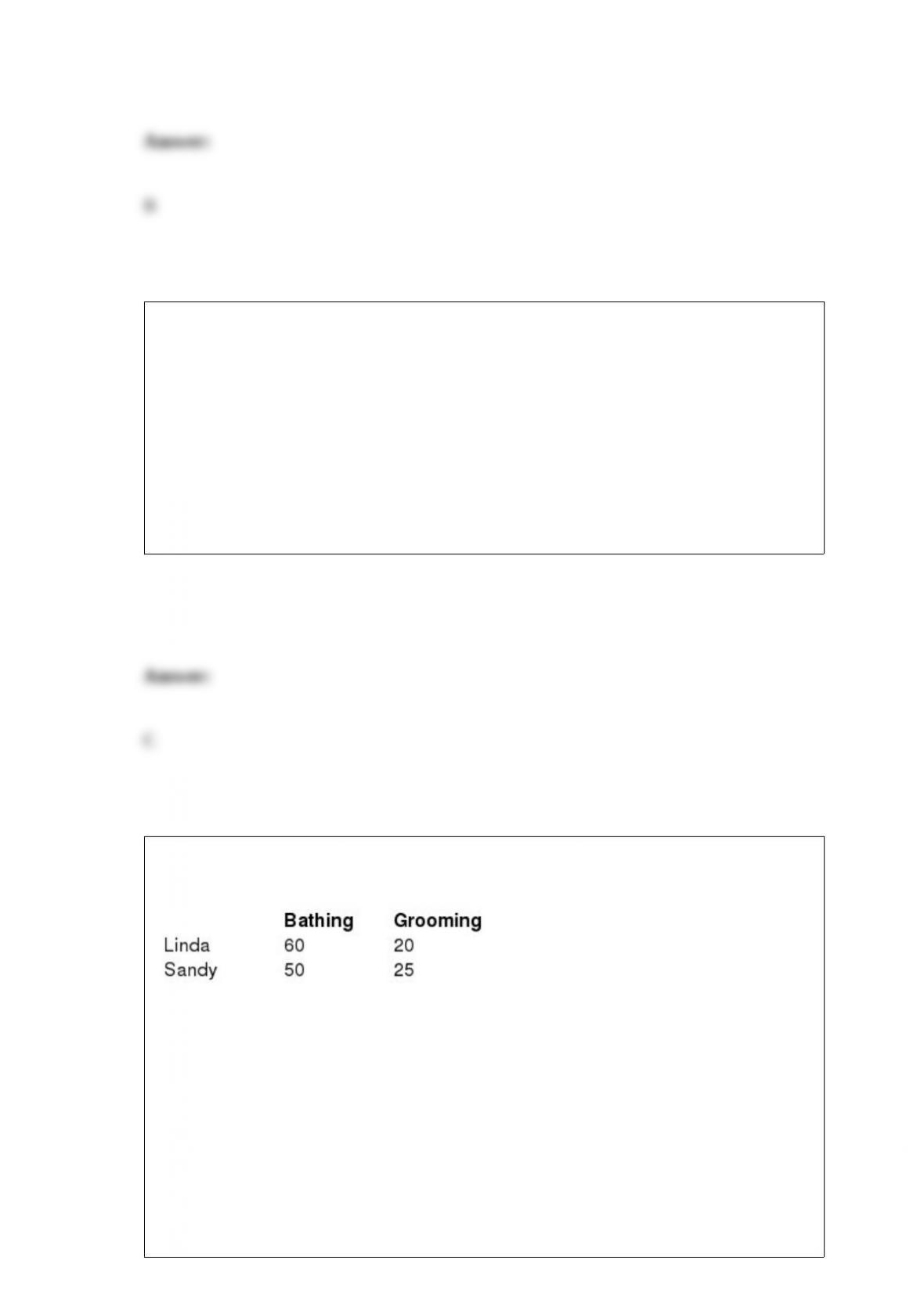
Table 9-1
Linda and Sandy own The Preppy Puppy, a dog grooming business. Table 9-1 lists the
number of dogs Linda and Sandy can each bathe and groom in one week.
Refer to Table 9-1. Select the statement that accurately interprets the data in the table.
A) Sandy has a comparative advantage in dog grooming.
B) Linda has a comparative advantage in dog grooming.
C) Linda has a comparative advantage in dog grooming and dog bathing.

D) Sandy has a comparative advantage in dog bathing.
The price of admission to Walt Disney World
A) can vary by your age and address.
B) is the same for everyone.
C) is kept low to attract customers, but Disney earns most of its profits by selling tickets
to rides and attractions inside the park.
D) is kept low to attract customers, but prices of rides and attractions inside the park
vary by your age, address and other factors.
Which type of business has the most government rules and regulations affecting it?
A) sole proprietorship
B) partnership
C) corporation
D) They all have the same set of rules and regulations affecting them.