
The average-marginal rule states:
a. when the marginal magnitude is rising, the average magnitude must also be rising.
b. when the marginal magnitude is falling, the average magnitude must also be falling.
c. when the marginal magnitude is below the average magnitude, the average magnitude
falls.
d. when the average magnitude rises, the marginal magnitude falls.
e. a and b
The closer the Gini coefficient is to 1, the
a. greater the degree of income inequality.
b. less the degree of income inequality.
c. greater the degree of discrimination.
d. less the degree of discrimination.
Exhibit 22-2
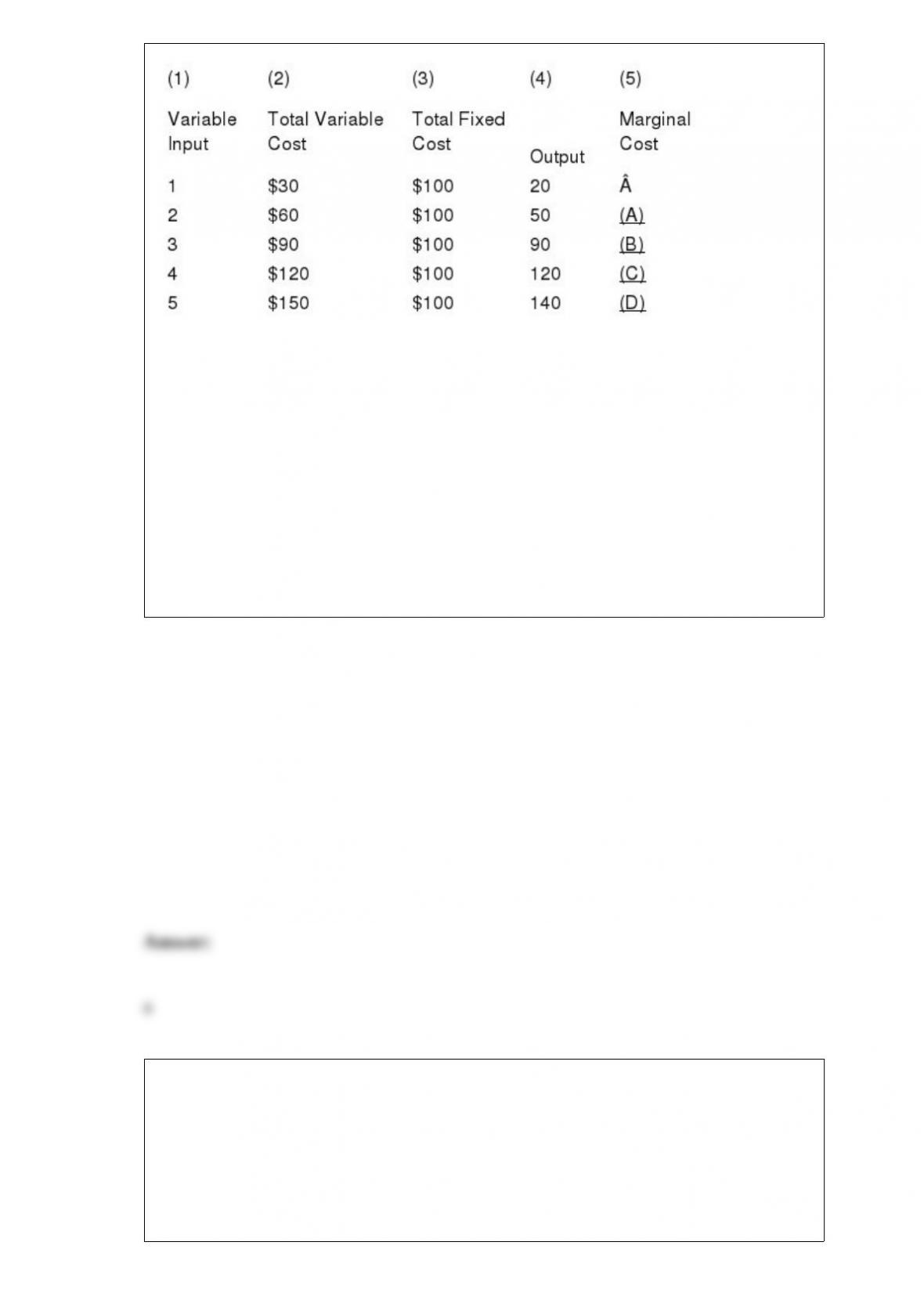
What is the average total cost of producing 140 units of output?
a. $1.79
b. $7.33
c. $4.23
d. $10.00
e. There is not enough information provided to answer the question.
The capture theory of regulation contends that
a. the public “captures” the benefits of regulation through lower prices.
b. natural monopolies “capture” high profits through the reduction of output.
c. the regulatory agency is eventually “captured” by the special interests of the industry

being regulated.
d. large corporations “capture” high profits by regulating the tastes and preferences of
the buying public.
Suppose farmers get together and decide to be less productive. They want to do this so
that they can shift the supply curve of farm products leftward and raise the price. They
must be assuming that the demand curve between the current price and the higher price
is
a. inelastic.
b. elastic.
c. unit elastic.
d. There is not enough information to answer this question.
Those who think that a popular investment is necessarily a good investment often find
themselves earning low returns.
a. True
b. False
Exhibit 3-3
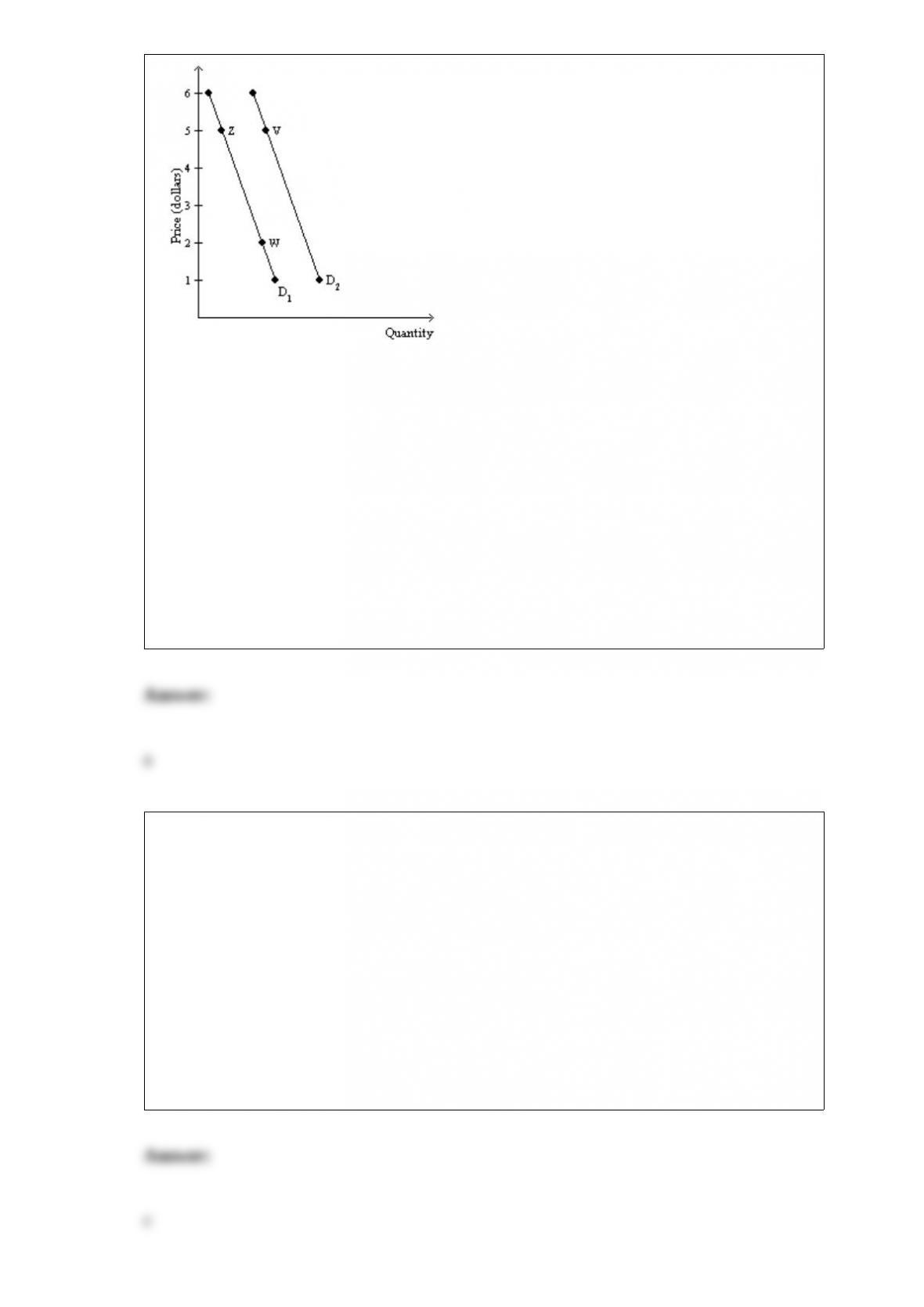
A movement from point V to point W could nothave been the result of
a. a increase in the price of good Y.
b. an increase in good Y buyers€ income (assuming that good Y is an inferior good).
c. an increase in the price of a complement to good Y.
d. a decrease in the number of buyers of good Y.
e. a decrease in good Y buyers€ income (assuming that good Y is a normal good).
To say that government sometimes functions as a “transfer mechanism,” means that
government sometimes
a. ends up transferring goods to individuals in return for taxes paid.
b. ends up transferring negative externalities into positive externalities.
c. ends up taking from group X to give to group Y.
d. transfers taxes into subsidies.
e. none of the above

Jack receives 30 utils from one apple, 45 utils from two apples, and 55 utils from three
apples. It follows that the marginal utility of the third apple is __________ utils and that
Jack’s __________utility rises as his __________ declines.
a. 55; marginal;total
b. 10; total; marginal
c. 130; total; marginal
d. 100; marginal; total
e. none of the above
Which of the following assumptions applies to both perfect competition and
monopolistic competition?
a. many buyers and sellers
b. easy entry into and exit from the market
c. profit is maximized at the level of output for which MR = MC
d. a and c
e. all of the above