
Assume that the four-firm concentration ratio in an industry is 85 percent. Which of the
following statements uses one of the five competitive forces to argue that this industry
may be more competitive than its concentration ratio suggests?
A) The high concentration may be due to patents owned by the largest firms but
competition will increase when patent rights expire.
B) If high concentration is the result of large firms owning much of the available supply
of a key input, the industry will become more competitive when new sources of the
input are discovered by other firms.
C) Even though concentration is high, large firms in the industry may act competitively
by spending large sums on advertising.
D) The threat of entry into this industry can cause firms in the industry to lower their
prices and profits in order to deter entry.
Which of the following best describes supply-side economics?
A) Labor productivity affects aggregate supply.
B) Education affects labor productivity which affects aggregate supply.
C) Education affects the incentive to work, save, and invest and, therefore, aggregate
supply.
D) Tax rates, particularly marginal tax rates, affect the incentive to work, save, and
invest and, therefore, aggregate supply.
Let D= demand, S = supply, P = equilibrium price, Q= equilibrium quantity. What

happens in the market for tropical hardwood trees if the governments restrict the
amount of forest lands that can be logged?
A) D decreases, S no change, P and Q decrease
B) S decreases, D no change, P increases, Q decreases
C) D and S decrease, P and Q increase
D) D no change, S decreases, P increases, Q increases
Given the equations for C, I, G, and NX below, what is the equilibrium level of GDP? C
= 1,000 + 0.8Y
I = 1,500
G=1,250
NX = 100 A) $3,080
B) $3,850
C) $6,930
D) $19,250
The key factors in raising standards of living in low-income countries have been
increases in
A) capital accumulation and the money supply.
B) technology and knowledge.
C) foreign aid and population.
D) income and government ownership of resources.
If the economy receives an influx of new workers from immigration,
A) the long-run aggregate supply curve will shift to the right.
B) the long-run aggregate supply curve will shift to the left.
C) we will move up along the long-run aggregate supply curve.
D) we will move down along the long-run aggregate supply curve.
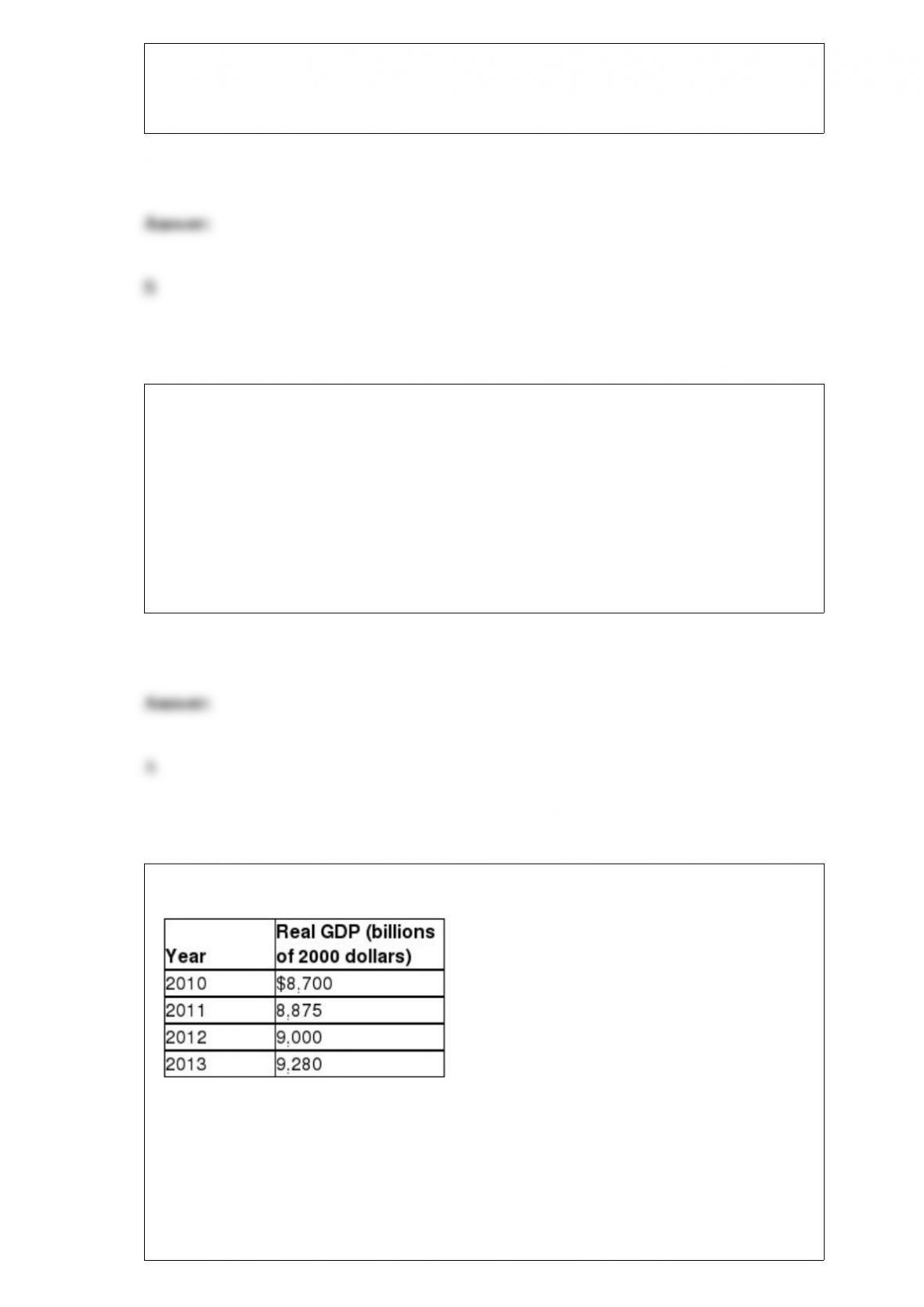
Table 21-1
Using the table above, what is the approximate average annual growth rate from 2010
to 2013?
A) 1%
B) 1.5%

C) 2%
D) 3%
Fiat money is generally issued by
A) private banks.
B) central banks.
C) brokerage firms.
D) major multinational corporations.
The health care system in Canada is referred to as ________, and is a system in which
the government provides national health insurance to all Canadian residents.
A) an out-of-pocket system
B) a single-payer health care system
C) a universal health insurance system
D) socialized medicine

Models that focus on factors other than changes in the money supply to explain
fluctuations in real GDP are called
A) nonmonetary business cycle models.
B) real business cycle models.
C) rational expectations models.
D) short-run macroeconomic models.
On average, jobs at small firms pay ________ wages than jobs at large firms and are
________ likely to offer fringe benefits such as health insurance and retirement
accounts.
A) higher; more
B) lower; more
C) higher; less
D) lower; less
A negative externality exists if

A) there are price controls in a market.
B) there are quantity controls in a market.
C) the marginal social cost of producing a good or service exceeds the private cost.
D) the marginal private cost of producing a good or service exceeds the social cost.
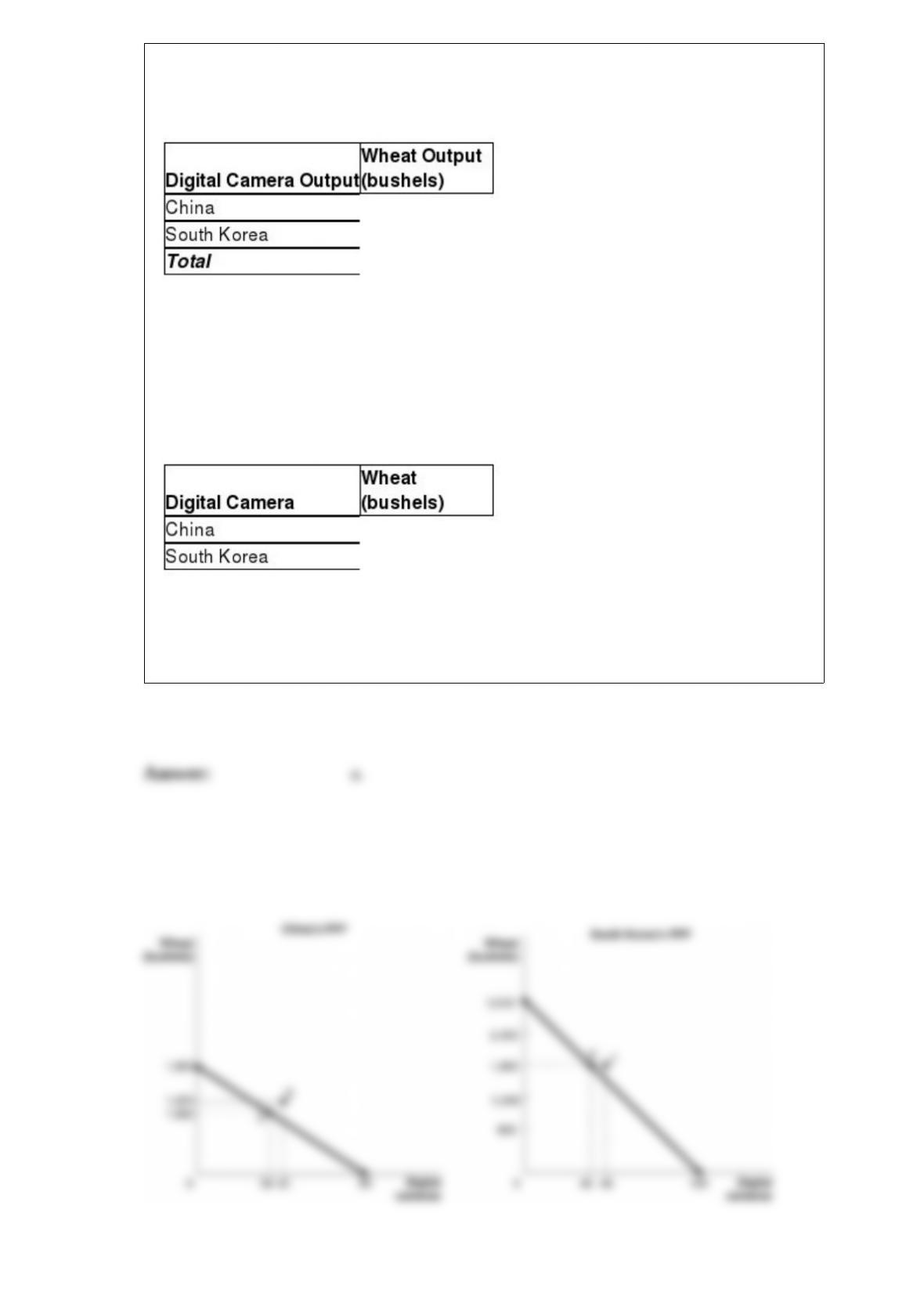
Table 2-21
This table shows the number of labor hours required to produce a digital camera and a
bushel of wheat in China and South Korea. a. If each country has a total of 9,000 labor
hours to devote to the production of the two goods, draw the production possibilities
frontier for each country. Put “Digital Camera” on the horizontal axis and “Wheat” on
the vertical axis. Be sure to identify the intercept values on your graphs.
b. Suppose each country allocates 60% its labor hours to wheat production and 40% to
the production of digital cameras. Complete Table 2-22 below to show each country’s
output of the two products. Table 2-22: Production and Consumption with no Trade
c. If the two countries do not trade and consume whatever they produce, identify the
current production and consumption point for each country on their respective
production possibilities frontiers. Label China’s consumption point “C” and South
Korea’s consumption point, “K.”
d. Suppose the two countries specialize and trade. Who should produce digital cameras
and who should produce wheat? Explain your answer.
e. Complete Table 2-23 below to show each country’s output with specialization. Table
2-23: Output with Specialization
f. Did specialization increase the combined output for the two countries without any
increase in resources? If so, by how much?
g. Suppose China and South Korea agree to trade so that in exchange for 1,200 bushels
of wheat, the exporter of wheat receives 48 digital cameras. Complete Table 2-24 below
to show each country’s consumption bundle after trade. Table 2-24: Consumption with
Trade
h. Show the consumption points after trade on each country’s production possibilities
frontier. Label these points “B” for China and “J” for South Korea.
i. Has trade made the two countries better off? Explain your answer.
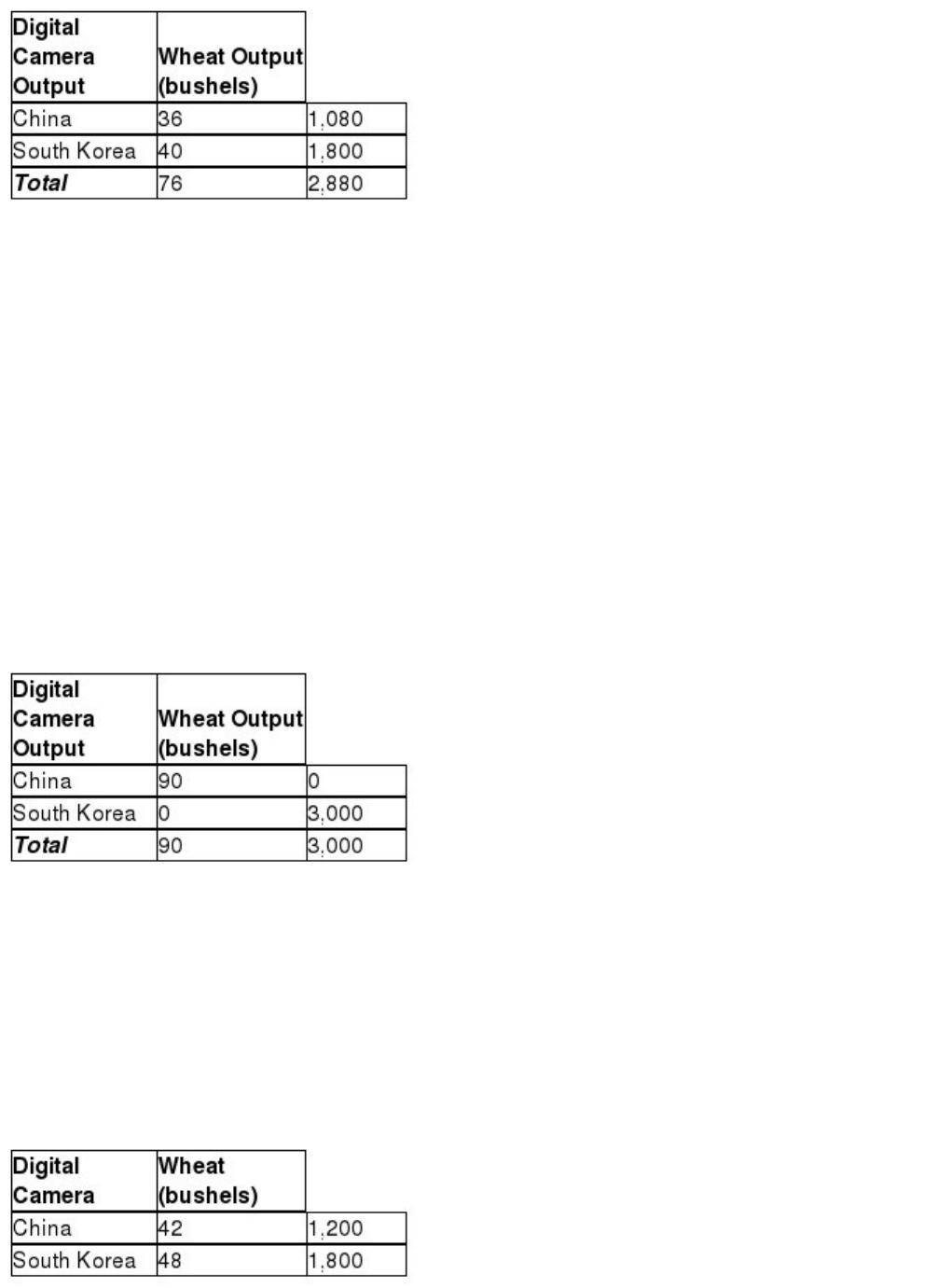
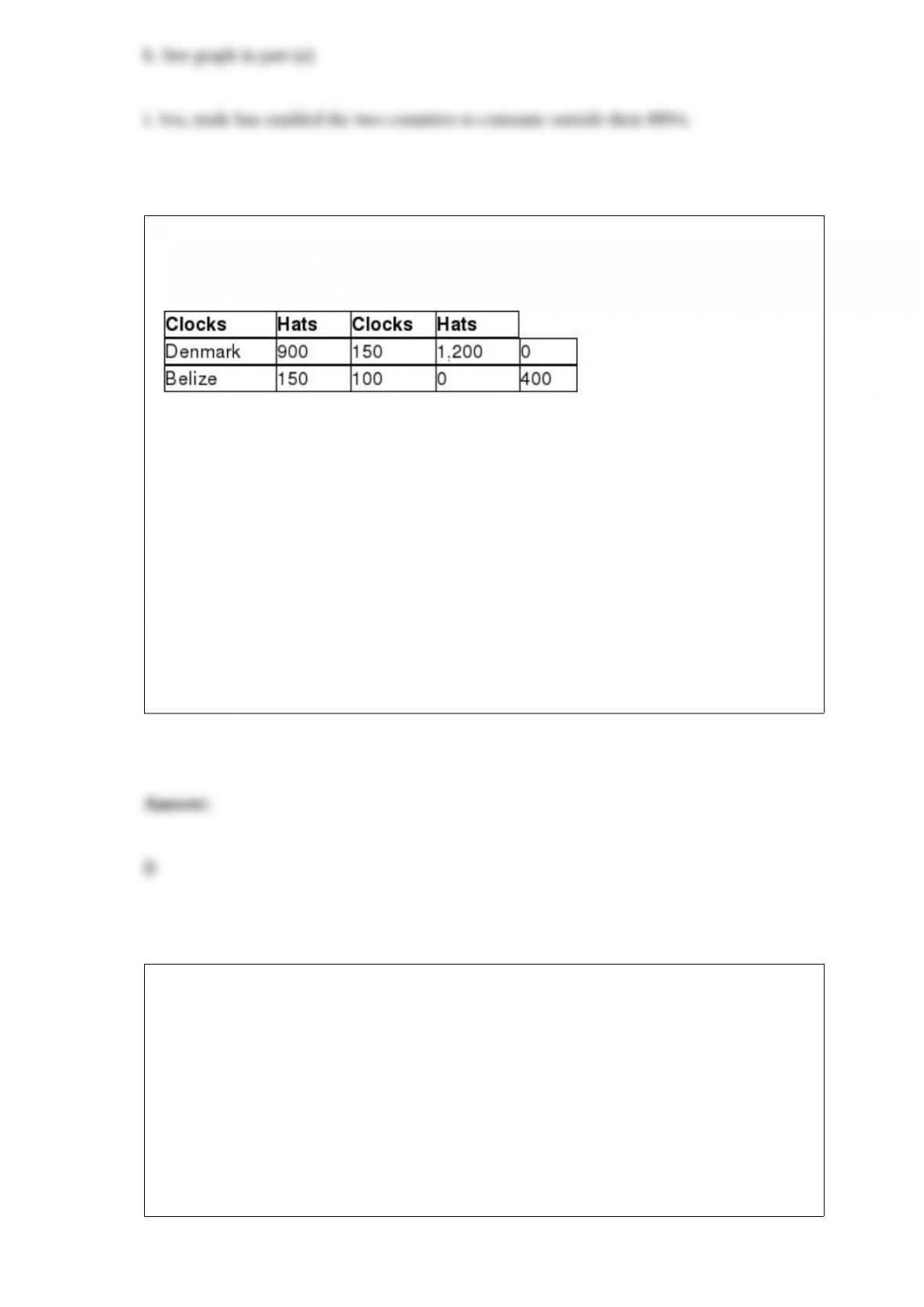
Table 9-11 Production and
Consumption Production
Without Trade With Trade
Denmark and Belize can produce both clocks and hats. Table 9-11 shows the production
and consumption quantities without trade, and the production numbers with trade.
If the actual terms of trade are 1 hat for 1.8 clocks and 150 hats are traded, how many
clocks will Belize consume?
A) 150
B) 270
C) 930
D) 1,200
Once a product becomes established, network externalities may create ________ costs
that make consumers reluctant to buy a new product with better technology.
A) external
B) implicit
C) switching
D) marginal
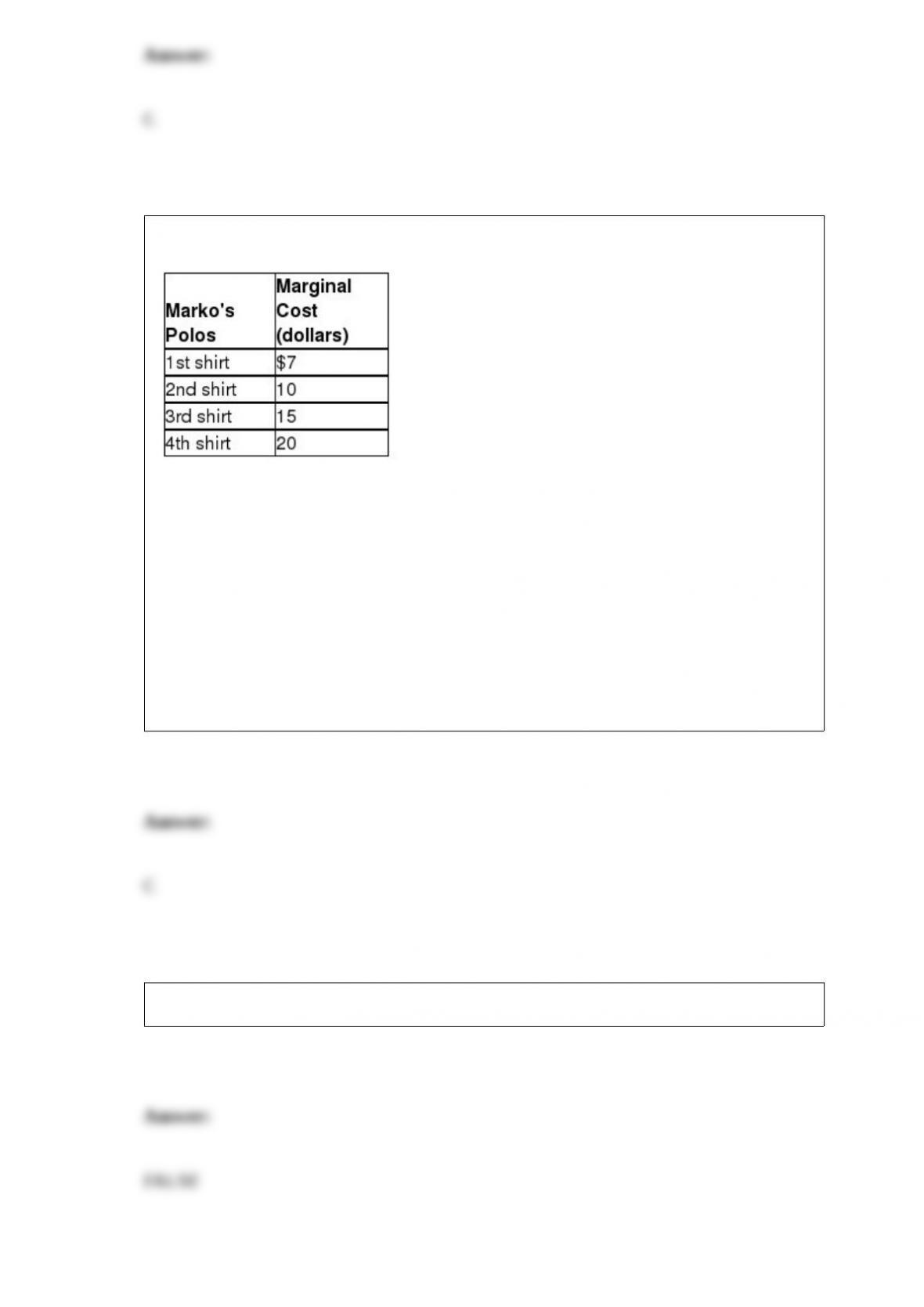
Table 4-6
The table above lists the marginal cost of polo shirts by Marko’s, a firm that specializes
in producing men’s clothing. If the market price of Marko’s polo shirts is $18,
A) Marko’s will produce four shirts.
B) producer surplus from the first shirt is $18.
C) producer surplus will equal $22.
D) there will be a surplus; as a result, the price will fall to $7.
Most economic growth in the world occurred between 1,000,000 B.C. and 1300 A.D.

The argument advanced by Milton Friedman for adopting a monetary growth rule is
that
A) active monetary policy potentially destabilizes the economy.
B) the Fed can control the money supply, but not the level of interest rates.
C) a constant rate of growth in the money supply would eliminate the booms and
recessions that make up the business cycle.
D) the growth rate of M1 has been unstable.
When a monopolistically competitive firm lowers it price one bad thing happens to the
firm. What is this “one bad thing” called?
A) the output effect
B) the income effect
C) the substitution effect
D) the price effect
Assume that the hourly price for the services of personal trainers has risen and sales of
these services have also risen. One can conclude that
A) the law of demand has been violated.

B) the number of personal trainers has increased.
C) the demand for personal trainers has increased.
D) personal trainers are deliberately charging high prices because they provide services
for wealthy clients.