Explain the effect of the following changes on equilibrium price and quantity of a
commodity:
(a) increase in average incomes.
(b) increase in population.
The construct used to demonstrate efficient use of society’s resources is the
a. production possibilities frontier.
b. payoff matrix.
c. input-output table.
d. cost-benefit table.
Inflation often bestows unearned income on

a. homeowners.
b. lenders.
c. creditors.
d. fixed income receivers.
While it is not certain that U.S. leadership will continue into the next generation, the
nation will continue to enjoy the abundance it has enjoyed in the past.
a. True
b. False
A major advantage of monetary policy over fiscal policy is that monetary
a. policy affects all sectors of the economy equally.
b. policy can be put into effect more quickly.
c. policy, once implemented, takes effect more quickly.
d. authorities see the need for policy more quickly.

Under a progressive tax, the fraction of income paid in taxes
a. rises as income rises.
b. is unchanged as income changes.
c. falls as income rises.
d. is proportional to the change in income.
If one adopts a pure free market approach to depletable resources, then one can expect
the price of resources to
a. rise steadily.
b. fall steadily.
c. fluctuate in a random-walk fashion.
d. remain unchanged.

Invention alone does not explain why free market societies have experienced such rapid
rates of economic growth.
a. True
b. False
If Argentina has a large amount of farmland and Great Britain has many factories,
a. the two nations have no reason to trade.
b. Argentina will be willing to trade but Great Britain will not.
c. Great Britain will be willing to trade but Argentina will not.
d. the two nations will probably engage in mutually advantageous trade.
Capital is the
a. flow of new equipment that a firm acquires over the course of a year.
b. amount of increase in a firm’s equipment over a year.
c. amount of money that a firm has on hand at a given time.
d. stock of plant, equipment, and other productive resources held by a firm.

During the financial crisis associated with the Great Recession, the interest rate spread
between Treasury bills and bank-to-bank lending increased substantially.
a. True
b. False
Prejudice leads, inevitably, to economic discrimination.
a. True
b. False
Economists define an aggregate as
a. a concrete object.

b. a specific principle.
c. a representative good or service.
d. a useful abstraction.
e. something immeasurable.
To get a complete measure of the total spending on U.S.-produced final goods and
services, one must adjust aggregate demand by
a. adding imports and subtracting exports.
b. adding imports that are purchased by U.S. consumers.
c. adding exports and subtracting imports.
d. subtracting exports sold to foreigners.
Figure 19-2
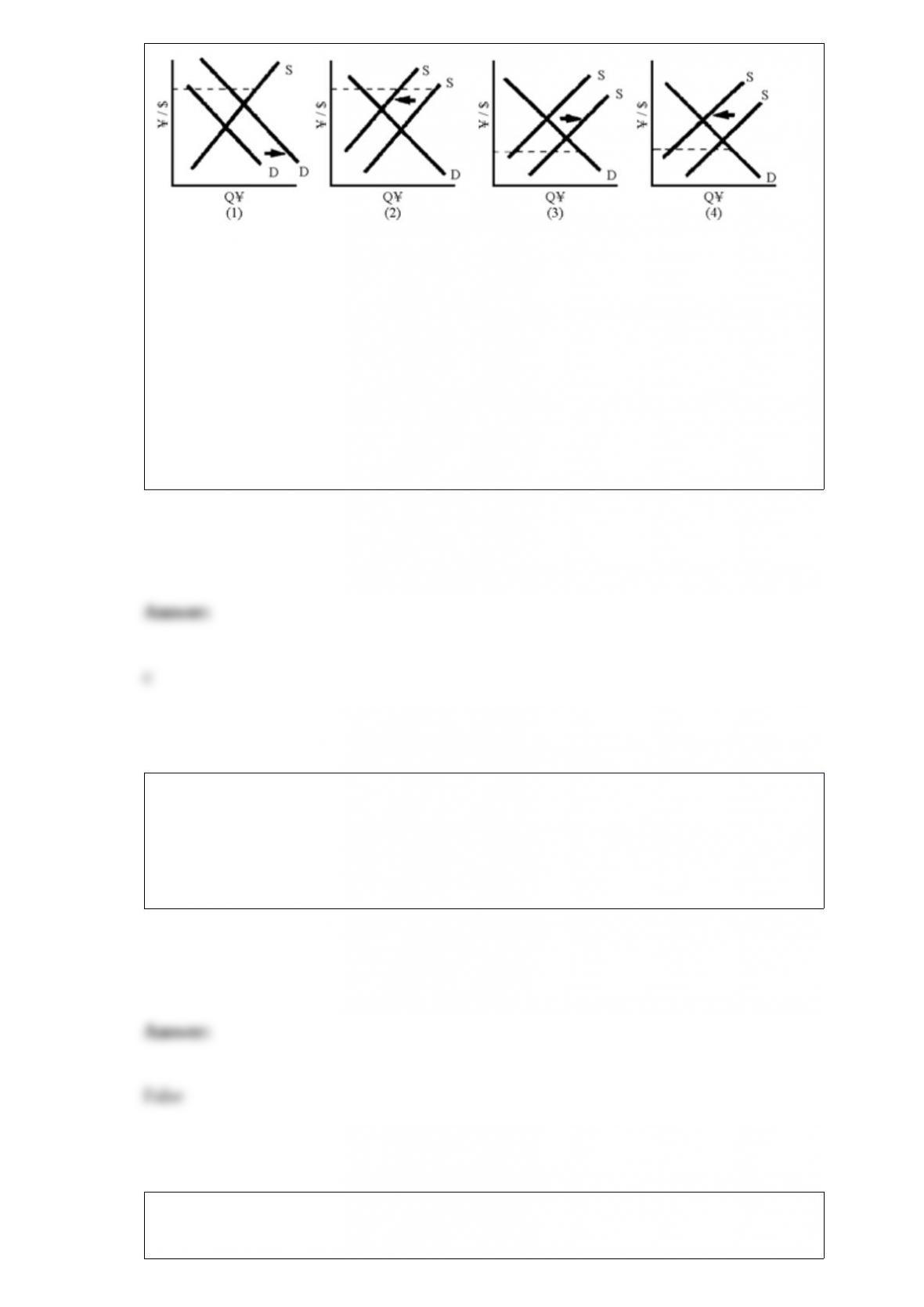
Of the graphs in Figure 19-2, which one shows the effects on the exchange rate of an
expansion in Japan?
a. 1
b. 2
c. 3
d. 4
The corporate tax applies to firms’ total revenues.
a. True
b. False
Regulations are sometimes used to “correct” the failures of a market mechanism.

a. True
b. False
The president wishes to increase spending for education by $4 billion but also maintain
a balanced budget. Therefore, taxes will also be increased by $4 billion. What will
happen to GDP?
a. It will increase.
b. It will remain the same.
c. It will decrease.
d. It’s impossible to know without the multiplier.
Figure 8-1
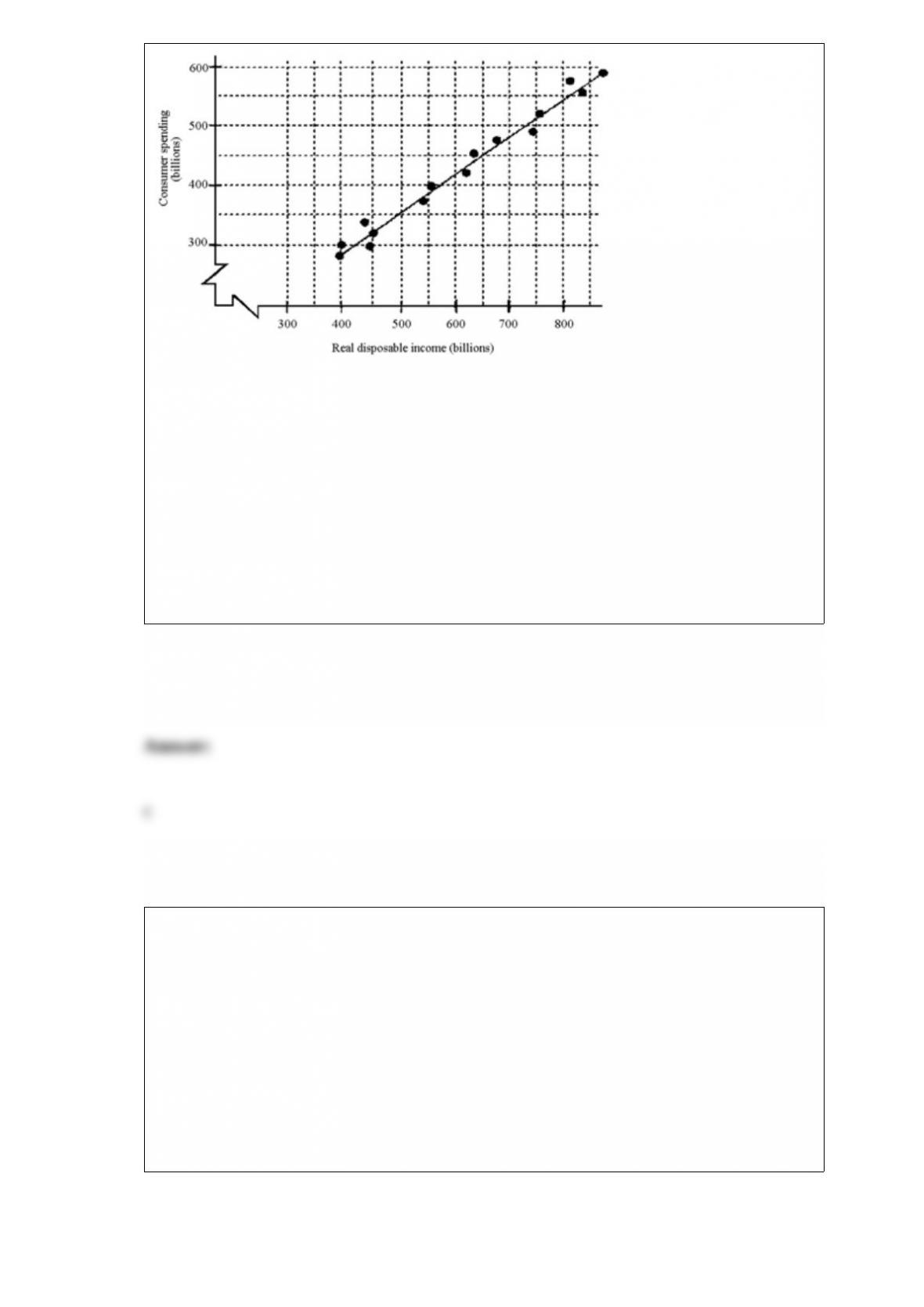
Based on the scatter diagram in Figure 8-1, approximately how much will consumption
increase after a permanent tax cut of $400 billion?
a. $100 billion
b. $150 billion
c. $250 billion
d. $350 billion
At its optimal output level, the profit-maximizing monopolist in Figure 11-6 will earn a
profit equal to
a. zero.
b. (P2 − P3)Q.
c. P > Q.
d. (P5 − P6 )Q.

Indifference curves show all combinations of commodities that are equally desirable to
the consumer.
a. True
b. False
Advertising by the monopolist
a. is not done because the monopolist has the only supply of the product and doesn’t
need to advertise.
b. would have the effect of shifting its demand curve to the left.
c. may lead to expanded production by the monopolist.
d. makes no sense because there are no substitute commodities available to consumers.
A futures contract is an agreement to buy a commodity at a specific future date, at a
price set today.
a. True
b. False
Briefly and concisely define the following terms:
a. statistical discrimination
b. compensating wage differential
c. affirmative action

If a detrimental externality is being produced in the course of producing a good, then
a. P > MSC.
b. MSC < MPC.
c. incidental costs are negative.
d. output is inefficiently large.
If a Mexican pension fund decides to purchase U.S. government bonds, what is the
effect in the foreign exchange market?
a. It will increase demand for U.S. dollars.
b. It will decrease demand for U.S. dollars.
c. It will increase supply of U.S. dollars.
d. It will decrease supply of U.S. dollars.
Innovation is
a. the same thing as invention.

b. the desired result of invention.
c. the necessary precondition of invention.
d. unrelated to invention.
The basic disadvantage of a proprietorship is unlimited liability.
a. True
b. False
Economics is the study of the logic of
a. rational decisions.
b. decision-making activities.
c. ends and means.
d. choosing options from those available.
e. All of the above are correct.

In the income-expenditure model, at equilibrium GDP
a. either unemployment or inflation may occur.
b. inflation can occur but unemployment cannot.
c. unemployment can occur but inflation cannot.
d. both unemployment and inflation are impossible.
As the unemployment rate rises,
a. real GDP also rises.
b. nominal GDP rises.
c. the employment rate rises.
d. lost national output rises.

When economists are critical of government regulations that prohibit free individuals
from making certain kinds of contracts, for example, to purchase a good or service, they
will usually invoke the concept of
a. marginal analysis.
b. mutual gains from voluntary trade.
c. inflation-unemployment trade-off.
d. the need for abstraction.
e. externalities.
Once the federal funds rate is reduced to zero, conventional expansionary monetary
policy is no longer an option.
a. True
b. False
How do macroeconomists differ from microeconomists?
a. the basic tools of analysis
b. the underlying principles

c. the use of abstractions and models
d. the problems studied
e. All of the above are correct.