
Who does NOT earn economic rent in a competitive factor market?
A) No one
B) Everyone
C) The last factor of production hired
D) The inframarginal workers
E) Only owners of physical properties earn economic rents
The food processing industry involves the canning of fruit products, among other
things, and the canning process produces canned goods and waste products. The
manufacturer of one kind of fruit product produces an external cost for third parties.
This external cost is expressed as:
MEC = 0.00005Q,
where MEC represents marginal external cost (dollars/unit), and Q represents cases
produced per week. The marginal cost of production (supply), ignoring MEC, at the
industry level is:
MC = 2 + 0.000175Q.
The industry demand for the product is:
P = 10 – 0.00025Q,
where price P is in dollars per unit.
a. Determine the output rate and price that would be established by profit maximizing
firms.
b. Determine the efficient output rate and price.
c. Determine the cost to society of firms producing at the profit maximizing rate rather
than at the efficient output rate.

If current output is less than the profit-maximizing output, then the next unit produced
A) will decrease profit.
B) will increase cost more than it increases revenue.
C) will increase revenue more than it increases cost.
D) will increase revenue without increasing cost.
E) may or may not increase profit.

Which of these is NOT a generally accepted means of reducing risk?
A) Diversification
B) Insurance
C) Obtaining more information
D) none of the above
See the information in Scenario 4.4. Suppose that the price should increase slightly
from $10, how will this affect the total expenditure of consumers on the game?
A) Total expenditures will increase.
B) Total expenditures will not change.
C) Total expenditures will decrease by a larger percentage than the price increase.
D) Total expenditures will decrease by a smaller percentage than the price increase.
E) either C or D could be true.
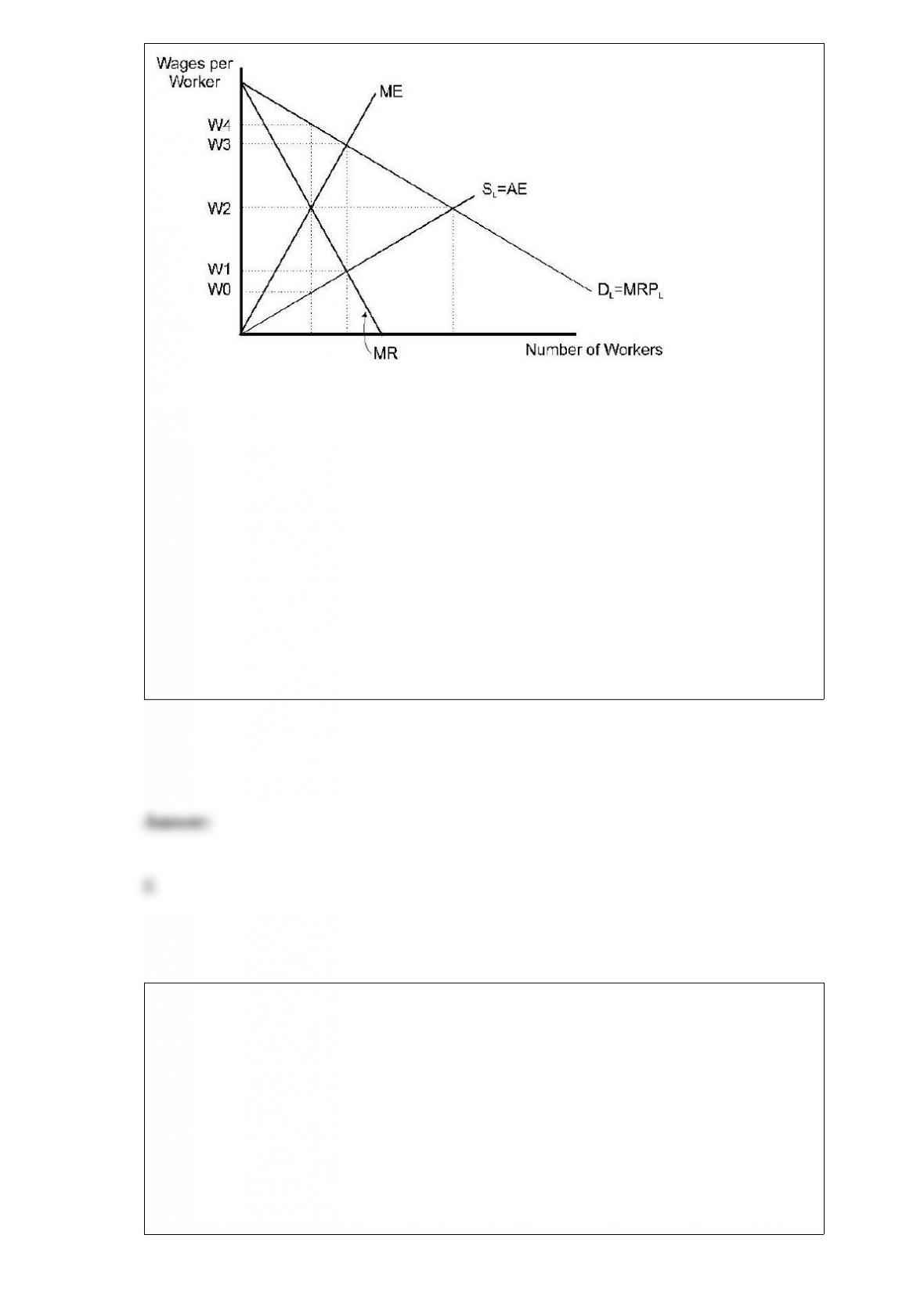
Figure 14.4
Given the information in Figure 14.4, the bilateral monopoly wage rate is:
A) W1.
B) W2.
C) W3.
D) W4.
E) Any of the above.
Suppose your firm operates in a perfectly competitive market and decides to double its
output. How does this affect the firm’s marginal profit?
A) Marginal revenue and marginal cost increase
B) Marginal revenue increases but marginal cost remains the same
C) Marginal cost may change but marginal revenue remains the same
D) Marginal revenue and marginal cost decrease

A bakery operating in the short run has found that when the level of employment in its
baking room was increased from 4 to 10, in increments of one, its corresponding levels
of production of bread were 110, 115, 122, 127, 130, 132, and 133.
a. Calculate the marginal product of labor.
b. Explain whether this production function exhibits diminishing marginal productivity
of labor.
Under an upward sloping supply curve for land, the economic rents to land ________ as
the demand for land shifts rightward.
A) decrease
B) increase
C) remain the same
D) We do not have enough information to answer this question.

The cross-price elasticity between a pair of complementary goods will be
A) positive.
B) negative.
C) zero.
D) positive or zero depending upon the strength of the relationship.
What do cooperative firms do if they make a profit?
A) Cooperatives never earn profits, so this issue does not occur.
B) Cooperatives must pay their profits to the federal governments as a windfall profit
tax.
C) Cooperatives must keep half of the profits and return the other half to their members.
D) Cooperatives generally return the profits to their members as a dividend.
Before their merger, XM and Sirius were competing sellers in the U.S. satellite radio
market. The U.S. Department of Justice allowed the merger even though it created a
single seller in the market. Why might we expect this merger to have limited impact on
U.S. consumers?
A) There are many close substitutes for satellite radio service (e.g., free AM-FM radio,

internet radio)
B) The merged firm is likely to act on behalf of its customers and keep its prices and
profits low
C) U.S. consumers are known to have perfectly inelastic demand for satellite radio (i.e.,
they are unresponsive to price changes)
D) all of the above are correct
Which of the following is true regarding income along a price-consumption curve?
A) Income is increasing.
B) Income is decreasing.
C) Income is constant.
D) The level of income depends on the level of utility.
The authors note that advertising can make the consumer demand for a product more
elastic (price responsive) by expanding the potential range of consumers. As this change
in demand occurs (ceteris paribus), what happens to the optimal advertising-sales ratio?
A) Increases
B) Decreases

C) Remains the same
D) We do not have enough information to answer this question
Marginal profit is equal to
A) marginal revenue minus marginal cost.
B) marginal revenue plus marginal cost.
C) marginal cost minus marginal revenue.
D) marginal revenue times marginal cost.
E) marginal revenue divided by marginal cost.
Under a transferable emissions permit system,
A) the firms with the lowest marginal abatement cost curves will reduce emissions
most.
B) the firms with the highest marginal abatement cost curves will reduce emissions
most.
C) the firms with the lowest marginal social cost curves will reduce emissions most.

D) the firms with the highest marginal social cost curves will reduce emissions most.
E) all firms will reduce emissions equally.
Scenario 13.10
Consider the game below:
In the game in Scenario 13.10, there is
A) a mixed strategy equilibrium, and no other.
B) a mixed strategy and a pure strategy equilibrium.
C) a mixed strategy and two pure strategy equilibria.
D) a mixed strategy and four pure strategy equilibrium.
E) no equilibrium in either mixed or pure strategies.

Scenario 12.2:
You are studying a market for which the kinked demand curve model applies. The
kinked demand curve is as follows:
Q = 1200 – 5P for 0 Q < 150
Q = 360 – P for 150 Q
The marginal cost is given as:
MC = Q
Refer to Scenario 12.2. Suppose that the marginal cost falls such that:
MC = Q – 10
What is the profit maximizing level of output?
A) 43
B) 120
C) 150
D) all of the above
E) none of the above
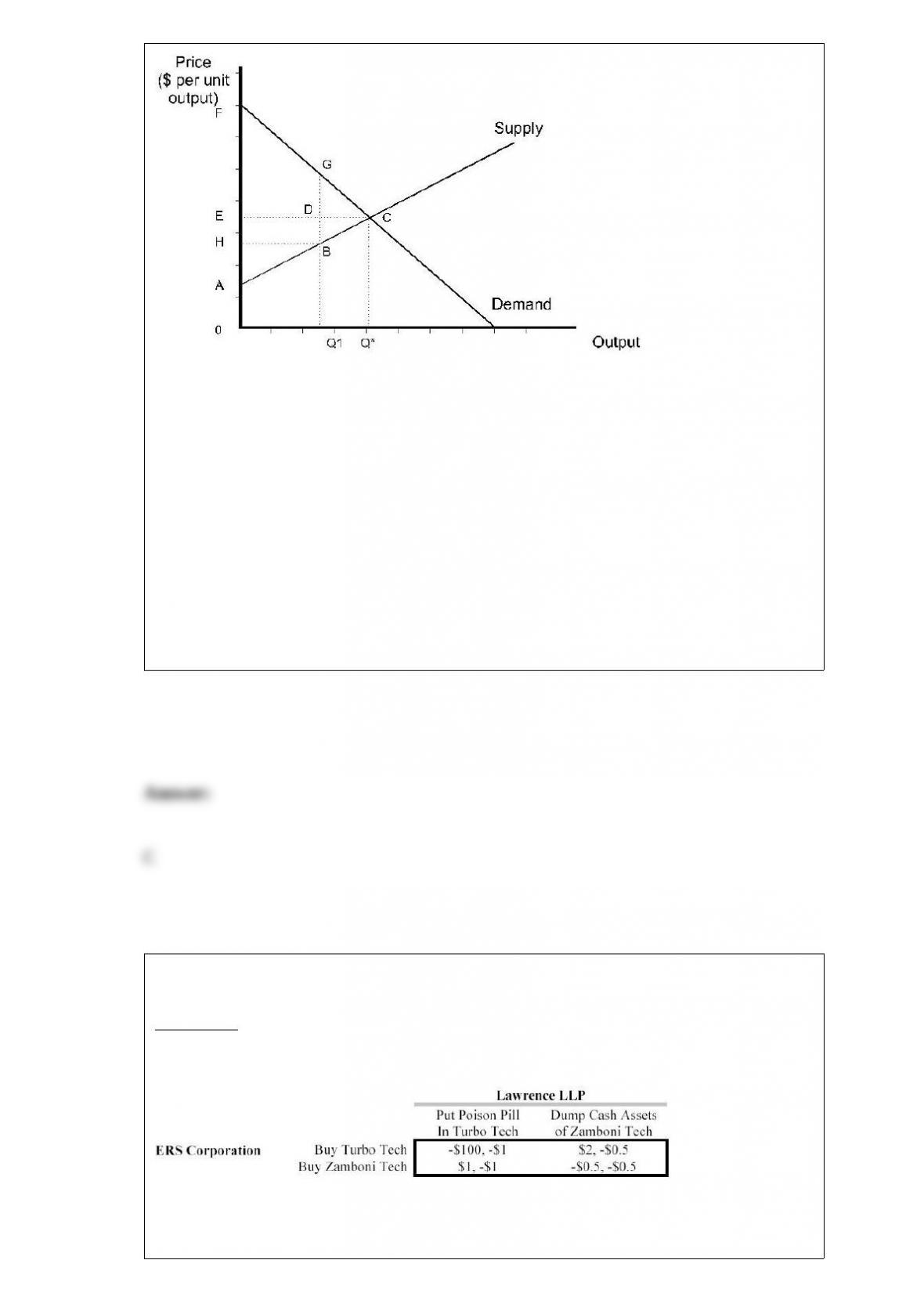
Figure 9.2
Refer to Figure 9.2. At price 0E and quantity Q*, consumer surplus is the area
A) 0FCQ*.
B) AFC.
C) EFC.
D) AEC.
E) none of the above
Scenario 6
Consider the following game. Payoffs are in millions of dollars.
Refer to the game in Scenario 13.6. What will occur if ERS Co. plays a maximin
strategy?

A) -$100, -$1
B) $2, -$0.5
C) $1, -$1
D) -$0.5, -$0.5
E) There is a 0.25 chance of each outcome in that case.
The key disadvantage of the kinked-demand model is that it:
A) explains why firms may collude, but it does not explain how they interact.
B) does not explain why prices may be rigid in an oligopoly.
C) requires the assumptions of perfect competition.
D) only holds under price leadership.
Externalities
A) are not reflected in market prices, so they can be a source of economic inefficiency.
B) do become reflected in market prices, so they can be a source of economic
inefficiency.

C) are not reflected in market prices, so they do not adversely affect economic
efficiency.
D) do become reflected in market prices, so they do not adversely affect economic
efficiency.
E) may or may not become reflected in market prices, but do not have an impact on
economic efficiency in either event.
Gasoline and bicycles are substitutes in consumption. Suppose we increase the federal
gasoline tax to $1 per gallon. Initially, the gasoline price rises due to the tax, and the
demand curve for bicycles shifts rightward because these goods are substitutes. What
are the secondary changes that result from the gasoline tax as these markets adjust to a
new general equilibrium?
A) Bicycle price rises, demand for gasoline shift s leftward.
B) Bicycle price rises, demand for gasoline shifts rightward.
C) Bicycle price declines, demand for gasoline shifts leftward.
D) Bicycle price declines, demand for gasoline shifts rightward.
Scenario 4.4:

The demand curve for the new computer game, Rock and Roll Trivia, is given as
follows:
Q = 200 – 5P – .1Pc – .5Pd + .2A – I
where P is the price of the game
Pc is the price of a computer
Pd is the price of a diskette
A is the level of advertising
Q is the level of incomeSee the information in Scenario 4.4. Suppose P = 10, Pc = 100,
Pd = 2, A = 5, and I = 50. What is the cross-price elasticity of Rock and Roll Trivia
programs and diskettes?
A) -1/90
B) 0
C) 1/90
D) 1
E) none of the above
The market supply curve for music downloads is Q = 135(P-1) where Q is millions of
downloads and P is the price in dollars per track. If the current price is $1.20 per
download, what is the change in producer surplus if the price increases by $0.20 per
track?
A) $5.4 million
B) $8.1 million
C) $10.8 million
D) $27 million

A local restaurant offers “early bird” price discounts for dinners ordered from 4:30 to
6:30 PM. This is an example of
A) peak-load pricing.
B) second-degree price discrimination.
C) a two-part tariff.
D) tying.
E) none of the above
Use the following statements to answer this question:
I. The equal marginal principle may be used to characterize the maximum utility
consumption decision even if the diminishing MRS assumption does not hold.
II. The equal marginal principle implies that the MRS at the optimal consumption
bundle is always equal to the price ratio.
A) I and II are true.
B) I is true and II is false.
C) II is true and I is false.
D) I and II are false.

Suppose the U.S. government imposes a maximum price of $5 per gallon of gasoline,
and the current equilibrium price is $3.50 per gallon. This policy represents a:
A) binding price floor.
B) non-binding price floor.
C) binding price ceiling.
D) non-binding price ceiling.
Suppose labor and capital are variable inputs. The wage rate is $20 per hour, the
marginal product of labor is 30 units, the rental rate of capital is $100 per machine hour,
and the marginal product of capital is 150 units. If the wage rate declines to $15 per
hour, the firm employs more labor and the marginal product of labor declines to 20
units. Assuming the rental rate of capital remains the same, what is the marginal product
of capital at the new optimal level of input usage?
A) 100 units
B) 133 units
C) 150 units
D) We do not have enough information to answer this question.

A supply curve reveals:
A) the quantity of output consumers are willing to purchase at each possible market
price.
B) the difference between quantity demanded and quantity supplied at each price.
C) the maximum level of output an industry can produce, regardless of price.
D) the quantity of output that producers are willing to produce and sell at each possible
market price.
Suppose that the demand for artichokes (Qa) is given as:
Qa = 120 – 4P
a. What is the point price elasticity of demand if the price of artichokes is $10?
b. Suppose that the price of artichokes increases to $12. What will happen to the
number of artichokes sold and the total expenditure by consumers on artichokes?
c. At what price if any is the demand for artichokes infinitely elastic?

Consider the following statements when answering this question;
I. Suppose a semiconductor chip factory uses a technology where the average product
of labor is constant for all employment levels. This technology obeys the law of
diminishing returns.
II. Suppose a semiconductor chip factory uses a technology where the marginal product
of labor rises, then is constant and finally falls as employment increases. This
technology obeys the law of diminishing returns.
A) I is true, and II is false.
B) I is false, and II is true.
C) Both I and II are true.
D) Both I and II are false.

By 2020, automobile market analysts expect that the demand for electric autos will
increase as buyers become more familiar with the technology. However, the costs of
producing electric autos may increase because of higher costs for inputs (e.g., rare earth
elements), or they may decrease as the manufacturers learn better assembly methods
(i.e., learning by doing). What is the expected impact of these changes on the
equilibrium price and quantity for electric autos?
A) Unambiguously higher equilibrium price and quantity
B) Unambiguously higher price, and equilibrium quantity may be higher or lower
C) Unambiguously higher quantity, and equilibrium price may be higher or lower
D) We cannot form any unambiguous expectations for either price or quantity