
1) The legal cartel theory indicates that, in any industry where market demand and the
long-run average total cost curve intersect close to the latter’s minimum, government
regulation is mandatory and desirable.
2) Property rights over fish in the open ocean exist once the fish are caught.
3) real gdp = worker-hours labor productivity.
4) a price index is 100 times the ratio of real gdp to nominal gdp.
5) DVCs tend to have permanent shortages of farm labor.
6) The aggregate expenditures model does not allow for cost-push inflation.
7) (last word) the fallacy of composition states that:
a.generalizations relevant to microeconomics never apply to macroeconomics.
b.expectations give rise to self-fulfilling prophesies.
c.generalizations pertaining to individuals always apply to the group.
d.quantifiable economic goals are always incompatible with one another.
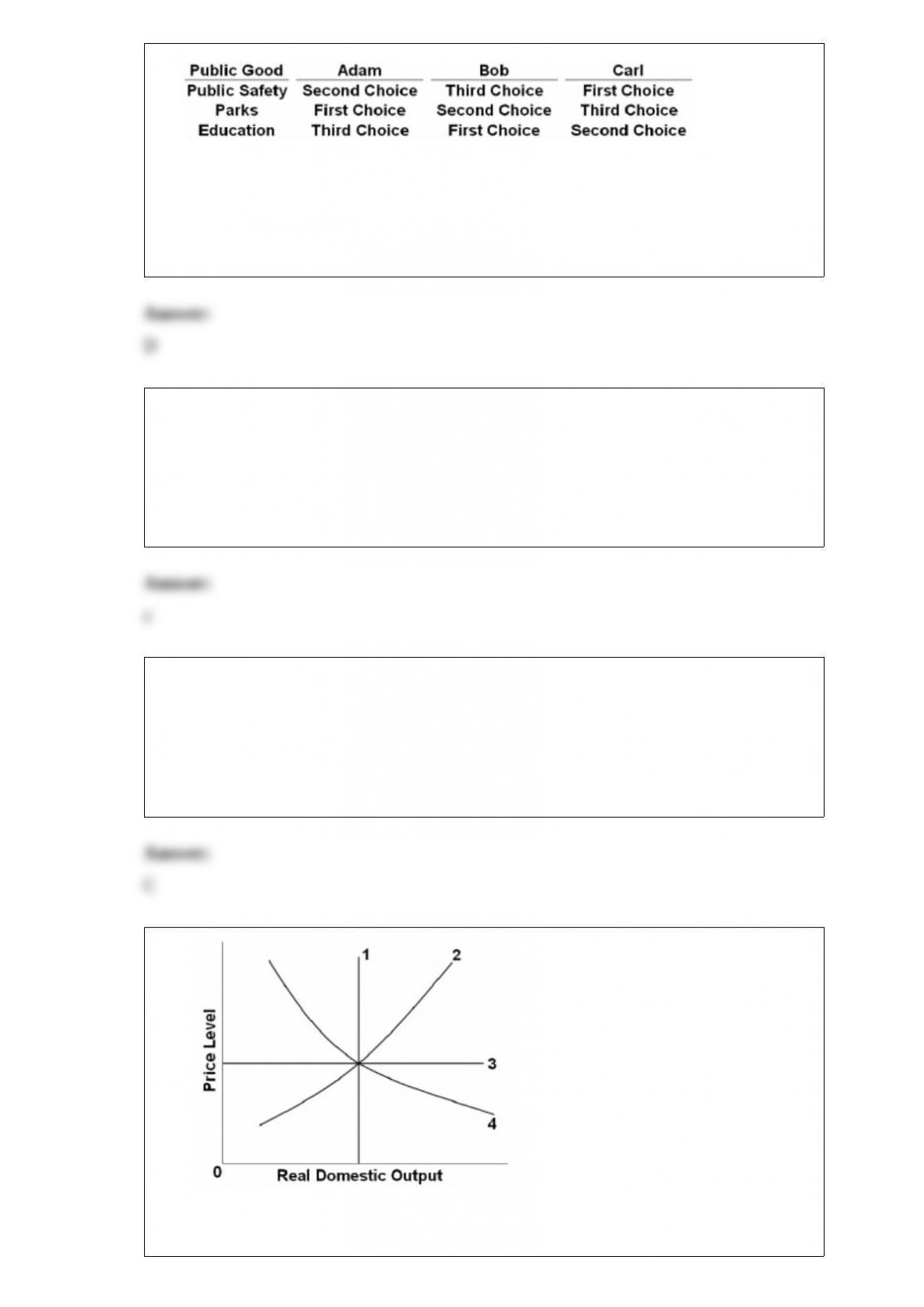
8)
Refer to the above table. In a choice between public safety and parks:
A.the outcome would depend on which item was listed first on the ballot.
B.a majority of voters would favor public safety.
C.no voter decision is possible.
D.a majority of voters would favor parks.
9) suppose that a pure monopolist can sell 20 units of output at $10 per unit and 21
units at $9.75 per unit. the marginal revenue of the twenty-first unit of output is:
a.$9.75.
b.$204.75.
c.$4.75.
d.$.25.
10) Which of the following would cause the present optimal extraction level of a
non-renewable resource to rise?
A.A decrease in the price of the resource.
B.An increase in the extraction cost of the resource.
C.A decrease in the user cost of the resource.
D.A decrease in interest rates.
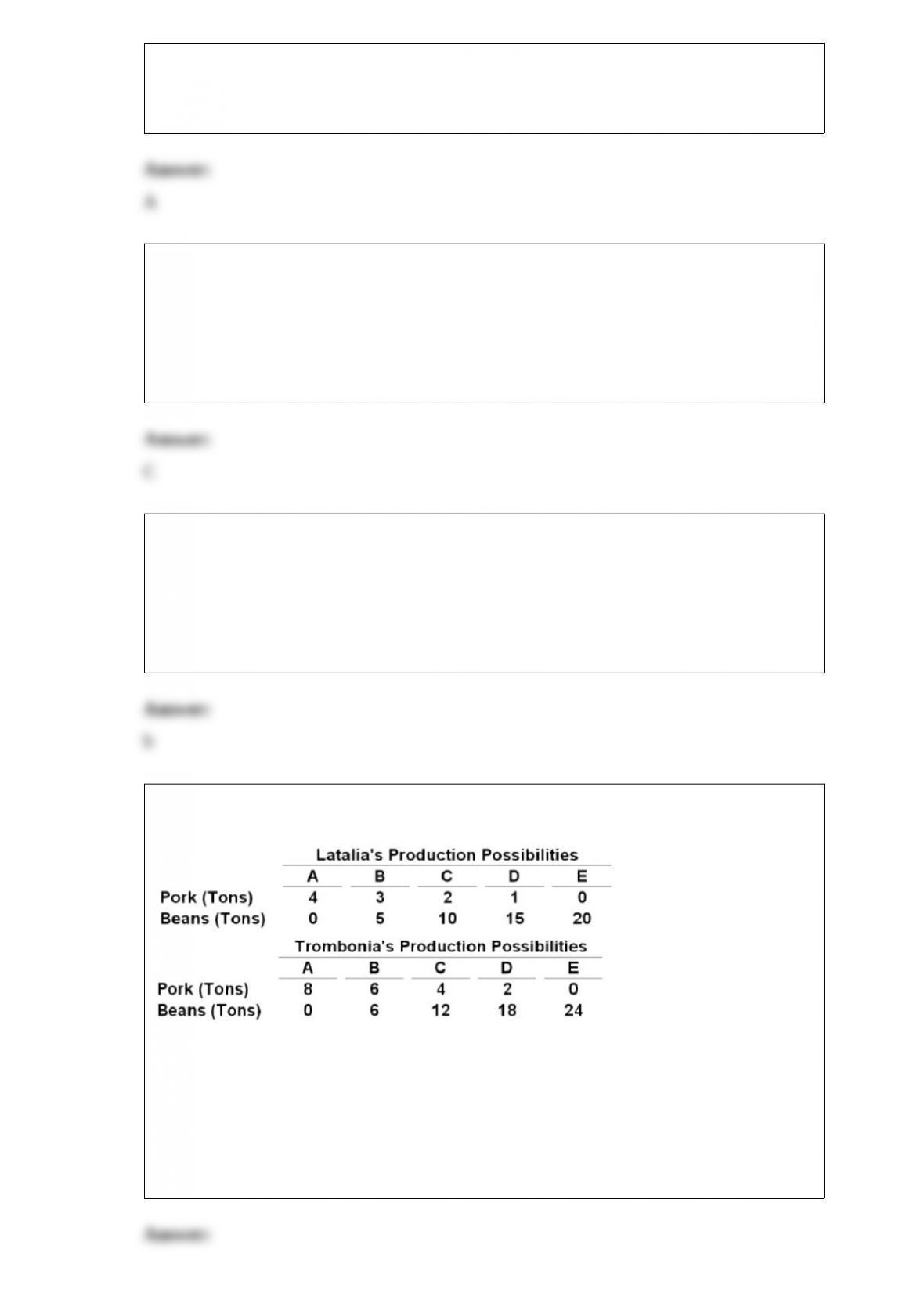
11)
In the above diagram, the economy’s long-run aggregate supply curve is shown by line:
A.1.
B.2.
C.3.
D.4.
12) Gigantic Corporation follows a strategy of waiting for rivals to innovate, then
quickly imitating any successful innovations. This behavior is known as:
A.collusion.
B.an entrepreneurial strategy.
C.a fast-second strategy.
D.pricing the demand curve.
13) the unemployed are disproportionately represented among the uninsured because:
a.one must be working to qualify for medicaid.
b.most workers obtain health insurance through their employers.
c.most are young and in excellent health, so they choose not to purchase health
insurance.
d.a large percentage of the unemployed are heads of single-parent families.
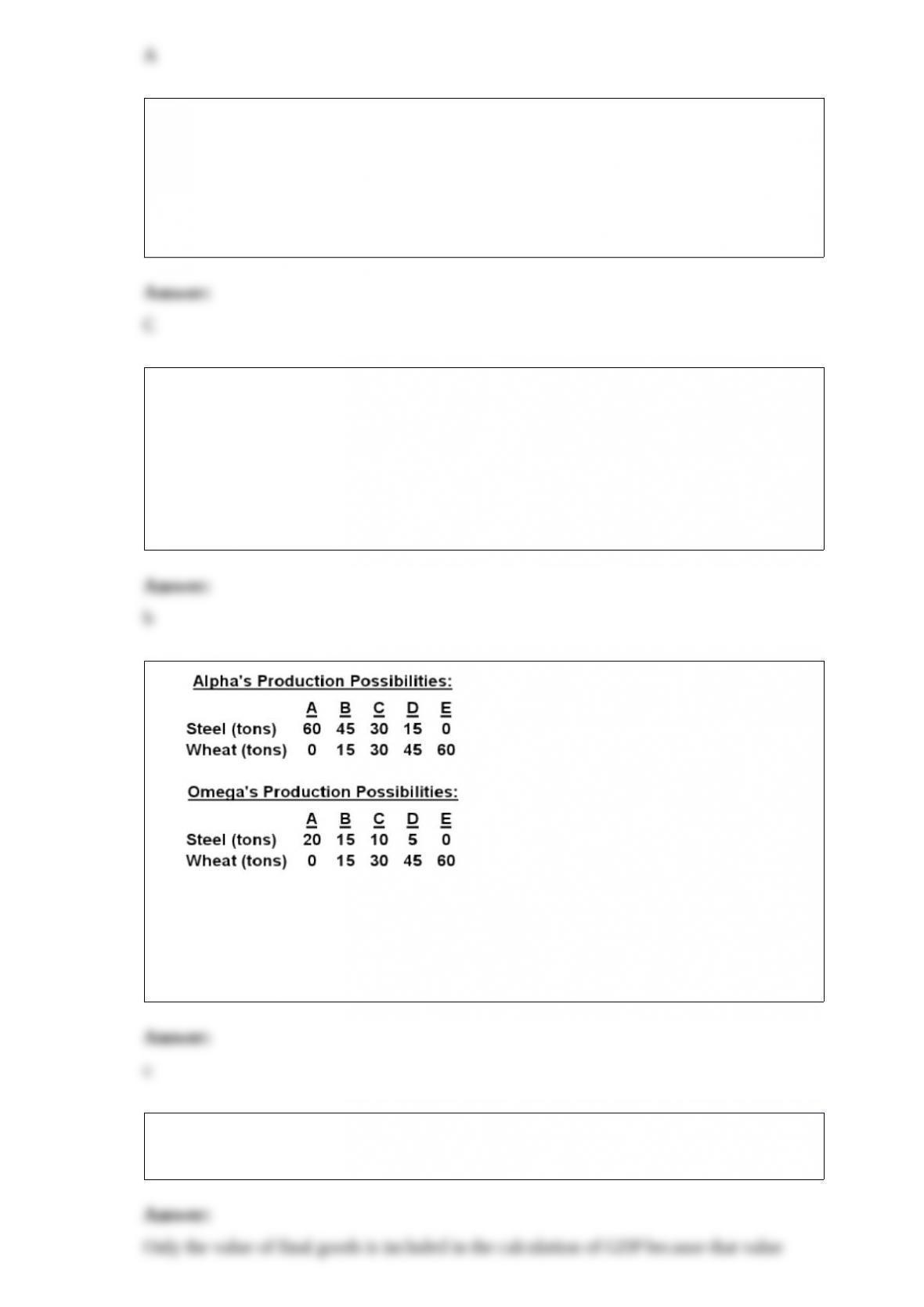
14) The following production possibilities tables for two countries, Latalia and
Trombonia:
The above data indicate that production in:
A.both Latalia and Trombonia is subject to constant opportunity costs.
B.Trombonia is subject to decreasing costs, but production in Latalia occurs under
increasing opportunity costs.
C.Latalia is subject to increasing costs, but production in Trombonia occurs under
constant opportunity costs.
D.both Latalia and Trombonia are subject to the law of increasing opportunity costs.
15) Which of the following is incorrect?
A.The nominal interest rate is the rate of interest expressed in terms of current dollars.
B.The real interest rate is the rate of interest expressed in terms of dollars of constant or
inflation-adjusted value.
C.The nominal interest rate is the real interest rate less the rate of inflation.
D.During periods of inflation the nominal interest rate will exceed the real interest rate.
16) a trade bloc is:
a.a tariff or quota that impedes imports.
b.a group of nations that allows free trade among member nations but restricts imports
from nonmember nations via tariffs and quotas.
c.an area of a nation where manufacturers can import product components without
paying tariffs.
d.a group of nations that advertise their common export goods abroad.
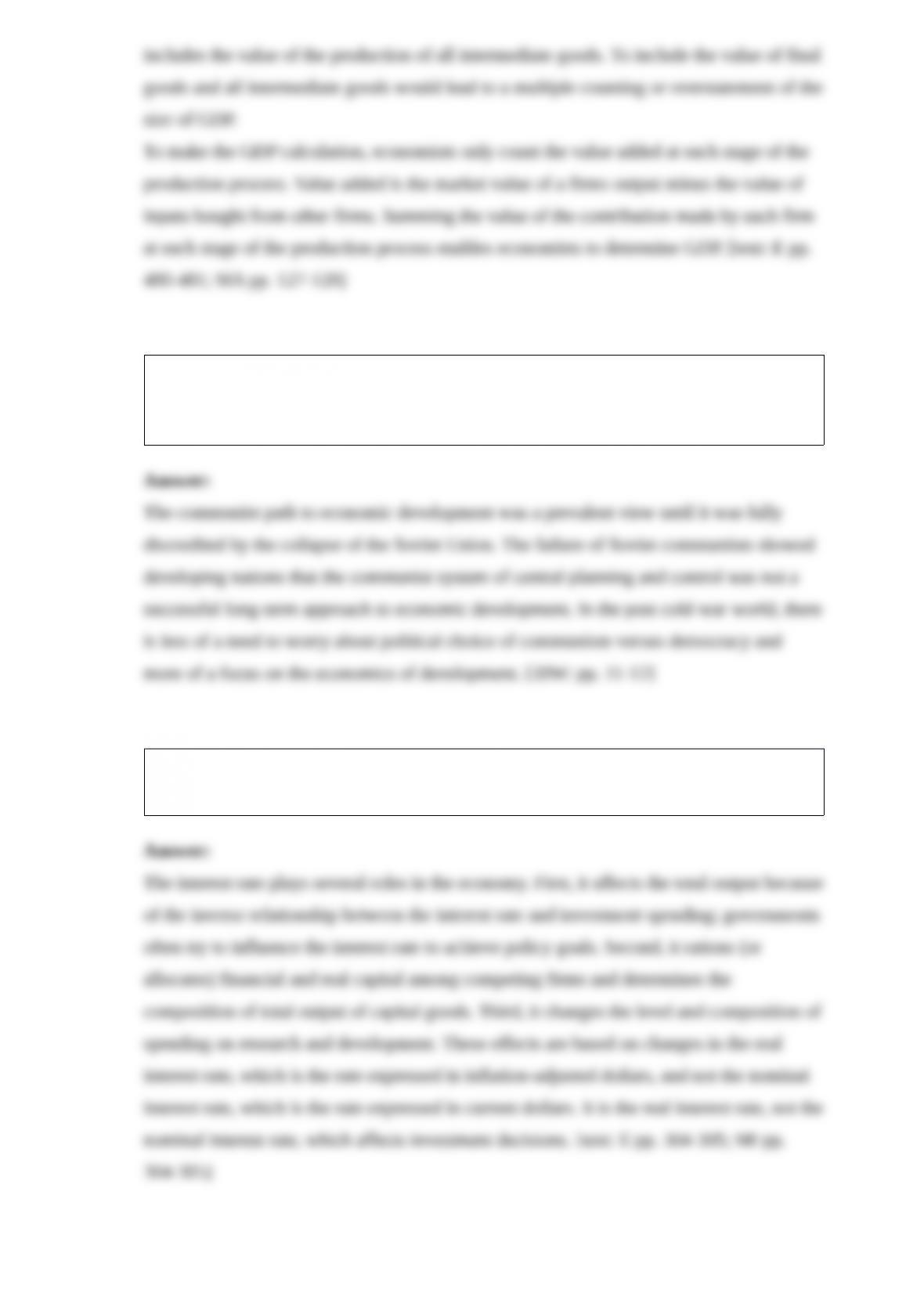
17)
refer to the above data. after specialization, alpha will produce:
a.60 tons of steel and omega will produce 45 tons of wheat.
b.20 tons of steel and omega will produce 60 tons of wheat.
c.60 tons of steel and omega will produce 60 tons of wheat.
d.30 tons of steel and omega will produce 30 tons of wheat.
18) Why do economists worry about multiple counting and calculate only the value
added in the production process?
19) The increasing gap between the advanced and the developing nations is not simply
a matter of economics; it is also a matter of the political choice between democracy and
capitalism or communism and central planning. Evaluate and explain.
20) What role does the interest rate play in the economy? Is the distinction between real
and nominal interest rates an important one in discussing these roles?
21) What are three examples of occupations that are expected to experience a rapid
decline in employment from 20062016? Why are these occupations likely to experience
this decline?
22) Explain what is meant by cyclical asymmetry with regard to monetary policy
effects.
23) What are the major characteristics of pure monopoly?