
The principal danger to Japan in 2001 when the yen was appreciating was that this
would
a. increase aggregate demand and make inflation worse.
b. decrease aggregate demand and make the recession worse.
c. decrease aggregate demand and make inflation worse.
d. increase aggregate demand and make the recession worse.
In 2013, the U.S. spending on research and development was:
a. the lowest among developed countries
b. more than any other country
c. more than most countries, but not China
d. consistent with spending on R&D in 2012
The marginal productivity principle has some relevance to organizing production in a
socialist society.
a. True
b. False

Monopolistic competitors and perfect competitors are alike in
a. having horizontal demand curves.
b. zero economic profit in the short run.
c. zero economic profit in the long run.
d. relying on advertising to attract buyers to their products.
The main component of the monetary union created by the Treaty of Maastricht is a(n)
a. single currency.
b. gold standard.
c. bilateral barter system of currencies.
d. unified stock market.

A tax that reduces economic efficiency is always bad policy.
a. True
b. False
A monopolist maximizes profit by producing the quantity at which MC = MR, just like
a perfect competitor.
a. True
b. False
A tax loophole is
a. an illegal method by which individuals or corporations avoid paying the taxes they
legally owe.
b. a provision in the tax code that allows individuals or corporations to reduce their tax
burdens legally by meeting certain conditions.
c. a tax surcharge on incomes within certain ranges.
d. a provision in the tax code that allows individuals or corporations to shift the
economic incidence of a particular tax on to someone else.

The “universal service” argument often requires that some products be sold at a loss
while other products be sold at profits higher than normal.
a. True
b. False
Which of the following events will lead to an inward shift of the aggregate supply
curve?
a. an increase in the price level
b. an increase in consumer spending
c. an increase in labor productivity
d. an increase in wage rates
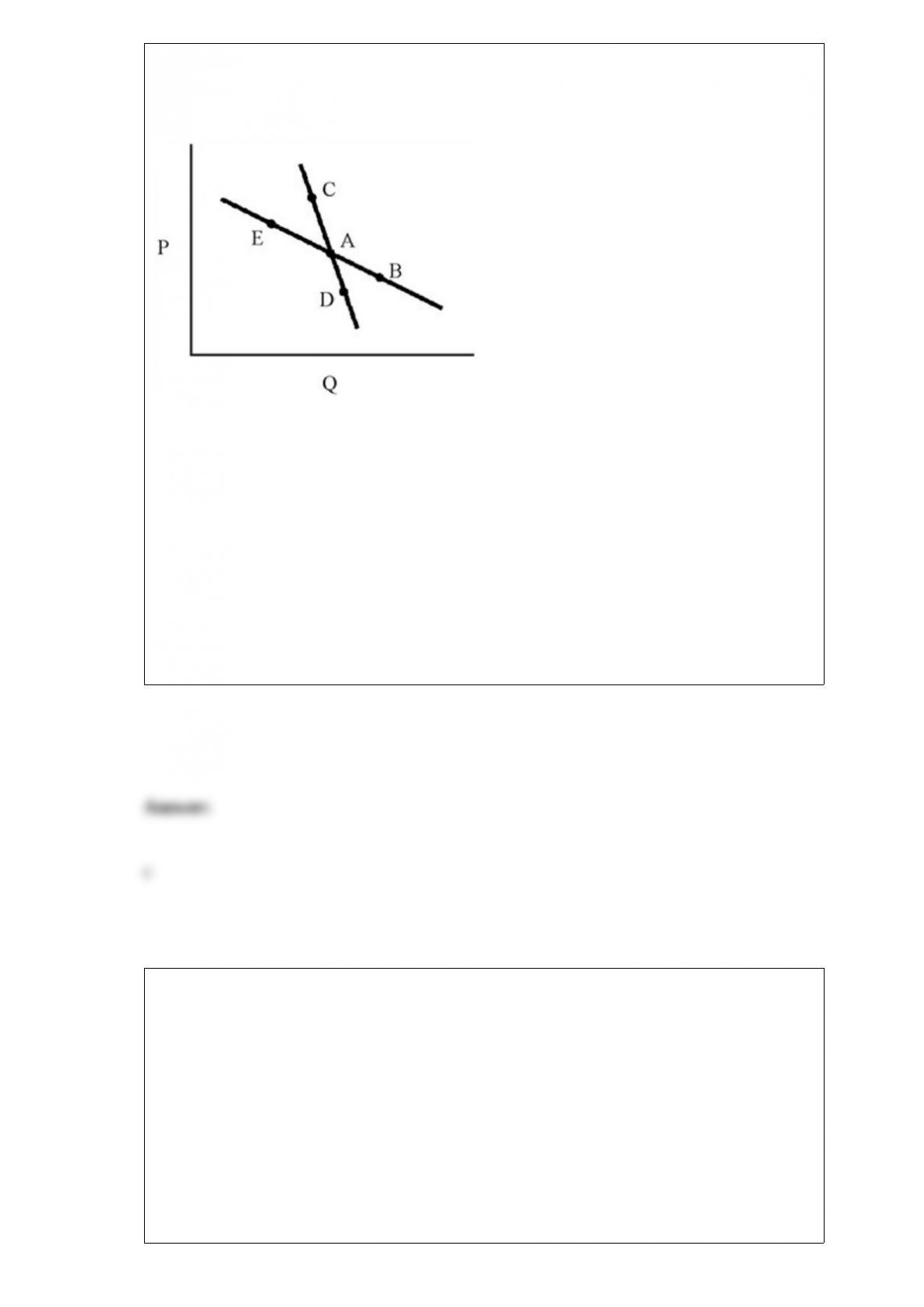
Figure 12-3
Oligopolist A cuts price in an attempt to enlarge his share of the market. His
competitors retaliate with identical price cuts. In this case, in Figure 12-3, oligopolist A
will move from point A to which point?
a. B
b. C
c. D
d. E
Employers near military bases are aware that wives generally accompany their
servicemen husbands when they are transferred. When presented with nonservice-wife
applicants and wives of servicemen, they hire the nonservice-wife applicants. This is an
example of
a. gender discrimination.
b. statistical discrimination.
c. economic discrimination.

d. prejudicial discrimination.
A depreciation of the dollar will cause an increase in the Consumer Price Index.
a. True
b. False
Which of the following is an example of wealth?
a. a yearly salary of $40,000
b. a mutual fund balance of $1,000
c. rental payments of $3,000 per month
d. stock dividends of $500 per quarter

A movement from one point to an another point on the same consumption function
could be caused due to
a. changes in wealth.
b. an increase in the general price level.
c. decrease in the real interest rates.
d. changes in disposable income.
The opportunity cost of postponing income to some future time depends on the interest
rate.
a. True
b. False
In 1971, a bank worker could process 265 checks in 1 hour. Currently, computers with
built-in reader-sorter processing capacity have pushed that number above 100,000
checks per hour. Economists describe this type of activity as
a. exploitation of labor.
b. an increase in labor productivity.

c. speed-up.
d. comparative advantage.
e. mutual gains from voluntary trade.
For a consumer to maximize utility, he will choose the
a. point where the slope of the budget line equals the slope of the indifference curve.
b. any point where the budget line and indifference curve intersect.
c. point where he gets the most of the good he prefers most.
d. point where the marginal rate of substitution is greatest.
e. the point where marginal utility is zero for both goods
When equilibrium GDP is greater than potential GDP, jobs are plentiful and labor is in
great demand.
a. True
b. False

In order to consider the equation of exchange an economic model, what must we
assume?
a. Real GDP is a constant value.
b. Changes in GDP cause changes in the money supply.
c. The money supply is constant.
d. Changes in velocity are small and predictable.
If the interest rate is r (expressed as a decimal number), the present value today of $1 to
be received n years from today equals ____.
a. $1rn
b. $1(1 + r)n
c. $1/(1 + r)n
d. $1/(1 + n)r

Using the standard 45-degree line diagram, how does a decrease in net exports effect
the expenditure schedule?
a. It increases the slope of the expenditure schedule.
b. It decreases the slope of the expenditure schedule.
c. It shifts the expenditure schedule upward.
d. It shifts the expenditure schedule downward.
Paper money has been in use since the
a. Roman Empire.
b. eleventh century in China.
c. Civil War in the United States.
d. development of money-center banking in nineteenth-century London.
Human capital includes the tools and equipment that human beings work with.
a. True

b. False
Consumers increased consumption by a relatively small amount in 2008 and 2009
because they believed the tax cuts were temporary.
a. True
b. False
Households can finance their consumer spending from current
a. income.
b. wealth.
c. debt.
d. income and current wealth.

Over the last 30 years, the income gap between the rich and the poor has declined.
a. True
b. False
The cost disease of personal services stems primarily from the fact that
a. prices rise too slowly to provide public receipts.
b. inflation has been with us since the early 1970s.
c. personal service requires direct contact between producer and consumer.
d. sellers of personal services have strong unions.
Regardless of quantity in long-run equilibrium, the industry price cannot exceed the
a. long-run average cost of supplying that quantity.
b. total variable cost of supplying that quantity.
c. long-run total cost of supplying that quantity.
d. minimum long-run marginal cost of supplying that quantity.

Which of the following best expresses the attitude toward competition of a firm
engaged in tacit collusion with its rivals?
a. A rolling stone gathers no moss.
b. Waste not, want not.
c. Do unto others as you would have them do unto you.
d. Ask, and ye shall receive.
The money wage rate has little effect on the supply curve. It mainly affects the
aggregate demand curve.
a. True
b. False