
Economists Kenneth Chay and Michael Greenstone find that in the two years following
the passage of the Clean Air Act of 1970, the sharp reduction in air pollution also led to
a decline in infant deaths. Although this and other studies provide compelling evidence
of the link between pollution and infant health, it is not clear that reductions from the
much lower levels of ambient pollution today would have the same effect. Which of the
following reasons could explain this?
A) The cost of pollution abatement today is much higher than it was in the 1970s. Thus,
it would be far more costly to achieve the same level of benefit today as the benefit
achieved in 1970.
B) When levels of pollution are high, the marginal benefit of reducing pollution also is
high. It follows therefore that the benefit of reducing air pollution in 1970 would be
much higher than the benefit from a proportional reduction in air pollution today when
the level of pollution is much lower.
C) Today, the level of pollution is much higher. Therefore, it will take a much larger
reduction in air pollution to reap similar benefits as it did in 1970.
D) When levels of pollution are high, the marginal benefit of reducing pollution is low.
Therefore, it was necessary to significantly reduce air pollution in 1970 before benefits
can be realized. Today, when the level of pollution is much lower, such drastic measures
are unnecessary.
Autonomous expenditure is a type of expenditure that does not depend on
A) wealth.
B) expectations.
C) rates.
D) GDP.
At a product’s equilibrium price,
A) anyone who needs the product will be able to buy the product, regardless of ability
to pay.
B) the federal government will provide the product to anyone who cannot afford it.
C) not all sellers who are willing to accept the price will find buyers for their products.
D) any buyer who is willing and able to pay the price will find a seller for the product.
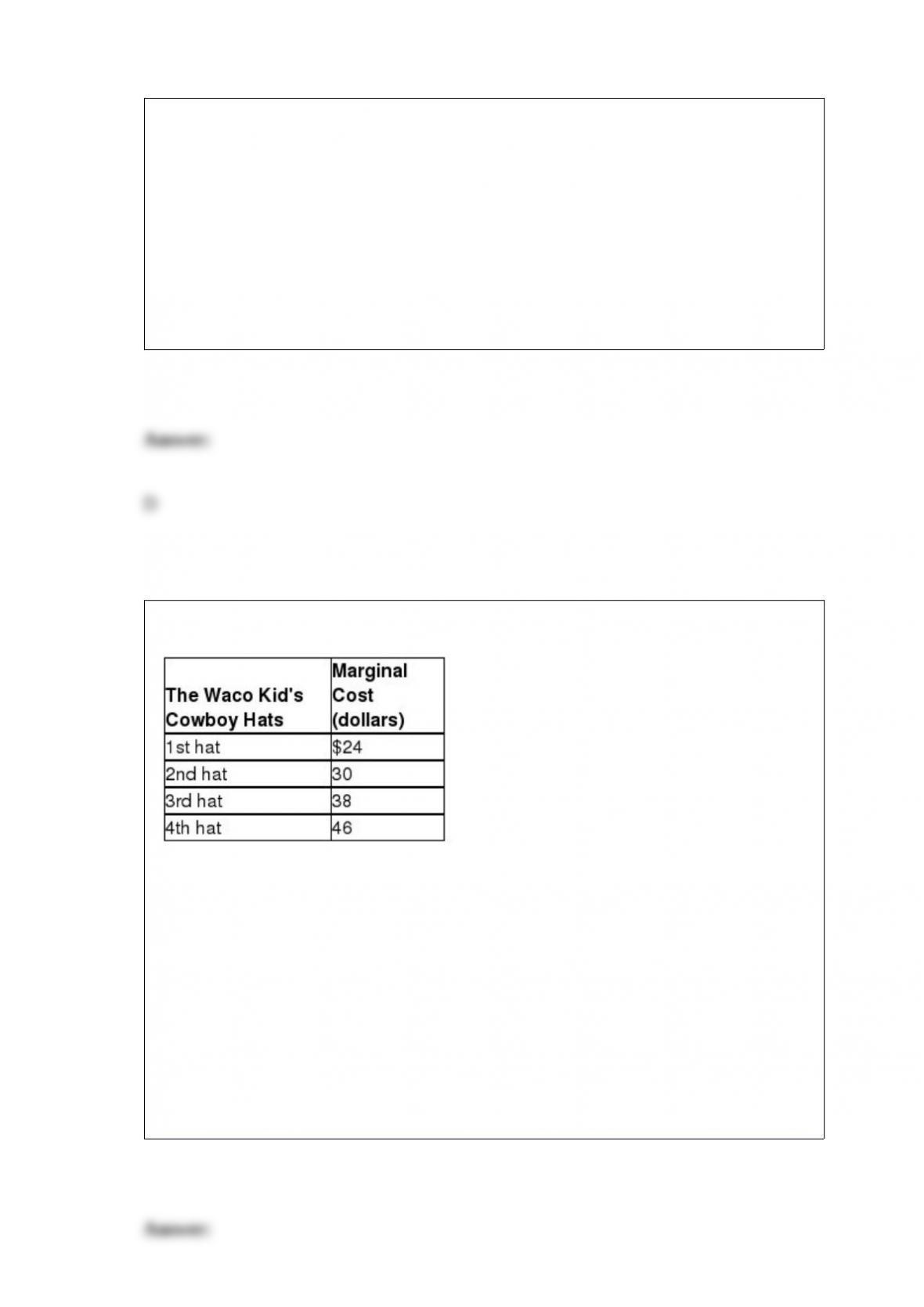
Table 4-3
The table above lists the marginal cost of cowboy hats by The Waco Kid, a firm that
specializes in producing western wear. If the market price of The Waco Kid’s cowboy
hats is $40
A) The Waco Kid will produce four hats.
B) producer surplus from the first hat is $40.
C) producer surplus will equal $28.
D) there will be a surplus; as a result, the price will fall to $24.

Letters are used to represent the terms used to answer this question: price (P), quantity
of output (Q), total cost (TC) and average total cost (ATC). Which of the following
equations is equal to a firm’s average profit?
A) P – ATC
B) (P – ATC) Q
C) (P Q) – TC
D) P – TC
The coupon rate of a bond is equal to
A) the coupon payment.
B) the interest payment.
C) the interest rate.
D) the face value.
The ________ illustrates the relationship between the price level and the quantity of
planned aggregate expenditure, holding constant all other factors that affect aggregate

expenditure.
A) aggregate demand curve
B) savings line
C) 45-degree line
D) consumption function
Because Whirlpool produces durable goods, the demand for their goods
A) is likely to increase during recession.
B) declines when incomes in the economy are rising.
C) is consistently high, regardless of the state of the economy.
D) tends to follow the business cycle.
The Fed
A) always engages in countercyclical policy.
B) always intends to engage in procyclical policy.
C) can engage in procyclical policy if it mistimes its policy response.
D) never intends to engage in countercyclical policy.
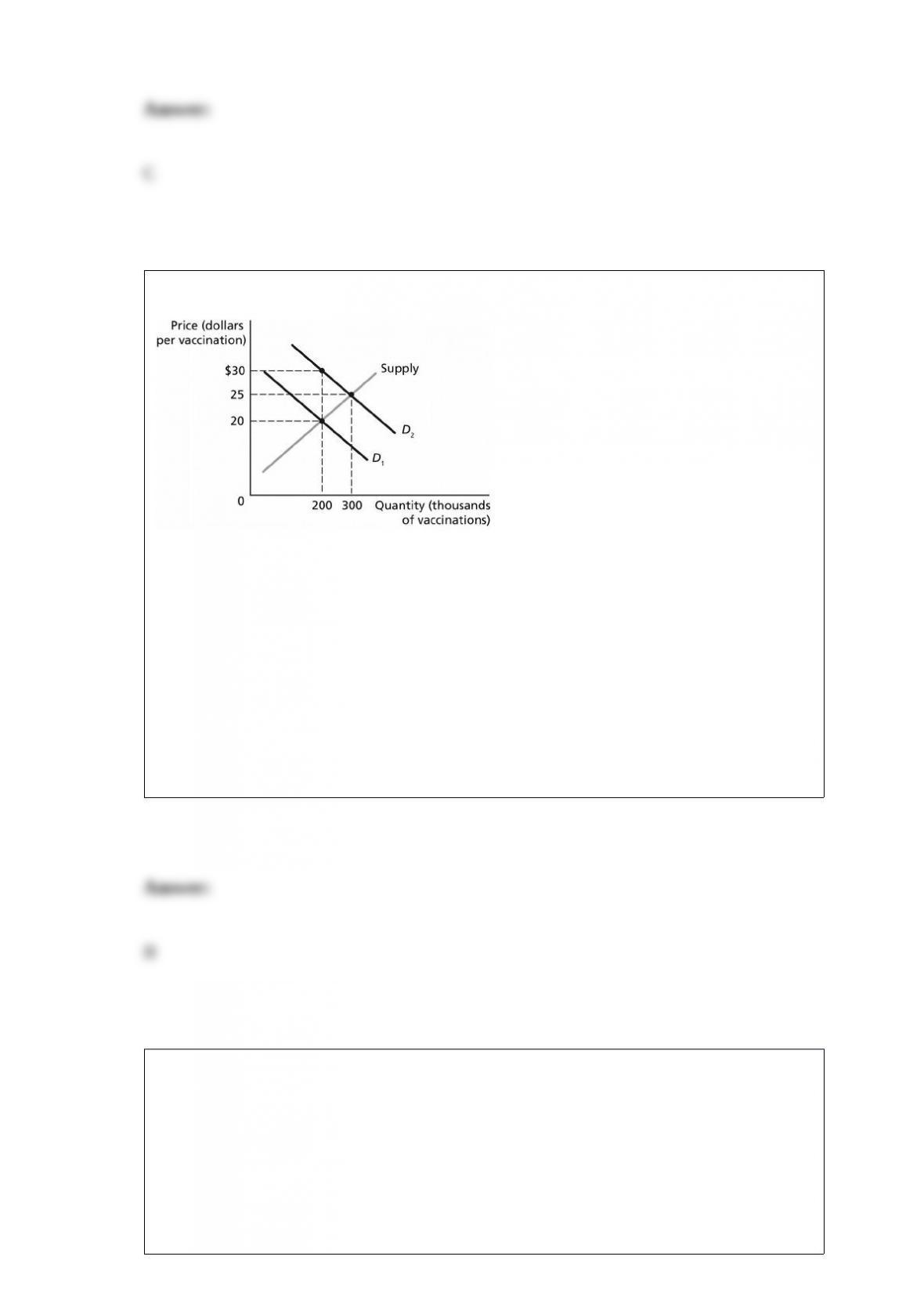
Figure 7-1
Figure 7-1 represents the market for
vaccinations. Vaccinations are considered a benefit to society, and the figure shows both
the marginal private benefit and the marginal social benefit from vaccinations. At the
market equilibrium
A) the marginal benefit is equal to the marginal cost.
B) the marginal benefit is greater than the marginal cost.
C) the marginal benefit is less than the marginal cost.
D) the marginal benefit is zero.
If the Fed raises the interest rate, this will ________ inflation and ________ real GDP
in the short run.
A) reduce; raise
B) increase; lower
C) increase; raise

D) reduce; lower
An increase in real GDP
A) increases the buying and selling of goods and increases the demand for money as a
medium of exchange.
B) increases the buying and selling of goods and decreases the demand for money as a
medium of exchange.
C) decreases the buying and selling of goods and increases the demand for money as a
medium of exchange.
D) decreases the buying and selling of goods and decreases the demand for money as a
medium of exchange.
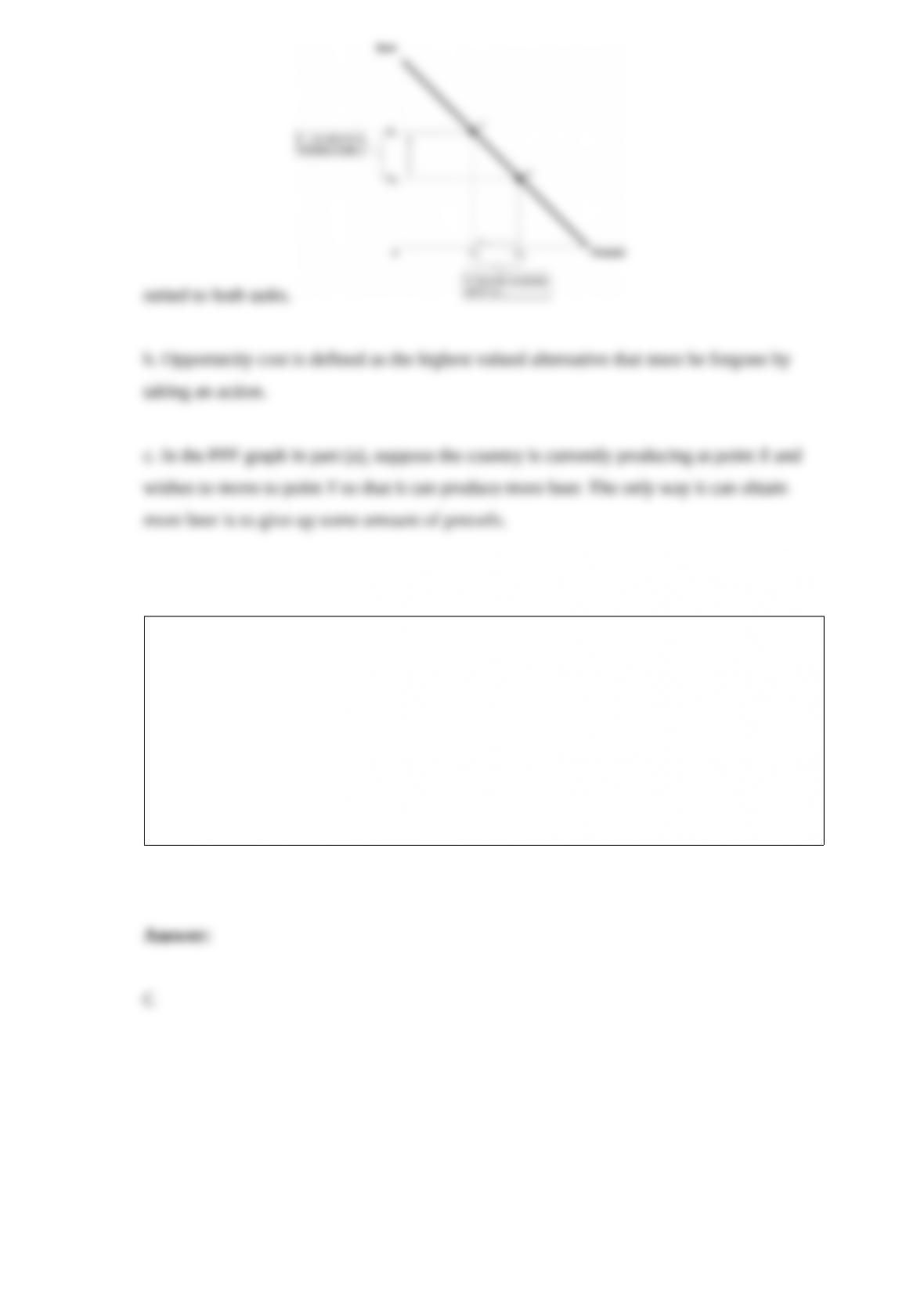
a. Draw a production possibilities frontier for a country that produces two goods, beer
and pretzels. Assume that resources are equally suited to both tasks.
b. Define opportunity costs.
c. Use your production possibilities frontier graph to demonstrate the principle of
opportunity costs.
The maximum price that a buyer is willing to pay for a good measures his
A) consumer surplus.
B) marginal benefit.
C) willingness to pay.
D) producer surplus.