1)
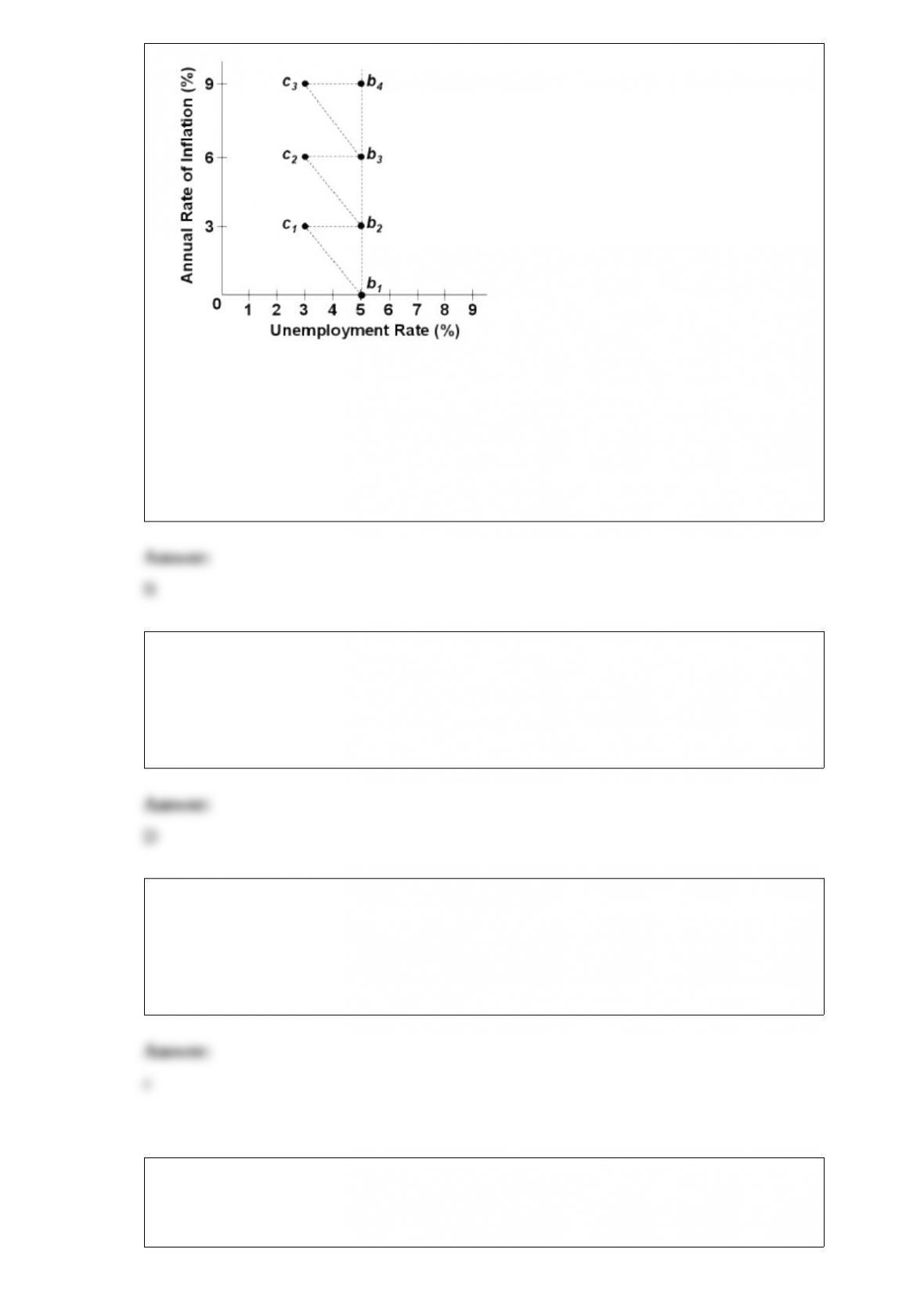
Refer to the above diagram and assume the economy is initially at point b1. The
long-run relationship between the unemployment rate and the rate of inflation is
represented by:
A.the line connecting b1 and c1.
B.the line through b1, b2, b3, and b4.
C.the line connecting c1 and b2.
D.any line parallel to the horizontal axis.
2) Currency in circulation is part of:
A.M1 only.
B.M2 only.
C.neither M1 nor M2.
D.both M1 and M2.
3) if for a firm p = minimum atc = mc, then:
a.neither allocative efficiency nor productive efficiency is being achieved.
b.productive efficiency is being achieved, but allocative efficiency is not.
c.both allocative efficiency and productive efficiency are being achieved.
d.allocative efficiency is being achieved, but productive efficiency is not.
4) In 2007, the number of union members in the United States and the rate of U.S.
unionization were:
A.10.2 million and 7.8 percent.
B.15.7 million and 12.1 percent.
C.25.1 million and 19.4 percent.
D.32.6 million and 25.2 percent.
5)
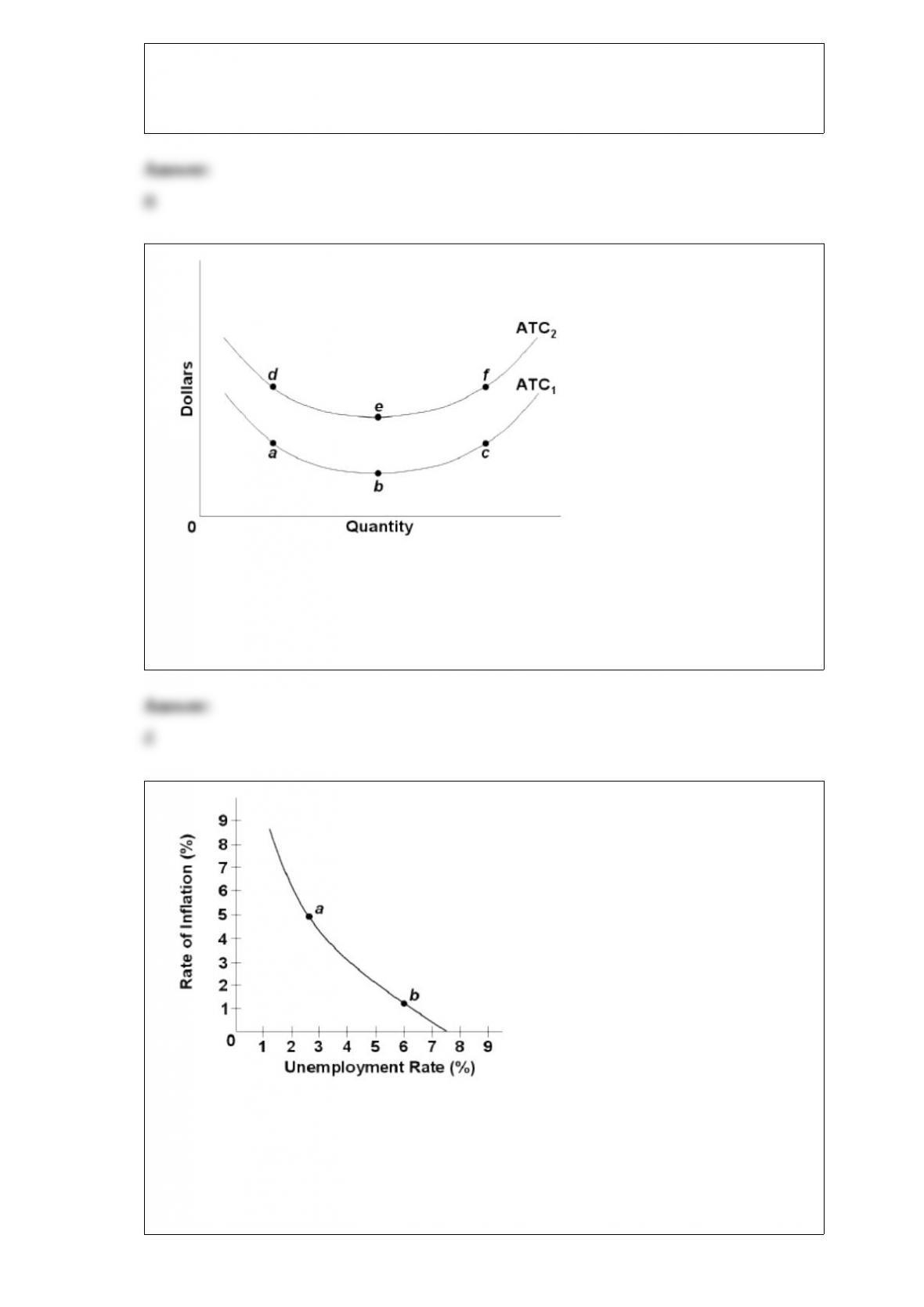
refer to the above graph. a decrease in fixed costs is shown by:
a.a move along short-run average total cost curve atc2 from point e to point f.
b.a move along short-run average total cost curve atc1 from point a to point b.
c.the shift of the short-run average total cost curve from atc1 to atc2.
d.the shift of the short-run average total cost curve from atc2 to atc1.
6)
Refer to the above diagram for a specific economy. The curve on this graph is known as
a:
A.Laffer Curve.
B.Phillips Curve.
C.labor demand curve.
D.production possibilities curve.
7)
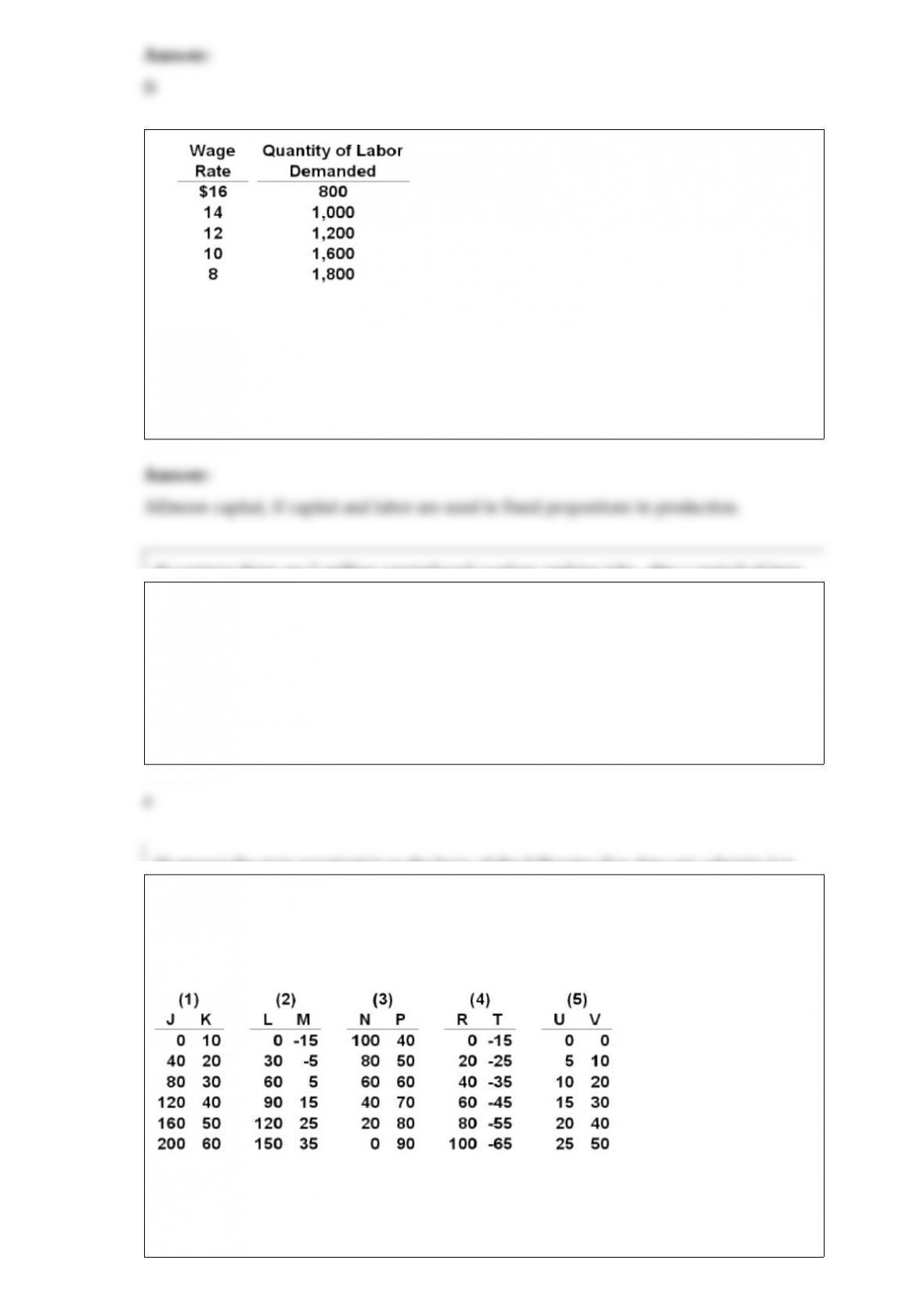
Refer to the above data. Suppose that the union that provides labor to firms in this
market successfully negotiates an increase in the wage rate from $10 to $12. As a result
of the wage increase, firms will hire:
A.fewer workers and the total paid out for wages will decline.
B.fewer workers, but the total paid out for wages will increase.
C.fewer workers, but the total paid out for wages will remain unchanged.
8) suppose there are 5 million unemployed workers seeking jobs. after a period of time,
1 million of them become discouraged over their job prospects and cease to look for
work. as a result of this, the official unemployment rate would:
a.decline.
b.increase.
c.increase in the short run but eventually decline.
d.be unchanged.
9) answer the next question(s) on the basis of the following five data sets wherein it is
assumed that the variable shown on the left is the independent variable and the one on
the right is the dependent variable. assume in graphing these data that the independent
variable is shown on the horizontal axis and the dependent variable on the vertical axis.
refer to the above data sets. the variables are directly related in:
a.all five data sets.
b.in none of the data sets.
c.in data sets 1, 2, and 3 only.
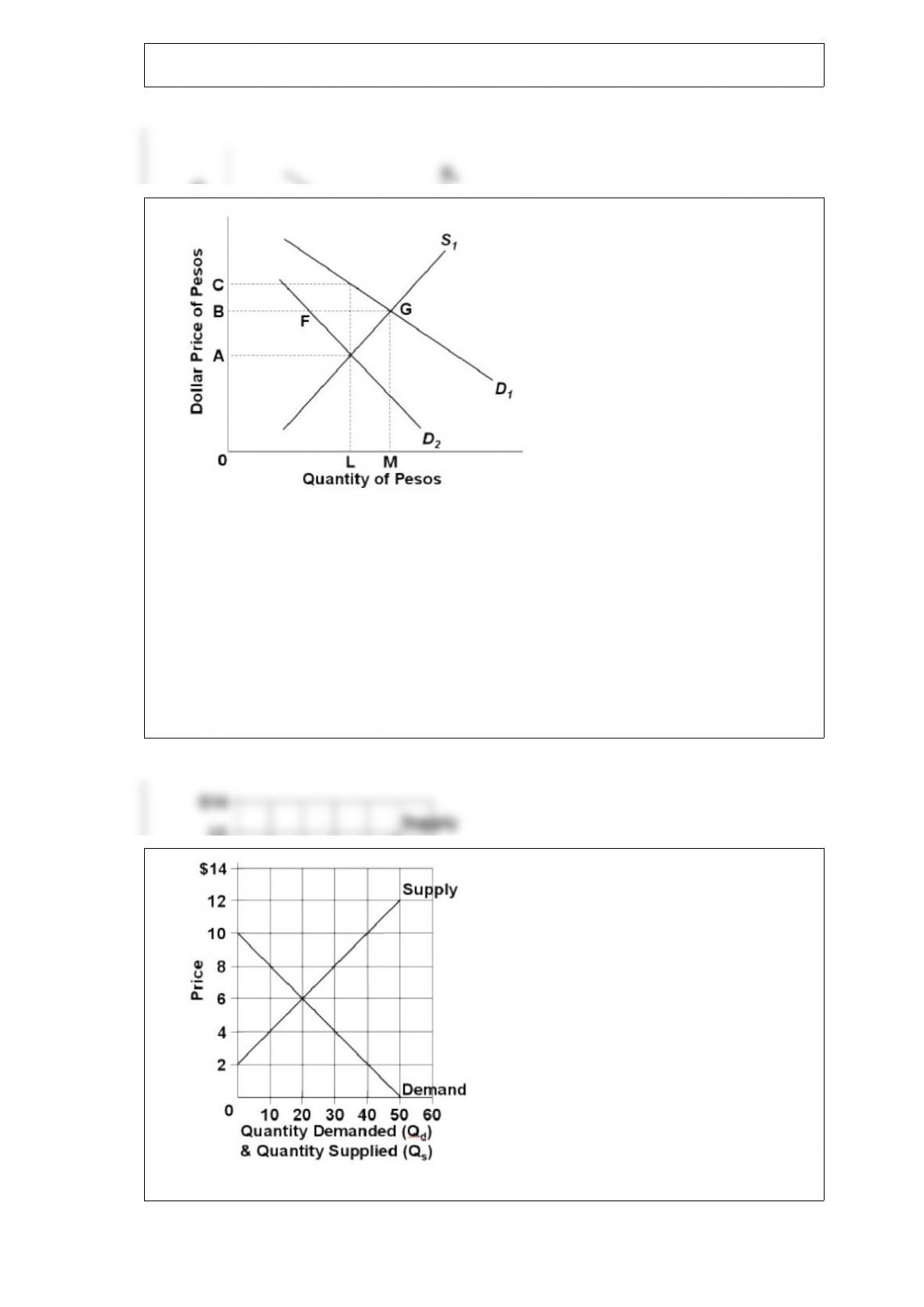
d.in data sets 1, 2, and 5 only.
10)
Refer to the above diagram. The initial demand for and supply of pesos are shown by
D1 and S1. Suppose the United States reduces its imports of Mexican goods, shifting its
demand for pesos from D1 to D2. If the United States was operating under a system of
exchange controls, the U.S. government would:
A.find that, at the controlled exchange rate, pesos would be in surplus.
B.be faced with deteriorating terms of trade.
C.be faced with the problem of rationing BG pesos to U.S. importers who want BF
pesos.
D.be faced with the problem of rationing BF pesos to U.S. importers who want BG
pesos.
11)
refer to the above graph. which of the following schedules correctly reflects “demand”?

a.choice a
b.choice b
c.choice c
d.choice d
12) if the price of k declines, the demand curve for the complementary product j will:
a.shift to the left.
b.shift to the right.
c.decrease.
d.remain unchanged.
13) The factors that affect the amounts that consumers, businesses, government, and
foreigners wish to purchase at each price level are the:
A.real-balances, interest-rate, and foreign purchases effects.
B.determinants of aggregate supply.
C.determinants of aggregate demand.
D. sole determinants of the equilibrium price level and the equilibrium real output.
14) Which of the following best describes the cause-effect chain of a restrictive
monetary policy?
A.A decrease in the money supply will lower the interest rate, increase investment
spending, and increase aggregate demand and GDP.
B.A decrease in the money supply will raise the interest rate, decrease investment
spending, and decrease aggregate demand and GDP.
C.An increase in the money supply will raise the interest rate, decrease investment
spending, and decrease aggregate demand and GDP.
D.An increase in the money supply will lower the interest rate, decrease investment
spending, and increase aggregate demand and GDP.
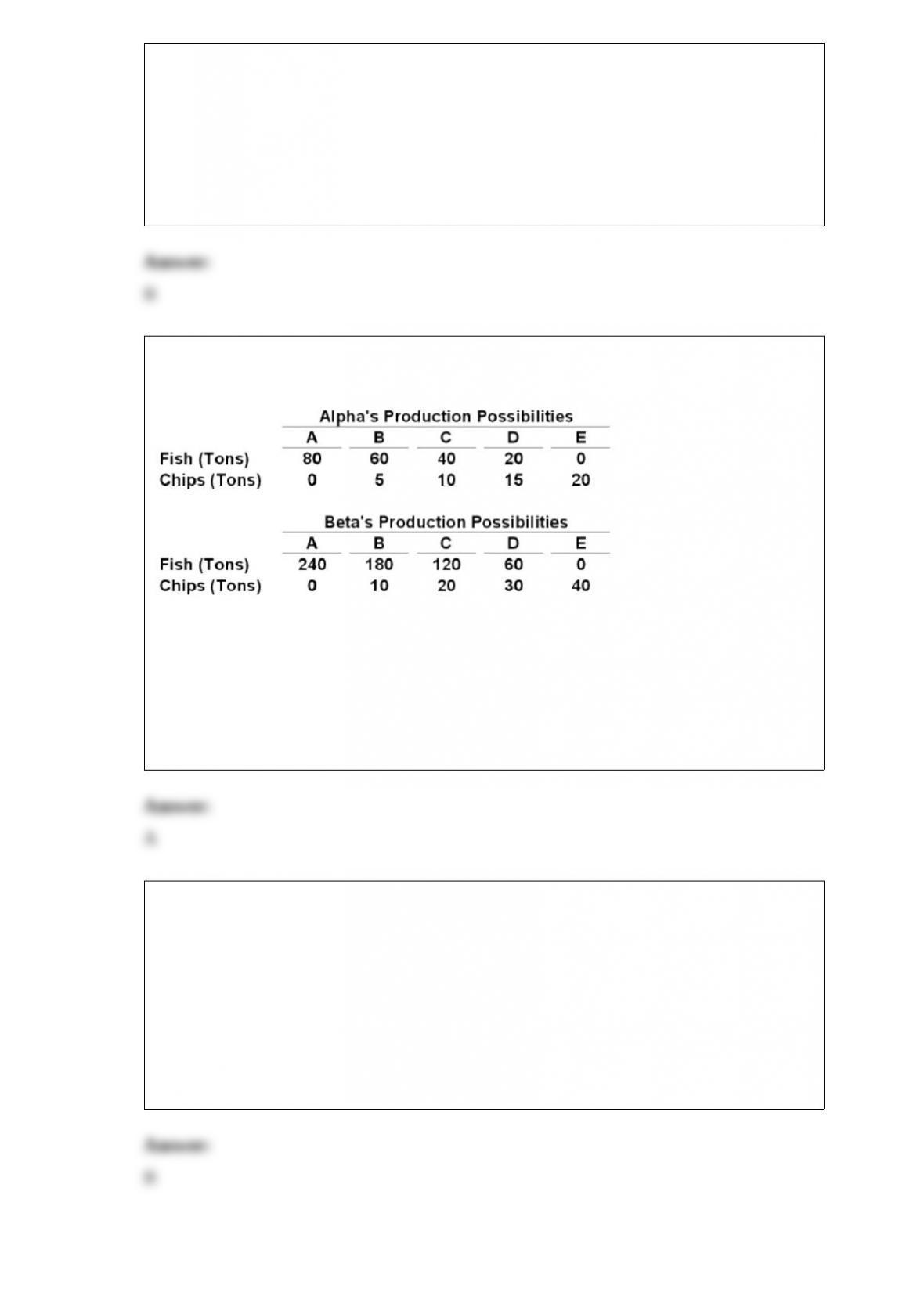
15) The following production possibilities data for two countries, Alpha and Beta,
which have populations of equal size.
Refer to the above data. Suppose that before specialization and trade Alpha chose
production alternative C and Beta chose production alternative B. After specialization
and trade the gains will be:
A.20 tons of fish.
B.20 tons of chips.
C.20 tons of fish and 20 tons of chips.
D.240 tons of fish and 20 tons of chips.
16) Which of the following supports the contention that pure competitors have a strong
incentive to engage in R&D?
A.Entry to purely competitive industries is easy and thus profit from innovation is
quickly competed away.
B.Pure competitors cannot risk being complacent about innovation, since a new
product, production technique, or distribution method could undermine their normal
profit and drive them out of the market.
C.Most purely competitive industries are increasing-cost industries.
D.Pure competitors are happy to earn only a normal profit.

17) economy a: gross investment equals depreciation economy b: depreciation exceeds
gross investment economy c: gross investment exceeds depreciation
refer to the above information. positive net investment is occurring in:
a.economy a only.
b.economy b only.
c.economy c only.
d.economies a and b only.
18) A market in which the money of one nation is exchanged for the money of another
nation is a:
A.resource market.
B.bond market.
C.stock market.
D.foreign exchange market.
19) The principal-agent problem arises primarily because:
A.principals and agents share a common interest, leading to free-rider problems.
B.principals and agents are in an adversarial role, sharing no common interests.
C.principals pursue some of their own objectives that may conflict with the objectives
of the agents.
D.agents pursue some of their own objectives that may conflict with the objectives of
the principals.
20) Which of the following is an example of a capital-intensive commodity?
A.clothing
B.wool
C.sunflower seeds
D.chemicals