
Suppose you purchase a two-year bond that has a $450 coupon and a face value of
$5,000, and immediately after you purchase the bond, new bonds are issued that are
otherwise identical, except they have coupons of $375. If you sell your bond, you will
receive a gain of
A) $67.33.
B) $134.66.
C) $269.32.
D) $389.40.
If Texans decrease their purchases of Mexican beer, assuming all else remains constant,
this will ________ of the United States.
A) decrease the financial account balance
B) decrease net exports
C) increase the trade deficit
D) decrease the current account balance
Suppose you borrow $2,000 for one year and at the end of the year you repay the
$2,000 plus $110 of interest. The expected inflation rate was 2.2% at the time you took
out the loan, but the actual inflation rate turned out to be 3.3%. What was the actual real

interest rate you paid?
A) 2.2%
B) 3.3%
C) 5.5%
D) 8.8%
If the real wage is above the equilibrium real wage, there would be a ________ of
workers and the real wage would ________.
A) surplus; decline
B) surplus; rise
C) shortage; decline
D) shortage; rise
Figure 1
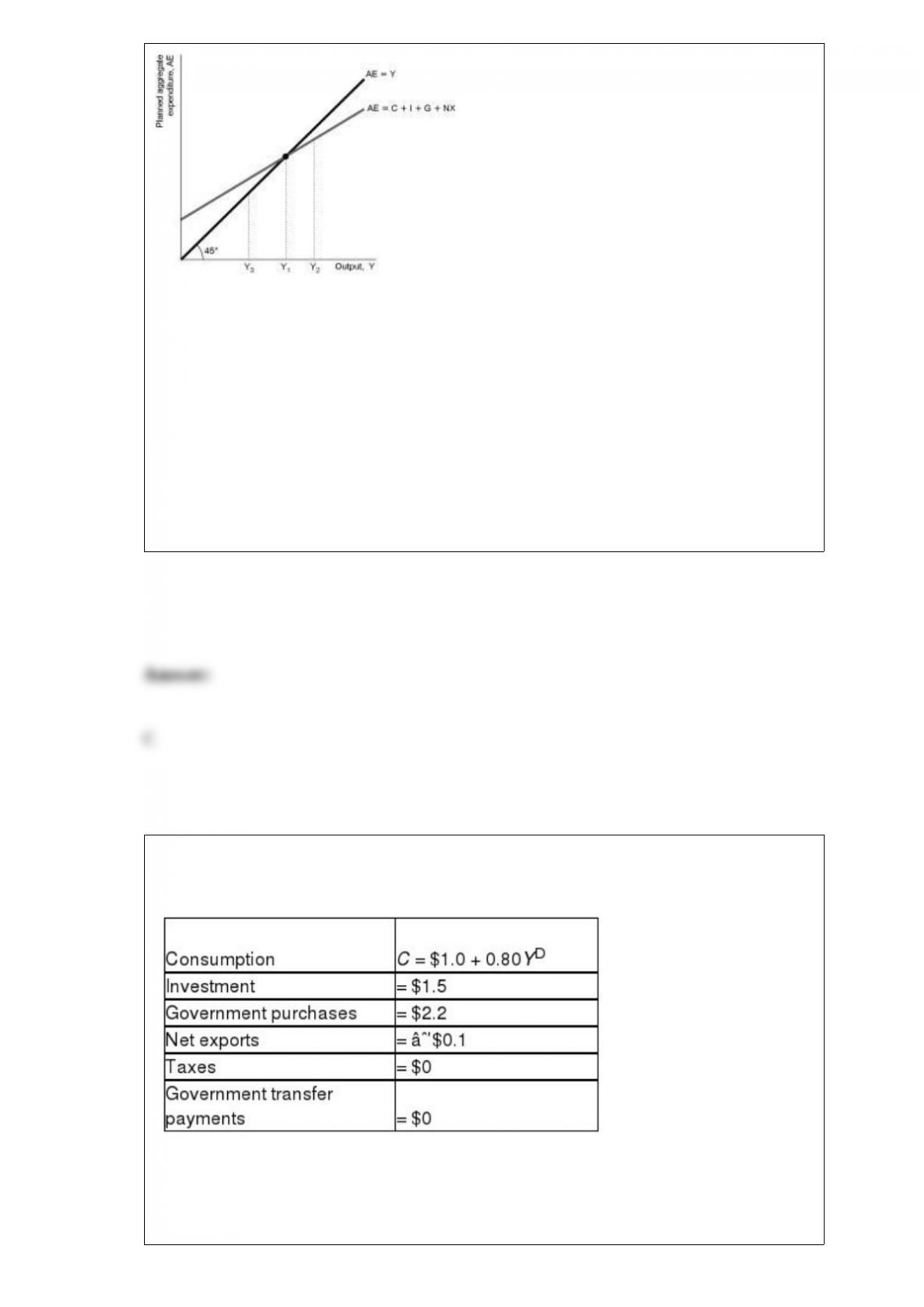
Refer to Figure 10.1. If the level of real GDP is initially Y3, firms will ________
production until equilibrium is reached at ________.
A) increase; Y3
B) decrease; Y3
C) increase; Y1
D) decrease; Y1
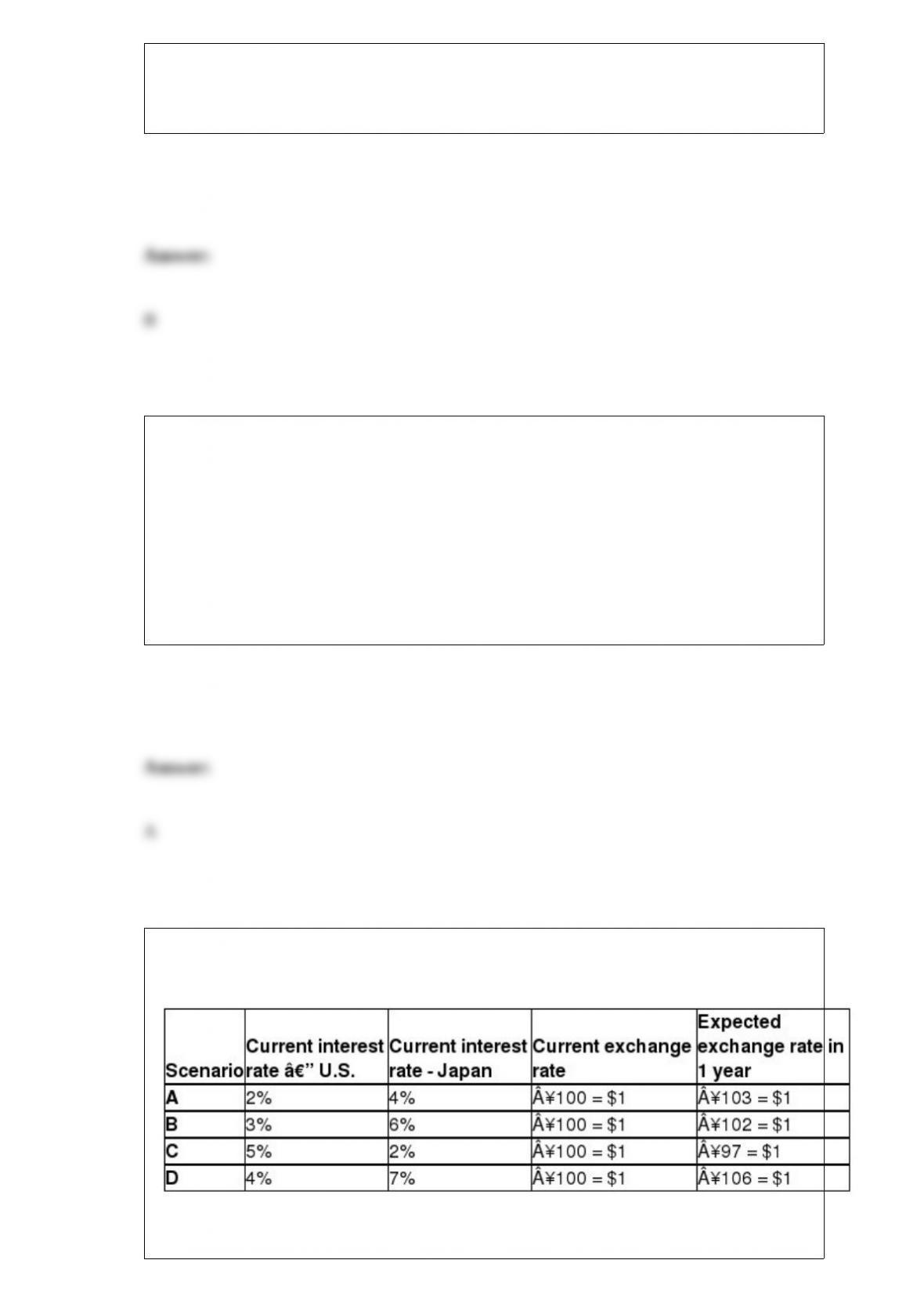
Table 10.1
(all values are in billions of dollars)
Refer to Table 10.1. Equilibrium real GDP for this economy is equal to

A) $5.75 billion.
B) $12 billion.
C) $23 billion.
D) $46 billion.
In the United States, spending on Social Security, Medicare, and Medicaid was
approximately ________ of GDP in 1962, and is expected to be approximately
________ of GDP in 2050.
A) 12%; 50%
B) 3%; 20%
C) 40%; 5%
D) 25%; 65%
If the output gap is greater than zero, real GDP is ________ potential GDP, and the
economy will ________ to reach full employment.
A) greater than; expand
B) greater than; contract

C) less than; expand
D) less than; contract
Which of the following equations best represents the concept of constant returns to
scale?
A) 3Y = AF(3K, 3L)
B) 2Y = 2AF(2K,2 L)
C) 1/4Y = (AF / 4 )(4K, 4L)
D) 5Y = [AF(K, L)] / 5
Institutions that borrow money from savers to lend to borrowers are known as
A) financial markets.
B) bond brokers.
C) financial intermediaries.
D) asset exchanges.

According to the Bureau of Economic Analysis (BEA), personal consumption
expenditures grew at an annualized rate of 0.5% in August 2012, and this increase in
spending was accompanied by income growth. If you were building a macroeconomic
model that explores the effect of the growth in income on the increase in consumer
spending, the growth in income would be an ________ variable and the increase in
consumer spending would be an ________ variable.
A) endogenous; endogenous
B) endogenous; exogenous
C) exogenous; exogenous
D) exogenous; endogenous
Changes in the money supply are ________ to other economic variables, and since the
early 1990s the Fed has ________ in monetary policymaking.
A) closely connected; emphasized the role of M2 over M1
B) closely connected; emphasized the role of M1 over M2
C) closely connected; emphasized the roles of both M1 and M2
D) no longer closely connected; deemphasized the roles of M1 and M2

Among the countries that use the euro, the real exchange rate ________ and the
nominal exchange rate ________.
A) is fixed; is fixed
B) is fixed; can change
C) can change; is fixed
D) can change; can change
Suppose that the production function for the economy is: Y = AK1/4L3/4. Assume that A
= 1,000, the capital stock is $32,000 billion, and the current labor force is 120 million
(or 0.120 billion) workers. All else equal, if the labor force increased by 20 million
workers, the value of the marginal product of capital will be
A) $0.0104.
B) $0.0239.
C) $0.0639.
D) $0.0717.

From the classical perspective, an increase in unemployment during a recession
represents
A) voluntary unemployment.
B) a roughly equal mix of voluntary and involuntary unemployment.
C) involuntary unemployment.
D) a decrease in the number of discouraged workers in an economy.
The goal of fiscal policy is to ________, and typically focuses on ________.
A) balance the federal budget; tax rates and tax revenues
B) stabilize the supply of money in the economy; price stability
C) reduce the severity of economic fluctuations; employment and production
D) eliminate balance of payments deficits or surpluses; exchange rate stability
If potential GDP for the first quarter of 2013 = $75.8 billion, and real GDP for the first
quarter of 2013 = $80.3 billion, then the output gap was
A) -5.9%.

B) -5.6%.
C) 5.6%.
D) 5.9%.
One of the provisions of the second stimulus bill increased the amount of investment
spending that firms were allowed to depreciate for tax purposes from 50% to 100%. If
and when the government changes the depreciation allowance back to its original
amount, the desired capital stock will ________ and investment spending will
________.
A) increase; increase
B) increase; decrease
C) decrease; decrease
D) decrease; increase
Which of the following would be the least likely to increase total factor productivity?
A) a well-functioning financial system
B) government control of production and property
C) technological advances
D) improvements in education
When net capital outflows are negative,
A) capital inflows are greater than capital outflows.
B) net factor payments must be positive.
C) the current account must be negative.
D) foreign direct investment must be greater than foreign portfolio investment.
Table 4.2
Suppose that you intend to invest $10,000 in one-year government bonds. You are
looking for the highest return on your investment and do not care whether you

invest in the United States or Japan, but as U.S. resident, you want your
investment return to be in U.S. dollars. The Table lists 4 scenarios, each showing
the current interest rate for one-year government bonds in the United States and
Japan, the current exchange rate between the dollar and the yen, and the expected
exchange rate in one year. Other than the interest rates, you assume the bonds
from each country to be identical.
Refer to Table 4.2. With which scenario will you be best off by investing in Japanese
bonds instead of U.S. bonds?
A) A
B) B
C) C
D) D
The White House’s deficit commission has proposed several ways for the government
to reduce the federal budget deficit, including freezing salaries of federal workers.
Other things equal, freezing salaries of federal workers would tend to ________ the
opportunity cost of leisure and ________ the supply of labor.
A) increase; increase
B) increase; decrease
C) decrease; increase
D) decrease; decrease
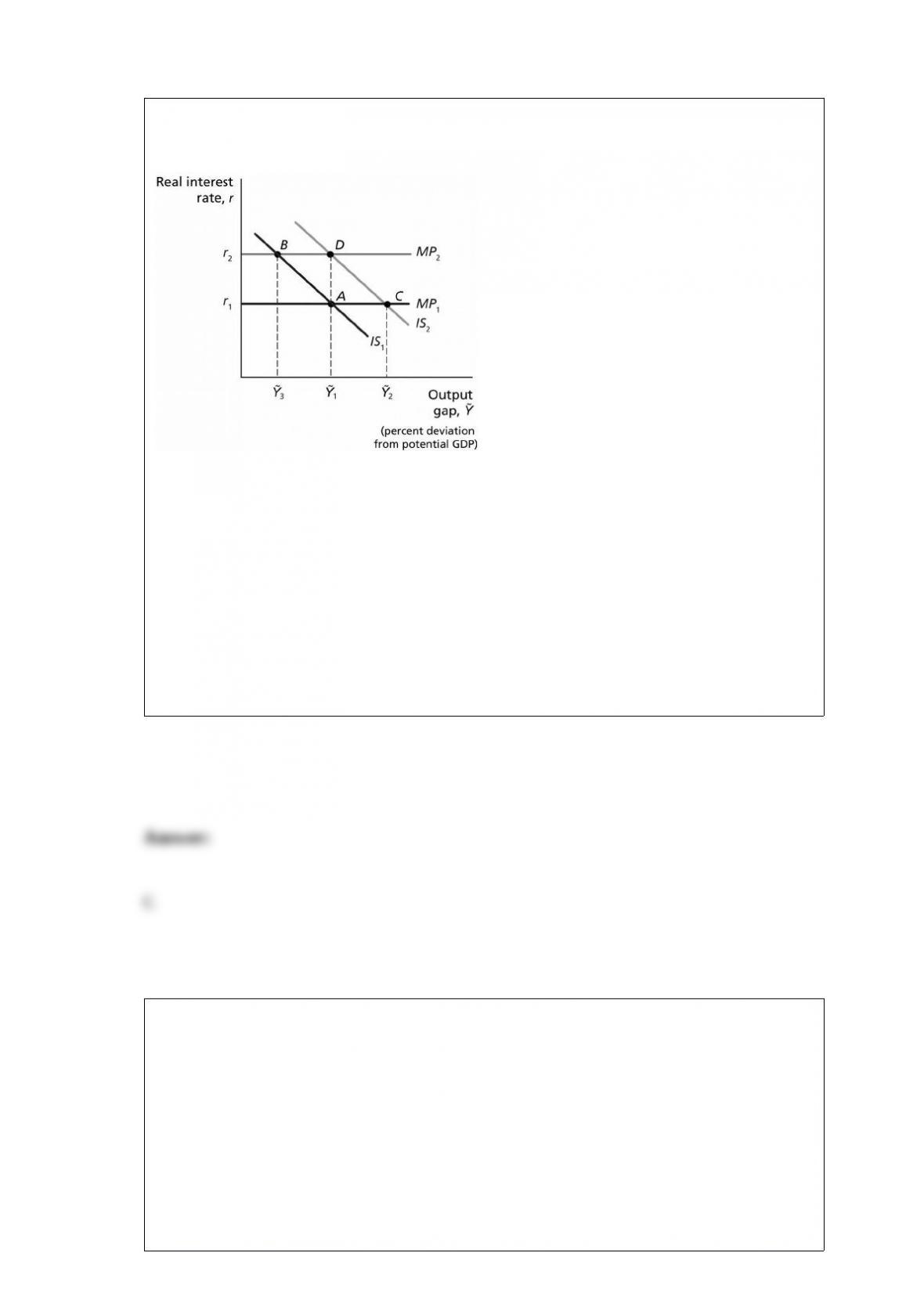
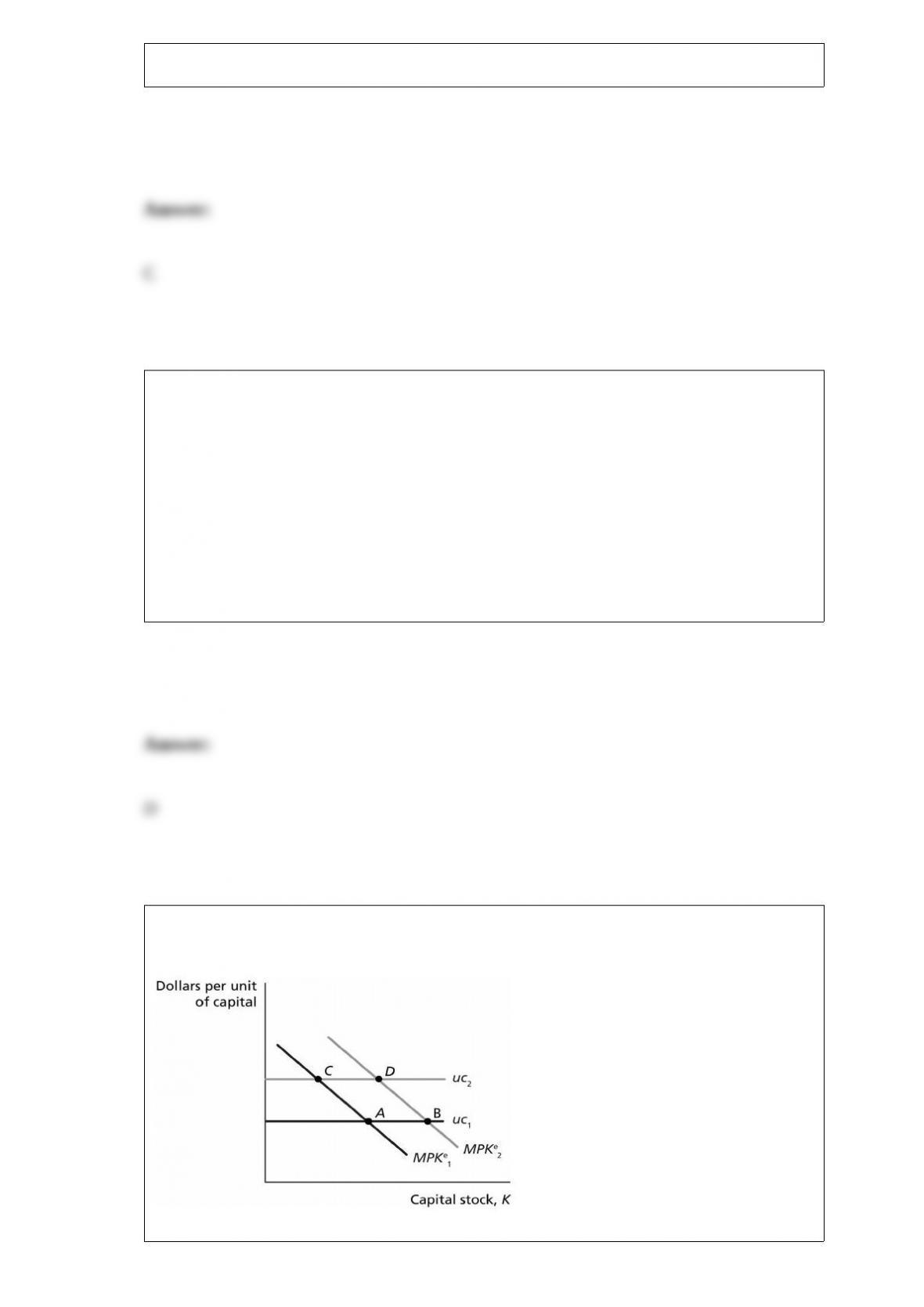
Figure 10.7
Refer to Figure 10.7. A movement from point C to point B could be caused by
A) an increase in consumer confidence accompanied by a decrease in the target interest
rate.
B) a decrease in consumer confidence accompanied by an increase in the expected rate
of inflation.
C) a negative demand shock accompanied by an increase in the term structure effect.
D) a positive demand shock accompanied by a decrease in the default-risk premium.
If the federal government tries to make fiscal policy sustainable by decreasing
expenditure on government capital goods, private capital goods will become ________
productive, and this will result in ________ potential GDP.
A) more; lower
B) more; higher
C) less; lower
D) less; higher
In the short run, macroeconomic analysis focuses on ________, while in the long run,
the focus is on ________.
A) fiscal policy; monetary policy
B) short-run economic growth; population demographics
C) unemployment; inflation
D) the business cycle; long-run economic growth
Figure 16.1
Refer to Figure 16.1. An increase in the corporate tax rate is best represented by a

movement from
A) point A to point B.
B) point B to point A.
C) point A to point C.
D) point C to point A.
An increase in the inflation rate results in ________ in the quantity of real GDP
demanded because a higher price level ________.
A) an increase; increases consumption and investment
B) a decrease; increases consumption and investment
C) a decrease; reduces consumption and investment
D) an increase; reduces consumption and investment
The key reason that the Soviet Union failed to develop new ways to make the economy
efficient and was therefore not able to sustain economic growth was due to
A) the Soviet Union relying on entrepreneurs to develop new production technologies.
B) the typical behaviors of managers and employees in a centrally planned economy.

C) the failed attempt to convert to a market-based economy.
D) the Soviet Union’s lack of accumulating capital goods.
During recessions, the value of collateral decreases and corporate profits decrease, so
firms do not have cash to finance new investment projects. Therefore, credit rationing
depends on the state of the economy. This situation is known as the
A) risk acceptance cost.
B) lender’s dilemma.
C) default premium.
D) financial accelerator.
If you want to know the present value of $4,000 in two years and the annual interest
rate is 5%, what formula can you use?
A) Present value = $4,000 / (0.05) × 2.
B) Present value = $4,000 / (1 + 0.05)2.
C) Present value = $4,000 × (1 + 0.05)2.
D) Present value = $4,000 × (1 + 0.05 )/ 2.

If the economy experiences an unanticipated demand shock and households and firms
have rational expectations, there is
A) no trade-off between unemployment and inflation in either the short run or the long
run.
B) a trade-off between unemployment and inflation in the long run, but not in the short
run.
C) a trade-off between unemployment and inflation in the short run, but not in the long
run.
D) a trade-off between unemployment and inflation in both the short run and the long
run.
Devastating damage resulting from a major earthquake and tsunami will most likely
A) initially move a country to a time path beneath its balanced growth path.
B) move a country to a lower point on its balanced growth path.
C) shift the balanced growth path for a country to a new, lower level.
D) have little to no impact on the short-term growth rate in a country.