
The basis for trade is comparative advantage, not absolute advantage.
Even if the population declines, scarcity will still exist.
Higher wages that compensate workers for unpleasant aspects of a job are called
compensating differentials.
An economic model is a simplified version of reality used to analyze real-world
economic situations.

One example of physical capital is the amount of savings that you have.
The term “market” refers to trading arrangements by which buyers and sellers come
together.
A tax is efficient if it imposes a large excess burden relative to the tax revenue it raises.
Economic efficiency requires that a natural monopoly’s price be set corresponding to
the quantity where marginal revenue equals marginal cost.

The additional output a firm produces by hiring one more worker is called the marginal
product of labor.
The marginal rate of substitution is determined by the slope of an indifference curve.
The slope of an isoquant is equal to the ratio of the price of the input on the horizontal
axis divided by the price of the input on the vertical axis, multiplied by -1.

Chips and salsa are complements. If the price of salsa decreases, the demand for chips
will increase.
If Tanisha can audit more tax returns in one hour than Libby, then Tanisha has an
absolute advantage in auditing tax returns.
Because of the flaws of the concentration ratio as a measure of the extent of
competition in an industry, some economists prefer another measure of competition, the
Herfindahl-Hirschman Index.
The term “globalization of production” refers to convergence in buyer preferences in
markets around the world.

The rising cost of malpractice insurance is one of the leading causes of the increase in
health care spending as a percentage of GDP in the United States.
A monopolistically competitive firm can convince buyers that its product has value by
differentiating its product to suit consumers’ preferences.
If the price elasticity of demand is unit-elastic, a 10 percent increase in price will result
in a 10 percent increase in revenue.

When workers are paid on a piece-rate basis, an employer must be able to easily
measure each worker’s output.
Life expectancy at birth in the United States has more than doubled since 1850.
A monopolistically competitive industry that earns economic profits in the short run
will be able to expand its market share even if the market size remains constant.
Accounting profit is the difference between a firm’s revenue and its opportunity costs.

The private cost of a good or service is the cost borne by the producer.
For a downward-sloping demand curve, marginal revenue decreases as quantity sold
increases.
One desirable outcome of a market economy is that it leads to a more equitable
distribution of income.

Extranets give distributors and suppliers access to a company’s database to place orders
or restock inventories electronically.
In the highly competitive fast-food restaurant market, brand name restaurants have a
strong profit incentive to maintain high sanitary conditions and avoid any negative
consequences.
An optimal two-part tariff pricing schedule maximizes consumer surplus.
The demand for The Federalist Papers is likely to be more elastic than the demand for
a best-selling mystery novel.

In a market with positive externalities, the market equilibrium price will be less than the
efficient equilibrium price.
Assume that price is greater than average variable cost. If a perfectly competitive firm
is producing at an output where price is $114 and the marginal cost is $102, then the
firm is probably producing more than its profit-maximizing quantity.
Economists believe that consumers would be better off if markets were perfectly
competitive rather than monopolistically competitive.

The sum of consumer surplus and producer surplus is called economic surplus.
If a firm in a perfectly competitive industry introduces a lower-cost way of producing
an existing product, the firm will be able to earn economic profits in the long run.
Perfect price discrimination will lead a firm to produce up to the point where price
equals marginal cost, the efficient level of output.
In the 1930s and 1940s, the Technicolor company was able to leverage its bargaining
power over the movie industry because Technicolor was the sole producer of cameras
and films needed to produce color films.

Net worth and stockholders’ equity are both equal to the difference between assets and
liabilities.
Income inequality increases as the Gini coefficient approaches 1.
a. What are the two effects of an increase in the wage rate on an individual’s labor
supply decision? Briefly explain each effect.
b. Explain how a labor supply curve could be backward-bending.

In the United States, total health care spending per person has been ________, and
out-of-pocket spending on health care per person has been ________.
A) rising; rising
B) rising; falling
C) falling; rising
D) falling; falling
Suppose the price of capital and labor remain constant but that the average educational
level of workers has increased and therefore, productivity of labor increases. This
would lead a firm
A) to adopt a more capital-intensive production technology.
B) to adopt a more labor-intensive technology.
C) to keep its output and production technology unchanged, but to use fewer units of
labor.
D) to use only labor to produce the product.

What is economic profit?
A) gross revenue minus explicit costs
B) gross revenue minus implicit costs
C) gross revenue minus explicit and implicit costs
D) the same as accounting profit
Assume that a perfectly competitive market is in long-run equilibrium. Suppose as a
result of a health hazard associated with the industry’s product, demand decreases
drastically. What is the immediate result of this event?
A) The market price falls and the typical firm suffers an economic loss.
B) The market supply increases to offset the fall in demand.
C) The typical firm’s average total cost curve shifts downward.
D) The typical firm’s marginal cost curve shifts to the left.

At a recent faculty meeting, Lorraine Waverly, president of Skywalker College,
announced that enrollment is up by 12 percent over the previous semester. If enrollment
the previous semester was 3,250 students, what is the student enrollment this semester?
A) 390
B) 2,860
C) 3,640
D) 4,030
How are the fundamental economic decisions determined in China?
A) Individuals, firms, and the government interact in a market to make these economic
decisions.
B) These decisions are made by the country’s elders who have had much experience in
answering these questions.
C) The government decides because China is a centrally planned economy.
D) The United Nations decides because China is a developing economy.
Which of the following describes two-part tariff pricing?
A) A firm charges two different prices for the same good.
B) An importer has to pay a tax at the nation’s borders, and a sales tax when the good is
sold.
C) A buyer pays an initial price for entrance to the market and an additional fee for each
unit of the product purchased.
D) A buyer must pay a down payment and monthly payments to buy big-ticket items
such as a car, a plasma television or a suite of furniture.
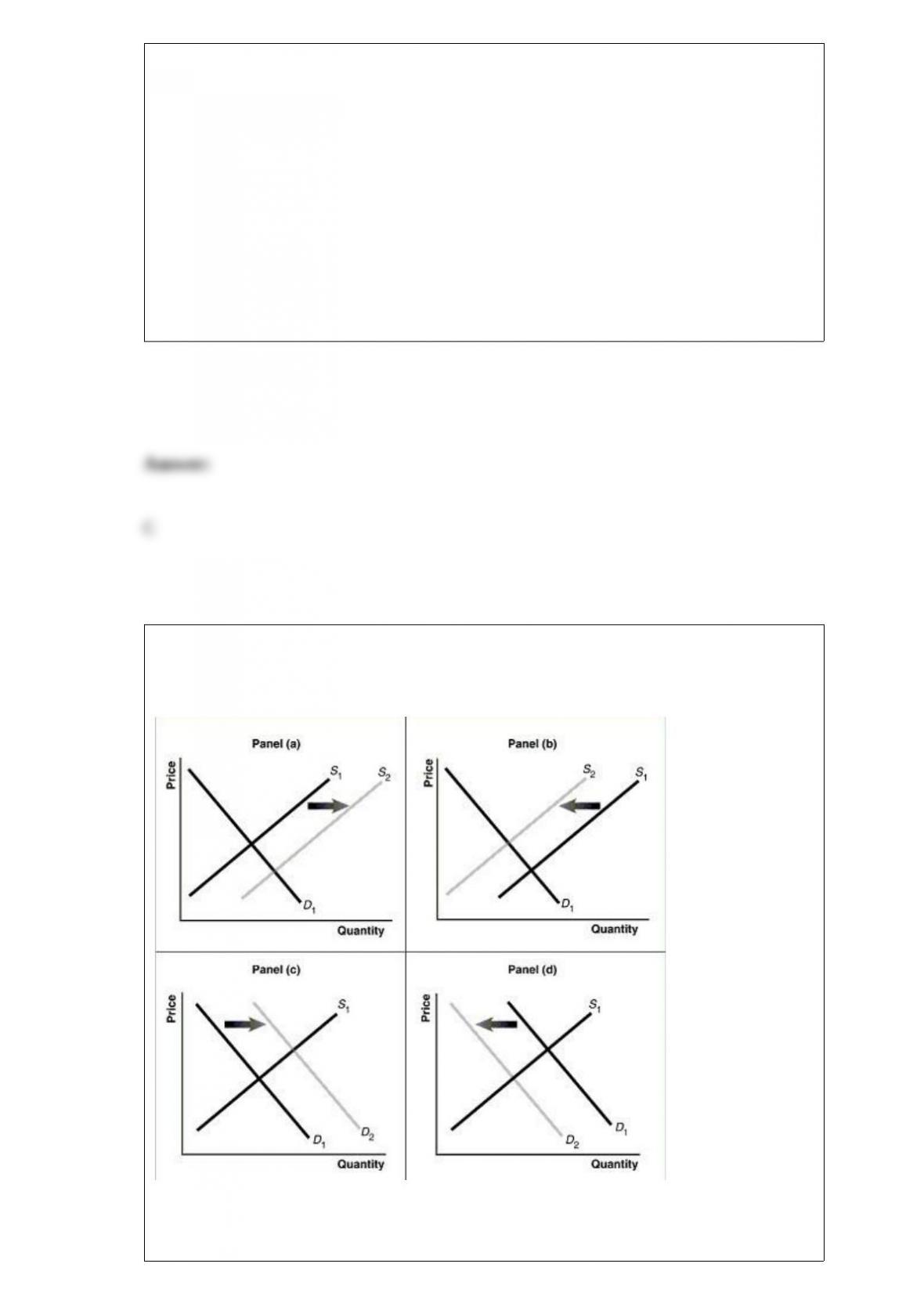
Figure 3-7
Refer to Figure 3-7. Assume that the graphs in this figure represent the demand and
supply curves for used clothing, an inferior good. Which panel describes what happens
in this market as a result of a decrease in income?

A) Panel (a)
B) Panel (b)
C) Panel (c)
D) Panel (d)
Both monopolistically competitive firms and perfectly competitive firms maximize
profits
A) by producing where price equals average total cost.
B) by producing where marginal revenue equals average revenue.
C) by producing where marginal revenue is equal to marginal cost.
D) by producing where price equals average variable cost.
Figure 5-13
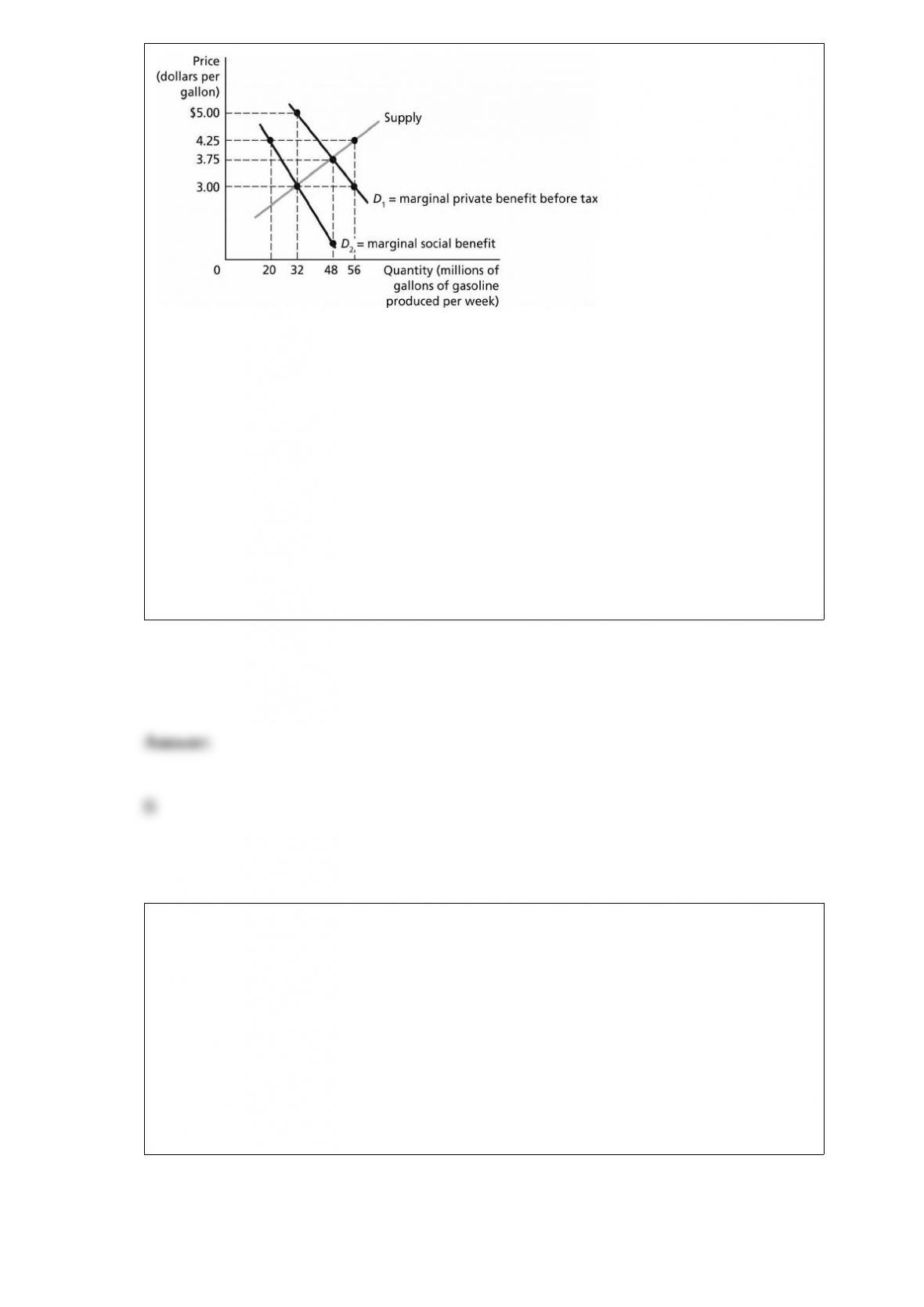
Figure 5-13 illustrates the market for gasoline before and after the government imposes
a tax to bring about the efficient level of gasoline production.
Refer to Figure 5-13. The gasoline tax raises the price paid by consumers by ________
per gallon.
A) $0.75
B) $1.25
C) $1.75
D) $2.00
When a firm experiences a positive technological change
A) the price of a share of the firm’s stock rises.
B) the firm is able to produce more output using the same inputs, or the same output
using fewer inputs.
C) the value of the firm’s assets rises.
D) the firm will hire additional workers in order to increase production.

An economic ________ is a simplified version of some aspect of economic life used to
analyze an economic issue.
A) market
B) trade-off
C) variable
D) model
Economic costs of production differ from accounting costs in that
A) economic costs include expenditures for hired resources while accounting costs do
not.
B) economic costs add the opportunity costs of a firm using its own resources while
accounting costs do not.
C) accounting costs include expenditures for hired resources while economic costs do
not.
D) accounting costs are always larger than economic cost.
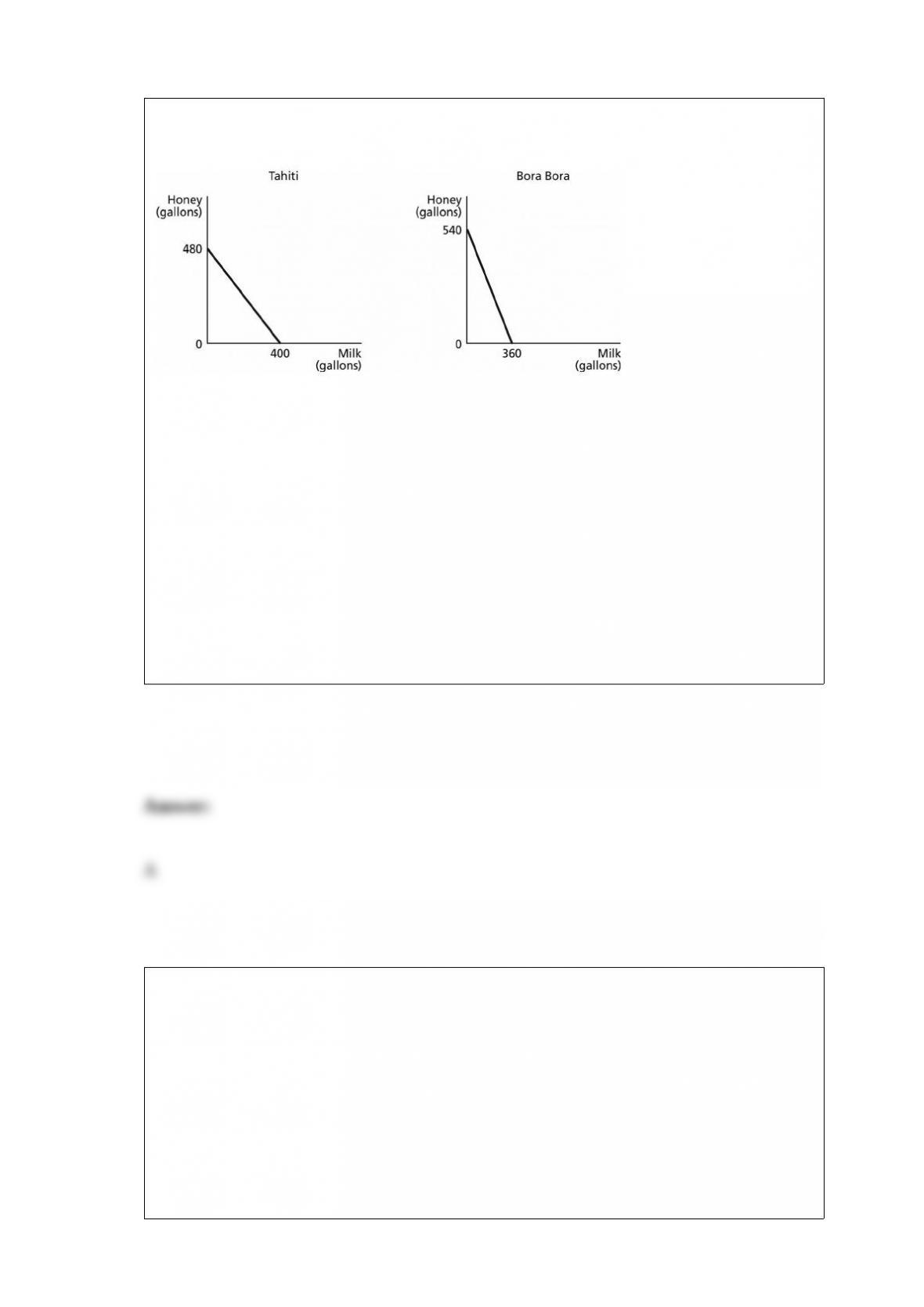
Figure 2-10
Figure 2-10 shows the production possibilities frontiers for Tahiti and Bora Bora. Each
country produces two goods, milk and honey.
Refer to Figure 2-10. What is the opportunity cost of producing one gallon of honey in
Tahiti?
A) 5/6 gallon of milk
B) 0.9 gallon of milk
C) 1.2 gallons of milk
D) 1 1/3 gallons of milk
A consumer’s utility-maximizing combination of goods is given by the bundle that
corresponds to the point on
A) the indifference curve that intersects the horizontal axis.
B) the indifference curve that intersects the vertical axis.
C) an indifference curve that is tangent to the budget constraint.
D) the budget constraint where it intersects one of the axes.

The costs in time and other resources that parties incur in the process of facilitating an
exchange of goods and services are called
A) enforcement costs.
B) implicit costs.
C) explicit costs.
D) transaction costs.
If, in a perfectly competitive industry, the market price facing a firm is above its
average total cost at the output where marginal revenue equals marginal cost, then
A) firms are breaking even.
B) new firms are attracted to the industry.
C) existing firms will exit the industry.
D) market supply will remain constant.

________ raised average tariff rates by over 50 percent in the United States in 1930.
A) The GATT
B) The WTO
C) NAFTA
D) The Smoot-Hawley Tariff
Select the phrase that correctly completes the following statement. “An increase in input
prices caused a decrease in the supply of baseballs. As a result ________.”
A) the price of baseballs increased and the demand for baseballs decreased
B) the equilibrium quantity of baseballs increased
C) the price of baseballs increased and the quantity demanded of baseballs decreased
D) the price of baseballs increased. The higher price caused the supply of baseballs to
increase
Mark Frost grows apples in a perfectly competitive market. If we drew a line in a graph
that illustrates Mark’s total revenue from selling apples, it would be
A) a straight, upward-sloping line.
B) a horizontal line.
C) a straight, downward-sloping line.
D) a curve that is negatively sloped at low levels of output and positively sloped at
higher levels of output.
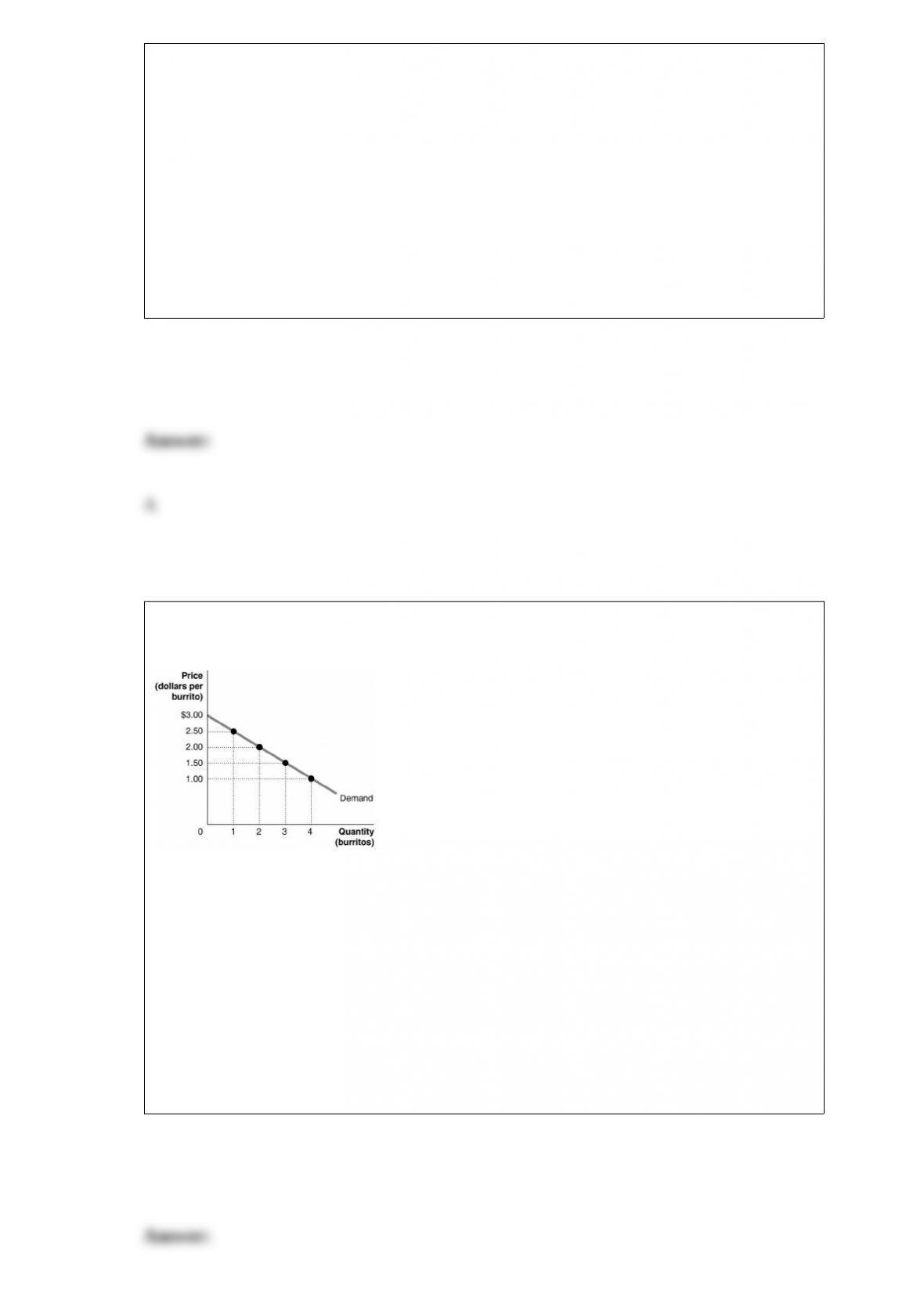
Figure 4-1
Figure 4-1 shows Arnold’s demand curve for burritos.
Refer to Figure 4-1. Arnold’s marginal benefit from consuming the second burrito is
A) $1.00.
B) $1.50.
C) $2.00.
D) $4.50.
Suppose at the current price, the demand for copper is estimated at -3.14. What happens
to sales revenue if the government imposes a price ceiling below the free market
equilibrium price in the copper market?
A) Sales revenue falls.
B) Sales revenue rises.
C) Sales revenue remains unchanged because copper is a necessity for most industries.
D) It cannot be determined without information on prices.
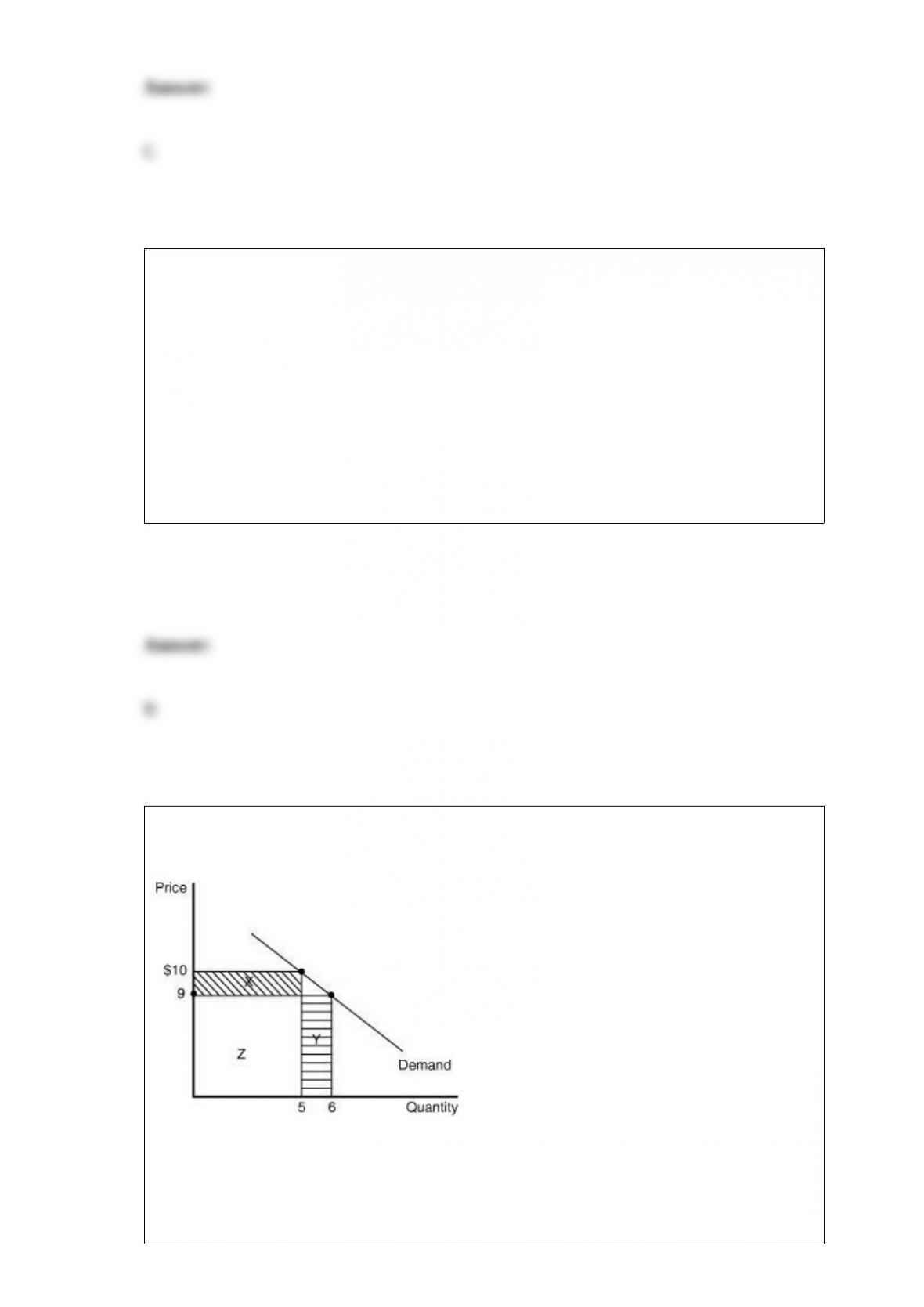
Table 2-9
Table 2-9 shows the number of labor hours required to produce a canoe and a sailboat in
Guatemala and Honduras.
Refer to Table 2-9. Does either Guatemala or Honduras have an absolute advantage and
if so, in what product?
A) Guatemala only has an absolute advantage in producing canoes.
B) Honduras only has an absolute advantage in producing canoes.
C) Guatemala has an absolute advantage in producing both products.
D) Honduras only has an absolute advantage in producing sailboats.
Donnie’s Donuts incurs $450,000 per year in explicit costs and $200,000 in implicit
costs. The bakery earns $800,000 in revenues and has $2 million in net worth. Based on
this information, what is the accounting profit for Donnie’s Donuts?
A) $150,000
B) $350,000
C) $600,000
D) $1.2 million
Figure 13-3
Refer to Figure 13-3. What is the marginal revenue of the sixth unit of output?
A) $4
B) $5

C) $9
D) $54
________ is an effective alternative to traditional distribution channels for firms that
sell digitized products.
A) Dual licensing
B) Electronic distribution
C) Visual merchandising
D) Digital switchover
A decrease in the wage rate causes
A) an increase in the quantity of labor demanded.
B) a rightward shift of the firm’s labor demand curve.
C) a leftward shift of the firm’s labor demand curve.
D) a decrease in labor’s productivity.
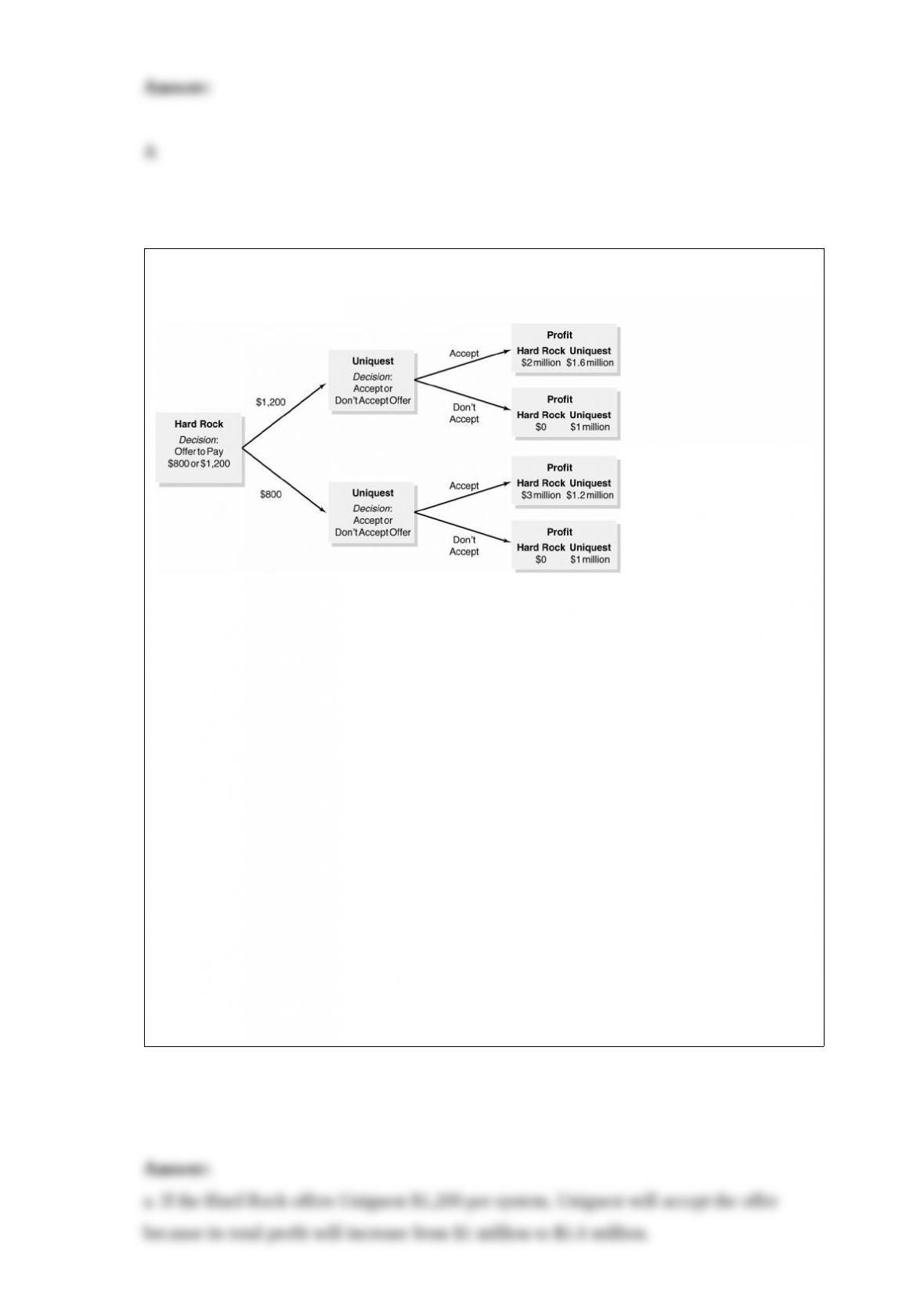
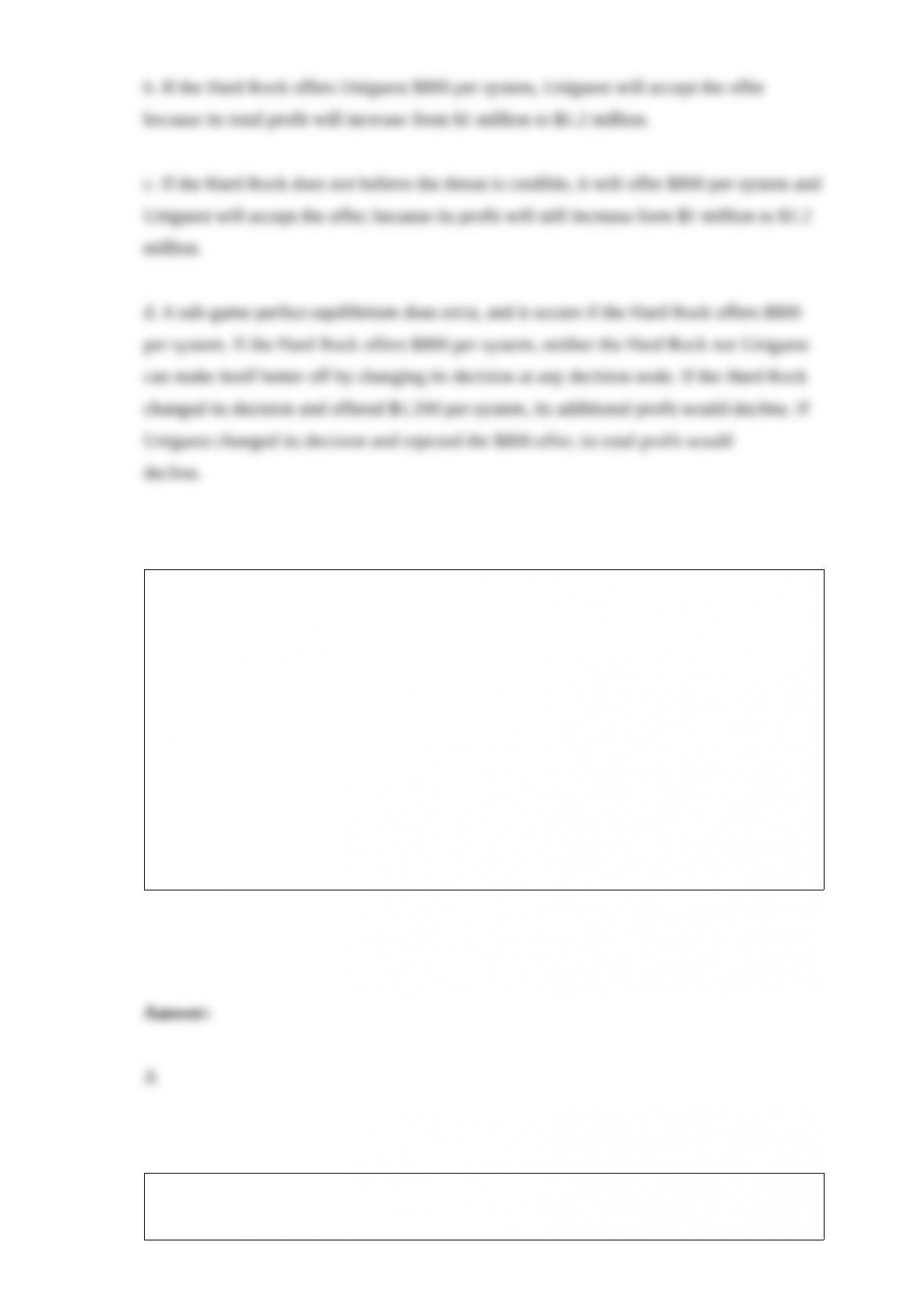
Figure 14-9
Refer to Figure 14-9. Uniguest, Inc. is a company that provides PCs with internet
access and touch-sensitive screens to hotels. Suppose the Hard Rock Hotel and Casino
in Las Vegas informs Uniguest that it is considering installing these systems in its hotel
rooms. The Hard Rock expects to be able to charge higher prices for these rooms if it
installs Uniguest’s systems in its rooms. The two companies begin bargaining over what
price the Hard Rock will pay Uniguest for its systems, and the decision tree shown
above illustrates this bargaining game. Note that the profit figures listed in the decision
tree are additional profits for the Hard Rock and total profits for Uniguest.
a. Suppose the Hard Rock offers Uniguest $1,200 per system. Will Uniguest accept or
reject this offer? Why?
b. Suppose the Hard Rock offers Uniguest $800 per system. Will Uniguest accept or
reject this offer? Why?
c. Suppose Uniguest attempts to obtain a favorable outcome from the bargaining by
telling the Hard Rock it will reject an $800-per-system offer. If the Hard Rock does not
believe the threat is credible, what will it do? Why? What will Uniguest do? Why?
d. Is there a sub-game perfect equilibrium in this situation? Explain.
Excess capacity is a characteristic of monopolistically competitive firms. What does
excess capacity mean?
A) It means that firms do not produce the output level that corresponds to the minimum
point on their average total cost curves.
B) It means that firms hire more than the minimum number of workers needed to
produce the profit-maximizing level of output.
C) It means that firms produce with inefficient combinations of resources.
D) It means that firms build plants that are not large enough to achieve minimum
efficient scale.
Which of the following takes place in the direct finance market?
A) Firms borrow funds from banks.
B) Deposits from savers are accumulated and loans made to borrowers.
C) Ownership in corporations is sold in the form of preferred stock.
D) Banks offer savings accounts to customers.
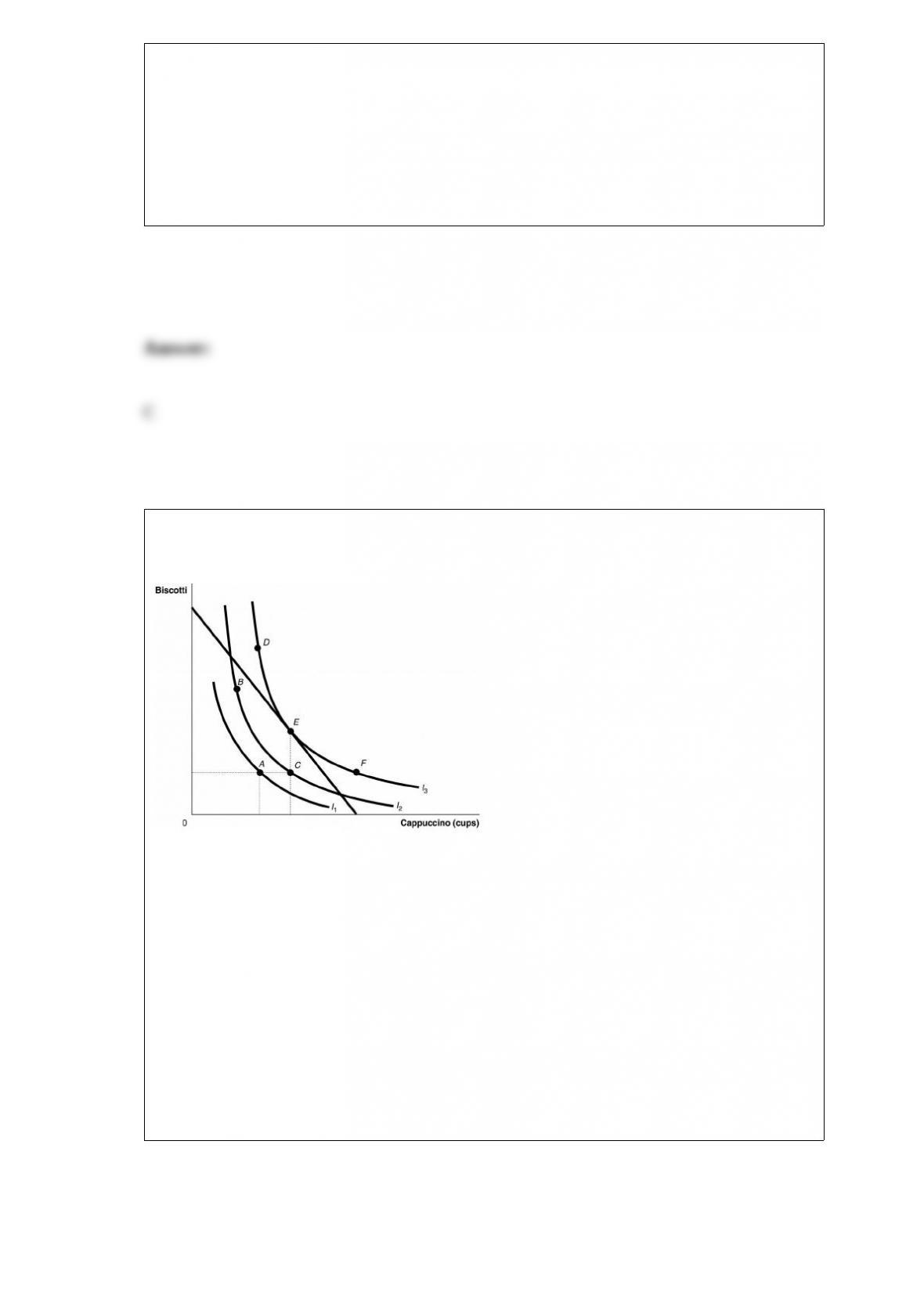
Figure 10-8
Refer to Figure 10-8. Given the budget constraint in the diagram, which of the
following statements is false?
A) The consumer receives the same level of utility from consumption bundles d, e and
f.
B) Consumption bundles b and c yield the same level of utility, which is higher than the
utility represented by bundle a.
C) Although the consumer receives the same level of utility from bundles d and e, she
cannot afford to purchase bundle d.
D) The consumer’s optimal bundle could be bundle d, e or f.
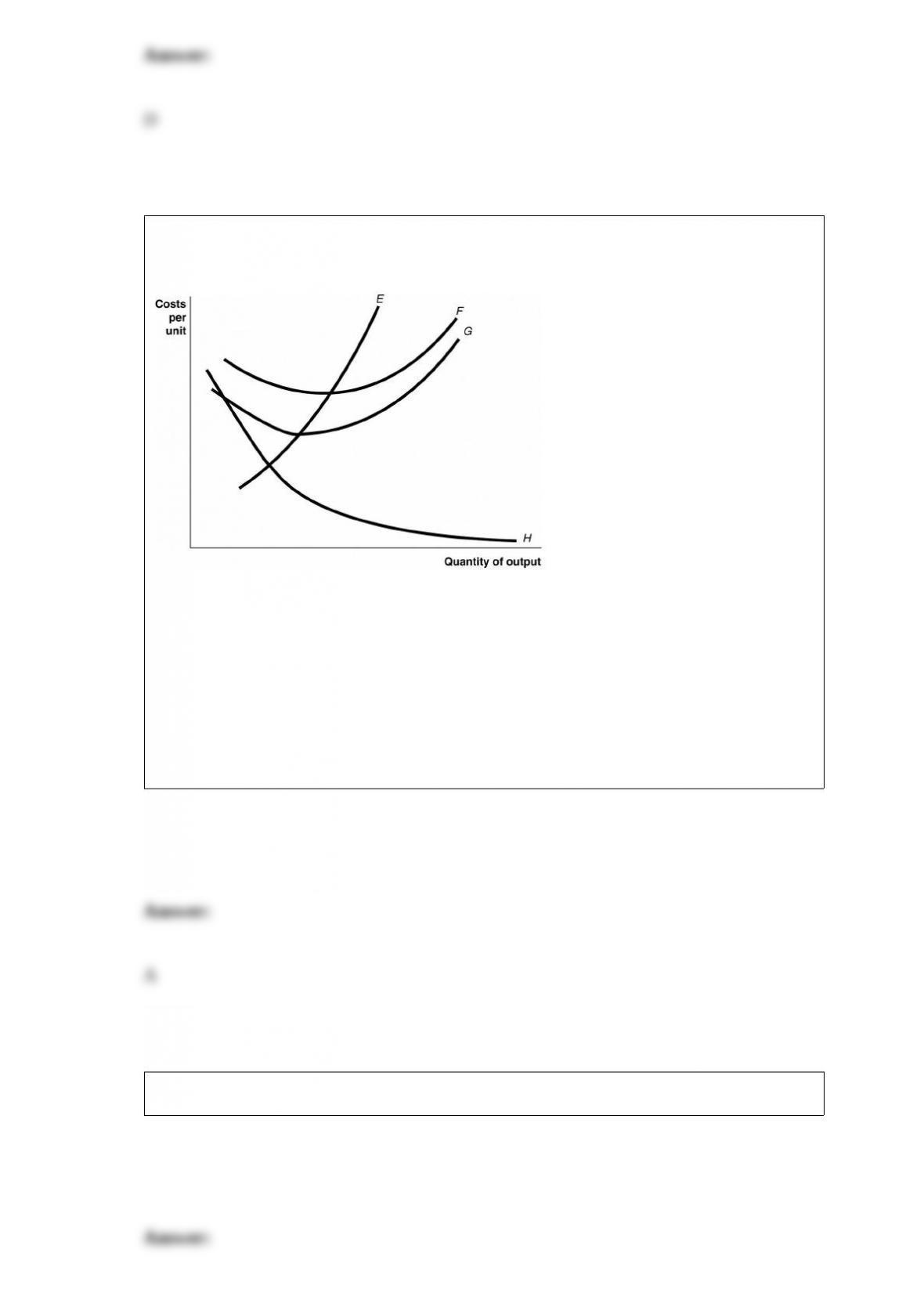
Figure 11-5
Refer to Figure 11-5. The vertical difference between curves F and G measures
A) average fixed costs.
B) marginal costs.
C) fixed costs.
D) sunk costs.
What is corporate governance?

Explain the difference between a firm’s revenue and its profit.
A construction project in Congressman Foghorn’s district is unfinished. Foghorn has
asked that a new appropriations bill include funds to complete the project, despite a
report by an independent agency that the project is a waste of taxpayer money.
Foghorn’s project is a bridge that crosses a river between two cities in his district. The
press has criticized Foghorn and dubbed the project “a bridge too far” since another
bridge, located closer to the same two cities Foghorn’s bridge will connect, already
exists and can accommodate all traffic between the two cities. Foghorn argues that if the
bridge project is not completed, the $50 million already spent will have been wasted. Is
Foghorn’s argument economically rational? Explain your answer.

Define productive efficiency. Does productive efficiency imply allocative efficiency?
Explain.
Define a sole proprietorship.
Provide two examples of a government barrier to entry.

If your income is $92,000 and you pay taxes of $19,475, what is your average tax rate?
Show your work.
Is a typical person likely to gather more information when buying a new computer or
when voting for a member of the U.S. Senate? Why?
Explain the relationship between price elasticity of demand and total revenue.
How do firms and households interact in markets?
What is meant by allocative efficiency? How does a perfectly competitive firm achieve
allocative efficiency?

Use the general relationship between marginal and average values to explain why a
marginal cost curve must intersect an average total cost curve and an average variable
cost curve at their minimum points.
The demand for labor is a derived demand. Explain what is meant by the term “derived
demand.”
Explain two different ways to determine the profit-maximizing level of output for a
firm in a perfectly competitive market.

Is it possible for average total cost to be decreasing over a range of output where
marginal cost is increasing? Briefly explain.
One of the assumptions of monopolistic competition is that firms produce differentiated
products. What does this assumption imply about the demand curve facing a
representative firm?