
A merger between firms at different stages of production of a good
A) is a vertical merger.
B) was made illegal by the Sherman Act.
C) was made legal by the Clayton Act.
D) is a horizontal merger.
The rules of accounting generally require that ________ costs be used for purposes of
keeping a company’s financial records and for paying taxes. These costs are sometimes
called ________ costs.
A) economic; legal
B) real; explicit
C) total; economic
D) explicit; accounting
Examples of ________ show how trade between two countries can make each better
off.
A) absolute advantage
B) comparative advantage
C) autarky
D) trade barriers
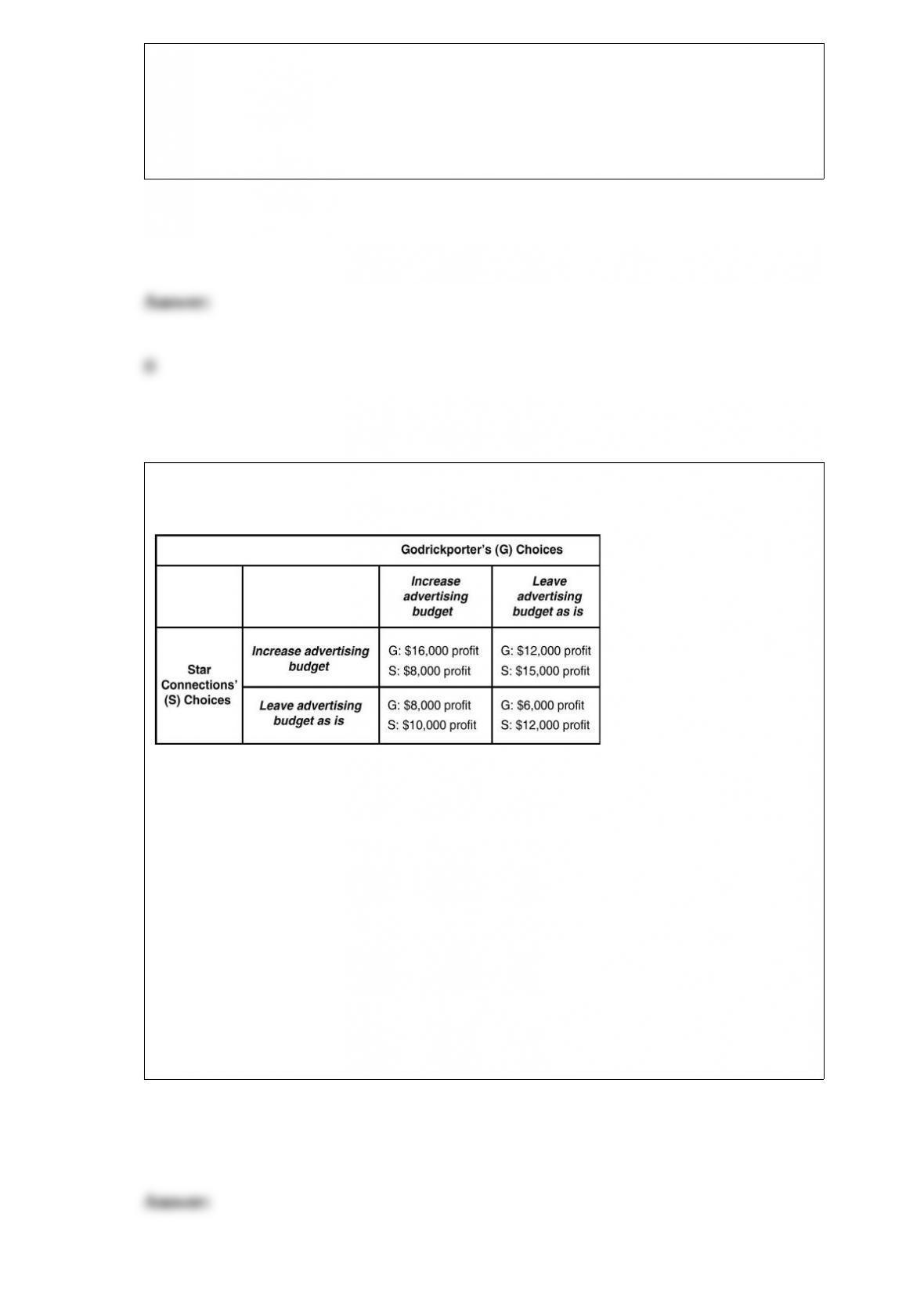
Table 14-1
Godrickporter and Star Connections are the only two airport shuttle and limousine
rental service companies in the mid-sized town of Godrick Hollow. Each firm must
decide on whether to increase its advertising spending to compete for customers. Table
14-1 shows the payoff matrix for this advertising game.
Refer to Table 14-1. Is there a dominant strategy for Godrickporter and if so, what is it?
A) No, its outcome depends on what Star Connections does.
B) Yes, Godrickporter should increase its advertising spending.
C) Yes, Godrickporter should reduce its advertising spending.
D) Yes, Godrickporter’s dominant strategy is to collude with Star Connections.

Seth is a competitive body builder. He says he has to have his 12-oz package of protein
powder to “feed his muscles” every day. On the basis of this information, what can you
conclude about his price elasticity of demand for protein powder?
A) It is elastic.
B) It is perfectly elastic.
C) It is perfectly inelastic.
D) The price elasticity coefficient is 0.
In 2011, the dividend yield on Microsoft (MSFT) stock rose from 1.97% to 3.10%.
Which of the following would have generated that result?
A) The closing price of Microsoft stock rose.
B) Microsoft announced an increase in the dividend it would pay per share.
C) The price-earnings ratio rose.
D) Microsoft issued bonds with a coupon rate equal to 3.10%.
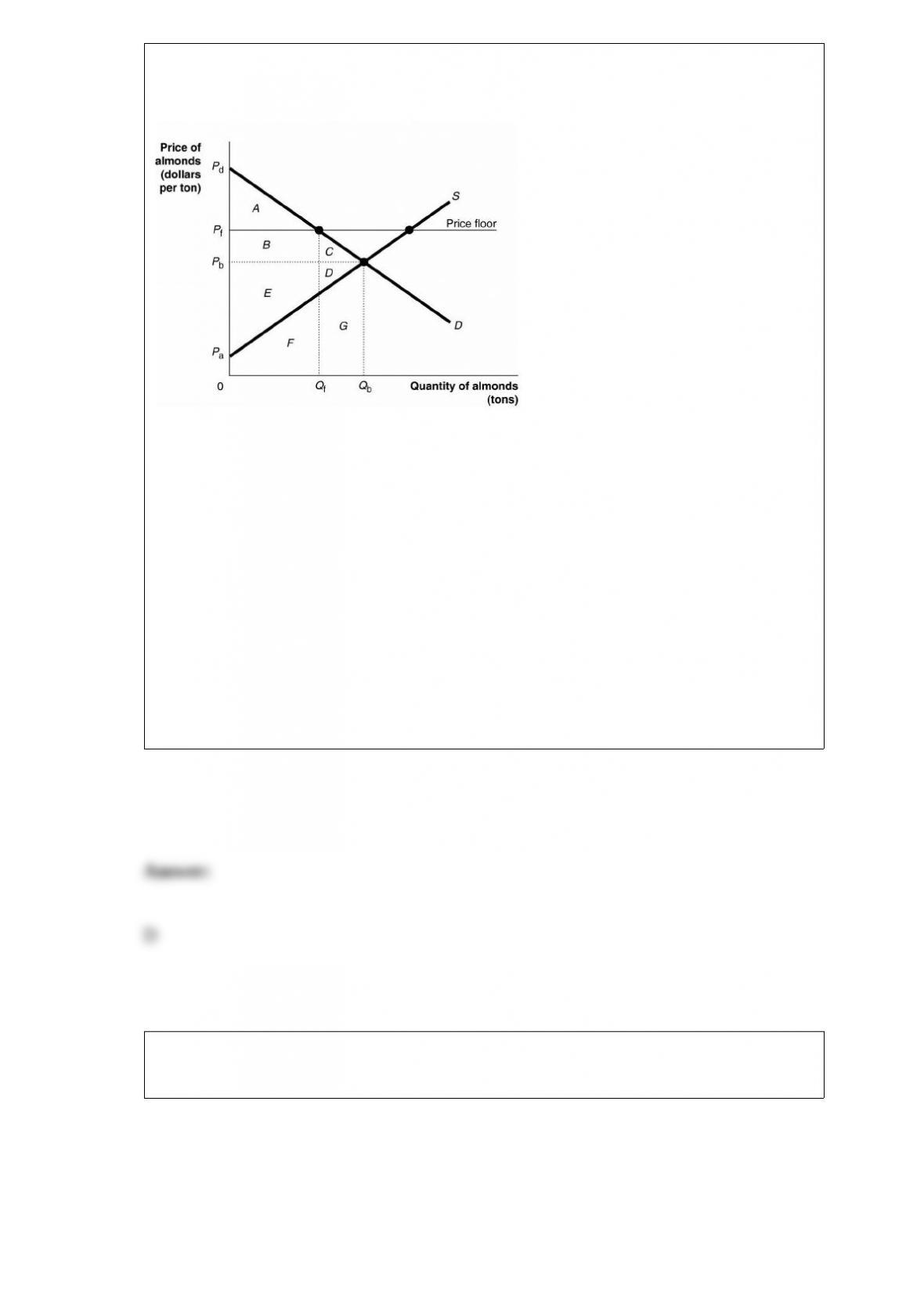
Figure 4-6
Figure 4-6 shows the demand and supply curves for the almond market. The
government believes that the equilibrium price is too low and tries to help almond
growers by setting a price floor at Pf.
Refer to Figure 4-6. What area represents consumer surplus after the imposition of the
price floor?
A) A + B + E
B) A + B
C) A + B + E + F
D) A
Figure 12-17
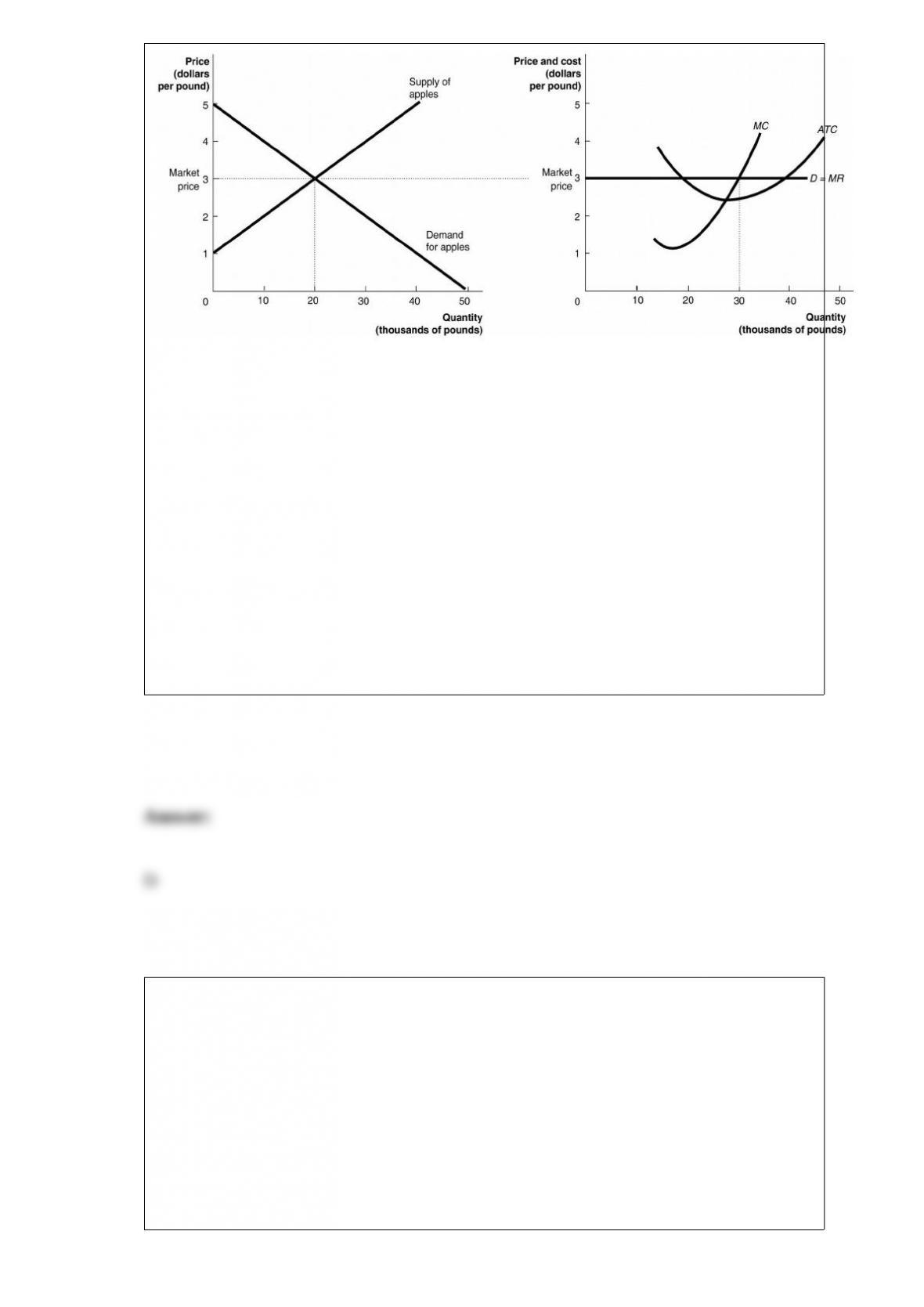
The graphs in Figure 12-17 represent the perfectly competitive market demand and
supply curves for the apple industry and demand and cost curves for a typical firm in
the industry.
Refer to Figure 12-17. The graphs depicts a short run equilibrium. How will this differ
from the long-run equilibrium? (Assume this is a constant-cost industry.)
A) Fewer firms will be in the market in the long run than in the short run.
B) The price will be higher in the long run than in the short run.
C) The market supply curve will be further to the left in the long run than in the short
run.
D) The firm’s profit will be lower in the long run than in the short run.
If a 5 percent increase in income leads to a 10 percent decrease in quantity demanded
for a product this product is
A) an income elastic good.
B) an inferior good.
C) a necessity.
D) a luxury good.
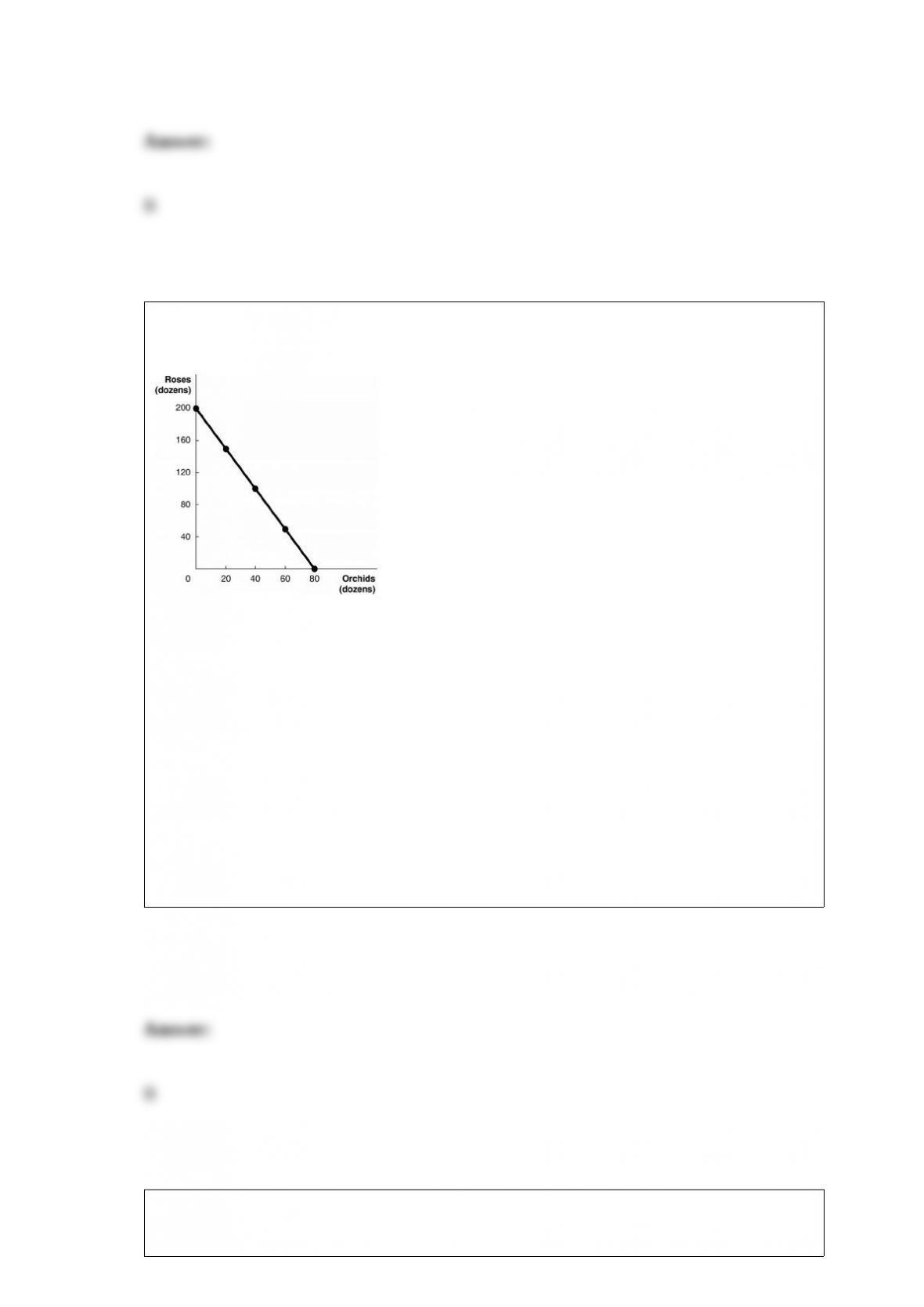
Figure 2-8
Figure 2-8 above shows the production possibilities frontier for Vidalia, a nation that
produces two goods, roses and orchids.
Refer to Figure 2-8. Suppose Vidalia is currently producing 60 dozen orchids per
period. How many roses is it also producing, assuming that resources are fully utilized?
A) 40 dozen roses
B) 50 dozen roses
C) 60 dozen roses
D) 100 dozen roses
Figure 17-3
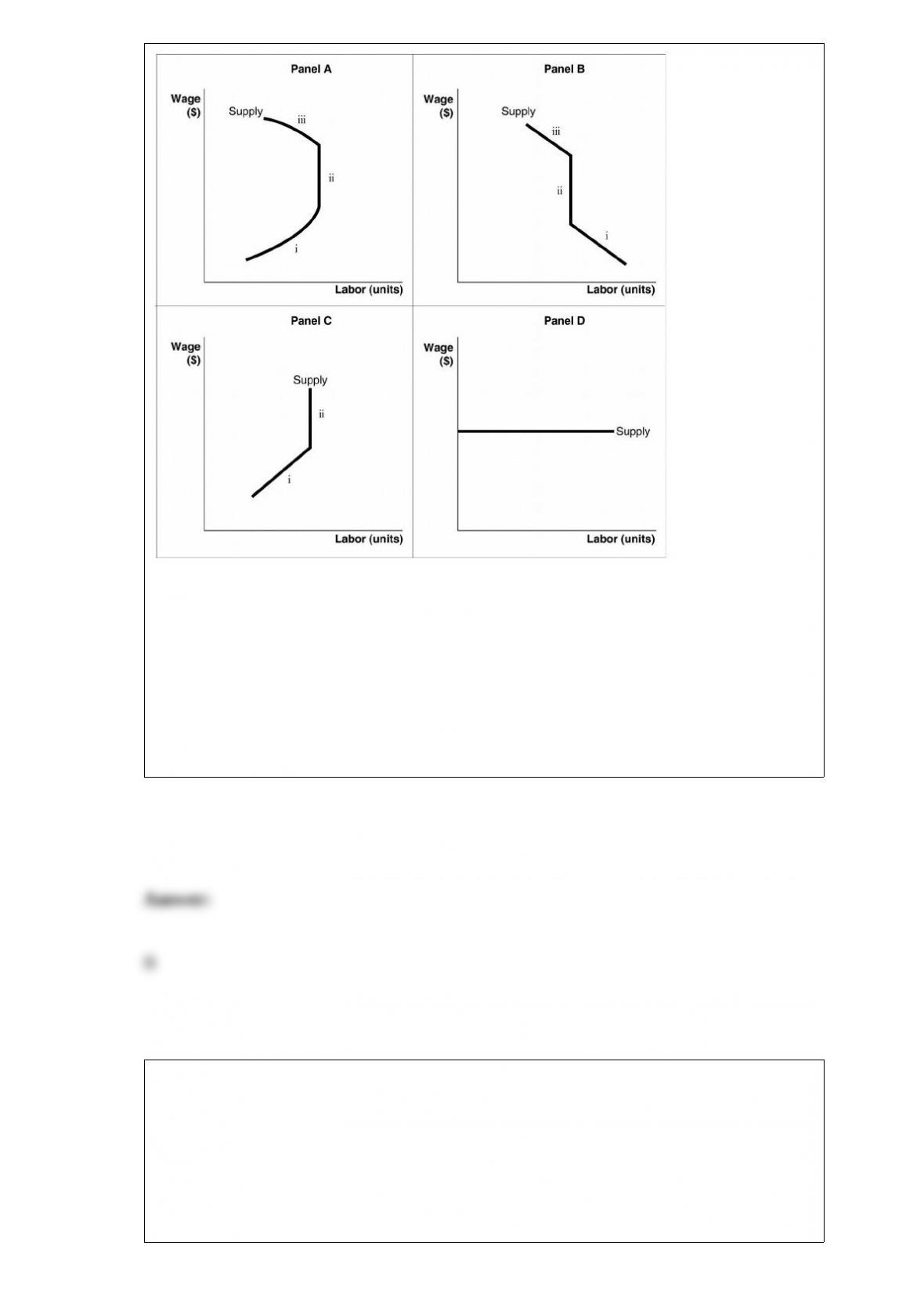
Refer to Figure 17-3. Panel D is appropriate when used to represent
A) the quantity of labor demanded by an input price taker.
B) the labor supply curve facing an input price taker.
C) the quantity of labor supplied by someone working a fixed number of hours.
D) the highly-skilled labor market supply curve.
If production displays economies of scale, the long-run average cost curve is
A) above the short-run average total cost curve.
B) downward-sloping.
C) upward sloping.
D) below the long-run marginal cost curve.
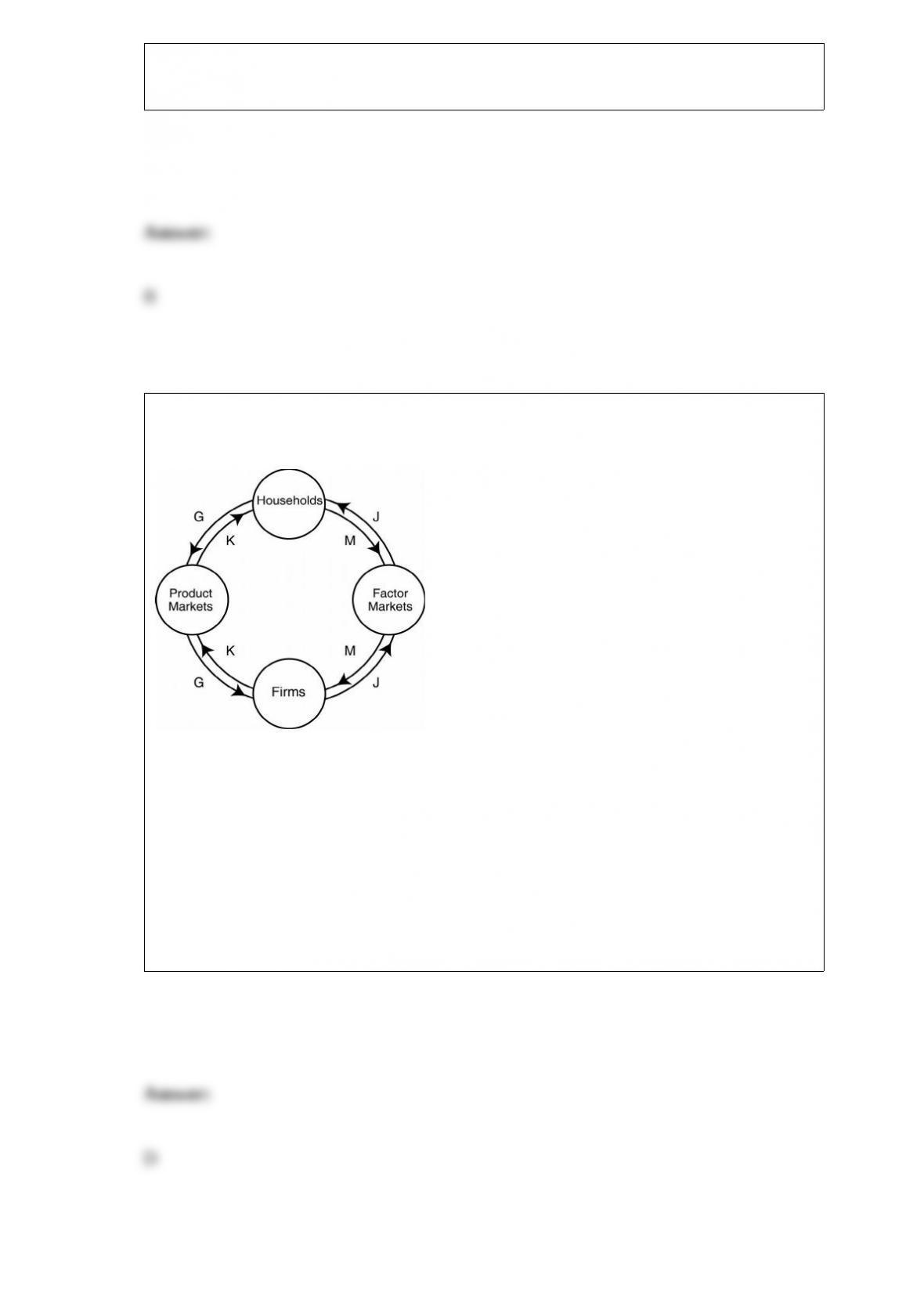
Figure 2-14
Refer to Figure 2-14. Which two arrows in the diagram depict the following
transaction: LaDonna sells 20 pairs of sunglasses at the Oakley store.
A) J and M
B) J and G
C) K and M
D) K and G

One would speak of a change in the quantity of a good supplied, rather than a change in
supply, if
A) supplier expectations about future prices change.
B) the price of the good changes.
C) the cost of producing the good changes.
D) prices of substitutes in production change.
Scenario: Jeans Unlimited
Jeans Unlimited produces clothing for young adults. It designs its clothes at its New
York headquarters and produces them at facilities located in two Southeast Asian
countries. The company recently received negative press after one of its facilities was
found using questionable labor practices, such as, employing children and operating in
a manner that damages the environment.Jeans Unlimited plans to set up new facilities
that are designed specifically to reduce impact on the environment. The management
has emphasized on recycling and reusing most of their resources. What concept is the
company emphasizing on in this scenario?
A) sustainability
B) standardization
C) ethnocentricity
D) industrialization

The branch of economics which studies the behavior of entire economies is called
A) public economics.
B) microeconomics.
C) macroeconomics.
D) normative economics.
Which of the following economists did not help to develop game theory analysis?
A) Adam Smith
B) John Nash
C) John von Neumann
D) Oskar Morgenstern
The marginal tax rate is
A) the amount of taxes paid as a percentage of income.
B) the amount of per-capita taxes paid.
C) the amount of taxes paid as a percentage of gross domestic product (GDP).
D) the fraction of each additional dollar of income that must be paid in taxes.
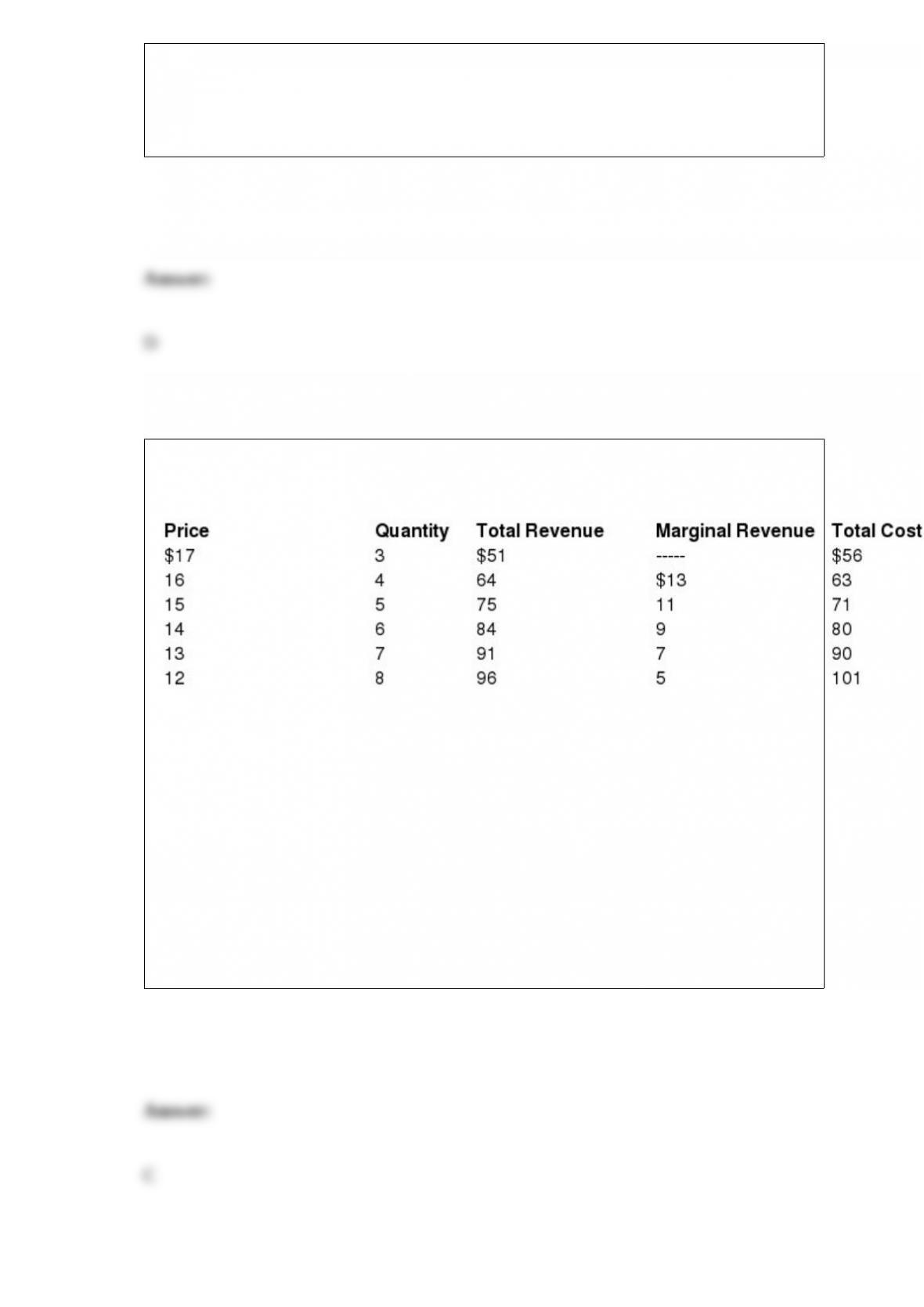
Table 15-3
Assume Table 15-3 gives the monthly demand and costs for subscriptions to basic cable
for Comcast, a cable television monopoly in Philadelphia.
Refer to Table 15-3. If Comcast maximizes its profits how much profit will it earn?
A) $84
B) $40
C) $4
D) Comcast will break even.
Most economists believe that a small amount of the gap between the wages of white
males and the wages of other groups is due to discrimination. Which of the following
factors is not another factor that explains part of this gap?
A) differences in education
B) geographic location
C) differences in experience
D) differing preferences for jobs
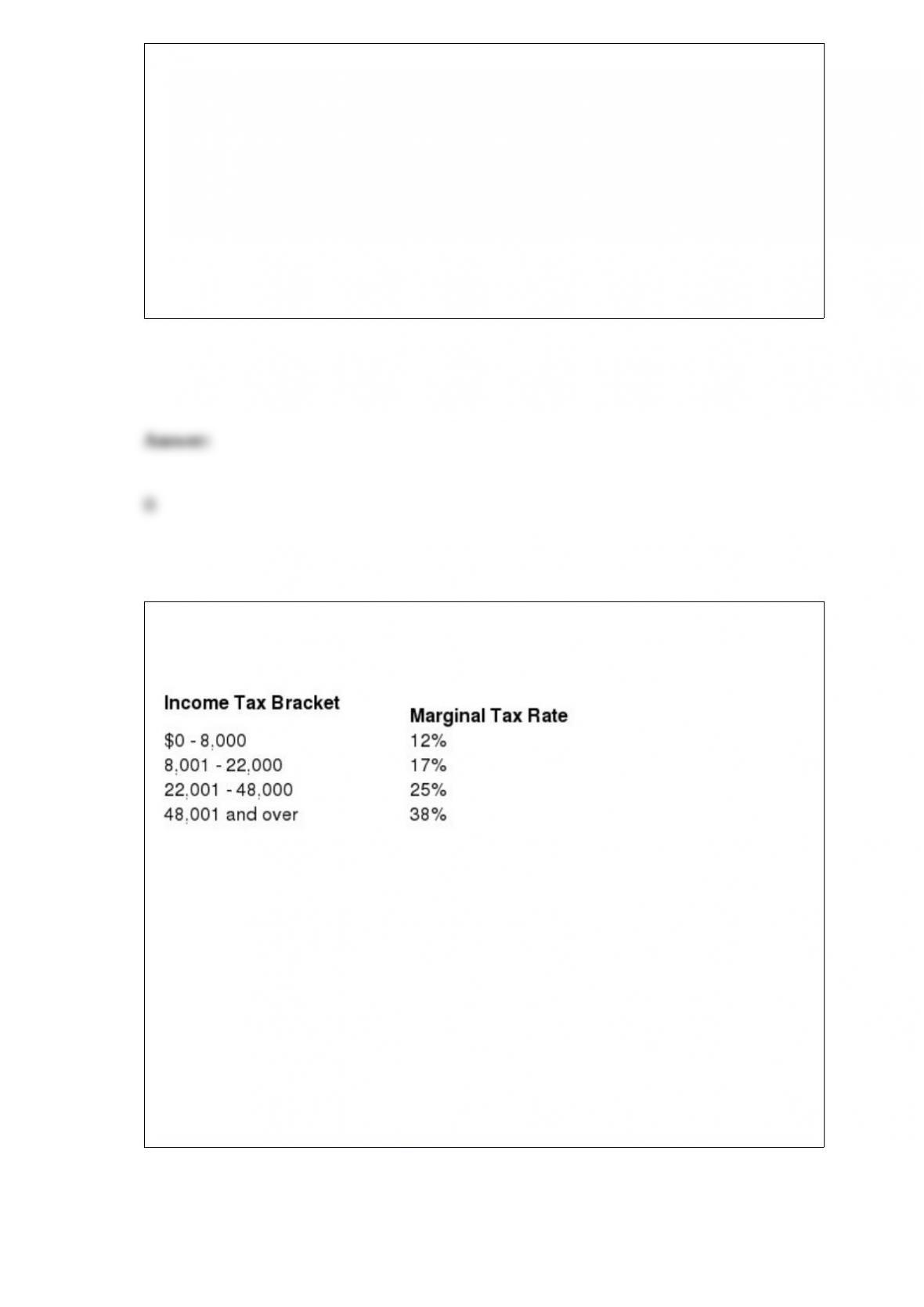
Table 18-6
Table 18-6 shows the income tax brackets and tax rates for single taxpayers in
Calpernia.
Refer to Table 18-6. Sasha is a single taxpayer with an income of $60,000. What is his
marginal tax rate and what is his average tax rate?
A) marginal tax rate = 38%; average tax rate = 23%
B) marginal tax rate = 17%; average tax rate = 21%
C) marginal tax rate = 38%; average tax rate = 24%
D) marginal tax rate = 23%; average tax rate = 38%

The decision to make the U.S. income tax system progressive was
A) a progressive decision.
B) a positive decision.
C) a decision that was needed to minimize the excess burden of taxation.
D) a normative decision.
If a state requires all drivers to purchase auto insurance, insurance companies still face
the problem of
A) correctly pricing their insurance.
B) sunk costs.
C) adverse selection.
D) excess demand for their insurance.
Every firm that has the ability to affect the price of the good or service it sells will
A) have a perfectly elastic demand curve.
B) have a marginal revenue curve that lies below its demand curve.
C) earn a short-run profit but break even in the long run.
D) shut down in the short run.
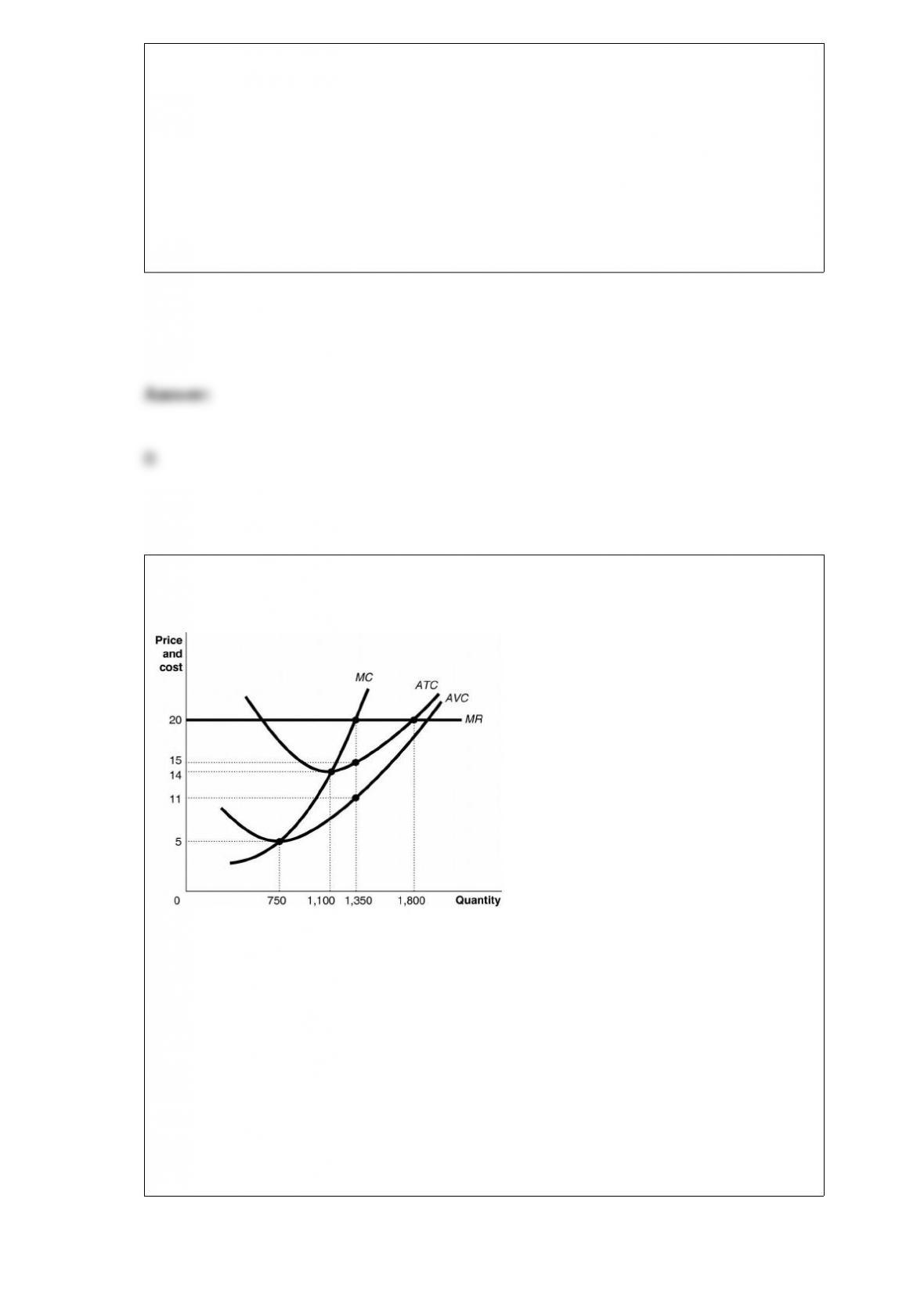
Figure 12-5
Figure 12-5 shows cost and demand curves facing a typical firm in a constant-cost,
perfectly competitive industry.
Refer to Figure 12-5. If the market price is $20, what is the amount of the firm’s profit?
A) $5,400
B) $6,750
C) $8,100
D) $16,200

Jeremy is thinking of starting up a small business selling NASCAR memorabilia. He is
considering setting up his business as a sole proprietorship. What is one advantage to
Jeremy of setting up his business as a sole proprietorship?
A) As a sole proprietor, Jeremy would face limited liability.
B) As a sole proprietor, Jeremy would have the ability to share risk with shareholders.
C) As a sole proprietor, Jeremy would have both ownership and control over the
business.
D) All of the above would be advantages of setting up his business as a sole
proprietorship.
Which of the following displays these two characteristics: nonrivalry and
nonexcludability in consumption?
A) public goods
B) private goods
C) quasi-public goods
D) common resources

A significant downside to network externalities is that
A) there may be large switching costs to consumers of changing products so that
consumers end up using products with inferior technologies.
B) firms may network with unethical suppliers or distributors.
C) the costs of hiring celebrity endorsements may be very high.
D) there may be large switching costs to firms changing technologies.
One implication of compensating differentials is that laws passed to protect the health
and safety of workers may not make workers better off than they were prior to the
passages of the laws. Why is this so?
A) Workers may suffer from cognitive dissonance, which means that the perception
workers have that their jobs are hazardous is not true.
B) If the laws make the work environment safer, there is no reason to pay workers a
compensating differential for the risk associated with their jobs.
C) The principal-agent problem that exists in the workplace may cause workers to shirk
more after the work environment becomes safer.
D) In non-competitive markets, workers are unlikely to receive a compensating
differential to compensate for jobs with extra risk. As a result, after the laws are passed
their wages will not change.

Marginal productivity theory implies that in a perfectly competitive market economy, a
worker will receive income
A) equal to the value of her marginal contribution to the production process.
B) that is greater than the value of her marginal contribution to production process.
C) that is less than the value of her marginal contribution to the production process.
D) greater than, less than, or equal to the value of her marginal contribution to the
production process, depending on her ability to negotiate with employers.
Economists usually assume that people act in a rational, self-interested way. In
explaining how consumers make choices this means that economists believe
A) consumers will always buy goods and services at the lowest possible prices.
B) consumers spend their incomes to order to accumulate the most goods and services.
C) consumers make choices that will leave them as satisfied as possible given their
incomes, tastes and the prices of goods and services available to them.
D) consumers will spend their incomes and time on activities that benefit themselves as
much as possible, without regard to the welfare of others.

If, for the last unit of a good produced by a perfectly competitive firm, MR > MC, then
in producing it, the firm
A) added more to total costs than it added to total revenue.
B) added more to total revenue than it added to total cost.
C) is maximizing marginal profit.
D) has minimized its losses.
The president of Toyota’s Georgetown plant was quoted as saying, “Demand for high
volumes saps your energy. Over a period of time, it eroded our focus [and] thinned out
the expertise and knowledge we painstakingly built up over the years.” This quote
suggests that
A) Toyota was experiencing an excess demand for its automobiles which it had
difficulty keeping up with.
B) as Toyota expanded its capacity, it experienced diseconomies of scale.
C) Toyota was focused on “churning” out cars for which it did not invest sufficiently in
training its workers.
D) high demand for Toyota’s cars prevented the company from focusing on its strength:
auto design.
Economists reason that the optimal decision is to continue any activity up to the point
where the
A) marginal benefit is zero.
B) marginal benefit is greater than the marginal cost.
C) marginal cost is zero.
D) marginal benefit equals the marginal cost.
Serafina was earning $75 per hour and working 50 hours per week. Serafina’s wage rose
to $90 per hour, and as a result, she now works 60 hours per week. What can you
conclude from this information about the income effect and the substitution effect of a
wage change for Serafina?
Suppose the current price of copper is $3 per pound and the quantity supplied is 200
pounds per day. If the price of copper falls to $2.50 per pound, the quantity supplied
drops to 180 pounds per day. Use the midpoint formula to calculate the price elasticity
of supply for copper.
Arturo runs a Taco Bell franchise. He is selling 250 Gordita Supremes per week at a
price of $2.75. If he lowers the price to $2.70, he will sell 251 Gordita Supremes. What
is the marginal revenue of the 251st Gordita Supreme? If selling the extra Gordita
Supreme adds $0.20 to Arturo’s costs, what will be the effect on his profit from selling
251 Gordita Supremes instead of 250?
How have U.S. imports and exports, as a fraction of GDP, changed from 1970 to the
present?
What type of business has the potential for double taxation of profits and why?
If you own a bond with a seven percent coupon rate and new bonds are paying five
percent, what will happen to your bond’s market price?
If the labor supply curve shifts to the right and the labor demand curve remains
unchanged, what will happen to the equilibrium wage and the equilibrium level of
employment? Illustrate your answer with a graph.
What is a firm’s balance sheet?
Studies on consumer behavior have found that most people value fairness enough that
they will refuse to participate in transactions they consider unfair, even if they are worse
off as a result. How does this affect a firm’s decision to raise prices in the event of a
temporary increase in demand?
Suppose that at a price of $55, 100 units were sold while at a price of $33, 153 units
were sold. Without calculating the price elasticity value, can you determine whether
demand is elastic, unit-elastic, or inelastic? Explain your answer.
Explain the differences between total revenue, average revenue, and marginal revenue.
What is economic surplus? When is economic surplus at a maximum?
What is the marginal product of labor and what is the average product of labor.
What is a monopoly? Can a firm be a monopoly if close substitutes for its product
exists?
Suppose the price of gasoline in July 2004 averaged $1.35 a gallon and 15 million
gallons a day were sold. In October 2004, the price averaged $2.15 a gallon and 14
million gallons were sold. If the demand for gasoline did not shift between these two
months, use the midpoint formula to calculate the price elasticity of demand. Indicate
whether demand was elastic or inelastic.
What is the principle-agent problem?
List the five main factors of production.