
When computing GDP via the income approach, we must include
a. exports minus imports.
b. gross investment.
c. depreciation and indirect business taxes.
d. household savings and consumption.
e. government purchases of goods and services.
Which of the following best states John Rawls’s argument for income equality?
a. A dollar taken from a rich man and given to a poor man provides the poor man with
more satisfaction than the rich man loses.
b. Income equality encourages people to take risks and to become more productive.
c. If people were framing a constitution for society without knowing what their class
position would be, they would opt for equality.
d. Greater income equality leads to significantly higher rates of capital formation.
e. Political freedom and economic equality can only be achieved with a perfectly equal
distribution of income.

Price supports are generally designed to
a. help consumers.
b. keep prices low.
c. increase sellers’ incomes.
d. discourage production.
e. supplement rationing.
According to economist Edward Denison, about one-half of the growth in the U.S.
output for the period 1929 to 1969 was the result of
a. increases in population.
b. increases in government spending.
c. surpluses in the balance of payments.
d. increased capital investment.
e. increased output per unit of input.
The following questions are based on the following demand schedule for a monopolist:

If a firm’s demand curve slopes downward, the firm’s
a. marginal revenue will rise as price is cut.
b. marginal revenue will always be less than price.
c. total revenue will fall steadily as price is cut.
d. demand will be less than marginal revenue.
e. price will exceed total revenue.
The value of the multiplier in an open economy is generally
a. less than zero.
b. greater than the multiplier in a closed economy.
c. identical to the value of the multiplier in a closed economy.
d. less than the value of the multiplier in a closed economy.
e. indeterminate because the behavior of exports is unpredictable.
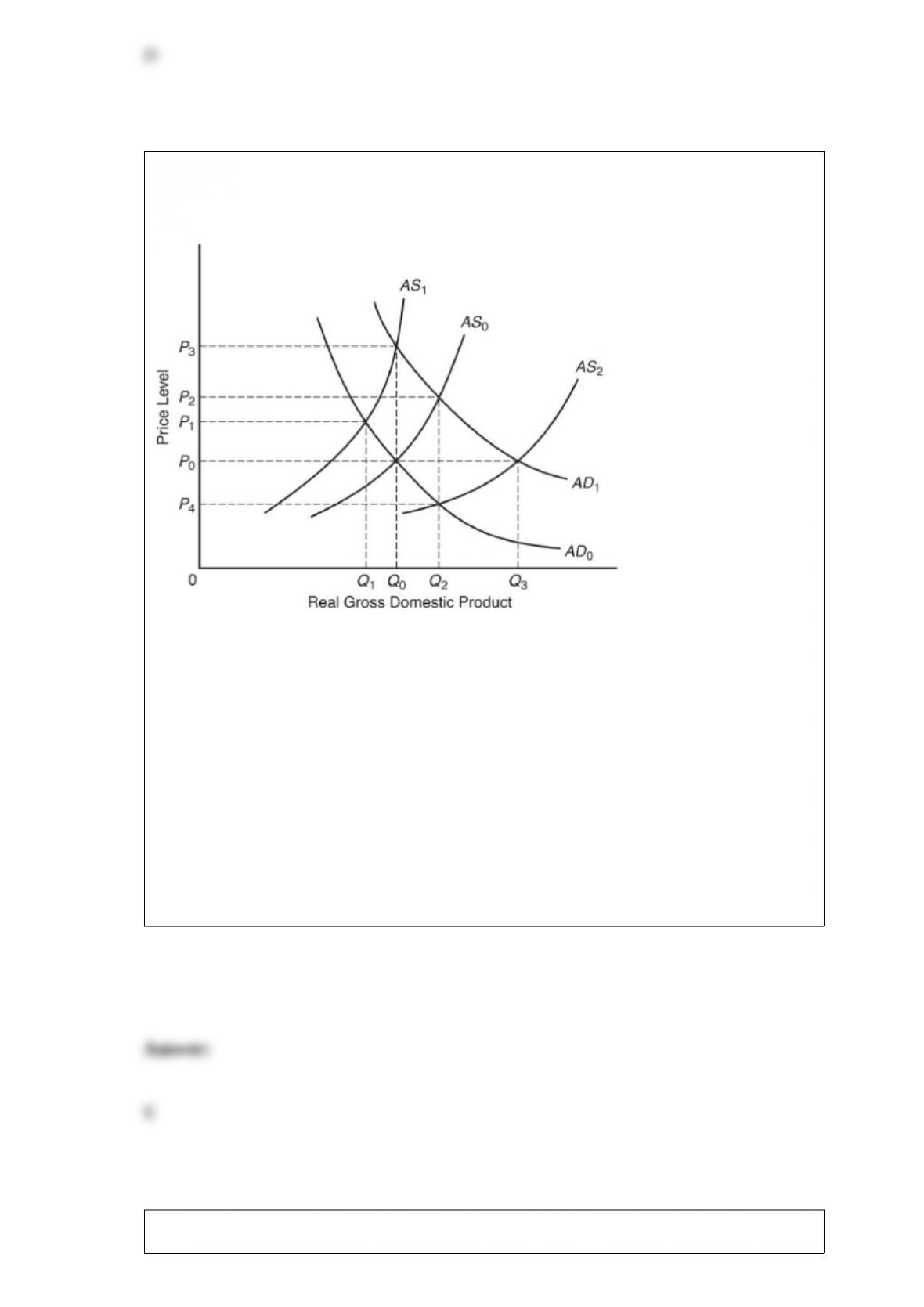
The following questions are based on the following diagram, in which existing
aggregate supply and demand curves are AS0 and AD0, respectively:
As a result of these strategic input price increases, the price level
a. rises to 0P2 and real output increases to 0Q2.
b. increases to 0P3 and real output remains unchanged.
c. remains unchanged and real output increases to 0Q3.
d. remains unchanged and real output remains unchanged.
e. rises to 0P1 and real output declines to 0Q1.
To earn economic profit, a monopolist must charge a price that

a. maximizes total output.
b. equals marginal revenue.
c. is above average cost.
d. is below marginal cost.
e. is greater than demand.
An element of economic welfare that is NOT effectively captured in growth
measurement of real per capita GDP is
a. population growth.
b. output growth.
c. the rate of inflation.
d. income distribution.
e. a change in the price level.
Which of the following was the most important force in bringing an end to the Great
Depression?

a. the natural resilience of the economy
b. Roosevelt’s New Deal policies
c. U.S. involvement in World War II
d. a delayed impact from increased business investment in the early 1930s
e. falling wages and prices
The Federal Reserve influences the money supply by managing
a. personal and corporate tax rates.
b. government spending programs.
c. the foreign trade balance.
d. the reserves of the banking system.
e. the number of financial intermediaries.
Under a flexible exchange rate system, the equilibrium price of one currency in terms of
another is
a. unaffected by international differences in relative price levels.

b. equal to the ratio of the amount of gold in a unit of each currency.
c. regularly adjusted by the International Monetary Fund within a fixed range.
d. determined by supply and demand.
e. more likely to appreciate than depreciate.
In the classical model, achieving a full-employment level of output
a. requires a modest amount of government intervention.
b. is a temporary state resulting from flexible wages and prices.
c. is possible because competition bids wage rates down to the point where everyone
who really wants a job can have one.
d. is based on the assumption that there is no saving in the economy because all the
income created is spent.
e. becomes more and more difficult to attain as labor-saving technology throws more
and more workers into unemployment.
From the perspective of economic analysis, society should
a. try to reduce pollution to a level as close to zero as is humanly possible.
b. realize that it is unrealistic to expect that efforts to reduce pollution will be cost
effective from society’s standpoint.
c. strive to maximize the difference between the costs of pollution and the costs of

pollution control.
d. reduce pollution as long as the reduction in social costs equals or exceeds the
additional cost associated with the control program.
e. pursue reduced pollution levels as long as the social cost of achieving these levels
exceeds the social cost of polluting.
Suppose that the consumer price index is 160, using the base year of 1982″84. If a
market basket of goods and services costs $525, what did it cost in the base year?
a. $30
b. $100
c. $160
d. $328
e. $525
When GDP is at its equilibrium value
a. firms’ inventories will neither increase nor decrease unexpectedly.
b. employment and GDP are identical.

c. the multiplier is zero.
d. intended investment equals the 45-degree line.
e. consumption equals disposable income.
If the quantity demanded is relatively insensitive to changes in price and the quantity
supplied is relatively sensitive to changes in price, the imposition of a sales tax will
a. shift entirely to the buyer.
b. fall more heavily on the buyer.
c. be equally shared by the buyer and seller.
d. fall more heavily on the seller.
e. shift entirely to the seller.
An advantage of proprietorship is that the owner is faced with
a. complete control.
b. easy-to-obtain financing.
c. unlimited liability.

d. limited liability.
e. lower tax rates than those applicable to a partnership.
Labor productivity is measured by the
a. unemployment rate divided by the employment rate.
b. output per hour of labor.
c. ratio of labor to capital with a given technology.
d. labor force participation rate.
e. size of the labor force.
The basis for specialization and trade, both within a nation and among nations, is
________ advantage.
a. specialized
b. dominant
c. academic
d. absolute

e. comparative
Which of the following activities is most likely to generate an external economy?
a. playing a stereo full blast in a dorm room during reading days
b. eating a pizza in a restaurant
c. driving while intoxicated
d. keeping a neatly mown, weedless lawn in a suburban neighborhood
e. quietly napping during an Economics class
Keynes disagreed with the classical model because he felt that
a. a modern economy has adequate levels of competition to ensure the flexibility of
wages and prices.
b. supply creates its own demand.
c. in the long run, capitalism will be replaced by socialism.
d. one cannot be certain that changes in interest rates equate saving to investment.
e. the automatic mechanism in a capitalist society produces accelerating rates of
inflation.

Which of the following characteristics would be inappropriate when describing a
perfectly competitive market?
a. many firms
b. homogeneous product
c. some power over price
d. low barriers to entry
e. no form of nonprice competition practices
According to Schumpeter, the large profits often realized from innovation tend to be
transitory because
a. interest rates rise, causing the value of the innovator’s assets to fall.
b. the state taxes away most of these excess earnings.
c. innovators sell their businesses by going public, and stock prices are very
unpredictable and unstable.
d. rival firms are induced to copy the innovations, and thus entry of new firms drives
down profits.
e. they result from contrived scarcities resulting from the use of monopoly power.

An MPC of zero means the value of the multiplier is
a. 0.
b. 1.
c. 2.
d. 2.5.
e. 3.
The following questions are based on the following information: The country has a
fractional-reserve banking system, required reserves are 12.5 percent of demand
deposits, each bank initially has reserves exactly equal to the required amount, each
wants to maintain this equality, and no person withdraws cash from the banking system.
Bank B may now safely increase its loans by a maximum of
a. $1,094.
b. $7,656.
c. $8,750.
d. $10,000.
e. $15,312.

Who wrote the classic work on the effect of population growth on the rate of economic
growth?
a. David Ricardo
b. Adam Smith
c. John Maynard Keynes
d. Thomas Malthus
e. Karl Marx
Under a gold standard, exchange rates
a. reflect balance-of-payments surpluses and deficits.
b. are set by the International Monetary Fund.
c. equal the amount of gold a nation needs to back its money.
d. are determined by the equation of exchange.
e. are effectively fixed.

Rent, interest, and profit are forms of ________ income.
a. bookkeeping
b. property
c. nonproductive
d. surplus
e. fixed
Under a system of flexible exchange rates, balance-of-payments deficits and surpluses
show up
a. in a country’s central bank purchases and sales of foreign currencies.
b. in gold flows into and out of the country.
c. as changes in exchange rates rather than as central bank transactions.
d. as the net difference between debit and credit items in the balance of payments
accounts.
e. in the unilateral transfer account in the balance-of-payments accounts.

Those at the lowest end of the income distribution are typically those who
a. have large amounts of inherited wealth.
b. are disabled, single, or lacking in employable skills.
c. hold jobs requiring extensive training.
d. have unique abilities or skills.
e. manage to obtain monopoly power.
The Federal Reserve System
a. is an outgrowth of the Bank of the United States.
b. is directly controlled by Congress.
c. was established by Congress in 1913 after a severe financial panic six years earlier.
d. controls the minting of coins.
e. includes by law all of this country’s financial institutions.

Under perfect competition, the existence of economic profits and losses
a. produces economic inefficiencies leading to the misallocation of resources in the long
run.
b. generally causes output in the short run to fall in markets where economic profits are
being made and to rise in markets where economic losses are being made.
c. creates hardships for producers, leading to industry concentration in the hands of
relatively few producers.
d. ensures that output will not be produced at minimum unit cost in the long run.
e. causes firms to enter or leave markets and otherwise reallocate resources in the long
run.
In real business cycle models, an unfavorable supply shock
a. leads to an increase in the price level and a decline in real GDP.
b. causes the aggregate demand curve to shift to the left.
c. increases total output.
d. increases aggregate demand because price levels rise.
e. leads to significant decreases in long-term involuntary unemployment.

Using the spending and taxing powers of government to stabilize the economy is called
fiscal
a. fitness.
b. policy.
c. federalism.
d. finance.
e. reserve.