
1) From 1950-2011 the price level in the United States increased more than
A) twofold
B) threefold
C) sixfold
D) ninefold
2) The Keynesian theory of money demand predicts that people will increase their
money holdings if they believe that
A) interest rates are about to fall
B) bond prices are about to rise
C) expected inflation is about to fall
D) bond prices are about to fall
3) An expectation may fail to be rational if
A) relevant information was not available at the time the forecast is made
B) relevant information is available but ignored at the time the forecast is made
C) information changes after the forecast is made
D) information was available to insiders only
4) The ________ is defined as the payments to the owner plus the change in a security’s
value expressed as a fraction of the security’s purchase price.
A) yield to maturity
B) current yield
C) rate of return
D) yield rate
5) The riskiness of an asset’s returns due to changes in interest rates is
A) exchange-rate risk
B) price risk
C) asset risk
D) interest-rate risk

6) If the optimal forecast of the return on a security exceeds the equilibrium return, then
A) the market is inefficient
B) no unexploited profit opportunities exist
C) the market is in equilibrium
D) the market is myopic
7) Everything else held constant, when the current value of the domestic currency
increases, the ________ domestic assets ________.
A) demand for; increases
B) quantity demanded of; increases
C) demand for; decreases
D) quantity demanded of; decreases
8) Under a fixed exchange rate system, countries that ran large, persistent balance of
payments surpluses would ________ international reserves, thereby pressuring them
into ________ their exchange rate.
A) gain; devaluing
B) gain; revaluing
C) lose; devaluing
D) lose; revaluing
9) As the payments system evolves from barter to a monetary system,
A) commodity money is likely to precede the use of paper currency
B) transaction costs increase
C) the number of prices that need to be calculated increase rather dramatically
D) specialization decreases
10) The total collection of pieces of property that serve to store value is a person’s
A) wealth
B) income

C) money
D) credit
11) In the liquidity preference framework, a one-time increase in the money supply
results in a price level effect. The maximum impact of the price level effect on interest
rates occurs
A) at the moment the price level hits its peak (stops rising) because both the price level
and expected inflation effects are at work
B) immediately after the price level begins to rise, because both the price level and
expected inflation effects are at work
C) at the moment the expected inflation rate hits its peak
D) at the moment the inflation rate hits it peak
12) The Phillips curve indicates that when the labor market is ________, production
costs will ________ and aggregate supply increases.
A) easy; rise
B) easy; fall
C) tight; fall
D) tight; rise
13) An important factor in producing the subprime mortgage crisis was
A) lax consumer protection regulation
B) onerous rules placed on mortgage originators
C) weak incentives for mortgage brokers to use complicated mortgage products
D) strong incentives for the mortgage brokers to verify income information
14) Both the CAPM and APT suggest that an asset should be priced so that it has a
higher expected return
A) when it has a greater systematic risk
B) when it has a greater risk in isolation
C) when it has a lower systematic risk
D) when it has a lower systematic risk and a lower risk in isolation

15) While the discount rate is “established” by the regional Federal Reserve Banks, in
truth, the rate is determined by
A) Congress
B) the president of the United States
C) the Senate
D) the Board of Governors
16) Regulations that reduced competition between banks included
A) branching restrictions
B) bank reserve requirements
C) the dual system of granting bank charters
D) interest-rate ceilings
17) Dennis notices that jackets are on sale for $99. In this case money is functioning as
a
A) medium of exchange
B) unit of account
C) store of value
D) payments-system ruler
18) The quantity of reserves demanded equals
A) required reserves plus borrowed reserves
B) excess reserves plus borrowed reserves
C) required reserves plus excess reserves
D) total reserves minus excess reserves
19) For restrictive covenants to help reduce the moral hazard problem they must be
________ by the lender.
A) monitored and enforced

B) written in all capitals
C) easily changed
D) impossible to remove
20) When the Treasury bond market becomes more liquid, other things equal, the
demand curve for corporate bonds shifts to the ________ and the demand curve for
Treasury bonds shifts to the ________.
A) right; right
B) right; left
C) left; right
D) left; left
21) ________ in the foreign interest rate causes the demand for domestic assets to
________ and the domestic currency to appreciate, everything else held constant.
A) An increase; increase
B) An increase; decrease
C) A decrease; increase
D) A decrease; decrease
22) An emerging market country that successfully used exchange-rate targeting to lower
its inflation from above 100 percent in 1988 to below 10 percent in 1994 (before
devaluation) was
A) Thailand
B) Mexico
C) The Philippines
D) Indonesia
23) The Federal Open Market Committee usually meets ________ times a year.
A) four
B) six
C) eight
D) twelve

24) A tool for managing interest-rate risk that requires exchange of payment streams is
a
A) futures contract
B) forward contract
C) swap
D) micro hedge
25) Managers (________) may act in their own interest rather than in the interest of the
stockholder-owners (________) because the managers have less incentive to maximize
profits than the stockholder-owners do.
A) principals; agents
B) principals; principals
C) agents; agents
D) agents; principals
26) Everything else held constant, when households save less, wealth and the demand
for bonds ________ and the bond demand curve shifts ________.
A) increase; right
B) increase; left
C) decrease; right
D) decrease; left
27) The formula that links checkable deposits to the money supply is
A) M =
B) M = D
C) D = M
D) D = (1 + c)

28) In one of the earliest studies on the link between interest rates and money demand
using United States data, James Tobin concluded that the demand for money is
A) sensitive to interest rates
B) not sensitive to interest rates
C) not sensitive to changes in income
D) not sensitive to changes in bond values
29) The main center of the Eurodollar market is
A) London
B) Basel
C) Paris
D) New York
30) The Federal Reserve ________ pay interest on reserves held on deposit. The
European System of Central Banks ________ pay interest on reserves held on deposit.
A) does; does
B) does; does not
C) does not; does
D) does not; does not
31) The most important developments that have reduced banks cost advantages in the
past thirty years include:
A) the growth of the junk bond market
B) the competition from money market mutual funds
C) the growth of securitization
D) the growth in the commercial paper market
32) The percentage of deposits that banks must hold in reserve is the
A) excess reserve ratio
B) required reserve ratio

C) total reserve ratio
D) currency ratio
33) FIRREA increased the core-capital leverage requirement for thrift institutions from
3% to
A) 8%
B) 5%
C) 10%
D) 25%
34) The formula that links checkable deposits to the monetary base is
A) m =
B) M =
C) M =
D) D =
E) D = MB
35) Stock prices are
A) relatively stable trending upward at a steady pace
B) relatively stable trending downward at a moderate rate
C) extremely volatile
D) unstable trending downward at a moderate rate
36) Under the Bretton Woods system, the organization assigned the task of making
loans to countries that were experiencing balance of payments difficulties is known as

the
A) World Bank
B) International Development Association
C) International Monetary Fund
D) Federal Reserve System
37) The General Motors Acceptance Company (GMAC) is a
A) sales finance company
B) consumer finance company
C) business finance company
D) public finance company
38) Financial markets promote greater economic efficiency by channeling funds from
________ to ________.
A) investors; savers
B) borrowers; savers
C) savers; borrowers
D) savers; lenders
39) Empirical evidence shows that the quantity theory of money is a good theory of
inflation
A) in the long run, but not in the short run
B) in the short run, but not in the longrun
C) in both the long run and the short run
D) not in either the long run nor the short run
40) If bad credit risks are the ones who most actively seek loans then financial
intermediaries face the problem of
A) moral hazard
B) adverse selection
C) free-riding
D) costly state verification
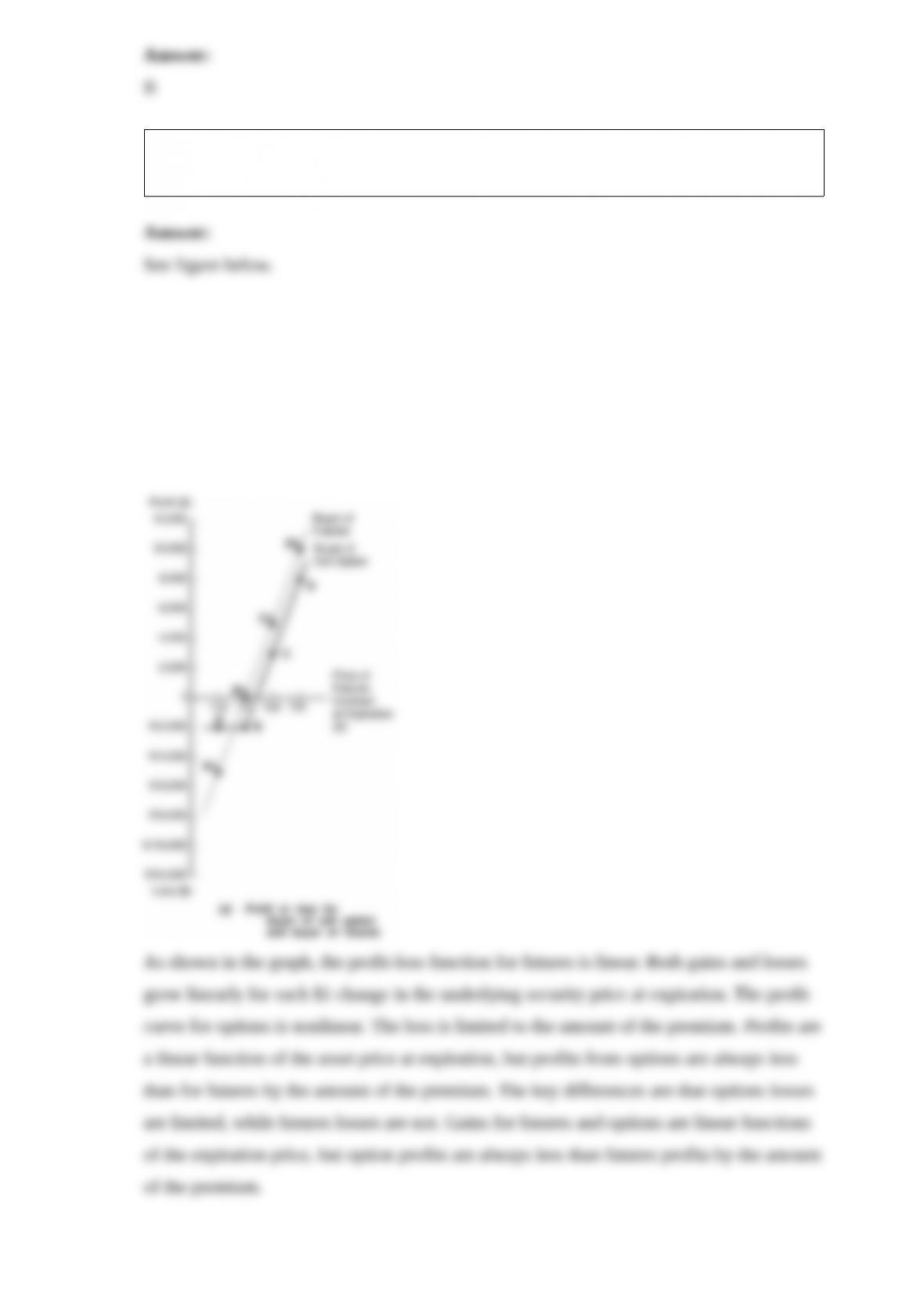
41) Show graphically and explain the profits and losses of buying futures relative to
buying call options.

42) How do regulators help to ensure the soundness of financial intermediaries?
43) Explain why the simple deposit multiplier overstates the true deposit multiplier.
44) Explain the factors that account for the large increase in market share experienced
by mutual funds since 1980 .
45) Your bank has the following balance sheet
AssetsLiabilities
Rate-sensitive$100 millionRate-sensitive$75 million
Fixed-rate100 millionFixed-rate125 million
What would happen to bank profits if the interest rates in the economy go down? Is
there anything that you could do to keep your bank from being so vulnerable to interest
rate movements?
46) Your bank has the following balance sheet:
AssetsLiabilities
Reserves$ 50 millionCheckable deposits$200 million
Securities 50 million
Loans150 millionBank capital50 million
If the required reserve ratio is 10%, what actions should the bank manager take if there
is an unexpected deposit outflow of $50 million?
47) What is arbitrage? Explain why arbitrage drives the contract price of futures to the
price of the underlying asset on the expiration date, for prices above and below the asset
price.