
Under a profit-sharing compensation scheme, the manager will:
A. shirk all day.
B. not shirk all day.
C. optimize his choice between income and leisure.
D. do the same thing as under a fixed salary scheme.
When the owner runs the business:
A. he does not bear the full cost of a bad decision.
B. there is not a principal-agent problem.
C. he does not receive the full benefit nor the full cost of any decision.
D. he has only limited liability for the actions of the business.
For the cost function C(Q) = 200 + 3Q + 8Q2 + 4Q3, what is the average fixed cost of
producing six units of output?
A. 18.31
B. 212.61
C. 42.12
D. 33.33
An excise tax shifts the supply curve
A. down by the amount of the tax.
B. up by the amount of the tax.
C. by rotating it counter-clockwise.
D. by rotating it clockwise.
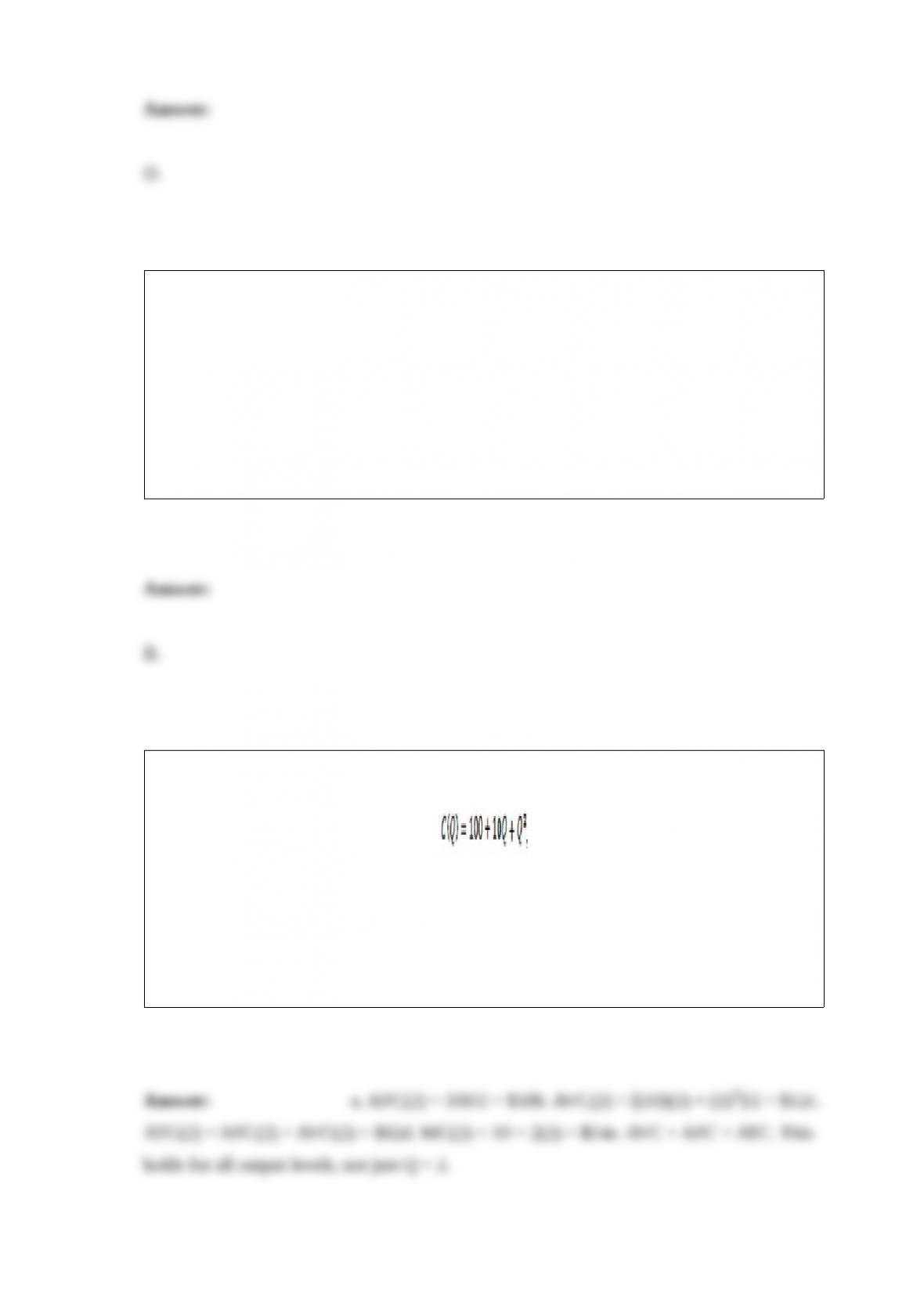
An accountant for a car rental company was recently asked to report the firm’s costs of
producing various levels of output. The accountant knows that the most recent estimate
available of the firm’s cost function is where costs are measured in
thousands of dollars and output is measured in thousands of hours rented.a. What is the
average fixed cost of producing 2 units of output?b. What is the average variable cost of
producing 2 units of output?c. What is the average total cost of producing 2 units of
output?d. What is the marginal cost of producing 2 units of output?e. What is the
relation between the answers to (a), (b), and (c) above? Is this a general property of
average cost curves?
Which of the following is true about a differentiated-product Bertrand duopoly?
A. Firm 1 and firm 2’s reaction functions are downward sloping.
B. Firm 1 and firm 2’s reaction functions are upward sloping.
C. Firm 1’s reaction function is downward sloping but firm 2’s reaction function is
upward sloping.
D. In a differentiated-product Bertrand duopoly neither firm has a reaction function.
Explain what would happen to the equilibrium consumption of two goods, X and Y, if
(a) income doubled and all prices tripled, (b) all prices doubled and income tripled, and
(c) all prices and income doubled. In each case, show the effects when both goods are
normal goods and when one good is a normal good and the other an inferior good.
Consider an antique auction where bidders have independent private values. There are
two bidders, each of whom perceives that valuations are uniformly distributed between
$100 and $1,000. One of the bidders is Sue, who knows her own valuation is $200.
What is Sue’s optimal bidding strategy in a first-price, sealed-bid auction?
A. Submit a bid of $150.
B. Submit a bid of $200.
C. Submit a bid that is less than $150.
D. Yell “mine” when the bid reaches $150.
Competitive market equilibrium
A. is determined by the intersection of the market demand and supply curves.
B. implies that quantity supplied is sufficiently larger than quantity demanded.
C. is determined by the intersection of the excess demand and excess supply curves.
D. implies that quantity demanded is sufficiently larger than quantity supplied.
Suppose compensation is given by W = 512,000 + 217 + 10.08S, where W
= total compensation of the CEO, = company profits (in millions) = $200,
and S = sales (in millions) = $400. What percentage of the CEO’s total earnings are tied
to profits of the firm?
A. 8.2 percent
B. 10.9 percent

C. 7.8 percent
D. 5.1 percent
Graphically, a decrease in advertising will cause the demand curve to:
A. become steeper.
B. shift rightward.
C. become flatter.
D. shift leftward.
Net benefits in the table:
A. initially increase, reach a maximum, and then decrease.
B. initially decrease, reach a minimum, and then increase.
C. remain relatively stable over different values for the control variable.
D. initially remain relatively stable and then decrease.

Firms advertise in order to cause the demand for their products to
A. shift to the right.
B. shift to the left.
C. remain unchanged.
D. all of the statements associated with this question are correct.
Refer to the following payoff matrix:
The Nash equilibrium for the simultaneous-move game depicted in the payoff matrix is:
A. {(A,a) and (A,b)}.
B. {(A,a)}.
C. {B,b)}.
D. There is no pure strategy Nash equilibrium to this game.