
A credit-rationed household is more likely to immediately ________ of a one-time tax
rebate than is a household that is not credit rationed.
A) spend a larger portion
B) spend a smaller portion
C) save a larger portion
D) spend none
If the world real interest rate were 6% and the domestic real interest rate in Denmark
was 9%, borrowers in Denmark would borrow at the rate of ________ and lenders in
Denmark would lend at the rate of ________.
A) 6%; 6%
B) 6%; 9%
C) 9%; 6%
D) 9%; 9%
According to the AK growth model, budget surpluses ________ the national saving rate
and ________ the steady-state growth rate.
A) increase; increase

B) reduce; reduce
C) increase; do not change
D) reduce; do not change
Suppose you borrow $5,000 at an interest rate of 8%. If the expected real interest rate is
3%, then the rate of inflation over the upcoming year that would be most beneficial to
you would be
A) 0%.
B) greater than 0% but less than 5%.
C) equal to 5%.
D) greater than 5%.
Which of the following statements about economic analysis is true?
A) Unlike positive economic analysis, normative economic analysis can be tested.
B) There is much more disagreement among economists over normative economic
analysis than over positive economic analysis.
C) Normative economic analysis is concerned with “what is,” whereas positive

economic analysis is concerned with “what ought to be.”
D) Economics is primarily about normative analysis, which measures the costs and
benefits of XOAXOAerent courses of action.
If the real wage is below the equilibrium real wage, there would be a ________ of
workers and the real wage would ________.
A) surplus; decline
B) surplus; rise
C) shortage; decline
D) shortage; rise
Figure 10.5
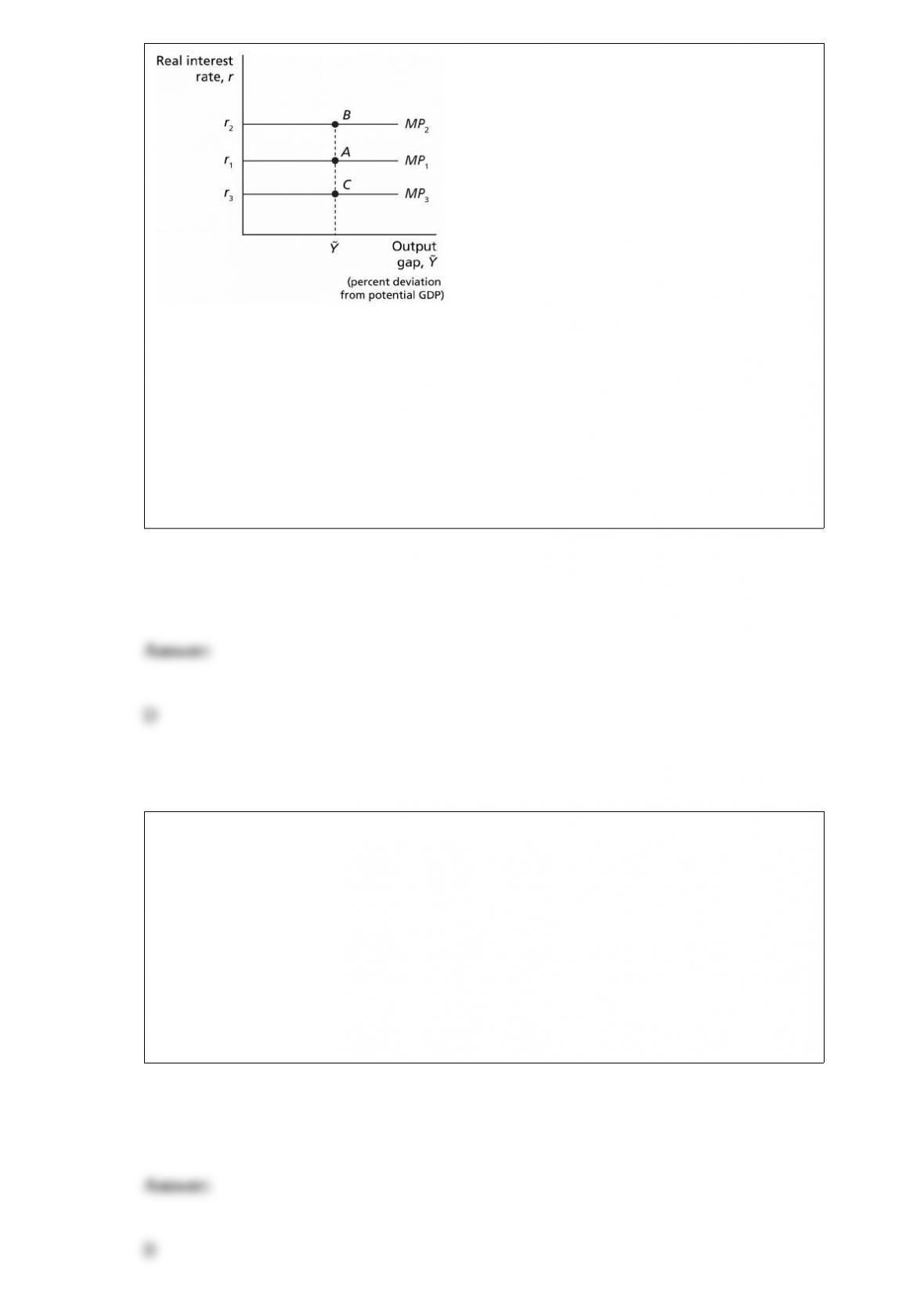
Refer to Figure 10.5. A shift from MP1 to MP2 will occur if
A) investors decrease the short-term interest they expect in the future.
B) investors decrease the term premium they require on long-term bonds.
C) the default-risk premium decreases.
D) the expected inflation rate decreases.
If you take out a mortgage with a nominal interest rate of 8% and you expect the
inflation rate to be 2%, then you expect to pay a real interest rate of
A) 4%.
B) 6%.
C) 10%.
D) 16%.
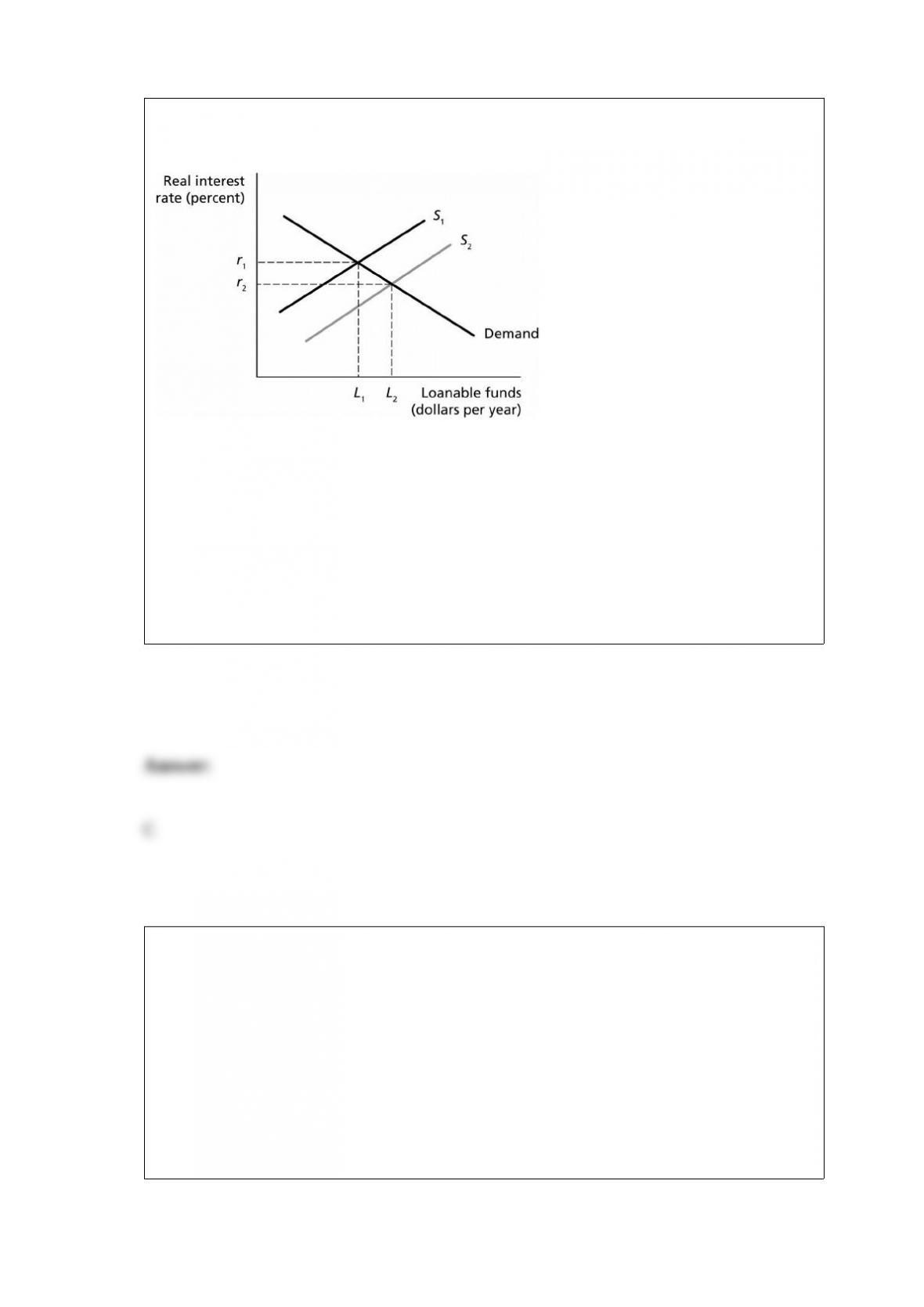
Figure 4.1
Refer to Figure 4.1. A shift from S1 to S2 will result from all of the following except
A) a decrease in the government’s budget deficit.
B) a decrease in net exports.
C) a decrease in corporate taxes.
D) a decrease in the desire of households to consume today.
Discuss the likely impact of each of the following on the unemployment rate and on the
natural rate of unemployment.:
a. The length of time workers are eligible to receive unemployment benefits is extended
by 26 weeks.
b. The government passes a law which increases the age of eligibility to collect Social
Security benefits.
c. The government decides to increase access to Social Security disability benefits.

Suppose that the production function for the economy is: Y = AK1/4L3/4. Assume that A
= 1,000, the capital stock is $32,000 billion, and the labor force is 120 million (or 0.120
billion) workers. The value of the marginal product of labor is
A) $14,290.17.
B) $17,043.29.
C) $20,451.95.
D) $22,724.33.
Assume the long-term nominal interest rate is 7% and the expected inflation rate is 3%.
If the Fed increases the money supply and as a result, the expected inflation rate
increases to 5%, then based on the Fisher effect, the long-term real interest rate will
A) remain at 4%.

B) increase to 6%.
C) fall to 3%.
D) increase to 9%.
The income and substitution effects move in ________ for lenders and in ________ for
borrowers.
A) the same direction; the same direction
B) the same direction; opposite directions
C) opposite directions; the same direction
D) opposite directions; opposite directions
As the best measure of the size of economic fluctuations associated with a business
cycle, economists typically use
A) real GDP.
B) the deviation of real GDP from potential GDP.
C) potential GDP.
D) the deviation of real GDP from nominal GDP.
Under a fixed exchange rate system, an expansionary fiscal policy is
A) more effective in an open economy than in a closed economy.
B) less effective in an open economy than in a closed economy.
C) equally effective in an open economy and in a closed economy.
D) marginally effective in an open economy and completely ineffective in a closed
economy.
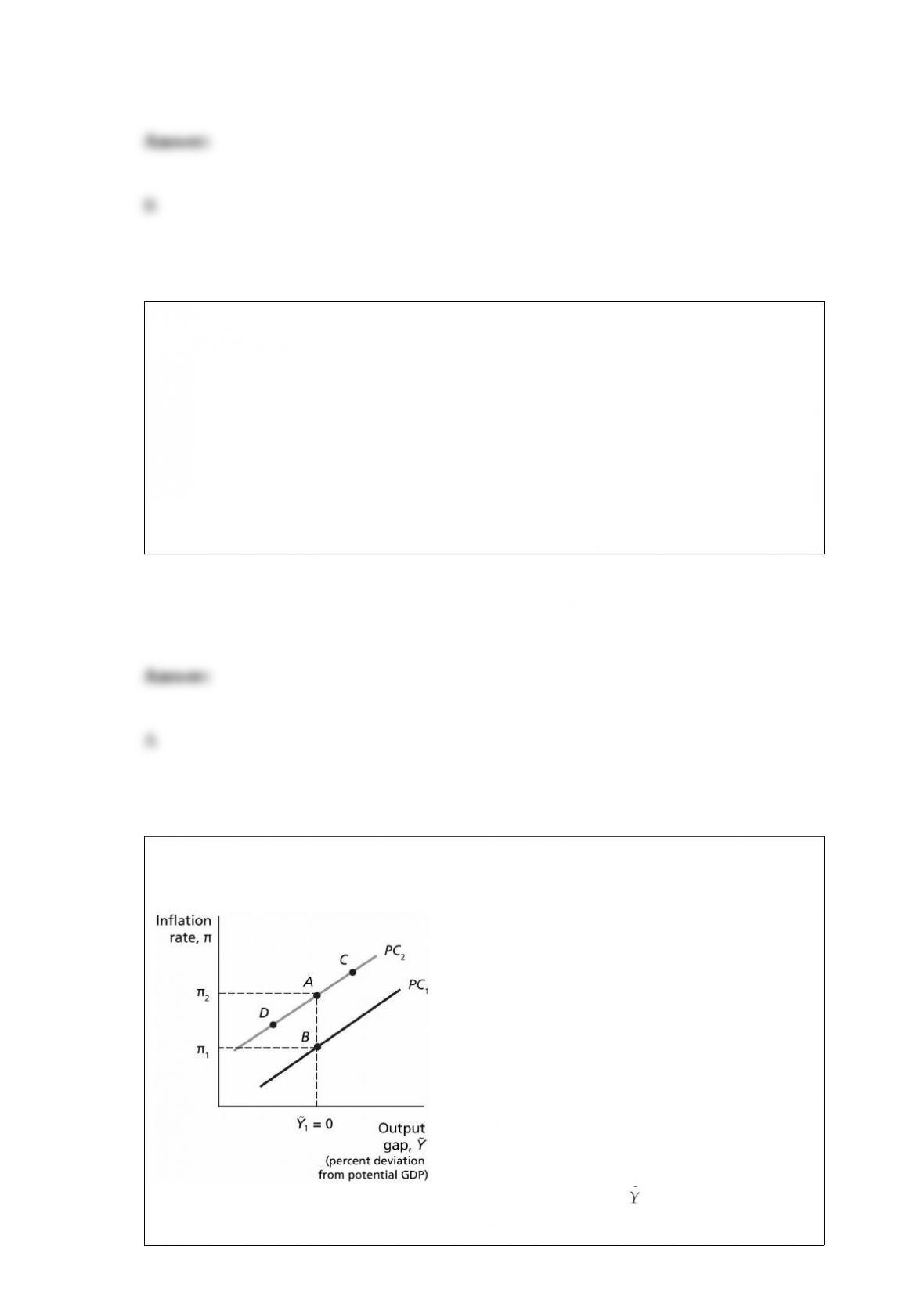
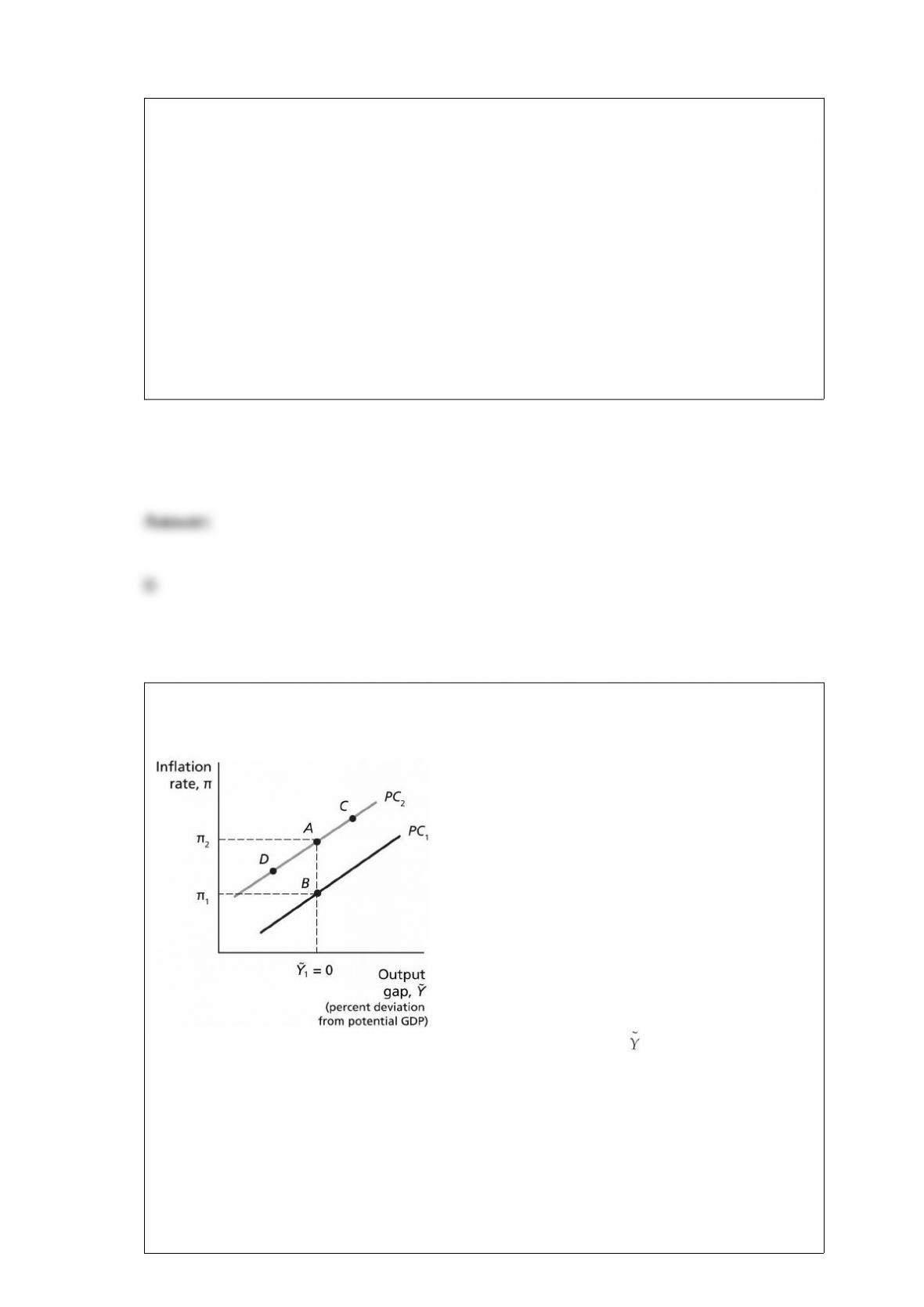
Figure 11.1
Refer to Figure 11.1. Assume the economy is in equilibrium at 1 = 0. Other things
equal, a negative demand shock such as the financial crisis of 2007-2009 would result
in a movement from point ________ to point ________.
A) A; B
B) B; A
C) A; C
D) A; D
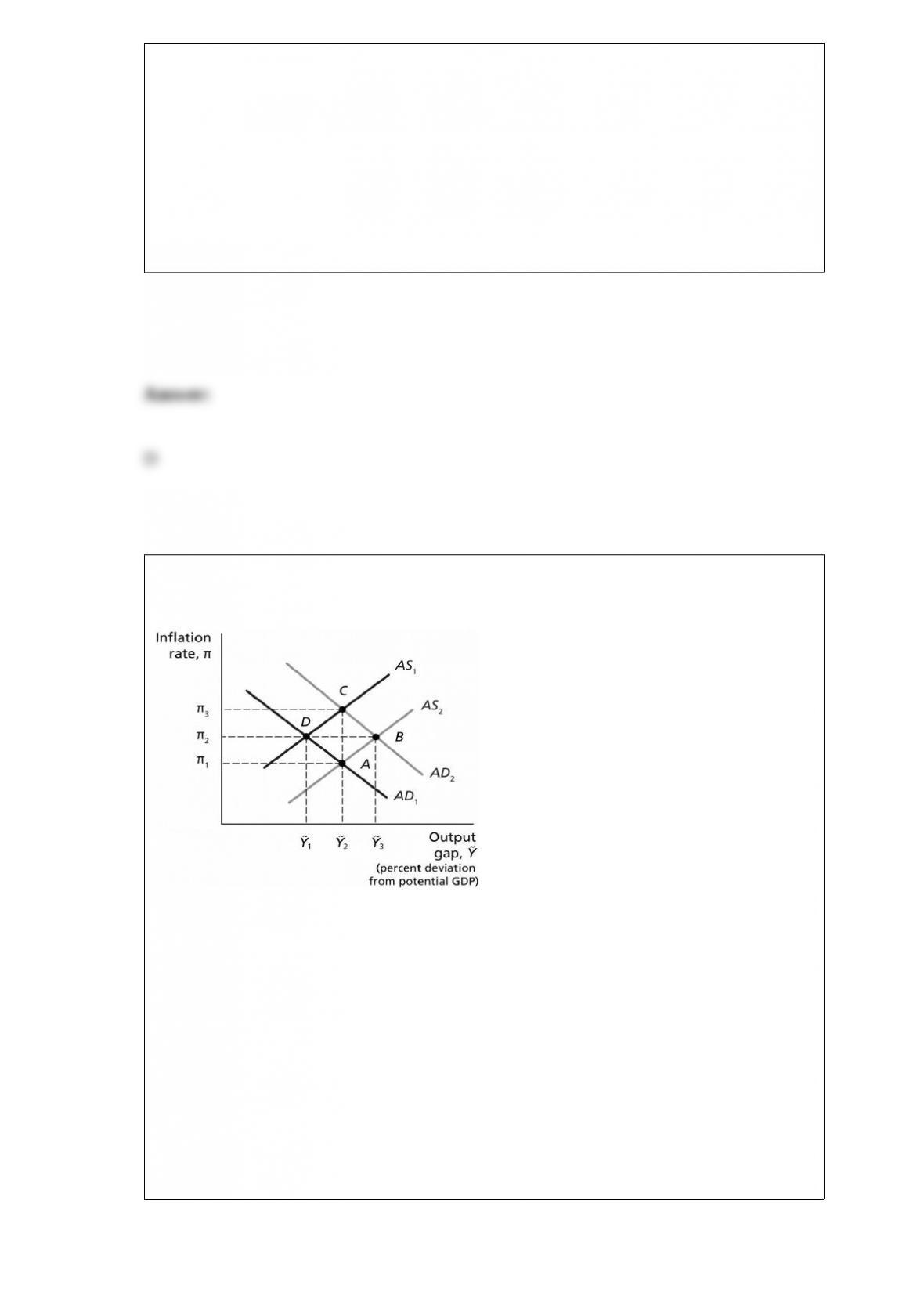
Figure 14.3
Refer to Figure 14.3. Suppose the economy is initially at long-run equilibrium and the
economy experiences a demand shock such as a stock market crash. The economy then
reaches a new, short-run equilibrium point. Assuming expectations are adaptive, this
will allow the central bank to decrease the real interest rate, so the next movement is
best represented as a movement from
A) point B to point D.
B) point D to point B.
C) point C to point D.
D) point D to point A.

Isabel purchases a $1,000 face value one-year Treasury bill for $934.58, and the next
day investors decide they will only buy one-year Treasury bills if they receive an
interest rate of 9%. If Isabel decides to sell her Treasury bill to another investor the day
after she purchased it, she will
A) receive a capital gain of $28.04.
B) receive a capital gain of $7.76.
C) suffer a capital loss of $18.69.
D) suffer a capital loss of $17.15.
In the United States, most periods of very high inflation occurred
A) during times of war.
B) during recessions.
C) in the past 25 years.
D) before the year 1800.
Suppose that the production function for the economy is: Y = AK1/4L3/4. Assume that
real GDP is $8,000 billion, capital stock is $32,000 billion, and the labor supply is 120
million (or 0.120 billion) workers. The value of the marginal product of labor is
________ per worker.
A) $30,000
B) $50,000
C) $66,667
D) $90,000
Figure 11.1
Refer to Figure 11.1. Assume the economy is in equilibrium at 1 = 0. Other things
equal, a decrease in the growth rate of productivity will result in a movement from
point ________ to point ________.
A) A; B
B) B; A
C) A; C

D) A; D
Workers who are unemployed for long periods of time are more likely to be
unemployed for ________ reasons than for ________ reasons.
A) cyclical; frictional or structural
B) frictional; structural or cyclical
C) structural; frictional or cyclical
D) frictional or structural; cyclical
The housing market crash that accompanied the 2007-2009 recession has had severe
negative effects on the U.S. economy. Since December 2008, the target federal funds
rate has been 0.0-0.25%. When the Fed keeps the real interest rate constant, an
economic shock such as the housing market crash would cause the ________, and the
output gap would ________.
A) MP curve to shift up; increase
B) MP curve to shift down; decrease
C) IS curve to shift to the left; decrease
D) IS curve to shift to the right; increase

An increase in real interest rates will ________ current consumption for households
who are lenders and will ________ current consumption for households who are
borrowers.
A) increase; decrease
B) decrease; increase
C) have an unclear effect on; decrease
D) decrease; have an unclear effect on
During the 2007-2009 recession and its aftermath, Okun’s law
A) predicted the cyclical unemployment rate more accurately than it did prior to the
recession.
B) predicted the cyclical unemployment rate at roughly the same rate of accuracy as it
did prior to the recession.
C) predicted a higher cyclical unemployment rate than was actually experienced in the
U.S. economy.
D) predicted a lower cyclical unemployment rate than was actually experienced in the
U.S. economy.

Assume that the Fed has a target inflation rate of 2% and that the values for how much
the nominal target federal funds rate responds to a deviation of inflation from its target,
g, and how much the nominal target federal funds rate responds to real GDP, h, are both
0.5. According to the Taylor rule, if inflation decreases by 2%, the real interest rate will
decrease by
A) 1%.
B) 2%.
C) 3%.
D) 4%.
Assuming everything else constant, what effect will each of the following have on the
long-term real interest rate?
a. The expected inflation rate decreases.
b. The default-risk premium increases.
c. Investors expect future short-term interest rates to fall.

Buying a product in one market and reselling it in another market at a higher price is
referred to as
A) arbitrage.
B) purchasing power parity.
C) crowding in.
D) barter.
How would each of the following events likely change measured GDP?
a. The sale and use of marijuana is legalized.
b. There is an increase in sales of counterfeit video games.
c. A foreign-owned furniture manufacturer opens a production facility in South
Carolina.
d. More people choose to forgo their lawn maintenance services to take care of their
own yards.
Suppose k = y1/4, total factor productivity is constant and equal to 1, s = 0.40, and d =
0.05.
a. Find the steady-state capital––labor ratio for this economy.
b. Find the steady-state real GDP per worker for this economy.
c. Find the steady-state level of investment per worker for this economy.
d. Find the steady-state level of consumption per worker for this economy.
Identify whether each of the following policies is an example of (1) a discretionary
fiscal policy, (2) an example of an automatic stabilizer, or (3) not a fiscal policy.
a. Food stamps
b. Government spending on rebuilding airports
c. Tax credits for the purchase of energy efficient appliances
d. The extension of the “Bush tax cuts” of 2001 and 2003
e. Changing the required reserve ratio
f. The bailout of large financial institutions during the financial crisis
g. The progressive income tax system
What is the present value of $750 received three 3 years from now if the current rate of
interest is 7%?
A) $612.22
B) $700.93

C) $918.78
D) $2,407.50
Suppose the Fed announced that it has chosen to accept a temporary period of
above-target inflation. Assuming that the announcement is seen as credible, this will
tend to increase inflationary expectations, which will result in
A) the AD curve shifting to the right.
B) the AD curve shifting to the left.
C) the AS curve shifting to the right.
D) the AS curve shifting to the left.
Figure 14.1
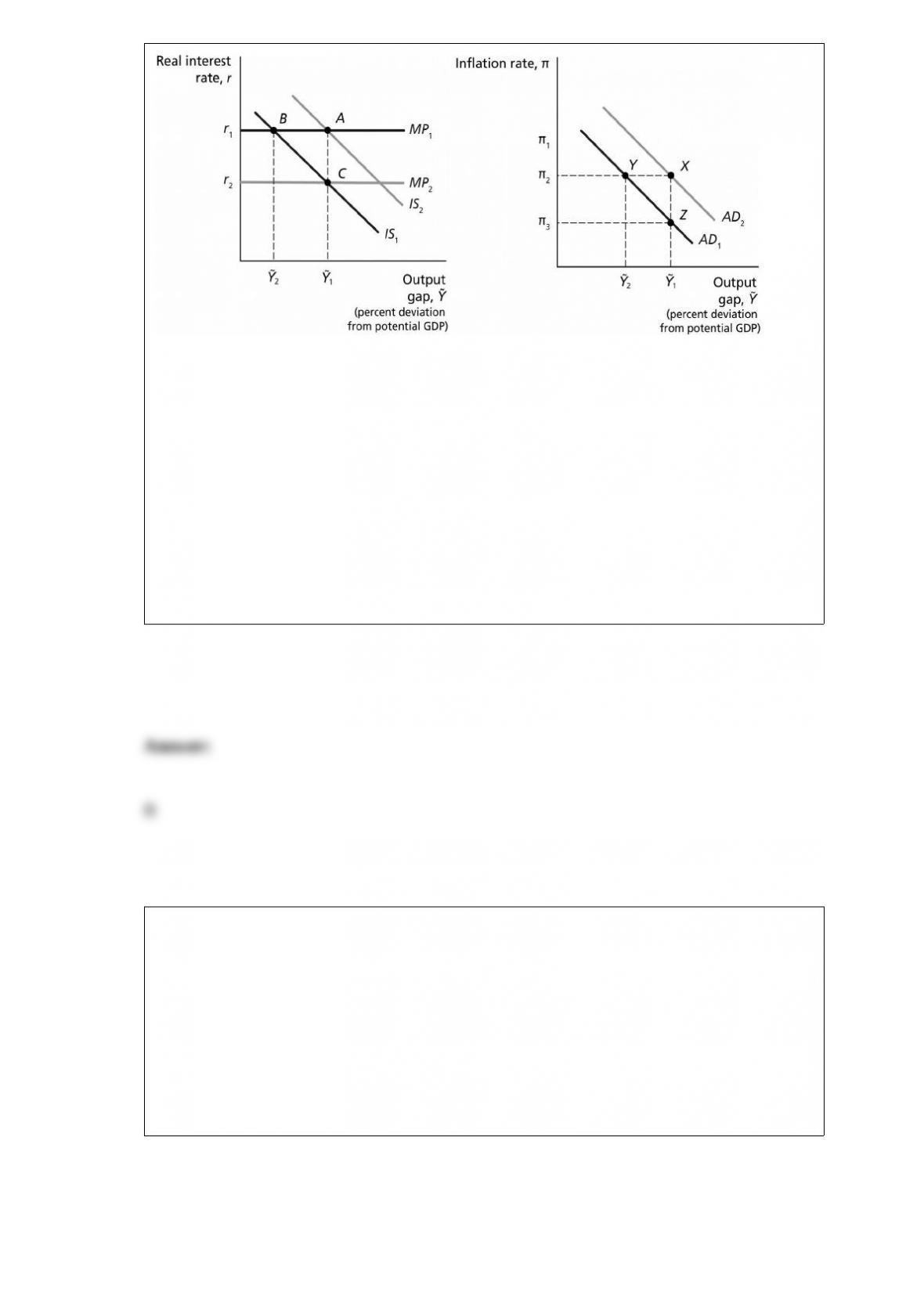
Refer to Figure 14.1. Assume that the economy is originally in equilibrium where real
GDP equals potential GDP. Other things equal, an increase in the target inflation rate
would best be represented as a movement from ________ in the short run and
________ in the long run.
A) point Y to point X; point X to point Y
B) point Y to point X; will remain at point X
C) point Y to point Z; remain at point Z
D) point Z to point X; point X to point Z
The Solow growth model predicts that a lower labor force growth rate will lead to
A) a decreased steady state and higher break-even investment.
B) higher productivity and a higher standard of living.
C) a lower saving rate and decreased investment.
D) a higher rate of dilution and lower break-even investment.