
If income were distributed solely according to marginal productivity,
a. every family would be above the poverty level
b. it would be distributed evenly
c. it would be distributed normally
d. workers in capital-intensive industries would earn less than workers in
labor-intensive industries
e. some individuals would not receive any income
Economic rent represents
a. a loss to society since resource owners do not earn it
b. the difference between marginal revenue product and marginal resource cost
c. a loss to resource owners who earn less than the market value of the resource
d. any resource earnings less than that resource’s opportunity cost
e. any resource earnings greater than that resource’s opportunity cost
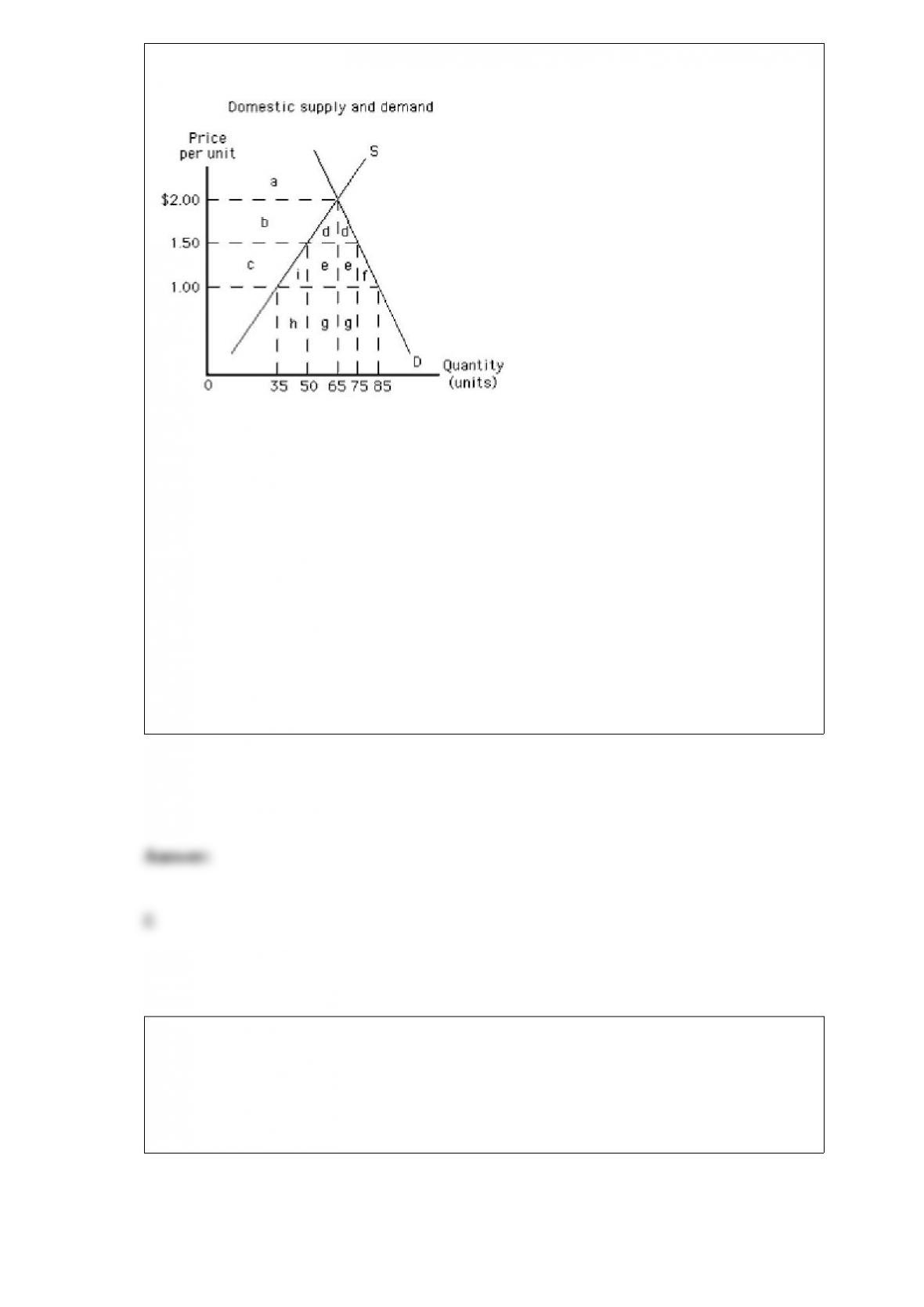
Exhibit 19-5
If the country illustrated in Exhibit 19-5 is initially trading without restrictions at a
world price of $1.00, the government revenue from a tariff of $0.50 per unit is
represented by area
a. c
b. e + g
c. i + e + f
d. d + e
e. e
The Bretton Woods system fixed all exchange rates in terms of the U.S. dollar.
a. True
b. False
In its case against Microsoft, the government contended that Microsoft
a. engaged in a pattern of predatory behavior designed to extend its monopoly power
b. had attempted to engineer a conglomerate merger
c. was seeking treble damages
d. was attempting to foreclose foreign competition
e. was using interlocking directorates
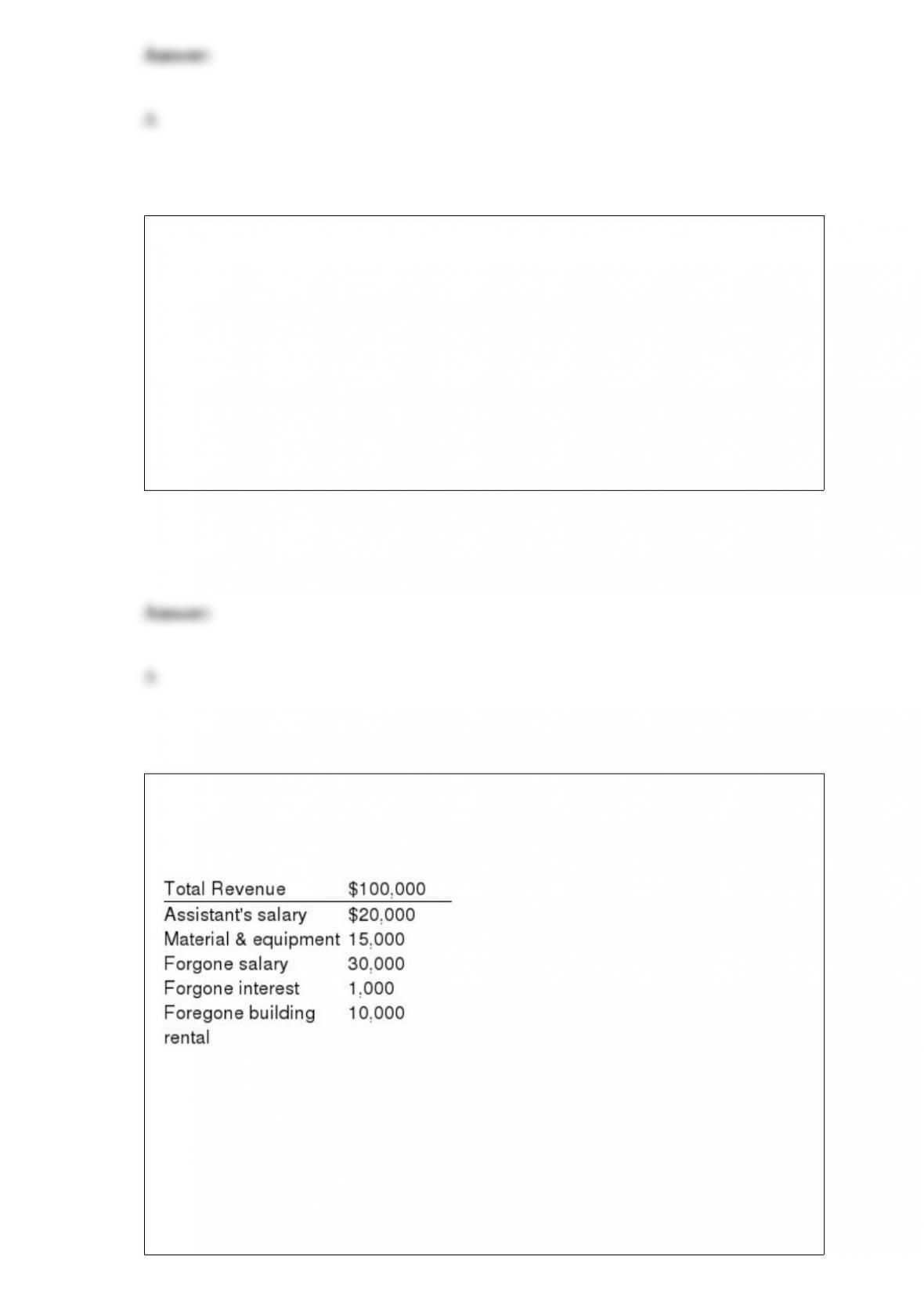
Exhibit 7-1
Sally owns a small business that she operates in a small building she owns. Given the
information in Exhibit 7-1, Sally’s accounting profit is
a. $80,000
b. $50,000

c. $65,000
d. $35,000
e. $24,000
Which of the following is true about foreign aid provided by the United States?
a. During the last four decades, the U.S. has provided less than $400 million in aid
b. Most U.S. aid has been coordinated by the Department of Defense
c. The U.S. Agency for International Development emphasizes short-range plans
d. The U.S. Agency for International Development concentrates primarily on health,
education, and agriculture
e. Foreign aid is large part of the U.S. federal budget
When quantity is measured in gallons, the price elasticity of demand for milk will be
__________ the price elasticity when quantity is measured in quarts.
a. the same as
b. four times
c. one quarter

d. two times
e. less than
Suppose Guild produces 5,000 guitars per year. Its average total cost is $90, and its
fixed cost is $250,000. What is its variable cost?
a. $250,000
b. $450,000
c. $25,000
d. $56,000
e. $200,000
Exhibit 5-28
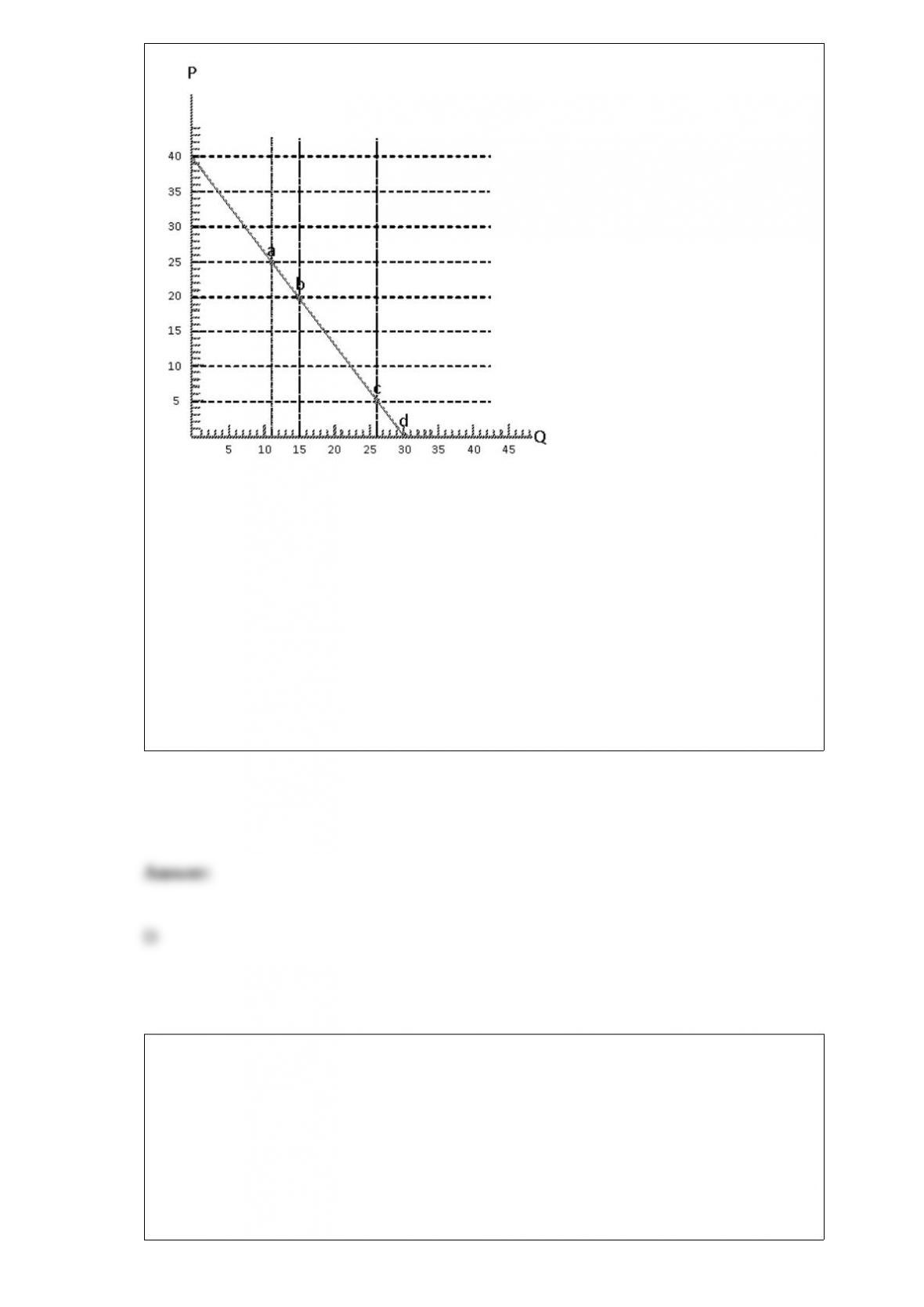
Consider Exhibit 5-28. Between points a and b, demand would be said to be
a. perfecly price inelastic
b. price inelastic
c. perfectly price elastic
d. price elastic
e. unitary elastic
If foreigners increase their ownership of U.S. assets, this would help to offset
a. a deficit in the U.S. current account
b. a deficit in the U.S. capital account
c. a surplus in the U.S. current account

d. a surplus in the U.S. capital account
e. a surplus in the total balance of payments
The payoff matrix refers to
a. the difference between total revenue and total cost at different price levels
b. a listing of the rewards and penalties associated with pursuing various strategies
c. the difference between average and marginal cost for the non-competitive firm
d. the difference between average and marginal revenue in a non-competitive industry
e. the difference between average variable and average total cost to the firm
The Bretton Woods system
a. established a worldwide gold standard
b. established a worldwide system of fixed exchange rates
c. established a worldwide system of flexible exchange rates
d. harmonized tariff systems
e. was restricted to industrialized nations

One likely reason that the country of Appleland is poor is that it
a. does not produce many goods and services
b. has highly educated and productive female workers
c. has a low birth rate
d. enjoys a low infant mortality rate
e. has a high literacy rate
Special-interest legislation is legislation where there are both widespread costs and
benefits.
a. True
b. False

Which of the following could explain why hockey players earn such high income?
a. All of the following are correct.
b. Average careers are very short; the chances of being unemployed are greater than in
many other jobs.
c. The income effect encourages them to work more as the wage increases.
d. Many people want to become hockey players.
e. The threat of injury makes the job more exciting than other jobs.
Economic regulation is government policy designed to
a. improve health and safety in products and in working conditions
b. prevent firms from monopolizing or developing a cartel in existing competitive
markets
c. eliminate existing monopolies by breaking them apart into many smaller firms
d. create monopolies by forcing competitive firms to merge
e. control price and output in industries where monopoly is desirable
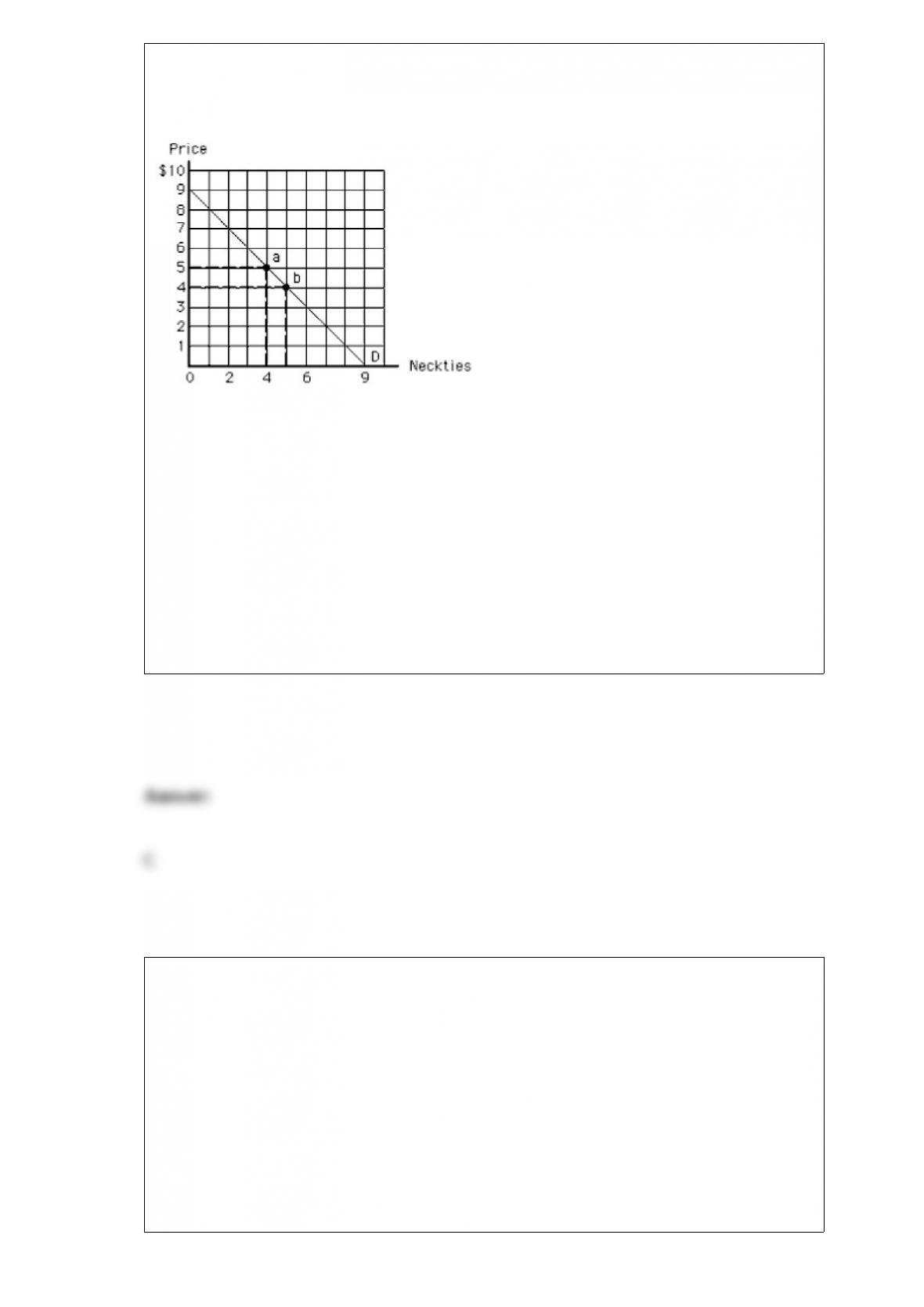
Exhibit 6-11
At point a in Exhibit 6-11, consumer surplus is
a. $0
b. $5
c. $6
d. $20
e. $26
Determining the most socially desirable level of income equality or inequality
a. is done through markets, rather than by the government
b. is done directly by firms
c. involves normative economics
d. involves evaluation of public goods
e. involves evaluation of all externalities, both positive and negative

If 900 million shares of stock are traded on the New York Stock Exchange today at an
average price of $100, then the total amount of money raised today by the corporations
whose stock traded on this exchange would be $90 billion.
a. True
b. False
Based on an analysis of opportunity cost, everyone should go to college.
a. True
b. False
Exhibit 6-29
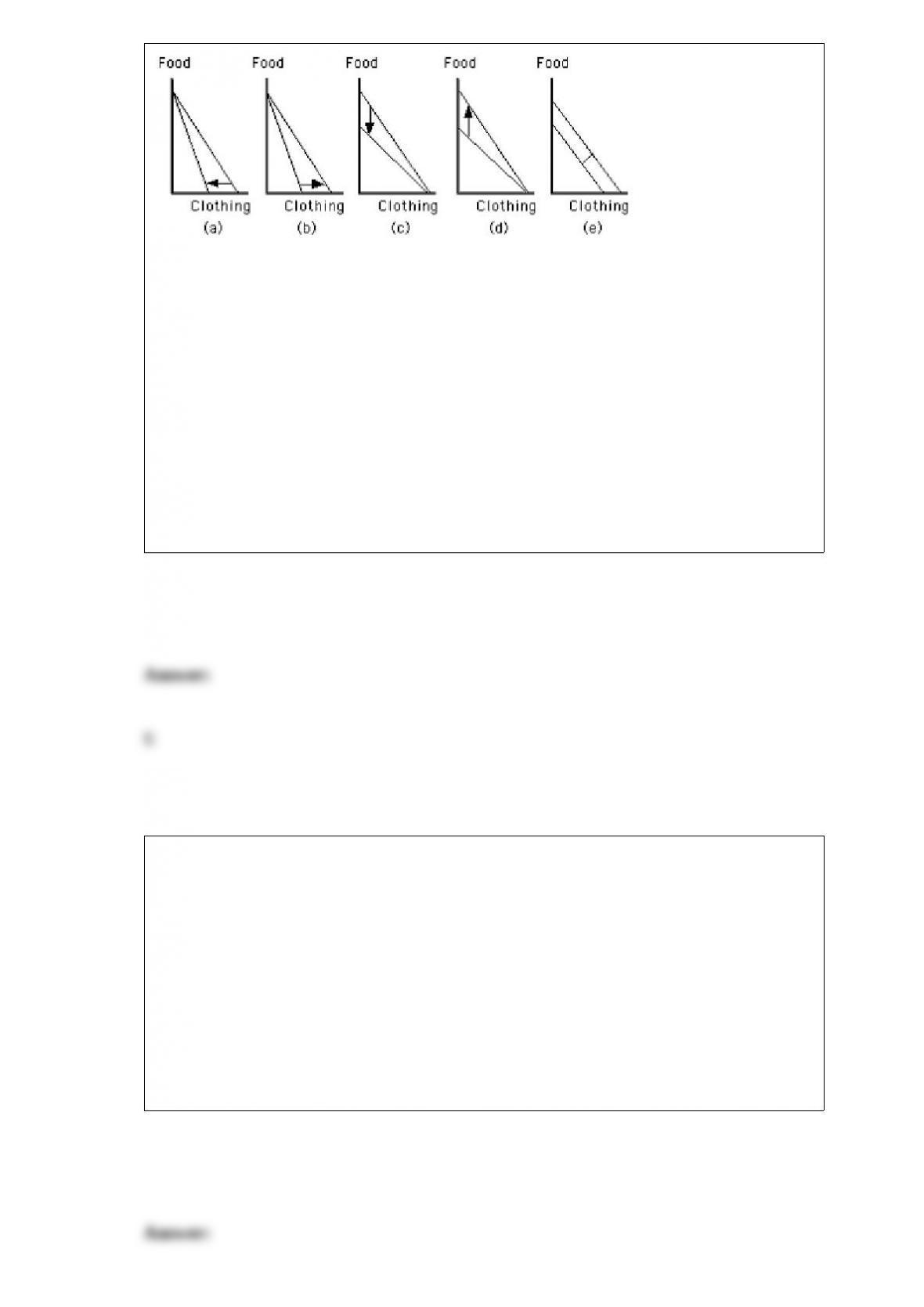
Which graph in Exhibit 6-29 shows the effect of an increase in the price of clothing and
a decrease in the price of food?
a. Graph a
b. Graph b
c. Graph c
d. Graph d
e. none of these
In a game that can be repeated, the optimal solution is
a. dependent upon each firm’s decision in the first round of decision making
b. independent of the decisions that competitive firms made on the first round
c. to maximize profits regardless of what competitors do
d. to minimize costs regardless of what competitors do
e. to select the solution that minimizes the potential losses from a decision

As defined by economists, interest is
a. only the amount earned by productive capital as a resource
b. only the amount earned by land as a resource
c. only the amount earned by lending money
d. both the amount earned by productive capital as a resource and the amount earned by
lending money
e. both the amount earned by land as a resource and the amount earned by lending
money
A meditation class meets on the second floor of a building; the first floor is a nightclub.
The loud music from the club disturbs the classes. Which of the following best explains
why the negative externality faced by the class arises?
a. The class has no property right to a quiet environment.
b. The club has a property right on the ground floor.
c. The class has a property right on the second floor.
d. The club uses an inappropriate technology (i.e., no soundproofing).
e. Both the club and class are profitable.

Household production still exists because it often requires fewer specialized resources
than market production does.
a. True
b. False
The portion of a worker’s total earnings that is not necessary to keep the worker in her
present job is called
a. opportunity cost
b. consumer surplus
c. economic profit
d. economic rent
e. normal profit
In response to the threat of budget cuts, the Connecticut State Department of Recreation
proposed shutting down many state parks and beaches. This is a good example of
a. cost efficiency in bureaus

b. Niskanen’s theory of budget-maximizing bureaus
c. the median-voter model
d. logrolling
e. direct democracy
The interest rate charged on a risk-free loan exceeds the rate on a risky loan.
a. True
b. False
Exhibit 1-12
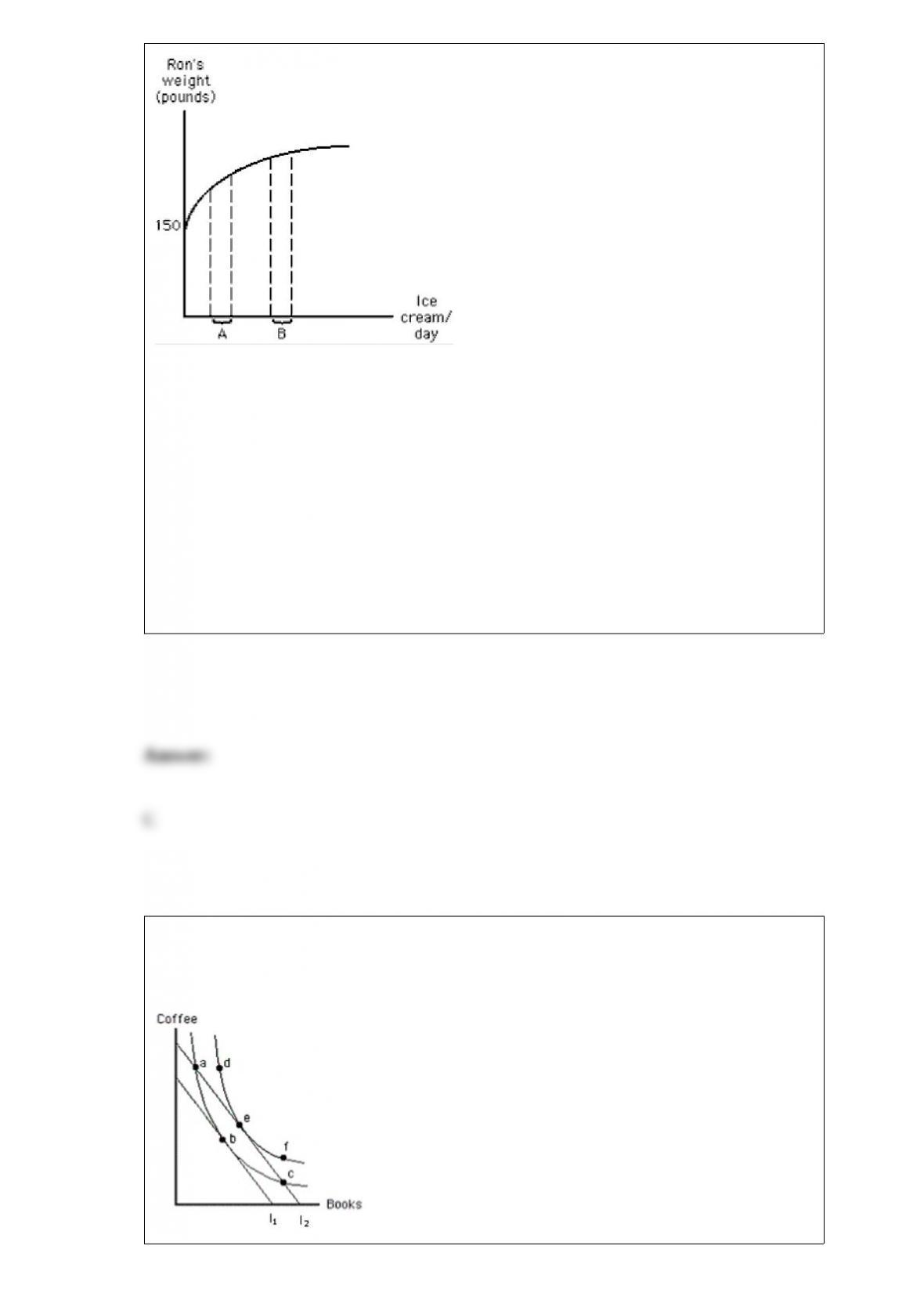
The slope of the line in Exhibit 1-12 is
a. positive and constant
b. positive and increasing
c. positive and decreasing
d. negative and increasing
e. negative and decreasing
Exhibit 6-25

At point b in Exhibit 6-25, the consumer’s utility is
a. higher than at points a and c, but the total cost of the goods is the same
b. the same as at points a and c, but the total cost of the goods is lower
c. the same as at points a and c, but the total cost of the goods is higher
d. lower than at points a and c, and so is the total cost of the goods
e. higher than at points a and c, and so is the total cost of the goods