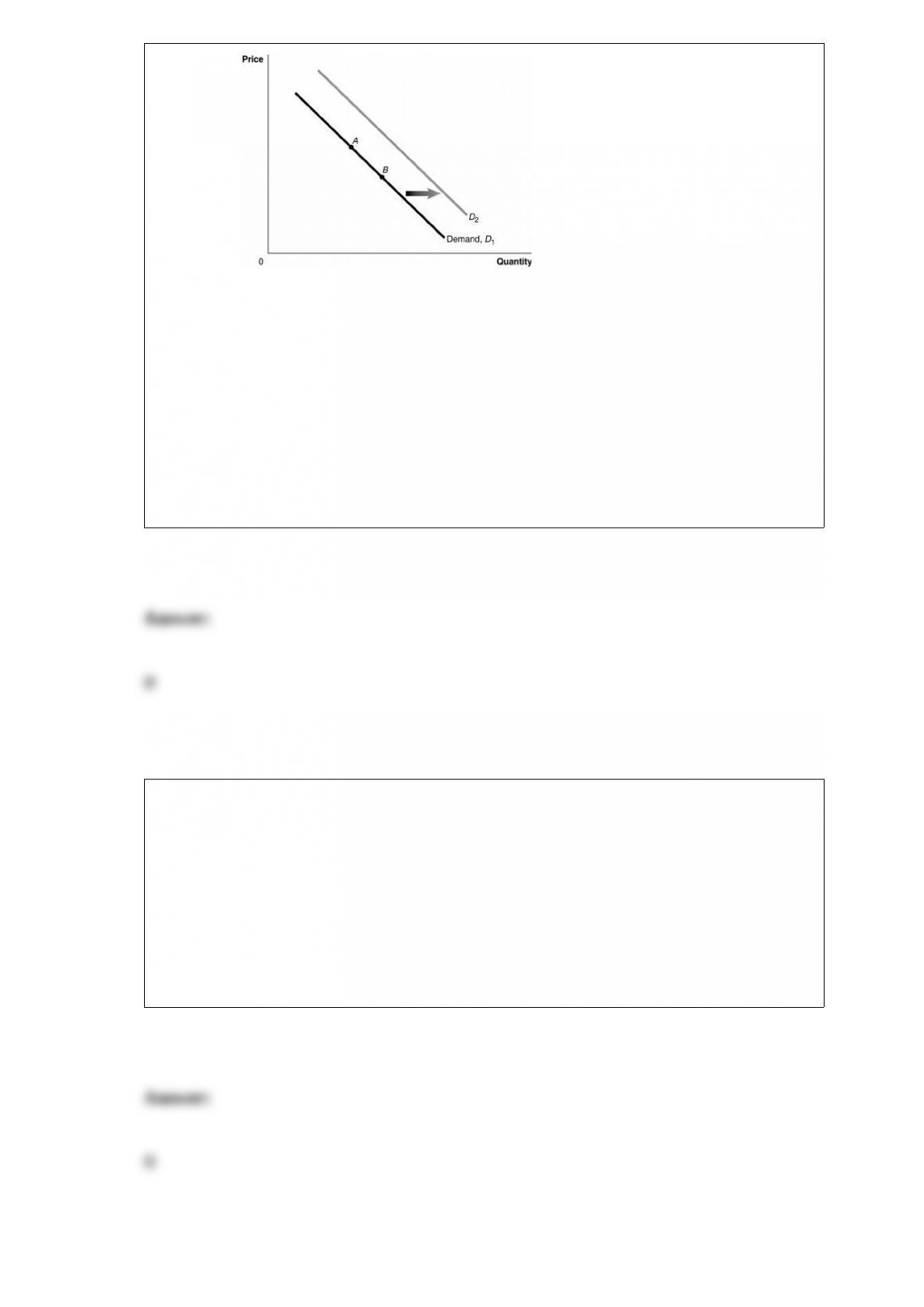
Figure 3-1
An increase in the price of the product would be represented by a movement from
A) A to B.
B) B to A.
C) D1 to D2.
D) D2 to D1.
Households ________ final goods and services in the ________ market.
A) purchase; factor
B) purchase; product
C) sell; factor
D) sell; product

A decrease in aggregate demand will
A) cause inflation.
B) decrease unemployment.
C) move the economy to a lower point on the short-run Phillips curve.
D) cause the short-run Phillips curve to shift to the right.
Economic efficiency requires that a natural monopoly’s price be
A) equal to average total cost where it intersects the demand curve.
B) equal to marginal cost where it intersects the demand curve.
C) equal to average variable cost where it intersects the demand curve.
D) equal to the lowest price the firm can charge and still make a normal profit.
Economists who support market-based reforms for health care believe that increased
competition among providers of health care would
A) decrease costs but decrease economic efficiency.
B) decrease costs and increase economic efficiency.
C) increase costs but increase economic efficiency.
D) increase costs and decrease economic efficiency.
All of the following have enhanced the Fed’s credibility in conducting monetary policy
except
A) following through with changes it has announced.
B) revealing the Fed’s target for the federal funds rate.
C) making the minutes of the open market committee meetings public.
D) discontinuing the policy of announcing whether it considered the economy to be at
greater risk of inflation or recession following each FOMC meeting.
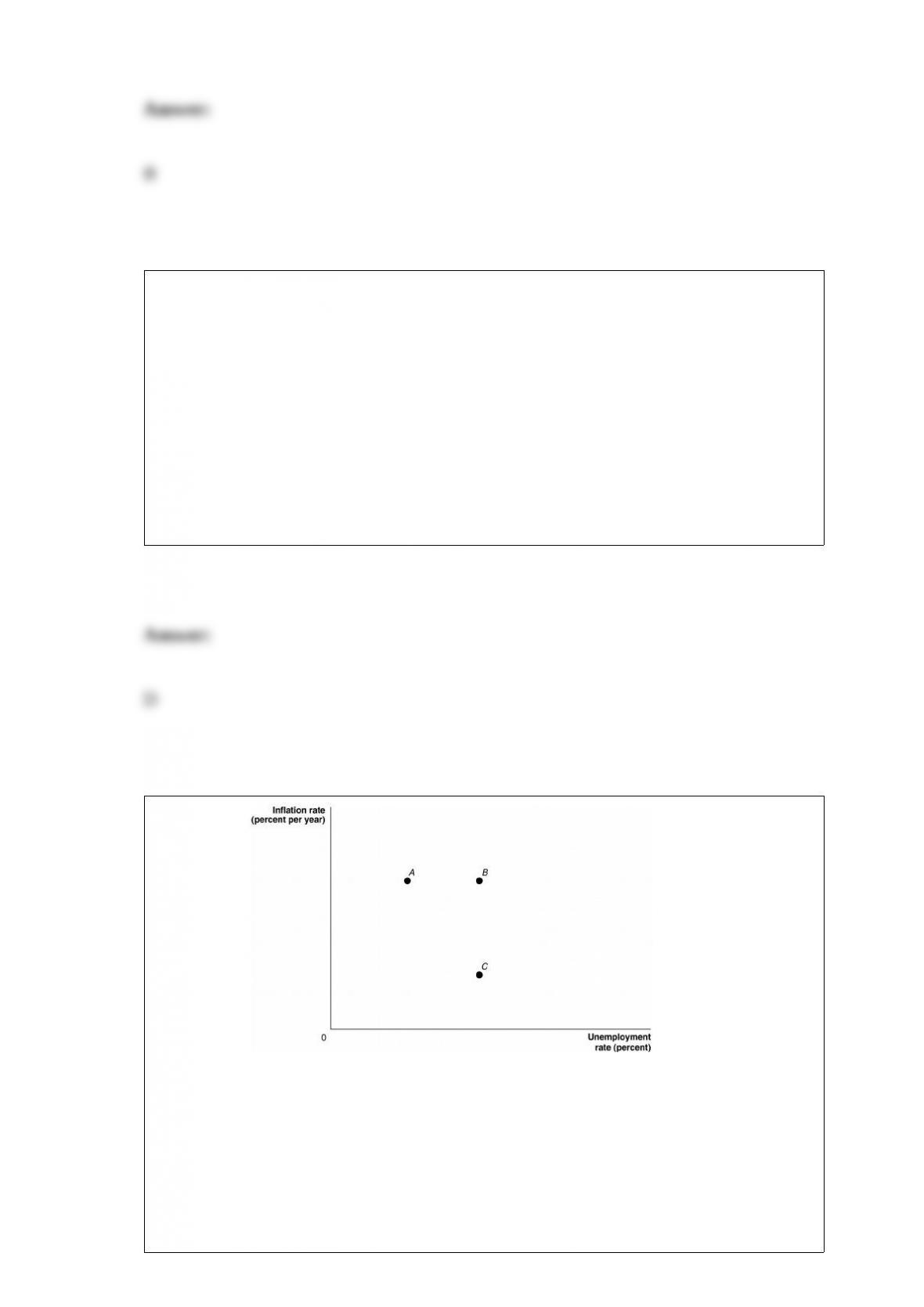
Figure 17-8
A typical long-run Phillips curve would have the appearance of a curve running through
points
A) A and B.
B) A and C.

C) B and C.
D) A, B and C.
Suppose real GDP is $14 trillion and potential real GDP is $14.4 trillion. An increase in
government purchases of $400 billion would cause real GDP to ________ potential real
GDP (assuming a constant price level).
A) equal
B) be less than
C) be more than
D) There is insufficient information given here to draw a conclusion.
The income effect of a wage increase will cause a worker to devote
A) more time to labor and more time to leisure.
B) more time to labor and less time to leisure.
C) less time to labor and more time to leisure.
D) less time to labor and less time to leisure.
Evidence shows that for many people, delaying searching for a job for a year or longer
after they are laid off will contribute to a deterioration of their job skills, making it
harder for them to find employment. This deterioration in job skills and the subsequent
retraining that is necessary to obtain employment relates to which type of
unemployment?
A) cyclical
B) frictional
C) seasonal
D) structural
Figure 4-20
The figure above represents demand and supply in the market for gasoline. Use the
diagram to answer the following questions.
a. How much is the government tax on each gallon of gasoline?
b. What portion of the unit tax is paid by consumers?
c. What portion of the unit tax is paid by producers?
d. What is the quantity sold after the imposition of the tax?
e. What is the after-tax revenue per gallon received by producers?
f. What is the total tax revenue collected by the government?
g. What is the value of the excess burden of the tax?
h. Is this gasoline tax efficient?
All of the following is counted as “capital” in economics except
A) money.
B) machine tools.
C) factory buildings.
D) warehouses.
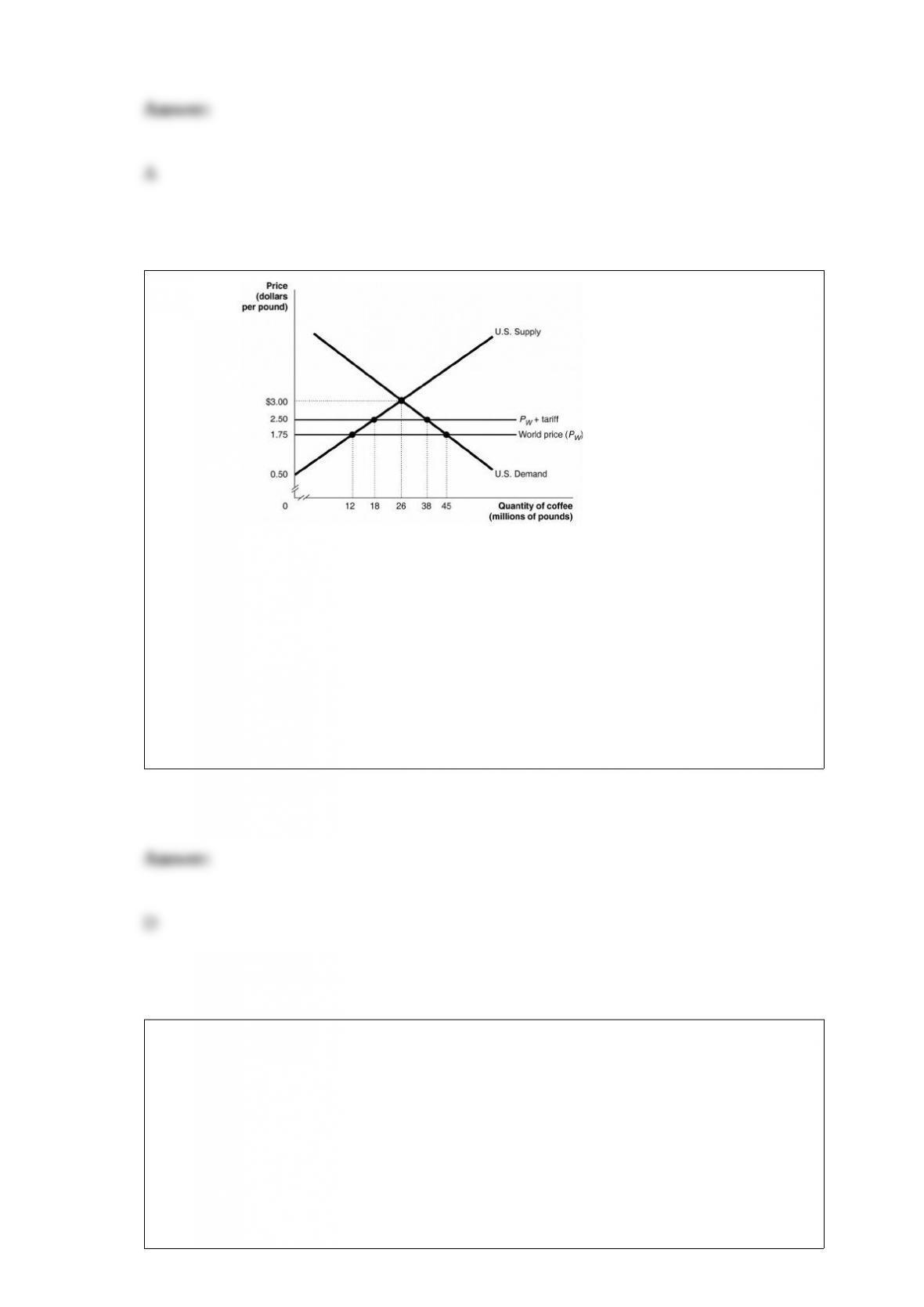
Figure 7-2 Suppose the U.S. government
imposes a $0.75 per pound tariff on coffee imports. Figure 7-2 shows the impact of this
tariff. The loss in domestic consumer surplus as a result of the tariff is equal to
A) $5 million.
B) $19.875 million.
C) $24.875 million.
D) $31.125 million.
Which of the following equations is incorrect?
A) ATC – AFC = AVC
B) AVC + AFC = ATC
C) AFC = ATC – AVC
D) ATC = AVC – AFC

Proponents of the real business cycle model argue that the short-run aggregate supply
curve is
A) flat.
B) positively sloped.
C) vertical.
D) negatively sloped.
Which of the following statements about the price elasticity of demand iscorrect?
A) The elasticity of demand for a good in general is equal to the elasticity of demand
for a specific brand of the good.
B) The absolute value of the elasticity of demand ranges from zero to one.
C) Demand is more elastic in the long run than it is in the short run.
D) Demand is more elastic the smaller the percentage of the consumer’s budget the item
takes up.