
Firms in perfect competition produce the productively efficient output level in the short
run and in the long run.
Holding everything else constant, government approval of horizontal mergers is more
likely to be granted if the “market” that firms are in are broadly defined rather than
narrowly defined.
Since 1960, out-of-pocket spending on health care has increased sharply as a fraction of
all health care spending.
If average product is decreasing, then marginal product must be negative.

While labor unions tend to negotiate above-equilibrium wage rates for their members,
they also tend to reduce the quantity of labor hired.
When a business is set up as a sole proprietorship, the owner of the business faces
limited liability.
If some monopolistically competitive firms exit their market after suffering short-run
losses, the demand curves of remaining firms will shift to the right.

If the demand curve for a product is vertical, any tax increase on the product is paid for
entirely by the consumer.
A characteristic of the long run that is not available in the short run is that a firm is free
to vary its output.
A successful trademark is one that becomes a generic name for a product, for example,
“Kleenex” has become a generic term for tissues.
In the alcohol industry, both wine and spirits are considered to be substitutes for beer.

For a monopolistically competitive firm, price equals average revenue.
Perfectly competitive industries tend to produce low-priced, low-technology products.
If the income effect of a wage increase equals the substitution effect, the labor supply
curve is horizontal at the equilibrium wage.

If consumers paid the full price of medical services instead of using health insurance
and third-party payers to cover part of the cost, the quantity of medical services
provided would increase.
Occupational licensing is an example of an entry barrier that improves a country’s
standard of living.
If in the long run a firm makes zero profit, it should exit the industry.
An equilibrium in which each player chooses its best strategy given the strategies
chosen by the other players is called a Nash equilibrium.

A decrease in the amount of human capital acquired by workers will lead to decrease in
the supply of labor.
The total amount of producer surplus in a market is equal to the area below the supply
curve.
A product is considered to be excludable if it is jointly owned by all members of a
community.

As output increases, average fixed cost gets smaller and smaller.
A member of a cartel earns more profits by producing more than its quota and selling at
a price higher than the cartel’s price.
An increase in the number of firms in a market will cause the quantity of a good
supplied to increase.
Table 15-1
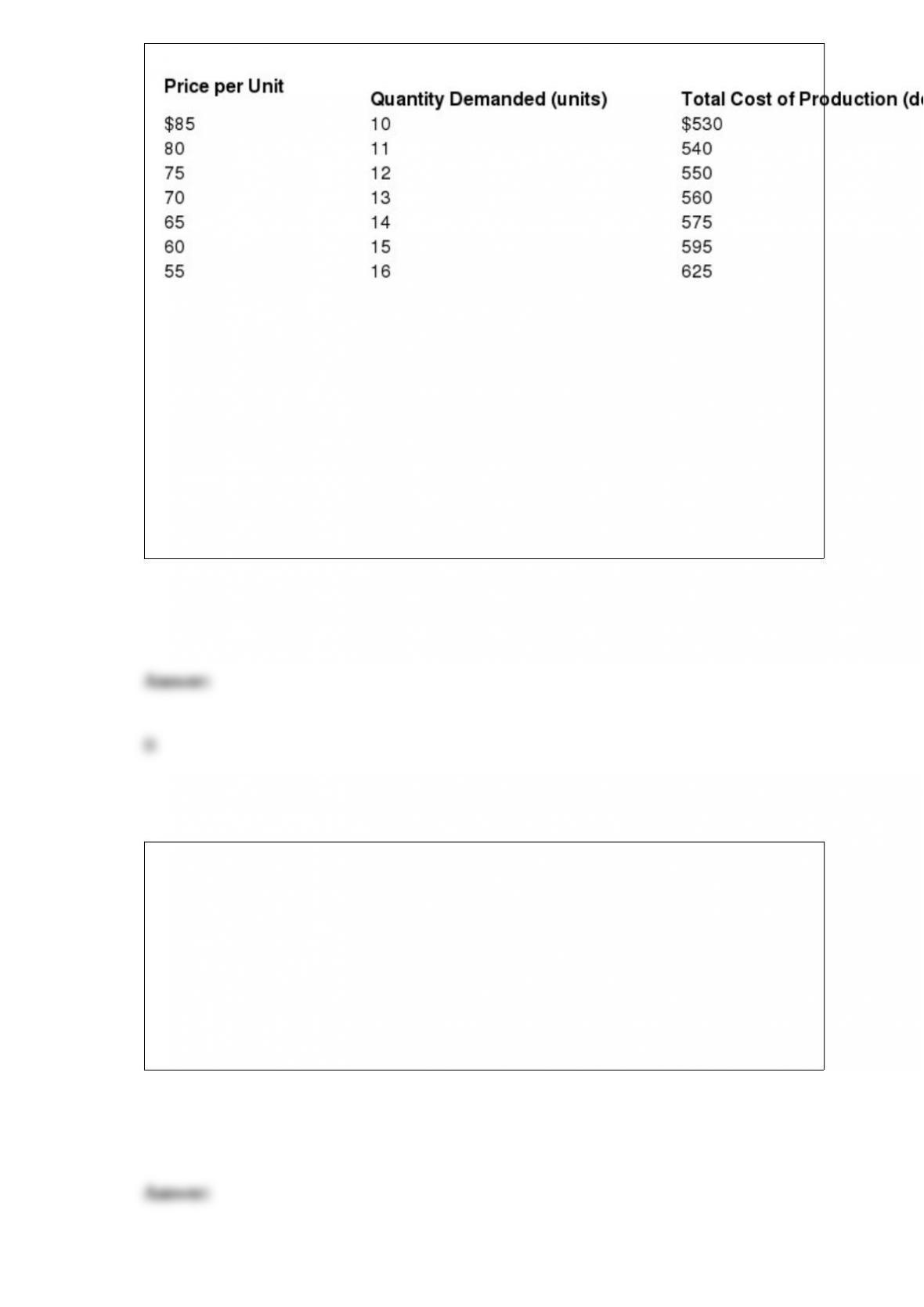
A monopoly producer of foreign language translation software faces a demand and cost
structure as given in Table 15-1.
Refer to Table 15-1. What is the amount of the firm’s profit?
A) $335
B) $350
C) $880
D) $910
Price elasticity of demand measures
A) how responsive suppliers are to price changes.
B) how responsive sales are to changes in the price of a related good.
C) how responsive quantity demanded is to a change in price.
D) how responsive sales are to a change in buyers’ incomes.

For certain public projects such as building a dam on a river or a bridge to an island,
what procedure is a government likely to use to determine what quantity of a public
good should be supplied?
A) It conducts public surveys to determine if consumers want the product.
B) It hires economists to estimate the market demand for the product.
C) It takes a vote in Congress.
D) It evaluates the costs and benefits of producing the good.
Arnold Kim began blogging about Apple products during his fourth year of medical
school. Kim’s Website, MacRumors.com, became so successful that he decided to give
up his medical career and work full time on his Website, despite the nearly $200,000 he
had invested in his education. In making his decision, Kim decided to ignore the money
and time he spent on his education. Economists would say that Kim made a
A) rational decision to ignore these sunk costs.
B) poor decision since he had already invested his time and money on his medical
career.
C) poor decision since doctors are in greater demand than bloggers.
D) hasty decision by not waiting to recoup his financial investment before giving up his
medical career.

An example of a factor of production is
A) stock issued by Dell.
B) the computers exported by Dell.
C) a computer produced by an Dell.
D) a worker hired by Dell.
Distinguish between a voluntary export restraint and a quota.
Juicy Couture has been successful in selling women’s clothing using an unusual
strategy.
According to an article in the Wall Street Journal, the key to the firm’s strategy is to
“limit distribution to maintain the brand’s exclusive cachet, even if that means
sacrificing sales, a brand-management technique once used only for high-end luxury

brands.” In 2006, Juicy clothes were sold in only four department stores: Neiman
Marcus, Saks, Bloomingdale’s, and Nordstrom. In 2006, its sales have more than
quadrupled since 2002.
Source: Rachel Dodes, “From Track Suits to Fast Track,” Wall Street Journal,
September 13, 2006.
How does limiting the number of stores in which Juicy’s products are sold contribute to
its success?
A) By sacrificing sales, the company was able to focus on producing high quality
products.
B) It enables Juicy to price its products at a premium and differentiate them from lower
priced products.
C) It helps establish Juicy’s products as luxury items favored by the very wealthy.
D) Maintaining the exclusivity of a product increases the demand for the product.
The benefit to the firm from hiring one additional worker is called the
A) marginal revenue product of labor.
B) marginal revenue.
C) marginal profit.
D) total revenue.

The Walt Disney Company is in a position to use a two-part tariff by charging for
admission and also charging for rides inside its two theme parks, Disneyland and
Disney World. Which of the following statements regarding Disney’s pricing strategy is
true?
A) At one time, admission fees were charged at both parks but all rides were free.
Disney has since changed its pricing policy; it earns higher profits by charging for both
admission and rides.
B) At one time, customers had to pay for admission and rides at Disneyland and Disney
World. Disney has since changed its pricing policy; it earns higher profits by charging
for admission but not for rides.
C) At one time, customers had to pay for admission and rides at Disneyland and Disney
World. Disney has since changed its pricing policy; it earns higher profits by charging
for rides but not for admission.
D) At one time, fees for admission and rides at both parks were set at their
profit-maximizing levels. Disney has since changed its pricing policy; it uses a
cost-plus pricing strategy for admission and does not charge for rides.
Which of the following is motivated by an efficiency concern?
A) In December 2006, the Bush administration restarted a short-term housing assistance
program for victims of Hurricane Katrina.
B) Each year, the University of Notre Dame conducts a lottery to parcel out the 30,000
seats available to contributors, former athletes and parents in the 80,000-seat stadium.
C) The United Network for Organ Sharing advocates a system of rationing scarce
kidneys that would favor young patients over old in an effort to wring more life out of
donated organs.
D) The federal government’s housing choice voucher program assists very low-income
families, the elderly, and the disabled to afford decent, safe, and sanitary housing in the
private market.

James Meade, who won the Nobel Prize in Economics in 1977, argued that positive
externalities resulted from
A) reducing emissions of sulfur dioxide.
B) producing automobiles and automobile tires.
C) home owners in the Northeast moving to the South and Southwest United States.
D) apple growing and beekeeping.
By the 21st century few people purchased printed encyclopedias. Which of the
following competitive forces best explains this?
A) competition from substitutes
B) the bargaining power of buyers
C) the bargaining power of suppliers
D) the threat from potential entrants
What are property rights?
A) the title to ownership of any physical asset
B) a legal document verifying ownership of intangible assets
C) the rights individuals or firms have to the exclusive use of their property, including
the right to buy or sell it
D) the right of the government to appropriate private assets for the good of society
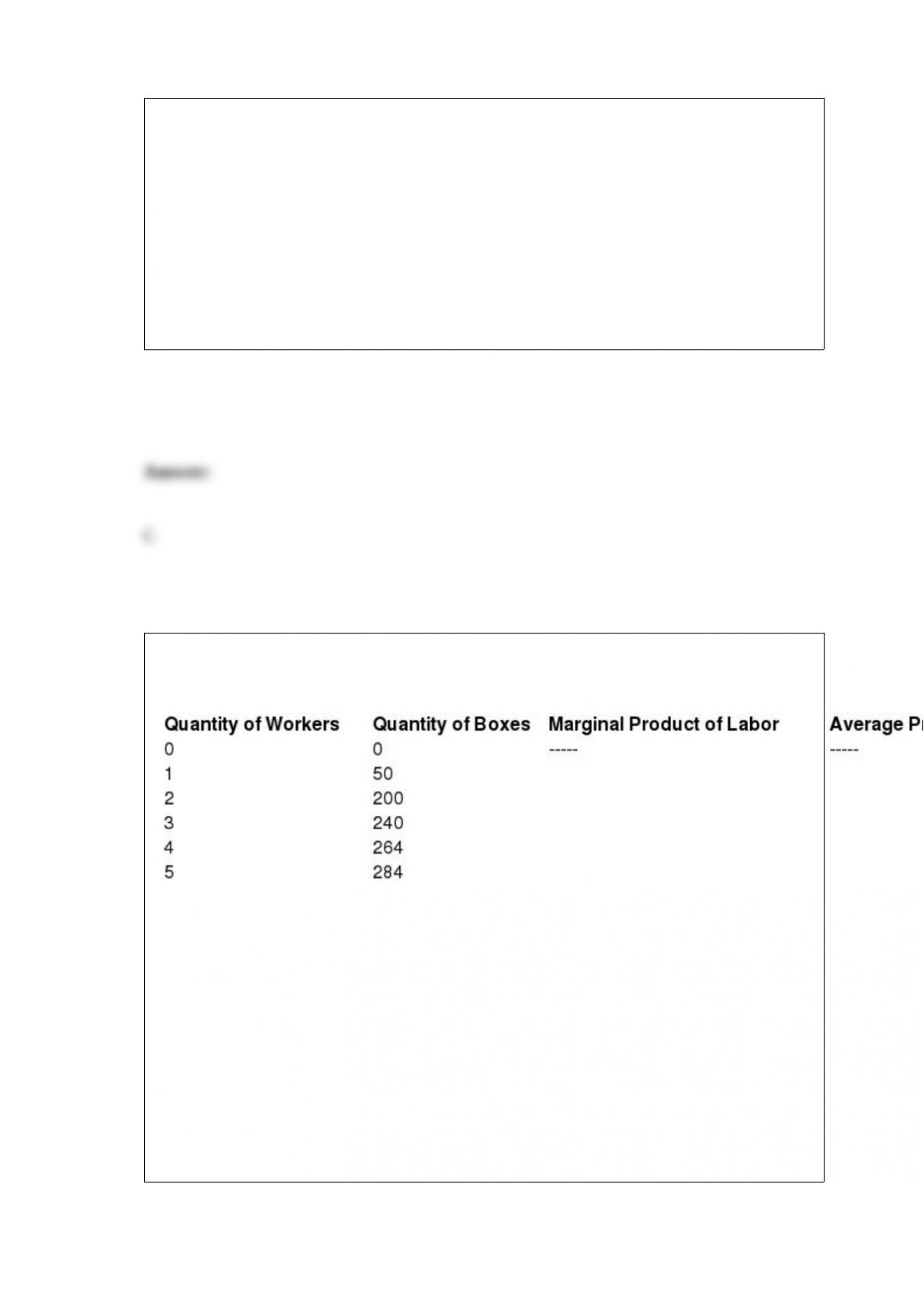
Table 11-3
Refer to Table 11-3. The table above refers to the relationship between the quantity of
workers employed and the number of cardboard boxes produced per day by Manny’s
House of Boxes. The capital used to produce the boxes is fixed. Diminishing returns to
labor are first observed in this example after Manny hires the ________ worker.
A) second
B) third
C) fourth
D) fifth

Assume that a 50 percent gasoline tax led to a large increase in its price and only a
small decrease in the quantity of gasoline demanded. Economic analysis would lead one
to conclude that
A) gasoline should be taxed because the benefits of the tax would exceed the costs.
B) gasoline should not be taxed because the benefits are uncertain.
C) gasoline should not be taxed on ethical grounds since ethical benefits and costs can’t
be measured.
D) the benefits of taxing gasoline is a normative issue. Economic analysis can be used
to contribute to discussion of this issue but cannot decide it.
Figure 4-4
Refer to Figure 4-4. The figure above represents the market for pecans. Assume that
this is a competitive market. If 8,000 pounds of pecans are sold
A) the deadweight loss is equal to economic surplus.

B) producer surplus equals consumer surplus.
C) the marginal benefit of each of the 8,000 pounds of pecans equals $9.
D) marginal benefit is equal to marginal cost.
All of the following will shift the labor supply curve except
A) an increase in labor force participation rate among women.
B) an increase in the average age of retirement.
C) an increase in the wage rate.
D) a change in a country’s immigration policy.
Absolute advantage is
A) the ability to produce more of a good or service than competitors when using the
same amount of resources.
B) the ability to produce higher quality goods compared to one’s competitors.
C) the ability to produce a good or service at a higher opportunity cost than one’s
competitors.
D) the ability to produce more of a good or service than competitors that have more
resources.
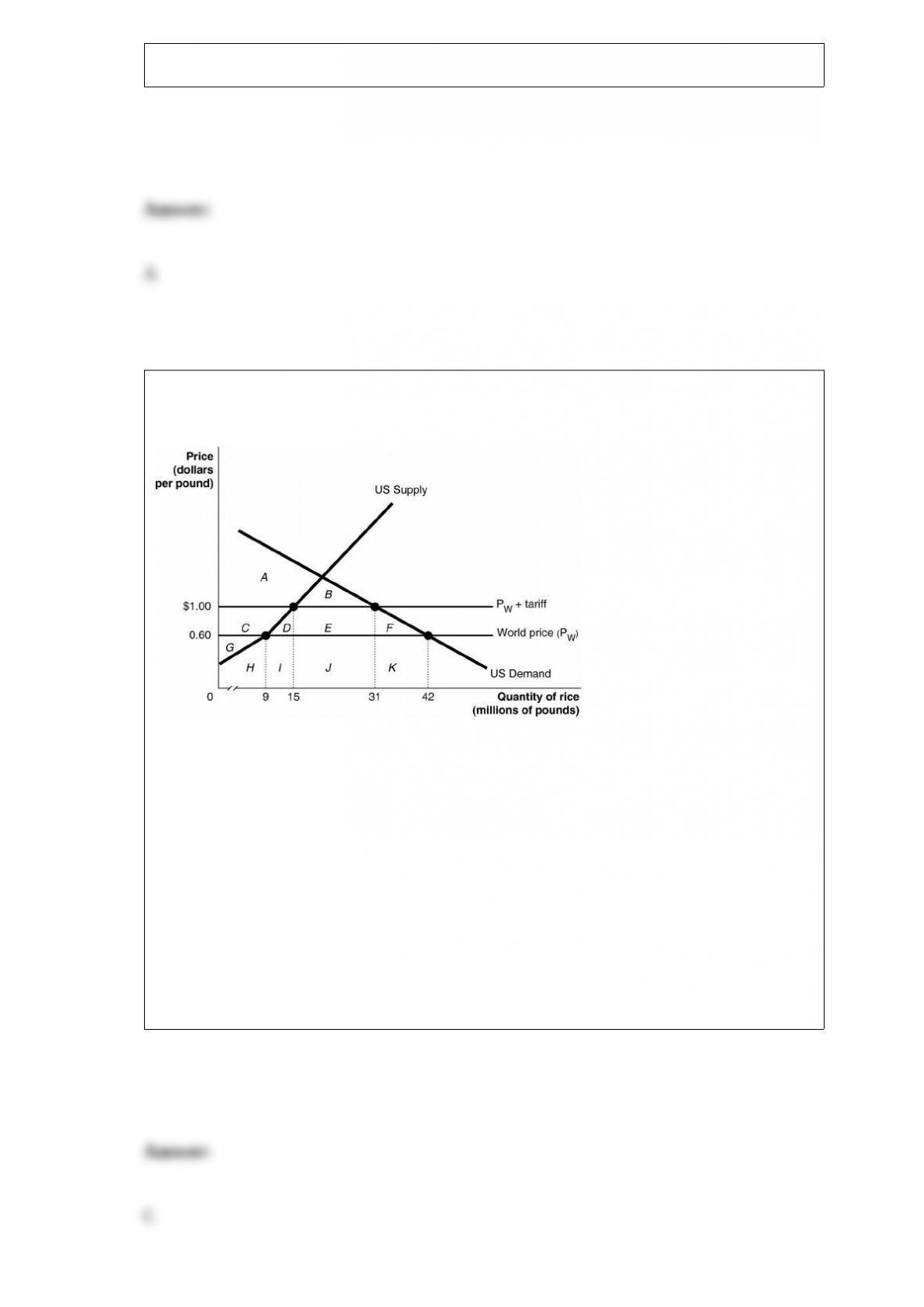
Figure 9-2
Suppose the U.S. government imposes a $0.40 per pound tariff on rice imports. Figure
9-2 shows the impact of this tariff.
Refer to Figure 9-2. If the tariff was replaced by a quota which limited rice imports to
16 million pounds, the amount of revenue received by rice importers would equal
A) $6.4 million.
B) $9.6 million.
C) $16 million.
D) $19.8 million.
Which of the following is not an example of a government-imposed entry barrier?
A) patents
B) occupational licensing
C) barriers to international trade
D) antitrust legislation
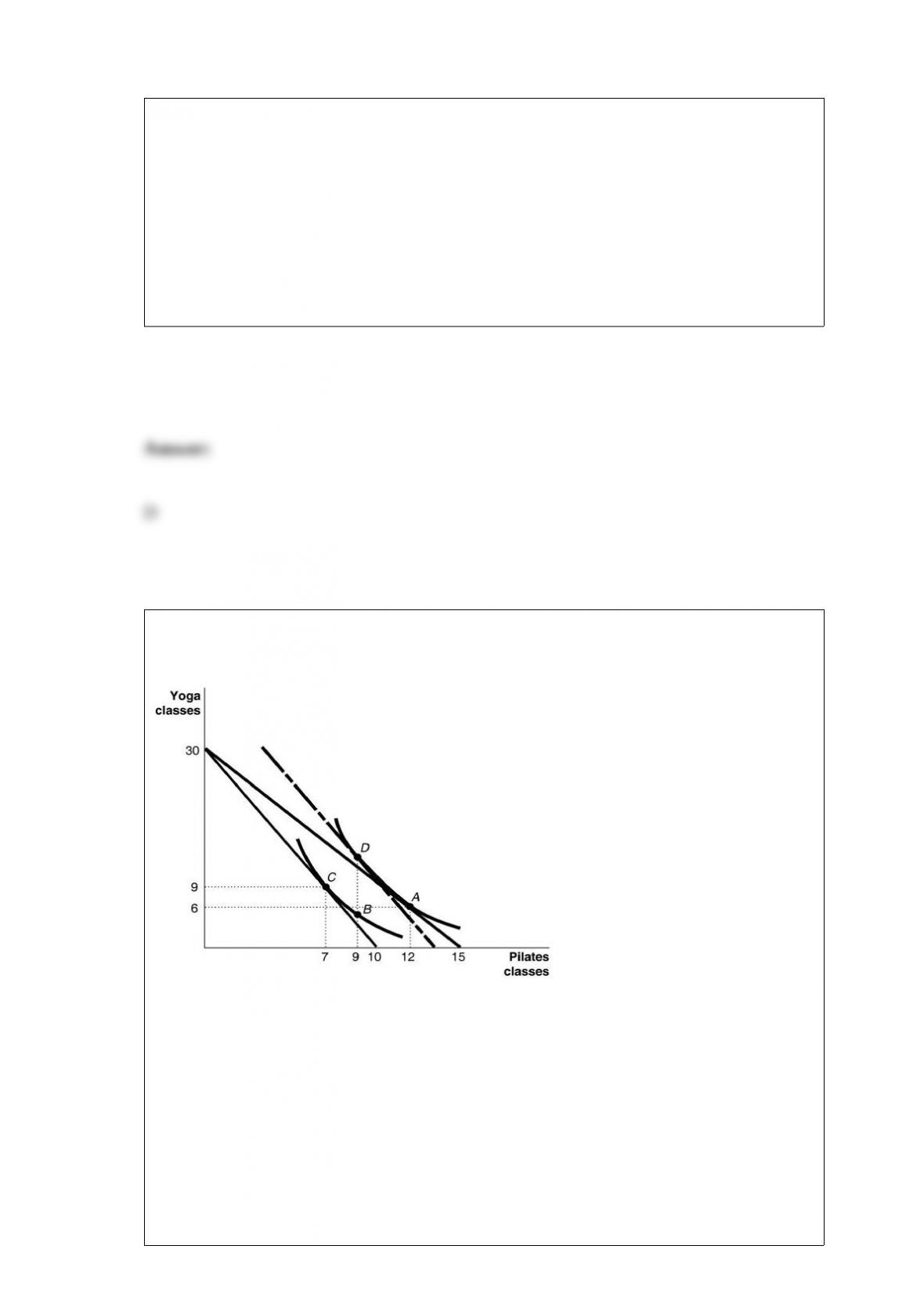
Figure 10-7
Manuri has $300 to spend on Pilates classes and Yoga classes. The price of a group
Pilates class is $20 and the price of a group Yoga class is $10. Manuri’s optimal bundle
is given by “A” in Figure 10-7.
Refer to Figure 10-7. Suppose the price of Pilates sessions rises to $30 while income
and the price of Yoga sessions remain unchanged. What is her new optimal bundle?
A) still remains at bundle A.
B) bundle B.

C) bundle C.
D) bundle D.
If the absolute value of the price elasticity of demand for DVD movies is 0.8 then the
elasticity of demand for the DVD for the movie The Hangover should be
A) less then 0.8 in absolute value.
B) greater than 0.8 in absolute value.
C) equal to 1 in absolute value.
D) equal to zero because the DVD of this movie has been out for several years.
Table 4-6
Refer to Table 4-6. The equations above describe the demand and supply for Chef
Ernie’s Sushi-on-a-Stick. What are the equilibrium price and quantity (in thousands) for
Chef Ernie’s sushi?

A) $80 and 80 thousand
B) $60 and 20 thousand
C) $50 and 100 thousand
D) $40 and 50 thousand
Competitive markets tend to eliminate economic discrimination, but there are many
historical examples of firms that hired few, or no, black or female workers. Which of
the following is not a reason for the persistence of this form of discrimination?
A) In many cases, white workers refused to work with black workers.
B) Some white consumers were unwilling to buy from companies that employed black
workers.
C) If discrimination makes it difficult for a member of a group to be hired in a
particular occupation, there is less incentive for members of the group to be trained to
enter that occupation.
D) Laws passed by the federal government made it more expensive to hire black or
female workers. As a result, it was less expensive for employers to hire mostly white
male workers.
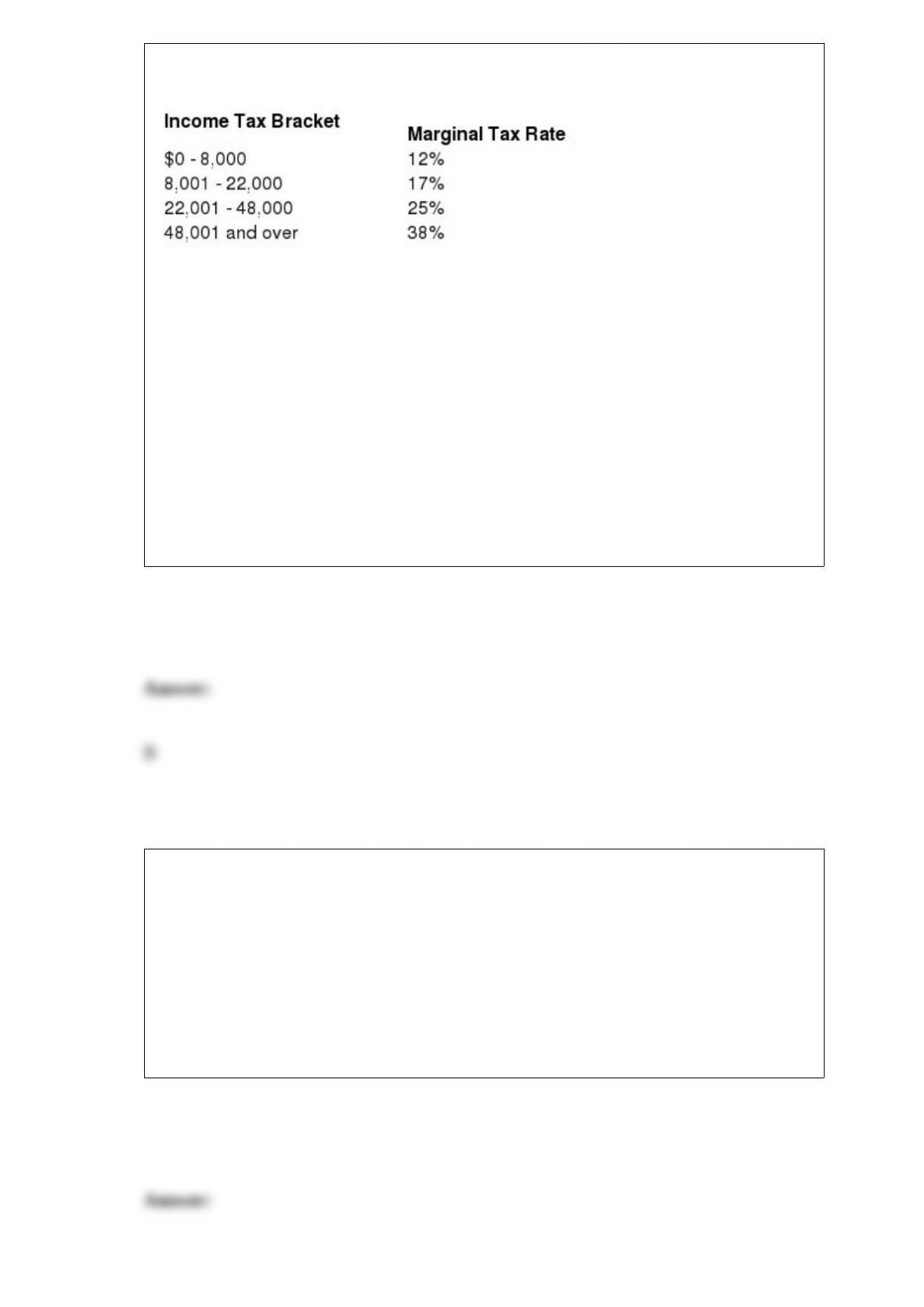
Table 18-6
Table 18-6 shows the income tax brackets and tax rates for single taxpayers in
Calpernia.
Refer to Table 18-6. Calculate the income tax paid by Sasha, a single taxpayer with an
income of $60,000.
A) $22,800
B) $14,399
C) $13,800
D) $13,642
If a monopolist’s marginal revenue is $35 per unit and its marginal cost is $25, then
A) to maximize profit the firm should increase output.
B) to maximize profit the firm should decrease output.
C) to maximize profit the firm should continue to produce the output it is producing.
D) Not enough information is given to say what the firm should do to maximize profit.

Online companies gather personal information about the customers who shop on their
Websites and some of those companies will use the data to estimate price elasticities of
the customers. Doing this is a way that these companies might be able to charge a
higher price for a product to those customers who have a ________ price elasticity of
demand.
A) high
B) low
C) negative
D) unitary
If 11 workers can produce 53 units of output while 12 workers can produce 56 units of
output, what is the marginal product of the 12th worker?
A) 0.16
B) 3
C) 4.67
D) 36
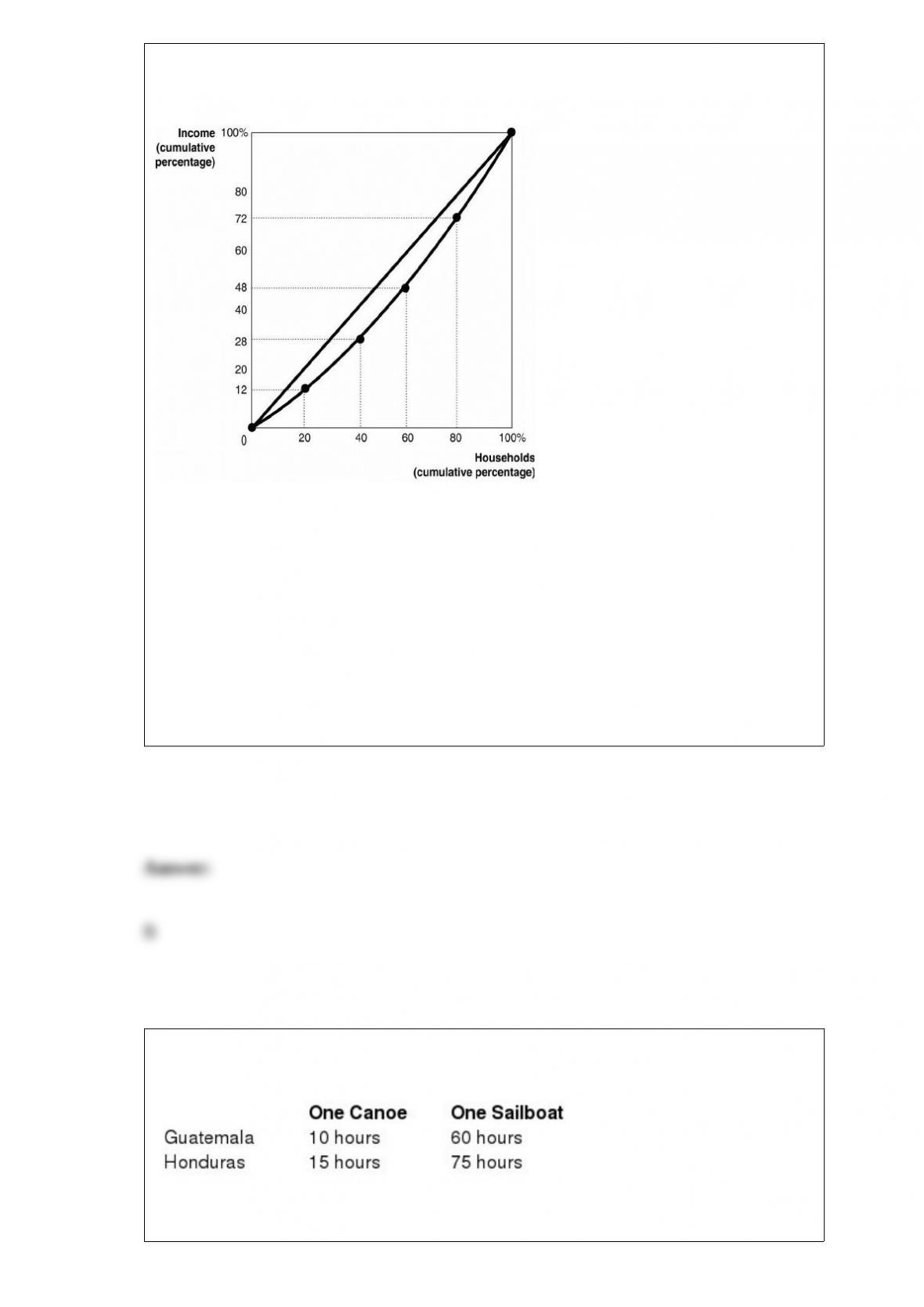
Figure 18-5
Figure 18-5 shows the Lorenz curve for a hypothetical country.
Refer to Figure 18-5. The highest 20 percent of households
A) earn 24 percent of the society’s total income.
B) earn 28 percent of the society’s total income.
C) earn 42 percent of the society’s total income.
D) earn 72 percent of the society’s total income.
Table 2-9
Table 2-9 shows the number of labor hours required to produce a canoe and a sailboat in

Guatemala and Honduras.
Refer to Table 2-9. If the two countries specialize and trade, who should export canoes?
A) There is no basis for trade between the two countries.
B) Guatemala
C) Honduras
D) They should both be exporting canoes.
Which of the following questions or statements regarding medical school is normative?
A) How do changes in expected future incomes affect the decisions of medical students
about which specialty to choose?
B) Medical students who enter specialized fields make a larger contribution to society
than do student who enter primary care.
C) What role does tuition play in a student’s decision about whether to attend medical
school?
D) Have tuition increases had a large effect or a small effect on the number of
applications to medical school?
Organizing a successful firm in a market economy has become ________ over the last
century.

A) legally impossible
B) politically impossible
C) less difficult
D) more difficult
What is a ‘social cost” of production?
A) the cost of the natural resources used up in production
B) the total costs of producing a product, both implicit and explicit costs
C) the sum of all costs to individuals in society, regardless of whether the costs are
borne by those who produce the products or consume the product
D) the cost of the environmental damage created by production
Figure 9-3
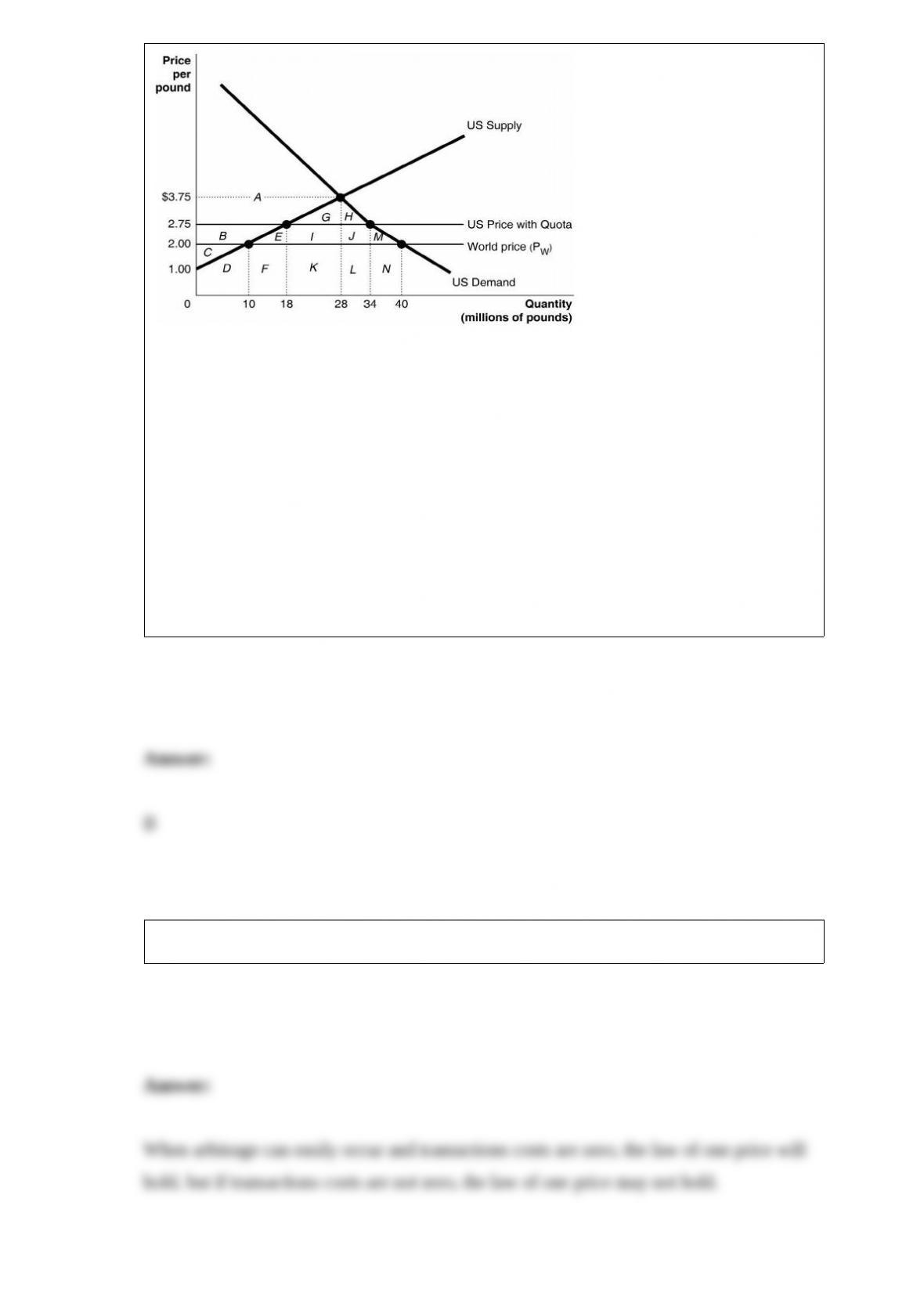
Since 1953 the United States has imposed a quota to limit the imports of peanuts.
Figure 9-3 illustrates the impact of the quota.
Refer to Figure 9-3. What is the area of domestic producer surplus after the imposition
of a quota?
A) B
B) B + C
C) B + E + I + J + M
D) E + I + J + M
Under what circumstances will the law of one price hold, and when might it not hold?

Briefly explain 4 of the difficulties in making cross-country comparisons in health care
outcomes.
How would a marketing campaign directed at single women improve the chances of
success at a place like a cigar bar?

Why are demand and marginal revenue represented by the same curve for a firm in a
perfectly competitive market, but by separate curves for a firm in a monopolistically
competitive market?
What is the difference between explicit costs and implicit costs? List three examples
each of explicit costs and implicit costs that may be experienced by a small business.
Companies often find it to be more profitable to use a commission or piece-rate system
of compensation rather than a salary system, yet many firms continue to pay their
workers salaries. List three reasons why a firm would choose a salary system of
compensation.

How does the principal-agent problem extend to managers and employees?
The government of Bassaland is looking for new revenue sources. It is considering
imposing an excise tax on two goods: palm wine and diapers. If the price elasticity of
demand for the goods are -0.47 and -1.89 respectively, which good should it tax if the
goal is to raise revenue? If the government wants to tax only one good, which good
should it tax if the goal is to discourage consumption? Explain your answer.
Why do economists refer to the pricing strategies of oligopoly firms as a prisoner’s
dilemma game?
Why might network externalities result in products that contain inferior technologies?
What is a long-run supply curve? What does a long-run supply curve look like on a
perfectly competitive market graph?

Explain why market power leads to a deadweight loss. Is the total deadweight loss from
market power in the United States large or small?
What is the difference between imports and exports?
Describe the main factors economists believe cause inequality of income.

What are economies of scale? What are diseconomies of scale?