
Based on the figure, if a union contract requires that the wage workers are paid be
raised from $25 to $30 per hour, the number of unemployed workers will increase by
______ workers.
A. 8
B. 10
C. 17
D. 18
Can sales agents, such as realtors, generate economic surplus?
A. No, because the value of a product is based purely on the cost of producing it and
not on who buys it.
B. No, because sales agents don’t produce anything new.
C. Yes, but only if they work for free, otherwise they are a waste of resources.
D. Yes, because they help ensure that goods are purchased by consumers who value
them the most highly.
The larger the mpc, the ______ the income-expenditure multiplier and the ______ the
effect of a change in autonomous spending on short-run equilibrium output.

A. larger; larger
B. larger; smaller
C. smaller; smaller
D. smaller; larger
In Macroland, autonomous consumption equals 100, the marginal propensity to
consume equals 0.75, net taxes are fixed at 40, planned investment is fixed at 50,
government purchases are fixed at 150, and net exports are fixed at 20. The vertical
intercept of the expenditure line is:
A. 0.25.
B. 0.75.
C. 290.
D. 320.
When the price of a good falls, marginal utility per dollar spent on that good ______,
prompting consumers to purchase ______ of that good.
A. rises; more
B. falls; more
C. rises; less
D. falls; less
To achieve long-run equilibrium in an economy with a recessionary gap, without the
use of stabilization policy, the inflation rate must:
A. increase.
B. decrease.
C. not change.
D. either increase or decrease depending on the relative shifts of AD and AS.
When a U.S. restaurant purchases French wine and the French wine company uses the
proceeds to buy U.S. government debt, U.S. ______ and there is a capital ______ the
United States.

A. imports increase; outflow from
B. imports decrease; inflow to
C. imports increase; inflow to
D. exports increase; outflow from
The growth in income inequality in the United States since the early 1980s has been
driven primarily by the dramatic:
A. increase in real incomes for the top 1 percent of earners.
B. increase in real incomes for the top 10 percent of earners.
C. increase in real incomes for the top 20 percent of earners.
D. decrease in real incomes for the bottom 20 percent of earners.
Public saving is:
A. increased when the government budget deficit rises.
B. identical to the government budget surplus.
C. less important to national saving than private saving.
D. more important to national saving than private saving.
In a free market, if the price of a good is below the equilibrium price, then;
A. government needs to set a higher price.
B. suppliers, dissatisfied with growing inventories, will raise the price.
C. demanders, to acquire the good, will bid the price higher.
D. suppliers, dissatisfied with growing inventories, will lower the price.
Assume consumers eat either rice or pasta for dinner every night. If the price of rice
increases, in the pasta market one would expect to see:
A. an increase in the quantity of pasta demanded.
B. an increase in the demand for pasta.
C. a decrease in the quantity of pasta demanded.

D. a decrease in the demand for pasta.
A political system that promotes the free and open exchange of ideas:
A. will not have well-defined property rights.
B. slows the development of new technologies and products.
C. increases average labor productivity.
D. is detrimental to economic growth.
Frank owns an apple farm and plans to spend 4 hours today picking apples. The number
of apples he can pick per hour depends on the total number of hours he spends working
in either the east orchard or the west orchard in the manner shown in the table below.
If Frank spends 2 hours picking apples in the east orchard and 2 hours picking apples in
the west orchard, how many apples in total will Frank be able to pick today?
A. 21
B. 42
C. 84
D. 92
Suppose that in an effort to help single parents, the government decides to pay part of
the cost of childcare. This measure would increase ______ in the market for childcare.
A. efficiency
B. consumer surplus
C. total economic surplus
D. producer surplus
In the short-run Keynesian model, to close an expansionary gap of $10 billion dollars
government purchases must be:
A. increased by $10 billion.
B. decreased by $10 billion.
C. increased by more than $10 billion.
D. decreased by less than $10 billion.
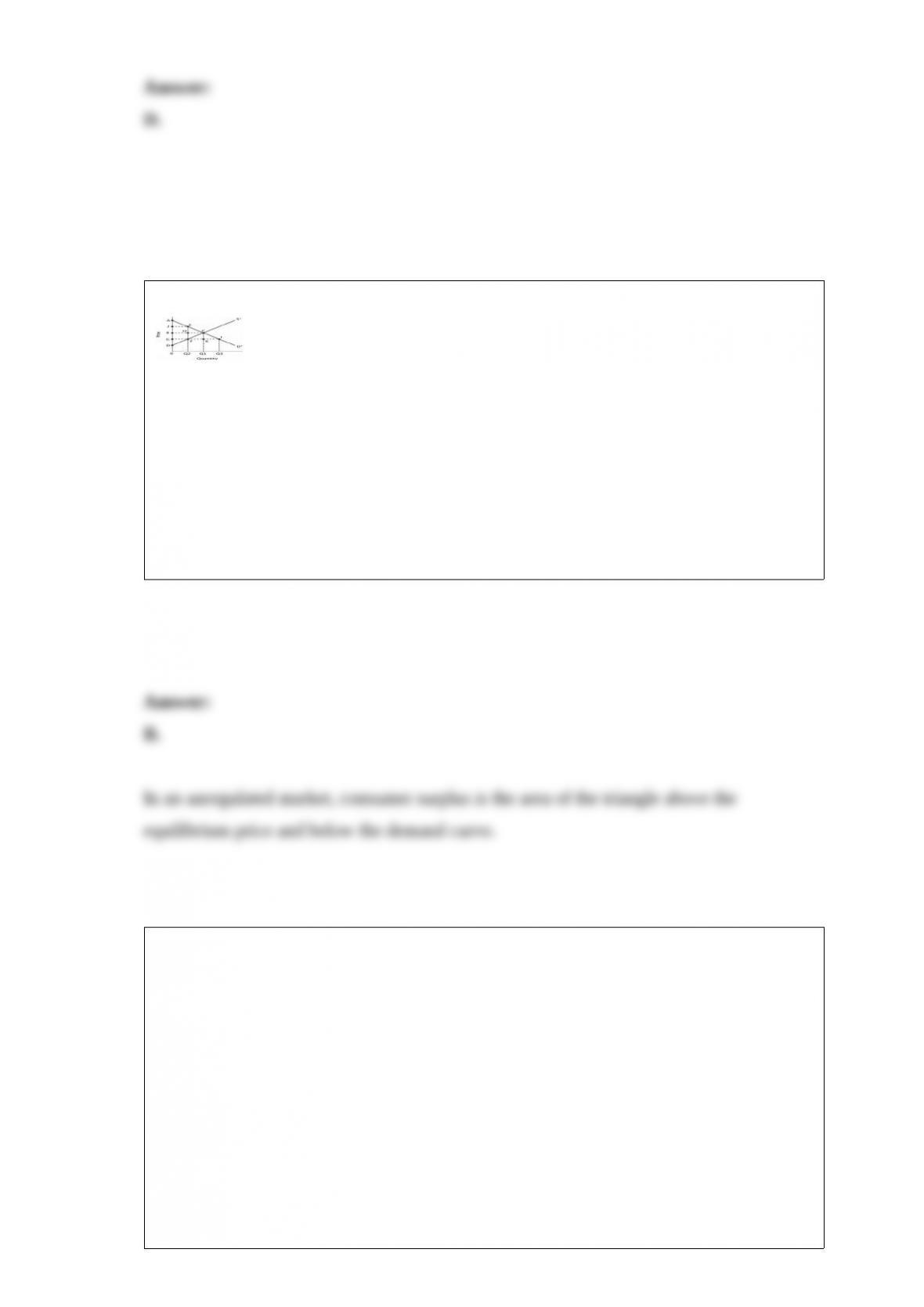
Refer to the figure below.
When the market is unregulated, consumer surplus is represented by the area:
A. AJE
B. ABC
C. AGI
D. DBC
Suppose you have $200 with which you can buy shares of stock from two companies:
ABC Hot Chocolate Company and XYZ Lemonade. Each company’s stock currently
sells for $100 per share. If the temperature next year is lower than average, the stock
price for ABC will increase by $20, and the stock price for XYZ will not change. If the
temperature next year is higher than average, the stock price for XYZ will increase by
$20, and the stock price for ABC will not change. There is a 50% chance that it will be
colder than average next year, and a 25% chance that it will be warmer than average. If
you purchase two shares of XYZ stock and no shares of ABC stock, your expected gain
will be ______.
A. $0
B. $10
C. $20
D. $30
Suppose that Nepal invests less in new factories and equipment than does the United
States. This will likely cause:
A. Nepal’s production possibilities curve to shift outward faster than the U.S.’s.
B. The U.S.’s production possibilities curve to shift inward faster than Nepal’s.
C. The U.S.’s production possibilities curve to shift outward faster than Nepal’s.
D. Nepal’s production possibilities curve to shift inward faster than the U.S.’s.
The ______ is the rate of increase of all prices except ______.
A. real rate of inflation; energy and food
B. core rate of inflation; energy and food
C. nominal rate of inflation; labor

D. core rate of inflation; interest rates
Where Y is GDP, C is consumption, I is investment, G is government spending, T is net
taxes, and there is no international trade, the government budget deficit equals:
A. T – G.
B. Y – G.
C. Y + T – G.
D. G – T.
The introduction of new technologies to production is ______ source of productivity
improvement.
A. the most important
B. the only
C. the least important
D. no longer a

An example of a government policy to enhance technological progress is:
A. the construction of an interstate highway system.
B. government support for basic research.
C. maintaining a well-functioning legal system.
D. the provision of publicly-funded education.
Money serves as a medium of exchange when:
A. it is used to purchase goods and services.
B. there is direct trade of goods and services.
C. it is a basic measure of economic value.
D. it is a means of holding wealth.
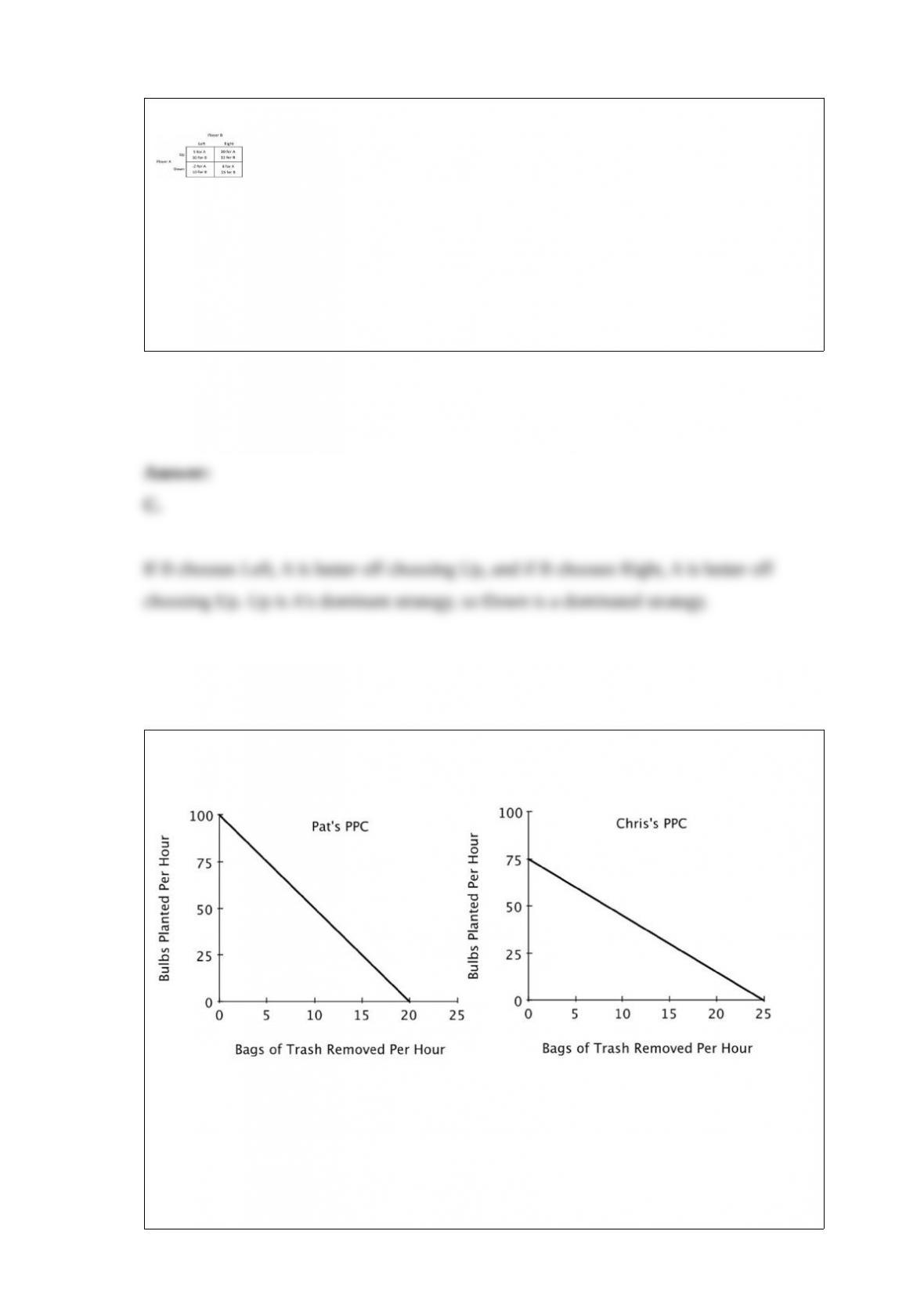
Refer to the figure below. In this game, the dominated strategy for Player A:
A. is to play up.
B. is to cooperate with Player B.
C. is to play down.
D. will depend on Player B’s move.
Refer to the figure below. For Chris, the opportunity cost of planting one bulb is
removing:
A. 25 bags of trash.
B. 1/25 of a bag of trash.
C. 3 bags of trash.
D. 1/3 of a bag of trash.

An open-market purchase of government securities by the Fed will:
A. increase bank reserves, and the money supply will increase.
B. decrease bank reserves, and the money supply will increase.
C. increase bank reserves, and the money supply will decrease.
D. decrease bank reserves, and the money supply will decrease.
One disadvantage of using the government to provide pure public goods is that
everyone receives ______ of the public good and has ______ for the public good.
A. a different amount; a different reservation price
B. a different amount; the same reservation price
C. the same amount; a different reservation price
D. the same amount; the same reservation price
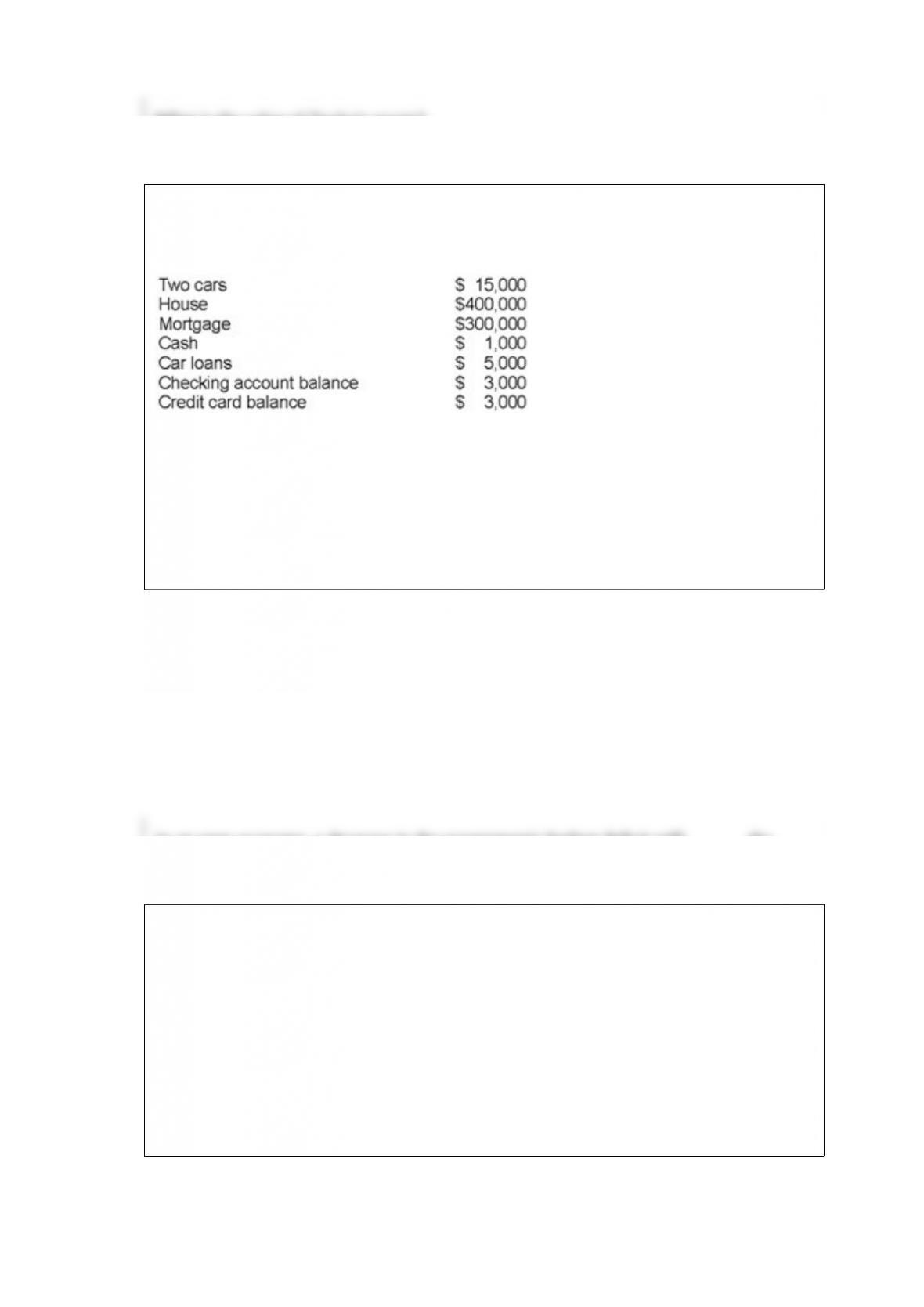
What is the value of Taylor’s assets?
Taylor has the following assets and liabilities:
A. $308,000
B. $416,000
C. $419,000
D. $422,000
In an open economy, a decrease in the government’s budget deficit will ______ the
domestic real interest rate and ______ the level of capital investment in the country,
holding other factors constant.
A. increase; increase
B. increase; decrease
C. decrease; decrease
D. decrease; increase
Whether or not a good can be classified as a complement depends on whether;
A. you personally tend to consume the goods together.
B. no substitutes exist.
C. an increase in demand for one good follows a decrease in the price of the other.
D. an increase in demand for one good follows an increase in the price of the other.
The cost-benefit model used by economists is:
A. unrealistic because it is too detailed and specific to apply to most situations.
B. unrealistic because everyone can think of times when he or she violated the
principle.
C. useful because everyone follows it all of the time.
D. useful because most people follow it most of the time.

Consider an industry with two firms producing similar products. Each firm’s total cost
(in dollars) is given below.
Mega Corp: TC = 5,000 + 100Q.
Big Inc: TC = 4,000 + 200Q.
If each firm produces 10 units, Mega Corp’s total cost will ______, and Big Inc’s total
cost will be ______.
A. $6,000; $6,000
B. $5,000; $4,000
C. $5,100; $4,200
D. $15,000; $14,200
Assume that all firms in this industry have identical cost curves, and that the market is
perfectly competitive.
If S3 is the market supply curve, then in the short run, the profit-maximizing level of
output for a single firm in this market is ______ gallons per week.
A. 0
B. 200
C. 400
D. 8000
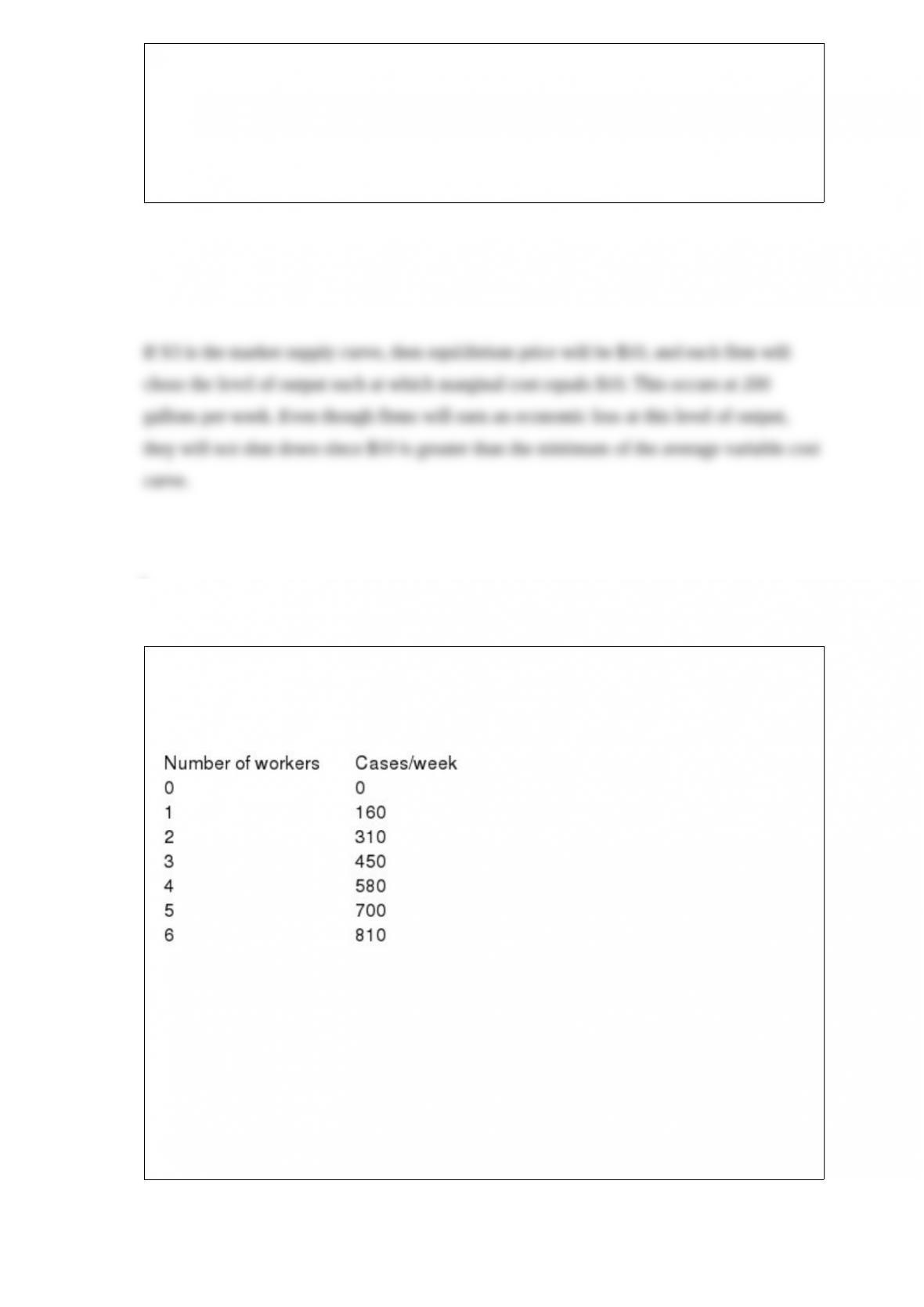
Sam owns a candy factory and hires workers in a competitive labor market to pack
cases of candy. The company’s weekly output of cases of candy varies with the number
of workers hired, as shown in the following table:
If each case sells for $3 more than the cost of the materials used in producing it, then
the most Sam would pay the 5th worker is ______ per week.
A. $330
B. $360
C. $390
D. $120