Suppose you are eating buffalo wings at a local happy hour. The total utils from doing
so after the fourth, fifth, sixth, and seventh wings are 80, 116, 136, 150, respectively.
The marginal utility of the sixth wing is __________ utils.
a. 14
b. 136
c. 20
d. 22.7
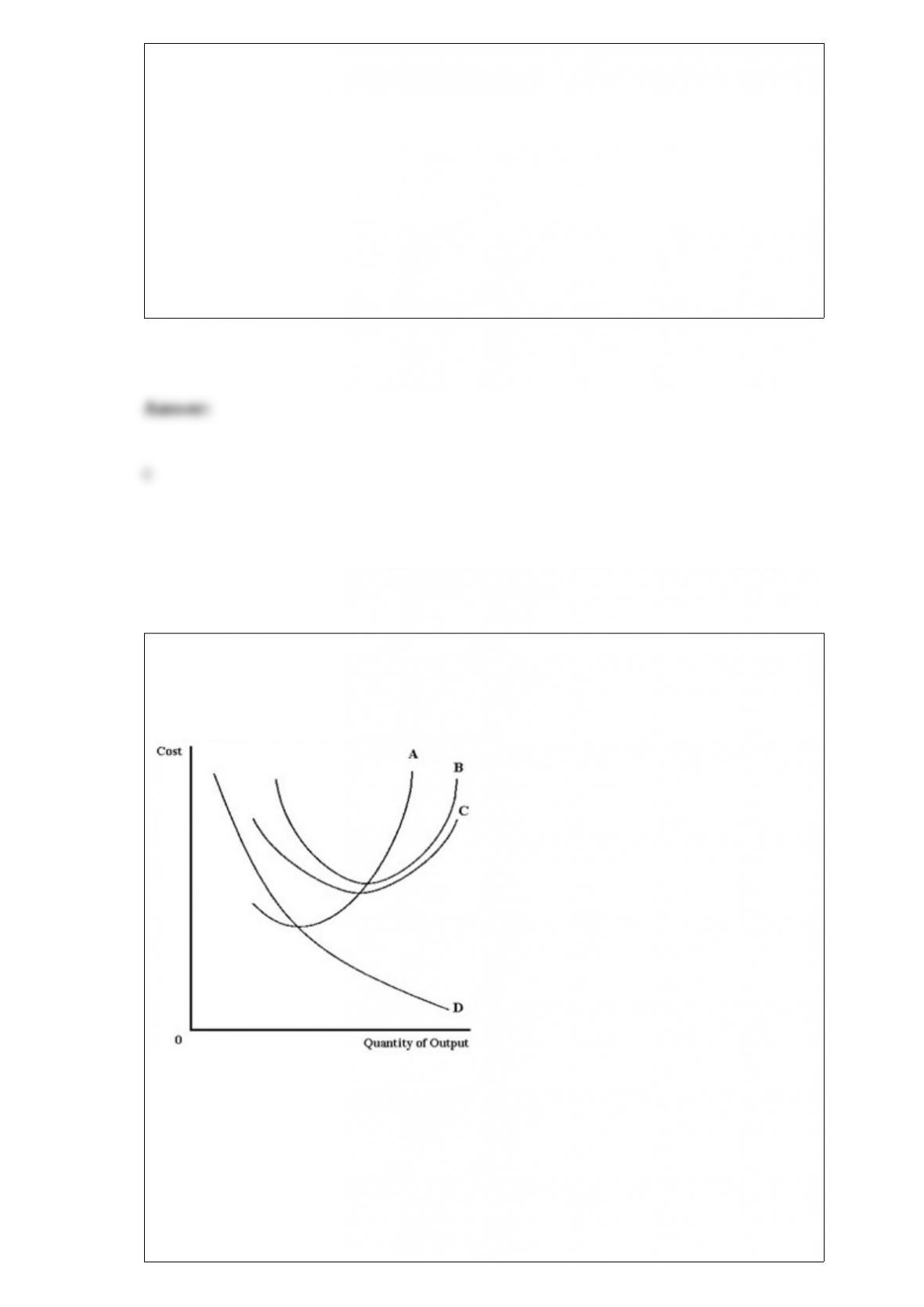
Diseconomies of scale are present when the __________ average total cost curve is
__________.
Exhibit 22-4
a. short-run; falling
b. short-run; rising
c. long-run; falling
d. long-run; rising

e. b and d
People will be more likely to vote if they believe that their vote will determine the
outcome of the election.
a. True
b. False
If the equilibrium exchange rate between U.S. dollars and Japanese yen is $0.008 = 1
yen, but currently the exchange rate is $0.007 = 1 yen, then with flexible exchange rates
the dollar price of a yen will __________, and the dollar will __________.
a. increase; appreciate
b. decrease; appreciate
c. increase; depreciate
d. decrease; depreciate
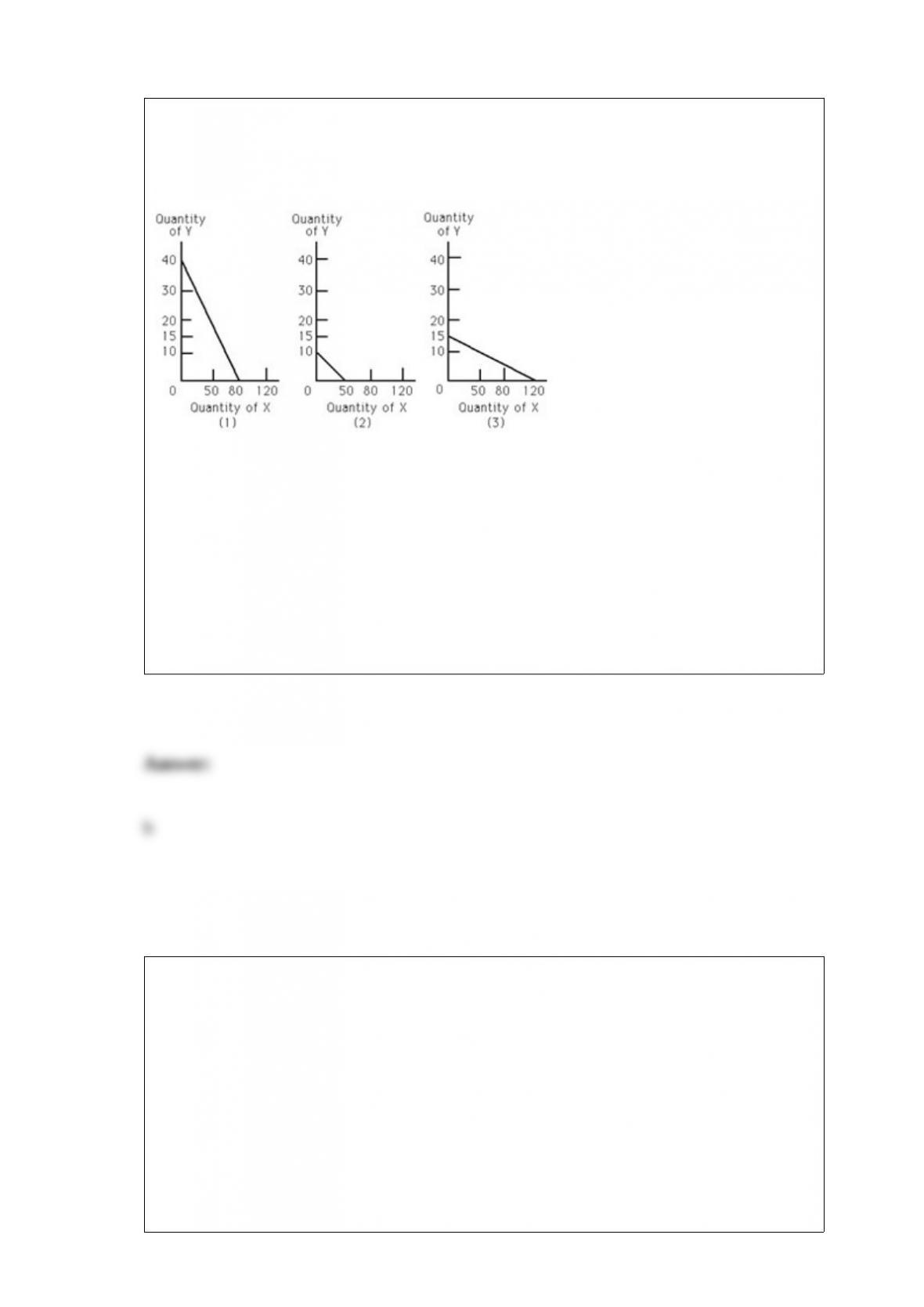
Refer to Exhibit 21-7. For graph (1), if the price of X is $20, the price of Y is
Exhibit 21-7
a. $10.
b. $40.
c. $80.
d. $100.
e. $160.
Economists Alchian and Demsetz suggest that firms are formed when
a. the sum of what individuals can produce alone is greater than what they can produce
as a team.
b. someone wants to earn profits.
c. someone comes up with the idea that customers will buy a new product.
d. the sum of what individuals can produce as a team is greater than the sum of what
they can produce alone.

The demand for factors (which arises from the demand for the products that the factors
help produce) is called a(n) __________ demand.
a. derived
b. indirect
c. secondary
d. expressed
The antitrust legislation that empowers the Federal Trade Commission to deal with false
and deceptive acts or practices (such as false and deceptive advertising) is
a. the Clayton Act.
b. the Wheeler-Lea Act.
c. the Celler-Kefauver Antimerger Act.
d. the Robinson-Patman Act.
e. none of the above

The seller of good X sells 1,000 units of the good.Each unit is being sold for the highest
price each consumer is willing to pay for the good. The seller practices
a. second-degree price discrimination.
b. third-degree price discrimination.
c. perfect price discrimination.
d. marginal revenue pricing.
e. rent seeking.
At a price for which the quantity supplied exceeds the quantity demanded, a
__________ is experienced, which pushes the price __________ toward its equilibrium
value.
a. surplus; downward
b. surplus; upward
c. shortage; downward
d. shortage; upward

The theory of monopoly assumes that the monopoly firm
a. faces a downward-sloping supply curve that is the same as its marginal revenue
curve.
b. faces a downward-sloping demand curve.
c. produces more than the perfectly competitive firm under identical demand and cost
conditions.
d. produces a product for which there are many close substitutes.
e. none of the above
“Rent-seeking” refers to
a. trying to pay the lowest rent possible for an apartment or house.
b. trying to lower rent that is paid on a factory in order to lower fixed costs.
c. the actions of individuals who spend resources to influence public policy in the hope
of transferring income to themselves from others.
d. the fact that the deadweight loss triangle is a genuine cost of monopoly.
e. none of the above

The marginal factor cost (MFC) curve for a factor price taker is
a. vertical.
b. horizontal.
c. downward sloping.
d. upward sloping.
Suppose that for Jim the marginal benefit (MB) of producing is $60 and that the
marginal cost (MC) of producing is $10.Suppose also that his marginal benefit of
stealing is $50 and the marginal cost of stealing is $10.Is Jim currently maximizing
utility in terms of producing and stealing?If not, should he produce more and steal less,
or produce less and steal more to move toward utility maximization?
a. Yes, Jim is maximizing utility.
b. No, Jim is not maximizing utility.Since the MB/MC ratio for producing is less than
the MB/MC ratio for stealing, Jim should produce more and steal less.
c. No,Jim is not maximizing utility.Since the MB/MC ratio for producing is greater than
the MB/MC ratio for stealing, Jim should produce more and steal less.
d. No,Jim is not maximizing utility.Since the MB/MC ratio for producing is greater than
the MB/MC ratio for stealing, Jim should steal more and produce less.
The Herfindahl index measures the

a. degree of concentration in an industry.
b. size of a market in terms of total dollar sales.
c. degree to which average variable cost is higher than average fixed cost at every level
of output.
d. the amount of deceptive and false advertising in an industry.
e. none of the above
If the demand for foodstuffs is inelastic, which of the following positions would be
most beneficial to Farmer Jones?
a. Bad weather for Jones and good weather for all other farmers.
b. Bad weather for all farmers except Jones (who witnesses good weather).
c. Bad weather for all farmers.
d. Good weather for all farmers.
e. There is not enough information to answer the question.
Refer to Exhibit 27-2. What type of firm are we dealing with?
Exhibit 27-2
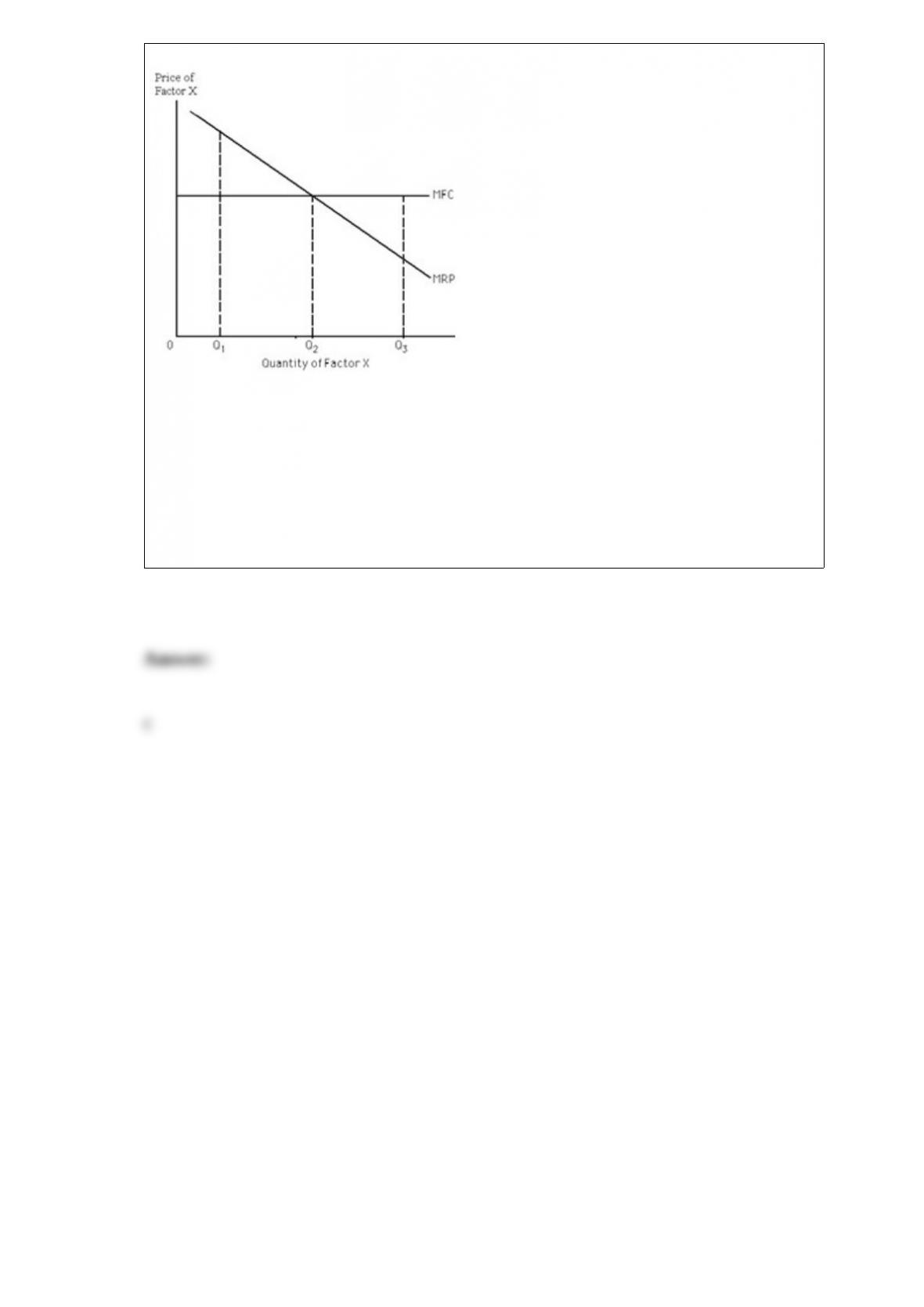
a. definitely a product price searcher (monopolist, oligopolist, etc.)
b. definitely a product price taker (perfectly competitive firm)
c. definitely a factor price taker
d. definitely a factor price searcher