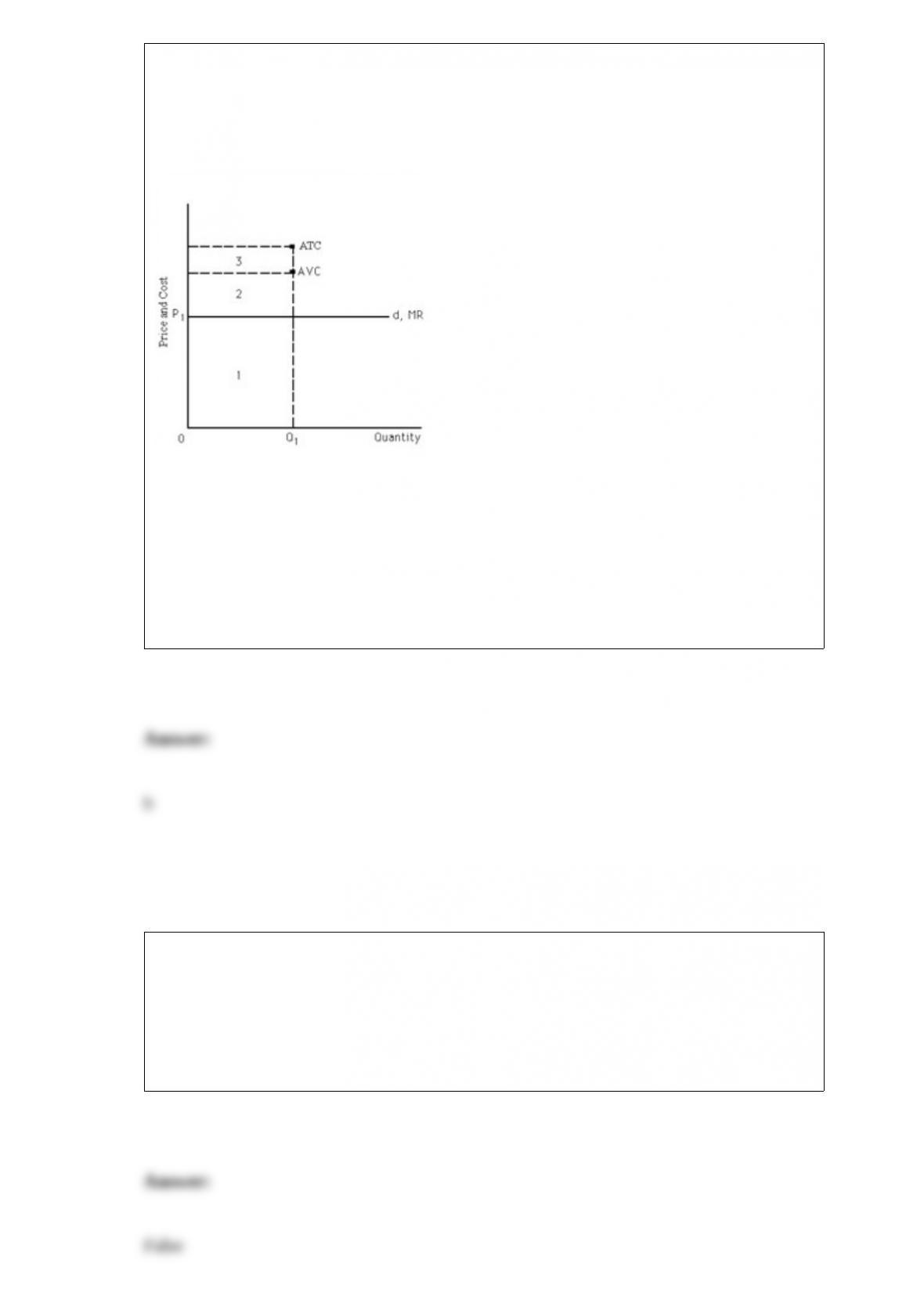
Refer to Exhibit 23-4. The market equilibrium price is P1and the firm produces Q1. At
this level of output, average variable cost and average total cost are indicated by the
dots. Given this situation, the firm is
Exhibit 23-4
a. receiving a profit equal to area 3.
b. taking a loss equal to area 2 + area 3.
c. earning total revenue equal to area 1 +area 2.
d. receiving a profit equal to area 2.
e. none of the above
A monopsonist firm faces an upward sloping supply of labor curve and its marginal
factor cost curve lies below its labor supply curve.
a. True
b. False

If a perfectly competitive firm and a single-price monopolist face the same demand and
cost curves, then the competitive firm will produce a
a. greater output and charge a lower price than the monopolist.
b. greater output but charge the same price as the monopolist.
c. greater output and charge a higher price than the monopolist.
d. smaller output and charge a lower price than the monopolist.
e. smaller output and charge a higher price than the monopolist.
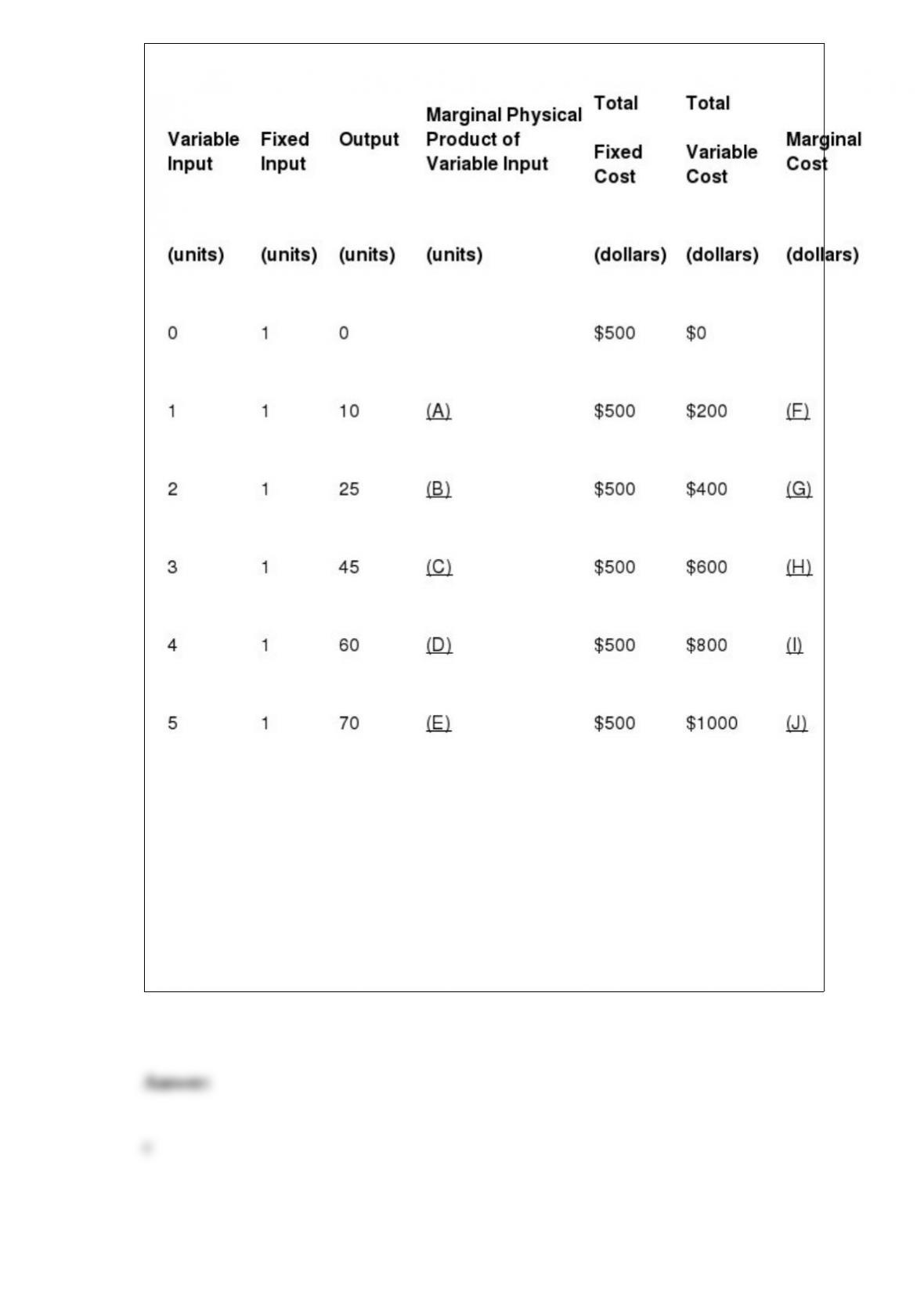
Refer to Exhibit 22-3. The average variable cost of producing 10 units of output is
Exhibit 22-3
a. $2.00.
b. $1.75.
c. $20.00.
d. $2.25.
e. $2.50.

There is a technological improvement in the production of good X.As a result, the
_____________ curve for good X will shift ____________ resulting in a(n)
_____________ in the equilibrium price of X and a(n) ____________ in the
equilibrium quantity of X.
a. supply; rightward; decrease; increase.
b. demand; leftward; decrease; decrease
c. demand; rightward; increase; increase
d. supply; leftward; increase; decrease
e. supply; leftward; increase; increase
In his article Straight Talk About Economic Literacy, economist
_______________________ said, “Citizens can vote even if they have no idea what
they are doing.If enough voters fit that description, democratic governments are bound
to make foolish decisions.”
a. Milton Friedman
b. James Buchanan
c. Bryan Caplan
d. John Maynard Keynes
When it comes to voting in a presidential election, we would expect, ceteris paribus,

a. a lower percentage of eligible voters will vote if the weather is bad and this makes it
harder to get to the polls on election day (than would have voted if the weather was
good).
b. a higher percentage of eligible voters will vote if the weather is bad on election day
(than would have voted if the weather was good).
c. many people to vote who are rationally ignorant.
d. a higher voter turnout in the North than in the South.
e. a and c
You turn to the bond market page of a newspaper and look under the column headed
“Close” and see that it says, “49 1/2” this indicates that
a. the closing price for the bond on this particular day is $495.
b. the closing price for the bond on this particular day is $49.50.
c. the closing price for the bond was $49.50 higher than on the previous trading day.
d. the bond will mature on June 30, 2049.
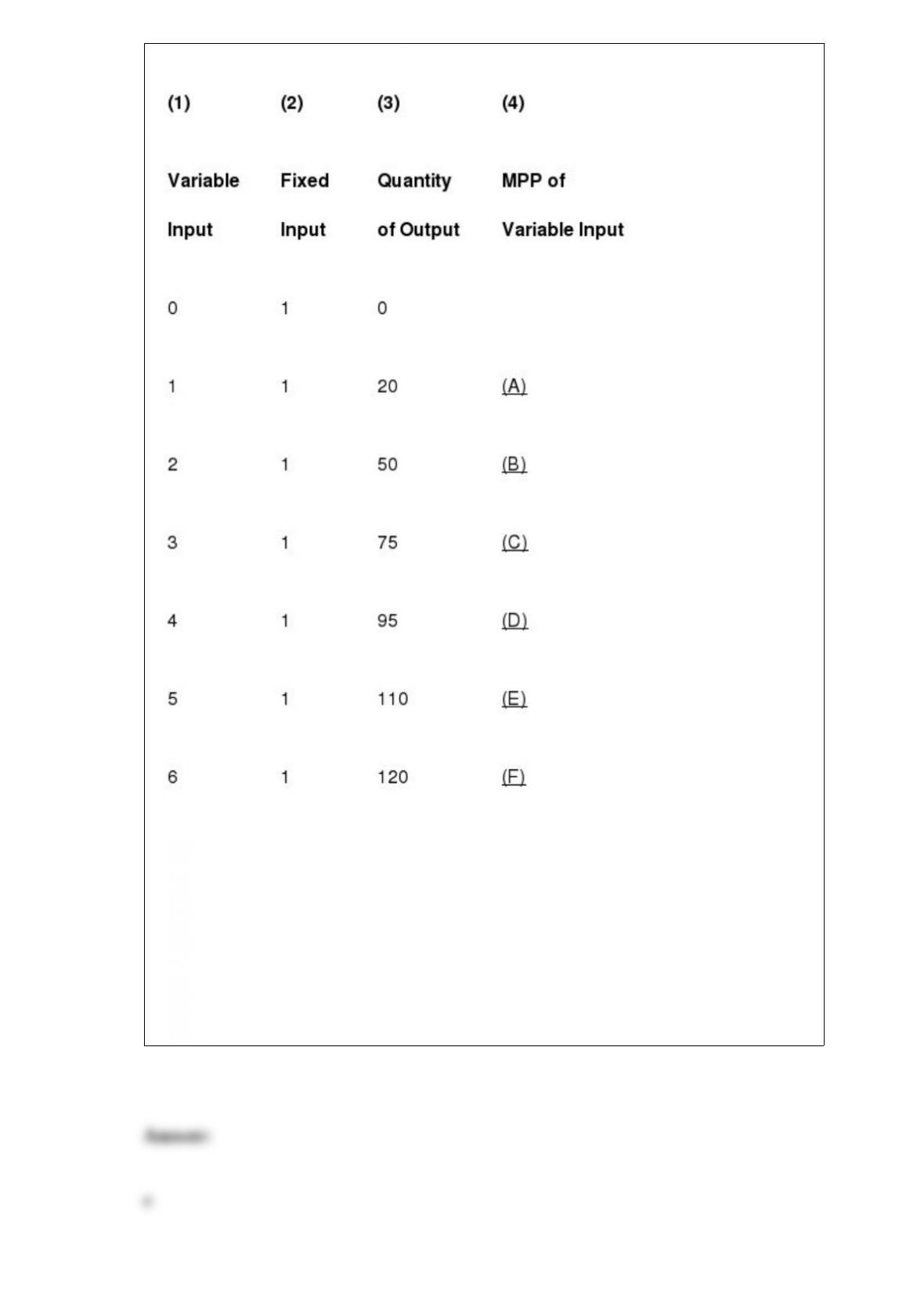
Refer to Exhibit 22-1. Diminishing marginal returns set in with the addition of which
unit of the variable input?
Exhibit 22-1
a. the fourth
b. the fifth
c. the sixth
d. the second
e. the third

If a theory gives a scientist results that she does not want, then she should not believe in
that theory.
a. True
b. False
According to the median voter model, a candidate (in a two-person race) is more likely
to label himself or herself a “middle-of-the-roader” than a conservative or liberal
because
a. the terms “conservative” and “liberal” are offensive to many people in today’s world.
b. the terms “conservative” and “liberal” are considered terms used of people who are in
the “wings” or “extremes” of the political distribution, and a candidate can only win an
election by being perceived as closer to the center of the political distribution than his
or her opponent.
c. they receive better treatment by the press.
d. it is customary and it has become a tradition in American politics.
e. none of the above
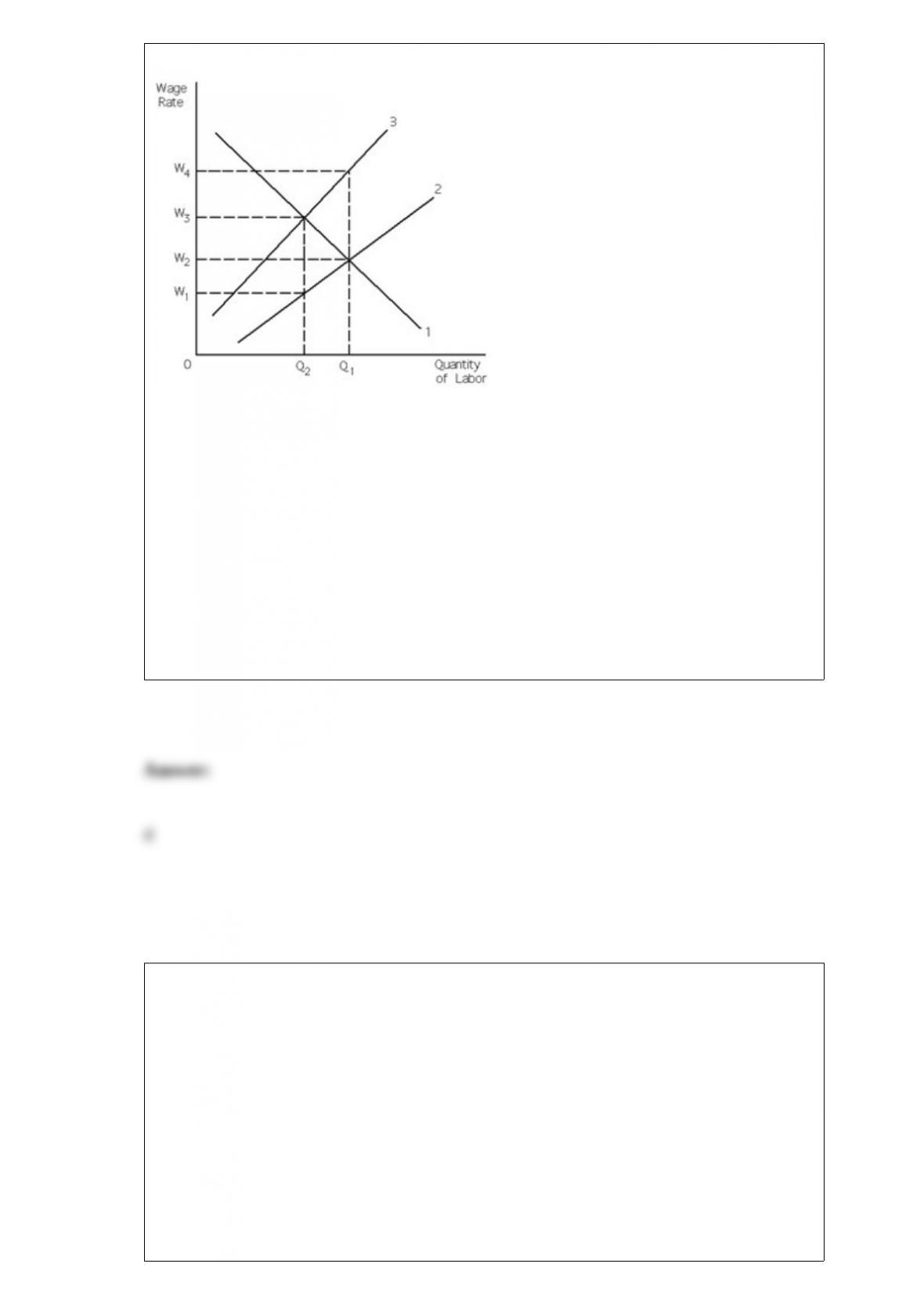
Refer to Exhibit 28-10. If the firm in the exhibit is a monopsony, then the difference
between its marginal factor cost and the wage rate it pays is equal to
Exhibit 28-10
a. W4 – W2.
b. W3 – W2.
c. W4 – W1.
d. W3 – W1.
e. There is no difference between the marginal factor cost and the wage rate a
monopsony pays.
Which of the following statements is false?
a. If Mexican restaurant owners provide free chips and salsa to their customers, the
quantity demanded of chips and salsa will be greater than if customers had to pay for
them.
b. If the price of a good falls, then the demand for its complements will increase.
c. If the price of a good rises, then the price of its complements will rise.
d. If chips and salsa are offered for free to Mexican restaurant customers, then
restaurants can charge a higher price for products that are complements to chips and
salsa (such as beer).
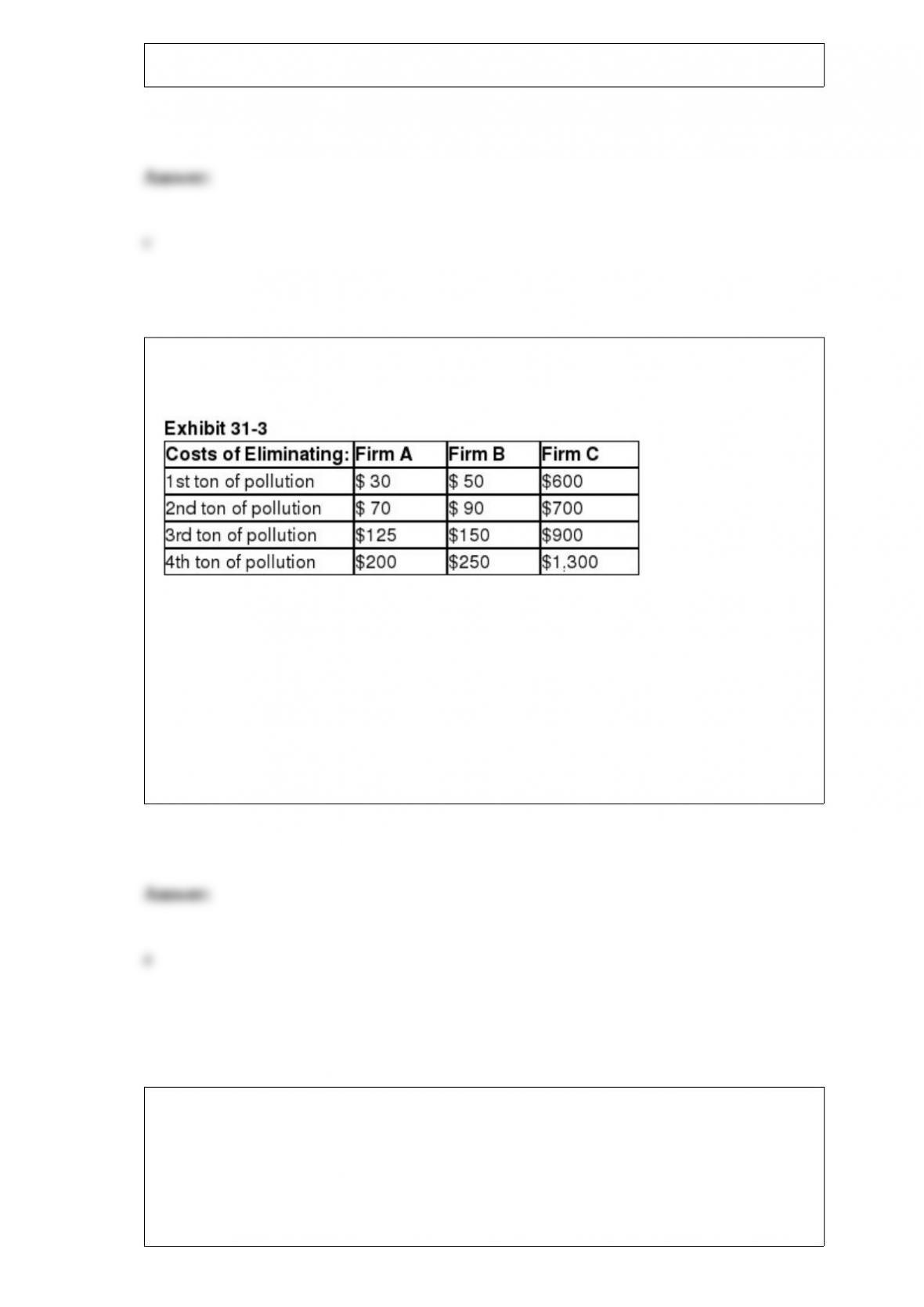
Refer to Exhibit 31-3. What is the cost to Firm A of eliminating 2 tons of pollution?
a. $100
b. $200
c. $700
d. $425
e. $1,500
The law of diminishing marginal utility helps to explain the direct relationship between
price and quantity supplied.
a. True
b. False
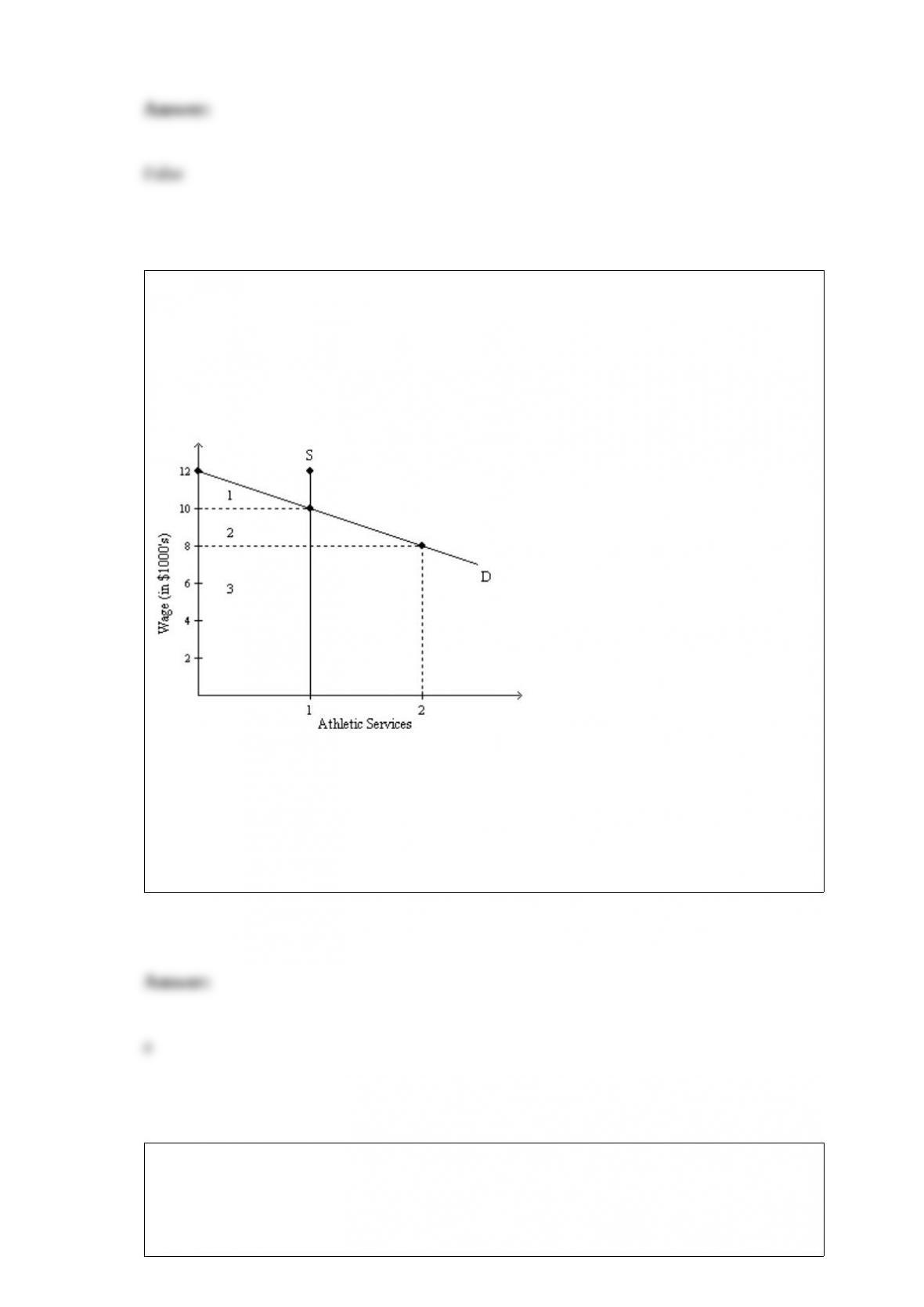
Refer to Exhibit 5-3 which shows the demand and supply of a college athlete.If the
college is allowed to pay this student athlete its market equilibrium wage of $10,000,
what is the consumers’ surplus for the college that buys this one athlete’s services at this
wage?
Exhibit 5-3
a. area 1
b. area 2
c. area 3
d. area 1 + 2
Which of the following statements is true?
a. A major corporation would tend to pay a higher interest rate for a $10,000 loan than a
single parent working for a fast food restaurant.

b. The more risky the loan, the higher the interest rate charged, ceteris paribus.
c. The less risky the loan, the higher the interest rate charged, ceteris paribus.
d. The duration (length) of a loan is unrelated to the interest rate charged for the loan.
e. c and d
Which of the following is an assumption of the theory of monopoly?
a. There are extremely high barriers to entry.
b. There are many sellers.
c. The product has a number of close substitutes.
d. The product is of extremely high quality.
In the theory of perfect competition, the market demand curve is __________ and the
firm faces a demand curve that is __________.
a. perfectly elastic; perfectly elastic
b. downward sloping; downward sloping
c. perfectly elastic; downward sloping

d. downward sloping; perfectly elastic
e. perfectly inelastic; downward sloping
Buying low and selling high is often referred to as
a. price discrimination.
b. rent-seeking.
c. arbitrage.
d. scarcity.
e. capitalization.
For the consumer, a point on an indifference curve that lies farther from the origin is
preferable compared to those points that are closer to the origin.
a. True
b. False

If the government does not provide it, the quantity of a nonexcludable good that private
firms will choose to produce is
a. zero.
b. more than the optimal amount.
c. the optimal amount.
d. optimal only if property rights are assigned.
e. optimal only if the industry is competitive.
The excess capacity theorem states that in equilibrium a monopolistic competitor will
produce an output level larger than the one that would minimize its unit costs.
a. True
b. False
A three-word synonym for the term ceteris paribus is
a. “nothing else changes.”
b. “in my opinion.”
c. “it is proved.”
d. “under this assumption.”
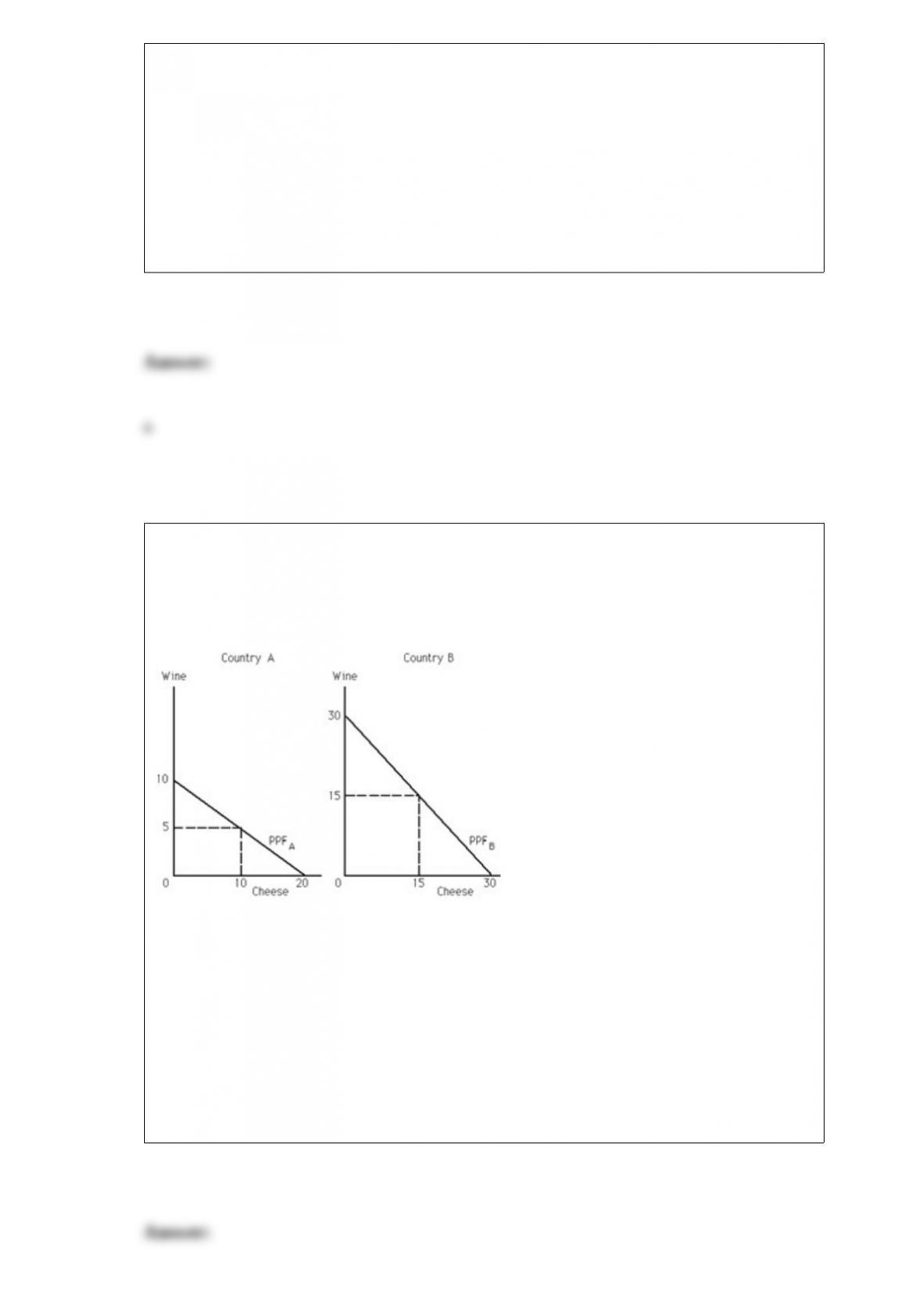
Refer to Exhibit 34-6. The opportunity cost of 1 unit of wine in terms of units of cheese
is __________ for country A.
Exhibit 34-6
a. 1/2
b. 2
c. 10
d. 5
e. none of the above