
An example of indexing is a “cost of living” adjustment clause in a wage contract.
a. True
b. False
When the average tax rate rises as income rises, this is known as progressive taxation.
a. True
b. False
All of the following are associated with a mixed economy except
a. some public influence over the workings of free markets.
b. public ownership mixed in with private property.
c. homogenization.
d. different countries blending the state and market sectors in different ways.
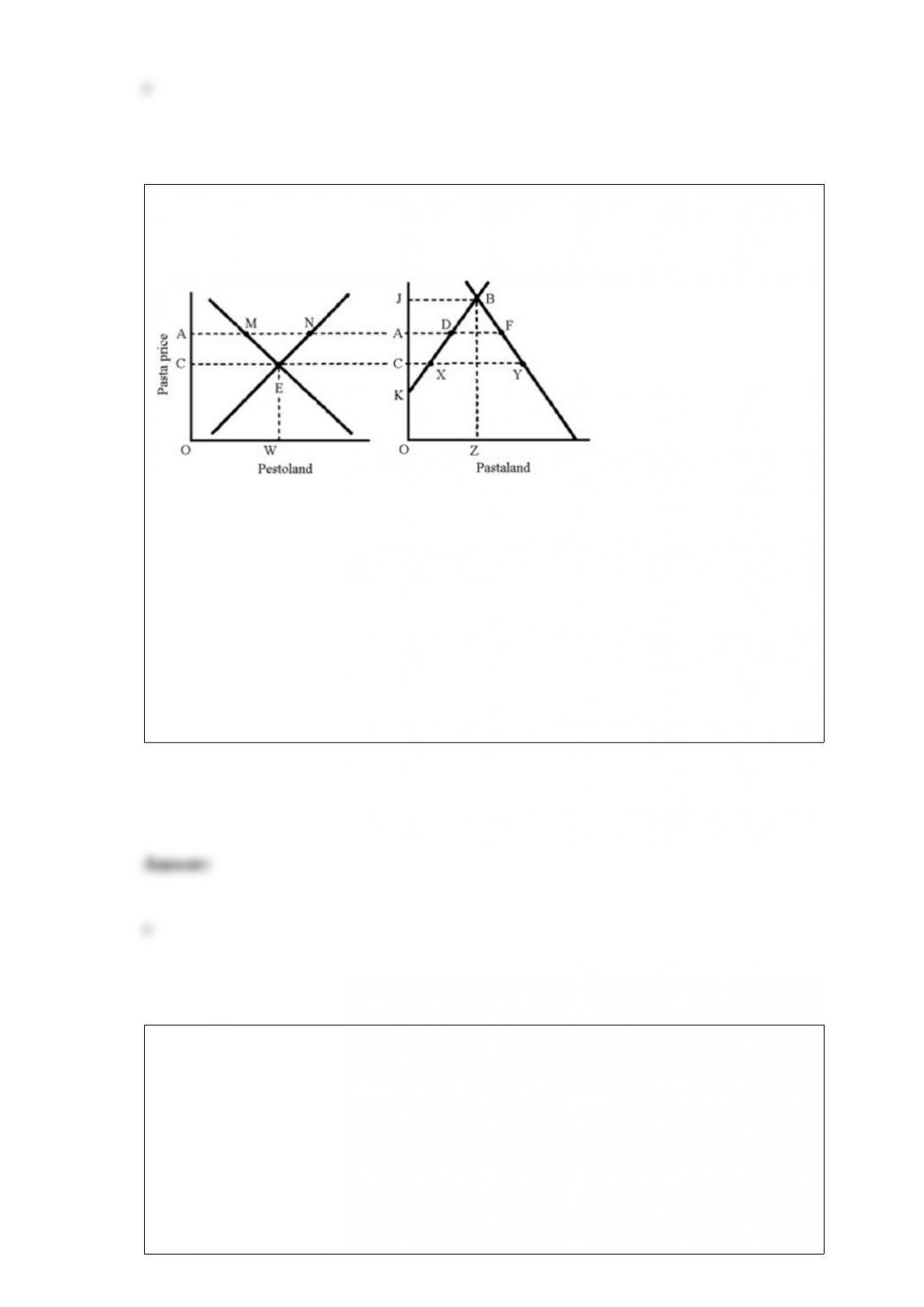
Figure 22-9
In Figure 22-9, Pestoland exports pasta to Pastaland. The equilibrium price of pasta will
be
a. OC
b. OJ
c. OA
d. OK
The elasticity measure which has been employed by the courts to assess the degree of
market competition is
a. price elasticity of demand.
b. income elasticity of demand.
c. cross elasticity of demand.

d. inverse elasticity of demand.
Only a market economy must answer the questions of what goods to produce, how to
produce them, and for whom to produce them.
a. True
b. False
Do economists know the value of the MPC for most economies?
a. Yes, with a high level of precision.
b. Yes, with a certainty level of four decimal places.
c. No, it is impossible to determine a national MPC.
d. Yes, but with some level of uncertainty.

An increase in autonomous consumption has the same equilibrium effect as a(n)
a. decrease in investment.
b. increase in investment.
c. decrease in net exports.
d. increase in taxes.
When OPEC raises the price of petroleum, American expenditures on oil imports
increase, suggesting that
a. the United States’ elasticity of demand for imported oil is greater than one.
b. the United States’ elasticity of demand for imported oil is less than one.
c. imported oil and domestically produced oil are complementary goods.
d. the short-run elasticity of demand for oil is greater than the long-run elasticity.
Nearly half of federal government research and development spending takes place in
the
a. National Science Foundation.

b. National Aeronautics and Space Administration (NASA).
c. Department of Defense.
d. Federal Office of Technology Policy.
The change in the contribution of capital formation was the chief cause of the
productivity slowdown in 1973-1995.
a. True
b. False
If (T − G) = (X − IM), then (S − I)
a. is greater than zero.
b. is zero.
c. is less than zero.
d. cannot be calculated.

Rational expectations are forecasts
a. that, while not necessarily correct, are the best that can be made given the available
data.
b. that are technically correct.
c. that accurately predict the short-term trade-off between inflation and unemployment.
d. made by economists using the most sophisticated econometric models.
The marginal productivity theory of distribution has been criticized because
a. it assumes that the existing distribution of ownership factors is fair and just when it
may not be.
b. it does not tell us much about real policy matters.
c. a factor’s MRP does not in any way correspond to productive effort.
d. All of the above are correct.

Which of the following is more likely be the price elasticity of demand for anti-venom?
a. highly inelastic
b. unit elastic
c. elastic
d. perfectly elastic
Adhering to a strict gold standard necessarily means that
a. each nation can vary its money supply in response to domestic economic conditions.
b. no country will experience inflation.
c. no country will have control over its monetary policy.
d. no country will experience deflation.
When the expenditure level is above the full employment level of GDP, a possible
consequence is
a. falling prices.
b. rising prices.

c. falling disposable income.
d. high levels of unemployment.
The underlying cause of inflation is
a. labor unions demanding higher wages.
b. businesses charging higher prices.
c. government raising taxes.
d. increasing aggregate demand.
If the marginal utility of a product exceeds its MC, we would want, on efficiency
grounds, to
a. increase production.
b. decrease production.
c. leave production constant.
d. One cannot tell without knowing the price.

If the public decides to hold smaller cash balances, this will cause a(n)
a. increase in interest rates.
b. decrease in average paychecks.
c. increase in nominal GDP.
d. increase in velocity.
In which of the following years was a tax cut ineffective in stimulating aggregate
demand?
a. 1964
b. 1975
c. 1981
d. 1999

In the long run, a perfectly competitive industry tends to develop differentiated
products.
a. True
b. False
Unexpected discoveries of mineral reserves will ordinarily cause the price of these
minerals to increase.
a. True
b. False
Economists predicted that the price of a depletable natural resource would rise by about
15 percent. Actually the price fell 10 percent. What most likely happened?
a. A government subsidy was removed.
b. Extraction costs increased.
c. Price controls were suspended.
d. An unexpected discovery of reserves was made.

Agraria uses bushels of wheat to quote prices. In this case, bushels of wheat act as a
a. medium of exchange.
b. store of value.
c. commodity value.
d. unit of account.
45 line diagrams show how
a. investment varies with income.
b. expenditures vary with income.
c. investment spending rises when GDP rises.
d. GDP is affected by government purchases.

The government’s budget accounts for about 80 percent of GDP in the United States.
a. True
b. False
Income elasticity of demand describes how change in income affects the quantity
demanded of a good.
a. True
b. False
In the long run the prices charged by a firm in monopolistic competition will be
a. high enough to provide profits to the firm.
b. so low that many firms will drop out of the industry.
c. equal to marginal cost.
d. equal to average cost, including the opportunity cost of capital.
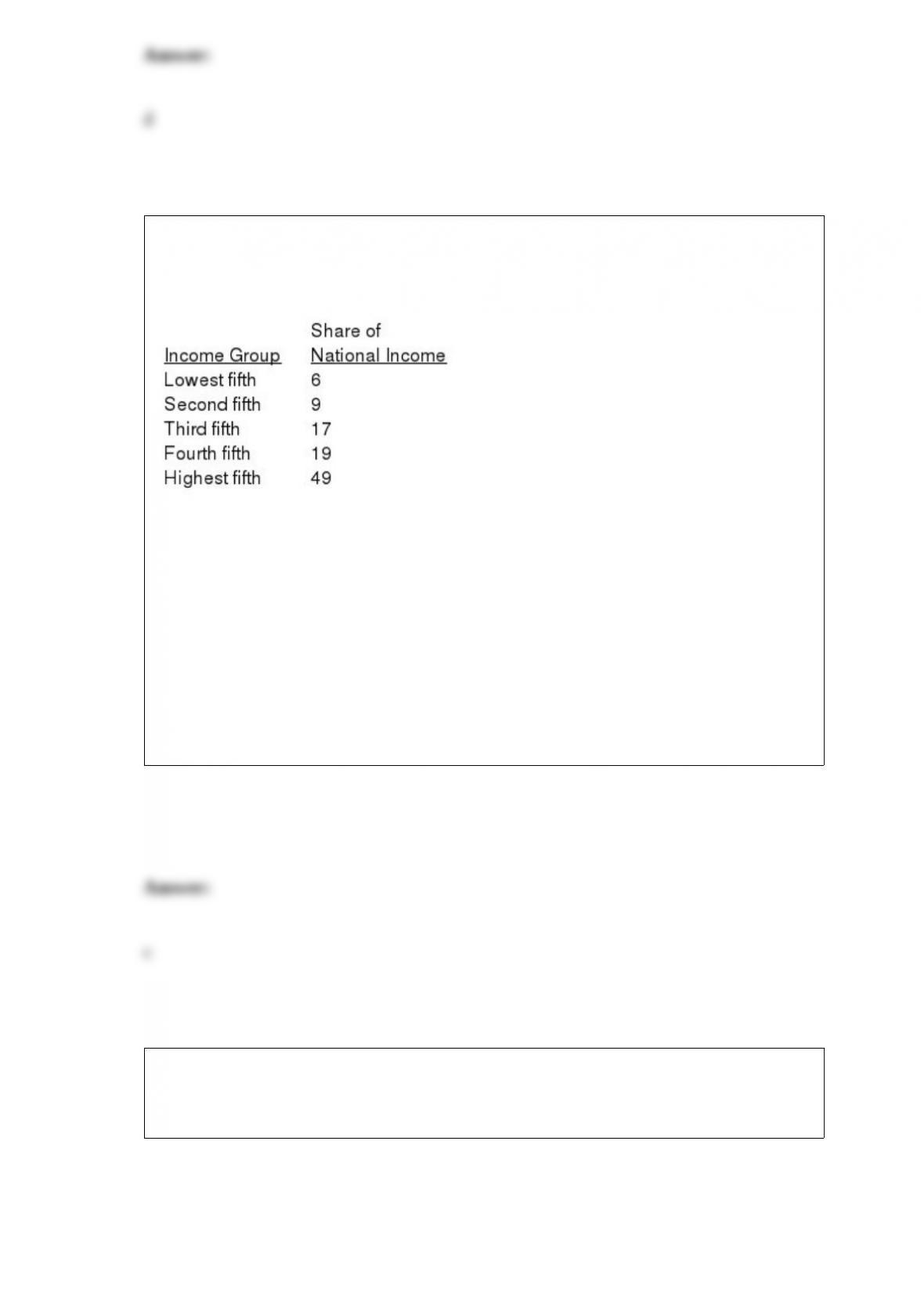
Table 21-1
Consider the economy described by the income distribution in Table 21-1. From this
table, we can conclude that the poorest 60 percent of the population earns
a. 15 percent of the income.
b. 17 percent of the income.
c. 32 percent of the income.
d. 68 percent of the income.
Figure 14-1
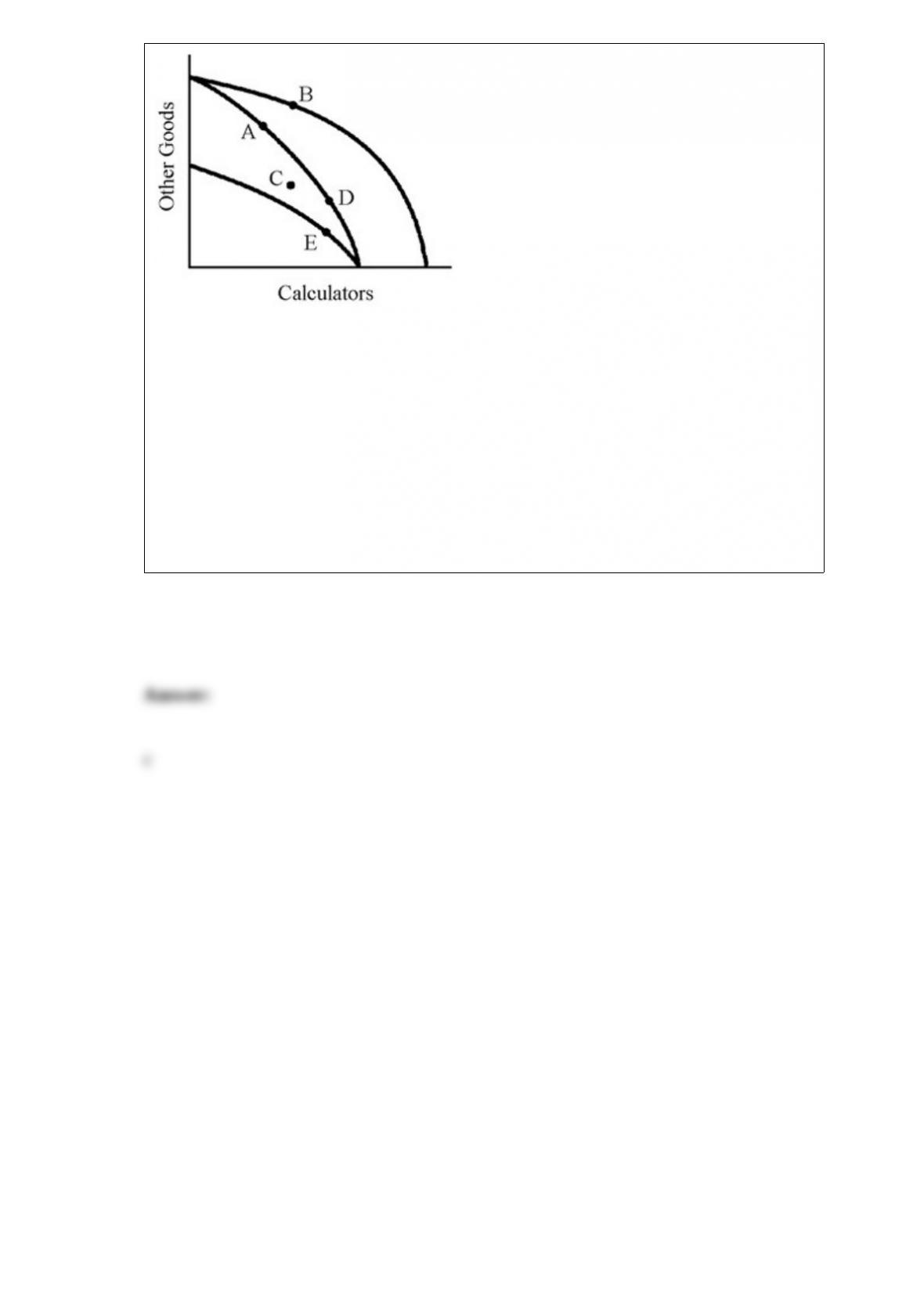
In Figure 14-1, a cost-reducing technological breakthrough in calculator production
would cause which movement?
a. A to D
b. A to C
c. A to B
d. A to E