
1) The differences in the per capita incomes of the IACs and the DVCs has diminished
sharply since the Second World War because of U.S. aid programs.
2) Monetarists say that fiscal policy, such as a tax cut, will only affect the level of real
GDP if it entails a change in the supply of money.
3) The Federal government has not paid subsidies to farmers since passage of the
Freedom to Farm Act in 1996.
4) In percentage terms, many of the 10 most rapidly declining U.S. occupations include
jobs for which capital is readily substitutable for labor.
5) the present choice of position on the production possibilities curve will not influence
the future location of the curve.
6) The user cost of a resource is the market price paid by the buyer of the resource.
7) Renewable natural resources can never be exhausted.

8) Monopolization is illegal under Section 1 of the Sherman Act.
9) Unemployment compensation is financed by taxes levied on employers.
10) the free-rider problem refers to the possibility that someone may benefit from a
good without paying for it.
11) Economists prefer free trade to tariffs and prefer tariffs to import quotas.
12) producing a good in the least costly way is known as allocative efficiency.
13) along a demand curve, product price and consumer surplus are inversely related.
14) a government tax per unit of output reduces supply.
15) a monopolistic firm has a sales schedule such that it can sell 10 prefabricated
garages per week at $10,000 each, but if it restricts its output to 9 per week it can sell
these at $11,000 each. the marginal revenue of the tenth unit of sales per week is:
a.-$1,000.

b.$9,000.
c.$10,000.
d.$1,000.
16) The tax cut passed by Congress and the Bush administration in 2001 was motivated
primarily by:
A.the recession that began in March 2001.
B.the terrorist attacks on September 11, 2001.
C.the desire to distribute income and wealth more equally.
D.projections that actual budget surpluses would rise to $5 trillion by 2010.
17) Suppose the price level is fixed, the MPC is .8, the GDP gap is a negative $200
billion. To achieve full-employment output (exactly), government should:
A.increase government expenditures by $200 billion.
B.reduce taxes by $200 billion.
C.increase government expenditures by $40 billion.
D.reduce taxes by $160 billion.
18) An employer whose discrimination coefficient is $4 will:
A.refuse to hire non-preferred-race workers at any wage rate.
B.hire only non-preferred-race workers if the actual non-preferred-preferred wage
differential is $3 an hour.
C.hire only preferred-race workers if the actual non-preferred-preferred wage
differential is $3 an hour.
D.hire only preferred-race workers if the non-preferred-preferred wage differential is
$4.
19) other things equal, the provision of a per unit subsidy for a product will:
a.increase its supply.
b.increase its price.
c.decrease the quantity sold.
d.decrease its demand.
20) the aggregate cost of unemployment can be measured by the:
a.amount by which actual gdp exceeds potential gdp.
b.amount by which potential gdp exceeds actual gdp.
c.excess of real gdp over nominal gdp.
d.excess of nominal gdp over real gdp.
21)
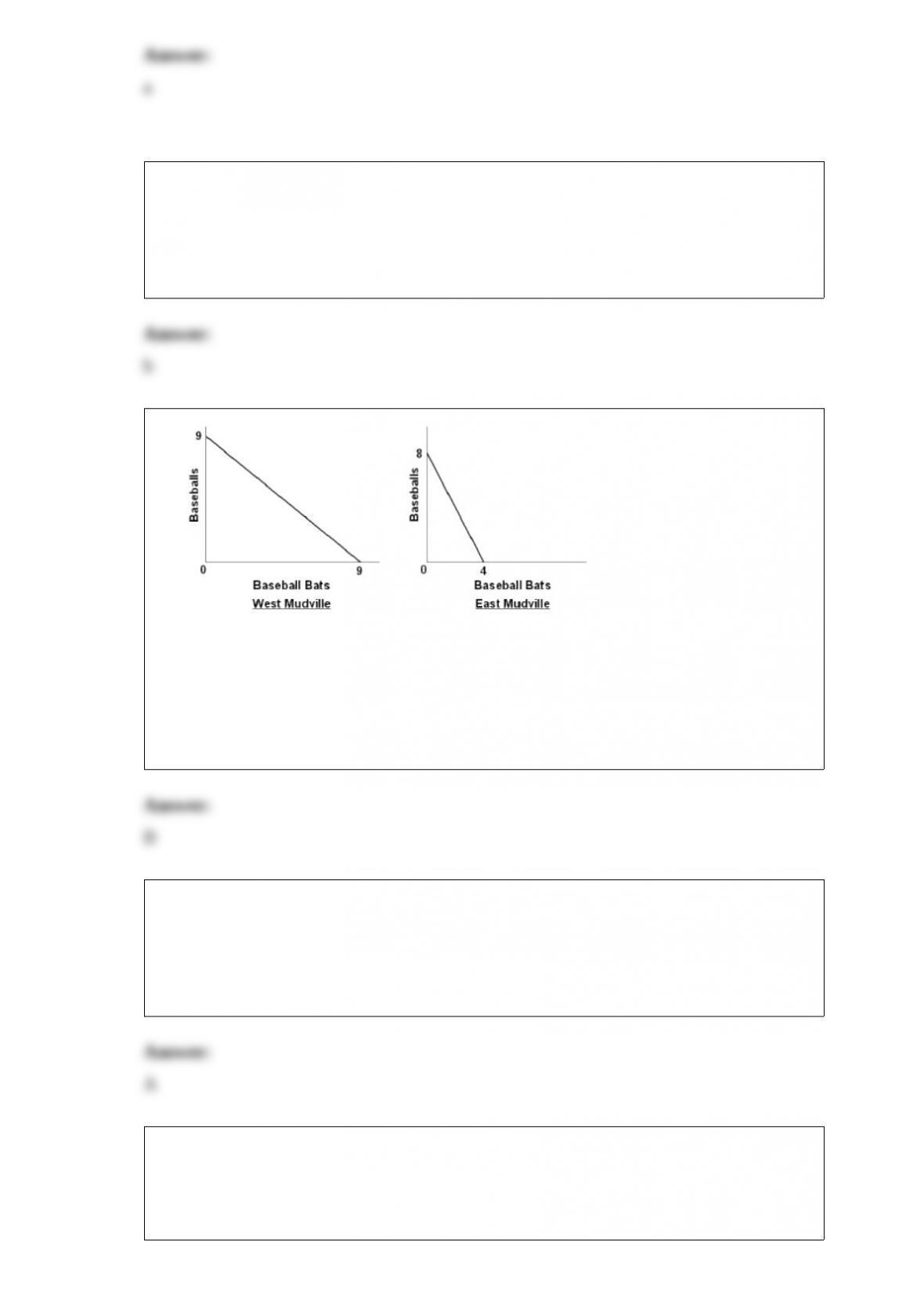
Assuming labor forces of equal size, the production possibilities curves above suggest
that workers in West Mudville will have:
A.lower wages than workers in East Mudville before trade but equal wages after trade.
B.higher wages than workers in East Mudville both before and after trade.
C.lower wages than workers in East Mudville both before and after trade.
D.higher wages than workers in East Mudville before trade but lower wages after trade.
22) Which of the following is an example of a labor-intensive commodity?
A.digital cameras
B.beer
C.aspirin tablets
D.gasoline
23) a demand curve:
a.shows the relationship between price and quantity supplied.
b.indicates the quantity demanded at each price in a series of prices.
c.graphs as an upsloping line.
d.shows the relationship between income and spending.
24) Assume the reserve ratio is 25 percent and Federal Reserve Banks buy $4 million of
U.S. securities from the public, which deposits this amount into checking accounts. As a
result of these transactions, the supply of money is:
A.not directly affected, but the money-creating potential of the commercial banking
system is increased by $12 million.
B.directly increased by $4 million and the money-creating potential of the commercial
banking system is increased by an additional $16 million.
C.directly reduced by $4 million and the money-creating potential of the commercial
banking system is decreased by an additional $12 million.
D.directly increased by $4 million and the money-creating potential of the commercial
banking system is increased by an additional $12 million.
25)
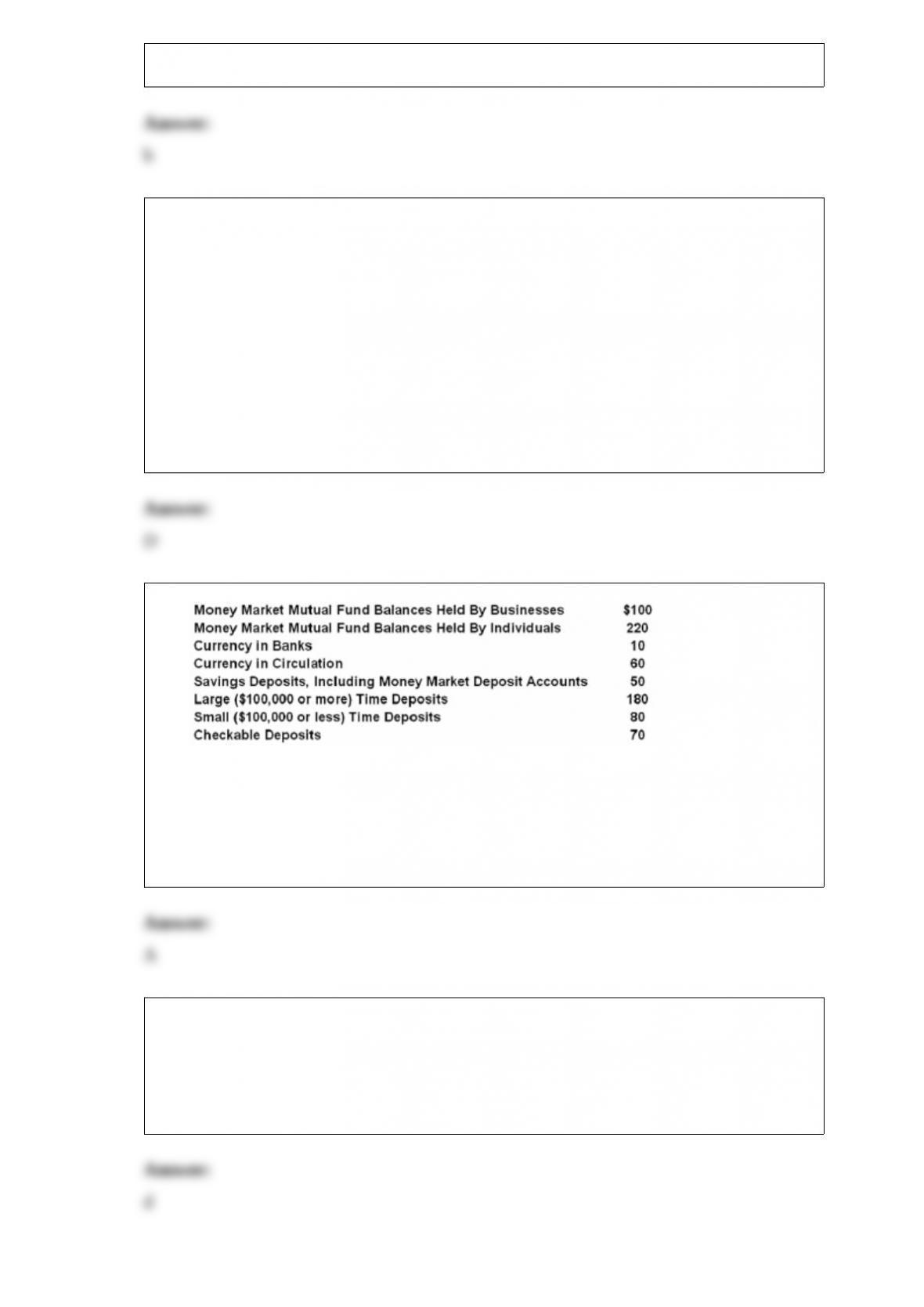
Refer to the above information. Money supply M2 for this economy is:
A.$480.
B.$130.
C.$490.
D.$630.
26) ticket scalping is likely to:
a.produce a less interested audience.
b.reduce the well-being of ticket sellers.
c.reduce the well-being of ticket buyers.
d.produce a more interested audience.
27) if unemployed workers leave a nation, the standard of living (national income per
capita) will rise in that nation.
28) Describe the positive and negative views of the economics of advertising.
The arguments over advertising focus on three major questions: (a) Is advertising
persuasion or information? (b) Does advertising promote monopoly power or
competition? (c) Does advertising contribute to economic waste or economic
efficiency?
29) If a nation has a current account surplus and it does not have to make any
inpayments or outpayments of official reserves, it must have a:
A.surplus in its capital and financial account.
B.balance of payments deficit.
C.balance of payments surplus.
D.deficit in its capital and financial account.

30) an industry comprised of a very large number of sellers producing a standardized
product is known as:
a.monopolistic competition.
b.oligopoly.
c.pure monopoly.
d.pure competition.
31) which of the following statements is true about causes of business cycle
fluctuations?
a.economists all agree that supply shocks are the cause of most business cycle
fluctuations.
b.economists all agree that productivity shocks are the cause of most business cycle
changes.
c.economists all agree that monetary changes are primarily responsible for business
cycle fluctuations.
d.there are a wide range of theories as to the underlying causes of business cycle
movements.
32) (Consider This) Explain the importance in understanding the difference between
income inequality and consumption inequality.
33) Assume that M is $500 billion and V is What is the level of nominal GDP according
to the monetarist equation? If V rises by 10%, then according to the monetarist
equation, what will be the new level of nominal GDP?
34) Assume that labor and capital are substitutes in production. If there is an increase in
the price of capital, how can this lead to either an increase or decrease in the demand
for labor?
35) In the short run, a monopolistically competitive firm calculates that marginal cost is
$6.00, average total costs are $4.00, and marginal revenue is $3.00. The firm is
charging a price of $6.00 and producing 200 units of output. How much profit is the
firm making? What output recommendation would you make as the company
economist?
36) On occasion the government has approved the merging of certain smaller firms in
oligopolistic industries (such as steel and automobiles) on the grounds that the net result
would strengthen competition. Do you think that this is sound policy? Justify your
answer.